Drug Smugglers Taking The Bus

It’s the smart way to go, says Mike Riggs:

Imagine you’ve been asked (or offered!) to take drugs from one state to another. How would you do it? Flying would be your absolute worst option. You’d have to keep your cool while going through passenger screening, and pray that your checked cargo (which has all your identifying information attached to it) doesn’t pique the curiosity of luggage screeners. And if your luggage gets lost between Hartsfield-Jackson and O’Hare? There’s no easy answer, I’m afraid. Probably best to kiss your sleeping children goodbye and run for the border.

What about Amtrak?

You handle your own luggage, which means it won’t get screened and it won’t leave your sight. While TSA agents now haunt some stations, they don’t subject passengers to searches. But it’s still a formalized mode of transportation. Amtrak takes a lot of information from passengers, even if they pay for their ticket with cash. There are also dogs in some stations. They probably sniff only for bombs, not drugs, but do you really know for sure?

“I could drive myself!” You could absolutely do this. No tickets, no checked bags, no drug dogs – unless you get pulled over.

The bus sounds downright relaxing:

Tickets are cheap and you can buy them with cash without telling the bus company too much about yourself. Companies like Bolt Bus even allow passengers to buy tickets with cash from the bus driver. When you board, there’s no system to make sure you are who you say you are, and other passengers don’t really care either. Maybe your luggage ends up under the bus, but you put it there yourself. Basically, you can stash your stash and then take a snooze.

Phantom Photographs, Ctd

lossy-page1-800px-Soldiers_in_front_of_-The_Junction-,_tent_-_NARA_-_527681.tif

A reader writes:

There were other, equally fascinating “phantom photographs” from the Civil War. During the war, Matthew Brady and other photographers practiced their relatively new art on the battlefield, “on location” for the first time instead of in a studio, photographing soldiers, sometimes wounded or dead, and the destruction of war. After the war, there was no market for these pictures in a nation saddened and disgusted by the carnage. The negatives were on glass plates which were then sold to make greenhouses – and over the next century, hundreds of images of that titanic struggle faded to ghostliness in backyard gardens. One can only hope the spirits of the dead witnessed the eternal renewal of nature and perhaps found a measure of peace.

In Ken Burns’ telling, the greenhouse glass was later rerecycled to make face plates for gas masks during World War I. His takeaway:

What I am trying to say in all of this is that there is a profound connection between remembering and freedom and human attachment. And that’s what history is to me. And forgetting is the opposite of all that: a kind of slavery, the worst kind of human detachment.

(Photo: Mathew Brady’s Civil War-era Soldiers in Front of “The Junction,” Tent)

Six Enrollments The First Day

CV1_TNY_11_11_13Blitt.indd

This is even more pathetic than people thought:

Healthcare.gov had tallied exactly six successful enrollments by the morning of Oct. 2, new documents released by the House Oversight Committee show. By the end of Oct. 2, the health law Web site that serves 36 states had received 248 insurance enrollments.

Suderman adds:

HHS has attempted to drum up uncertainty about the figures in the leaked documents. “These appear to be notes, they do not include official enrollment statistics,” an HHS spokesperson said in a statement, according to The Washington Post. But while the notes do mention that some insurers didn’t get the enrollment forms they were expected to receive, they express no doubts about the specific enrollment numbers presented. Indeed, the notes from the first day’s meeting list exactly which insurers have reported successful enrollments.

The Next Big Drone Market

This embed is invalid


Hollywood:

Drone cinematography is still in its primitive stage. For one thing, the UAVs (unmanned aerial vehicles) don’t have much range (about a mile) and only have enough battery life for 10 to 15 minutes of flight. Plus, the built-in cameras only have 720p resolution, or medium high-definition. (That’s about the quality you might get on a good smartphone.) But the latest drones also come with a camera mount so that they can hoist full HD (1080p) GoPro sports cameras. There’s still the little snag that the Federal Aviation Administration (FAA) does not yet permit private businesses to operate drones in the United States. (Non-commercial filmmakers may use them, but only below 400 feet and in sparsely populated areas.) But the agency will begin issuing drone licenses to businesses by 2015, and Hollywood could be the first set of private users.

The MPAA has already lobbied the FAA for drone privileges.

This Extraordinary Pope, Ctd

It was great that he asked the German Bishop of Bling to take a leave of absence after he spent $40 million on his official residence. But this is even greater:

Yesterday, church officials in Limburg said they were taking their own steps to admonish Bishop Franz Peter Tebartz-van Elst. “The residence is like an inherited sin which the bishop has left in his wake,” said a spokesman for the Caritas organisation for the homeless. “People who seek sanctuary with us could be given food in the residence,” he added. Turning the complex into a refugee centre would follow the practice of a former Limburg bishop who housed a refugee family from Eritrea while he moved into a residence for novice priests.

Isn’t it wonderful to see the teachings of Jesus actually followed by His church?

Will Clinton Campaign On Change?

Clinton Global Initiative Annual Meeting In New York

Chotiner looks at her overall challenges:

Hillary Clinton can’t reinvent herself as an Elizabeth Warren–type populist, and I doubt she will be running against big banks. But she can still run on “change,” channeling a streak of populism and appealing to a disgruntled left-wing of the Democratic Party. Much of the appeal to one’s base is about attitude. Howard Dean’s popularity among the netroots could coexist with his relatively moderate record as governor because he seemed angry. The point isn’t that Clinton is angry; rather, it is that you can appeal to different groups with non-policy related appeals. …

Will Clinton’s new rhetoric succeed? It’s probably smart of her to embark on it relatively early in the campaign, and there is reason to think it will be more effective than it would have been had she tried a similar strategy in 2008. She isn’t currently in government, for starters, and she has four years as Secretary of State behind her. This is the one cabinet job that seems to distance you from petty politics, and may go some way to making her seem like a figure who can rise above the fray.

Good luck with that. With today’s GOP, her ascendance is, alas, likely to drive them almost insane. The trouble for Clinton is that she really has never shown much chops as an actual politician. Her loss to Obama – when she was thirty points ahead for a long time – reveals her lack of instinct for the game. She’s not a good speaker; she’s not that great at schmoozing; and she can be easily rattled. Then there’s the fact that she doesn’t change much. The same clique that surrounded her in the White House still hover around. Exhibit A: this great Ben Smith piece explaining why the Clintons still drive the press and many of their closest friends crazy.

(Photo by Getty)

A Junker Of A Stimulus Program

Cost Per Job

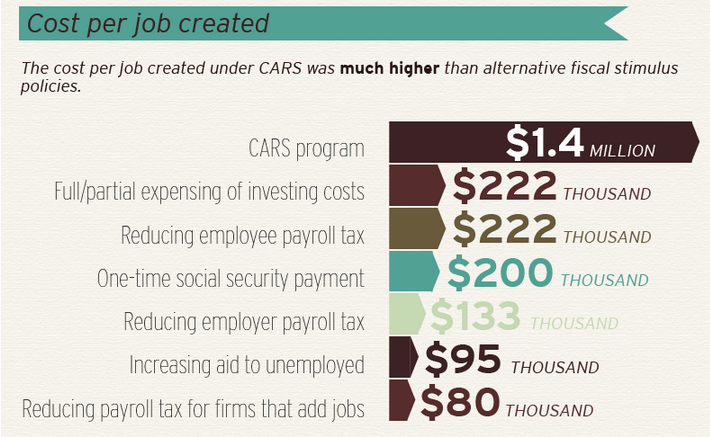
A new paper by Ted Gayer and Emily Parker evaluates the effectiveness of Cash For Clunkers – remember that? Plumer summarizes the key points:

Gayer and Parker estimate that pulling these vehicle sales forward probably boosted GDP by about $2 billion and created around 2,050 jobs. That means the program cost about $1.4 million per job created — far less effective than other conventional fiscal stimulus measures, such as cutting payroll taxes or boosting unemployment benefits:

Why does this matter? It was just one tiny program, after all. Yet inefficient stimulus programs add up. One recent study by economists Gerald Carlino and Robert Inman found that the 2009 Recovery Act could have been fully 30 percent more effective in boosting the economy if it had been better designed (i.e., more focused on things like aid to states and payroll tax cuts).

Where Bikes Are Driving Cars Off The Road

Krishnadev Calamur examined vehicle sales in Europe and found that “bicycle sales outpaced new-car sales last year in [27 European Union] countries, except Belgium and Luxembourg.” Sydney Brownstone elaborates:

dish_bikecarchartSome of this trend could be linked to the dip in car sales due to the global recession, since the most extreme differences were seen in countries with lower GDPs than their more prosperous EU peers. Lithuania sold nearly 10 times as many bikes as it did cars. In Greece, new bike sales outnumbered car sales by more than five to one. The same held true for Romania and Slovenia, while bike sales in Hungary quadrupled those of cars.

Still, a similar pattern held true for Spain, Italy, France, Britain, and Germany, all countries that also witnessed more bikes than cars sold in 2012. As NPR noted, this was the first time more bikes than cars were sold in Italy since World War II.

What’s The GOP’s Alternative To Obamacare?

Jonathan Cohn argues that most Republican healthcare plans would be more far disruptive than the ACA:

With Obamacare, a small number of people lose their current insurance but they end up with alternative, typically stronger coverage. Under the plans Republicans have endorsed, a larger number of people would lose their current insurance, as people migrated to a more volatile and less secure marketplace. Under Obamacare, the number of Americans without health insurance at all will come down, eventually by 30 or 40 million. Under most of the Republican plans, the number of Americans without insurance would rise.

Honest Republicans would justify their policies by arguing that Medicaid is a wasteful, inefficient program not worth keeping—and their changes, overall, would reduce health care spending while maximizing liberty. In other words, forcing people to give up their coverage is worth it. I don’t agree with those arguments, but they are honest. But they should stop pretending that it’s possible to address the problems of American health care without disrupting at least some people’s insurance arrangements—because, after all, they want to do the very same thing.

Chait thinks this is why Republicans have failed to propose a real Obamacare alternative:

Every iteration of an alternative conservative health-care proposal would impose far more disruption on the status quo than would Obamacare. Most conservative plans involve drastically curtailing the tax deduction for employer-based insurance. That would create cancellation notices for many times the number of people currently seeing them. Even the more modest plans to scale back Obama’s regulation of the individual market would run the GOP into a political minefield. Which regulations do they want to strip away? Discrimination against people with preexisting conditions? Discrimination against potentially pregnant women? Mental-health parity? Every single one of those changes creates millions of angry potential victims.

This is exactly why the actual Republican Party health-care plan is not repeal and replace, but repeal and cackle. Republicans are on strong ground exploiting fear of change. They have understood perfectly well that they must avoid having to defend a different set of changes to the status quo. They have kept their various replace ideas safely to the side for exactly that reason.

Beutler piles on:

[S]mart conservatives — which is to say, policy wonks without much cachet on Capitol Hill — would replace all insurance with subsidized catastrophic coverage and tax-preferred health savings accounts. Nobody with private insurance or Medicaid would get to keep what they have, no matter how much they like it.

Reihan objects:

To be sure, there are some people who think that government policy should lean against comprehensive insurance. David Goldhill, author of Catastrophic Care, favors something like single-payer catastrophic coverage. Brad DeLong has floated the idea as well. The conservatives I think Beutler has in mind certainly like the idea of catastrophic insurance. It’s just that they have no problem with allowing people to buy comprehensive insurance if that’s what they’d like to do with their money, and they recognize that low-income and disabled individuals will need larger subsidies than other people. …

One can definitely imagine alternatives to Obamacare that would be more disruptive than Obamacare. If consumers were banned from purchasing comprehensive health insurance, for example, there would definitely be a lot of disruption. But by and large, “reform conservatives” favor more modest measures that are designed to ease the transition to a more sustainable system.