Why Are Subway Conductors Always Pointing?

An explanation from an anonymous conductor:

What’s with pointing up when you stop at a station?

We’re pointing at the conductor’s indication board, which is a zebra-striped sign. If the sign is in front of my window, it means that the entire train is on the platform. They don’t trust us to just look (see that other question about zoning out), so required procedure is to point to it at every station before we open the doors. The absolute biggest violation a conductor can make is opening the doors where there isn’t a platform. If that ever happens, the first thing supervision is going to ask you is, “Did you point to the board?”

Or, as that charming video suggests, they could be pantless.

Ask Charles Camosy Anything

He has a new book out:

For Love of Animals is an honest and thoughtful look at our responsibility as Christians with respect to animals. Many Christians misunderstand both history and their own tradition in thinking about animals. They are joined by prominent secular thinkers who blame Christianity for the Western world’s failure to seriously consider the moral status of animals. This book explains how traditional Christian ideas and principles—like nonviolence, concern for the vulnerable, respect for life, stewardship of God’s creation, and rejection of consumerism—require us to treat animals morally.

A bit about the author:

Charles Camosy is an assistant professor of Christian Ethics at Fordham University. … His early work focused on medical and clinical ethics with regard to stem cell research and the treatment of critically ill newborns in the neonatal intensive care unit, which was the focus of his first book, Too Expensive to Treat? Finitude, Tragedy, and the Neonatal ICU. His second book, Peter Singer and Christian Ethics: Beyond Polarization, uses intellectual solidarity in an attempt to begin a sustained and fruitful conversation between Peter Singer and Christian ethics.

Let us know what you think we should ask Charles via the survey below (if you are reading on a mobile device, click here):


This embed is invalid

Recent Dish thread on the morality of eating meat is here.

It’s Hard Out There For A Writer

327939900_a752bcfdc5_o

In a much-discussed NYT essay, Tim Kreider beseeches his fellow writers to stop working for free:

A familiar figure in one’s 20s is the club owner or event promoter who explains to your band that they won’t be paying you in money, man, because you’re getting paid in the far more valuable currency of exposure. This same figure reappears over the years, like the devil, in different guises — with shorter hair, a better suit – as the editor of a Web site or magazine, dismissing the issue of payment as an irrelevant quibble and impressing upon you how many hits they get per day, how many eyeballs, what great exposure it’ll offer. “Artist Dies of Exposure” goes the rueful joke.

Harlan Ellison has a great, if somewhat excessive, rant on this:

Development economist Chris Blattman pushes back:

I feel for Kreider, but he tells only his side of the story. Writers were, to a degree, protected by costs of entry and distance and communication. That protection is falling away. This is painful and disruptive, especially because it is so abrupt. But the other sides must be told.

One is that more people get a shot at an audience than ever before, from academic development economists to North African activists to precocious 20-year olds with talent. Another side is that more people get more information and ideas at a lower price than ever before. If good writing and ideas are valuable, surely making it cheaper and more widely available is a good thing? Especially for the people in the world who before could least afford it.

I’m pinioned between these two conflicting forces. Magazine writers were coddled in luxurious greenhouses for years and in some ways, the new desert we are struggling in is a tonic against some of the mediocre crap that used to be run at endless length in what were effectively gilded guilds. And yet, the new landscape is also more of a desert than a plain. There’s almost nothing to eat unless you do something other than writing as well. Some new media patrons seem to be filling in the gaps – in nonfiction, we have Bezos and Omidyar and Hughes coming to the rescue. Others may follow. But that would be – yes, I will retire this metaphor in this sentence – a bunch of precious, gilded oases, in a still-vast wasteland, rather than a viable, renewable ecology.

What interests me is finding a way to pay writers with money that comes from readers.

It’s that simple really. The end of paper and print as the delivery system should make that feasible in principle. After all, what the old media barons used to have on their side was their unique ability to pay for all that industrial-sized printing and mailing. Now, all those costs have disappeared. So where are the new journals and magazines and blogazines, founded by writers and aimed at readers? There are many online, and at the Dish we do all we can to find and promote them. But there is as yet no viable, sustained model for them to stand on their own two feet.

But we’re trying to innovate one. I’m not saying this to ask you to [tinypass_offer text=”subscribe”] if you haven’t (but I’ll take a new subscription any time). I’m saying it because the Dish model of small, renewable subscription payments is an obvious way forward.

Companies like Tinypass have begun to make this technologically feasible. Affiliate revenue – like the Amazon revenue a blog like Brain Pickings relies on for a great deal of its income – can also help. Banner ads can also be useful – but it’s hard (and ethically tenuous) for a lone writer to both do her job and also persuade companies to sponsor her. Remnant advertizing – breakthroughs in testosterone! – can work too. Put some or all of this together and you have a model that might provide more writers with a way to make a living as writers.

In other words, what makes my own job so exhilarating – and nerve-wracking – is the chance not just to create and constantly evolve an online blogazine, but to pioneer a bit of this new writing economy. Dish subscribers already pay six full-time writers and researchers (including interns) and give everyone health insurance; in the future, we’d really like to start using this still-new model to commission and pay good money for long-form journalism. We won’t be able to help book-writers (except for promoting, examining and talking about), but we hope to be able to help nonfiction writers more generally – and not just with eyeballs. That’s why subscribing to the Dish is not just about the Dish. It’s about trying to create a new economy for writing. Think of us as an ice-breaker ship. If we can find a new passage to viable new media, many many others can follow. So, yes, I’m not going to be coy. If you care about the future of writers in this economy and want to empower them rather than potential new corporate overlords, [tinypass_offer text=”subscribe here”].

(Photo by Hamed Saber)

Why Heads Must Roll

Commenting on the Obamacare roll-out, Joe Klein insists that “surely, SOMEONE–maybe many people–should be fired for these opening pratfalls“:

I’ve been reading Tom Ricks’ excellent book about military leadership since World War II, The Generals. In it, Ricks argues that one of the reasons we were able to win World War II was that Generals George Marshall and Dwight Eisenhower were absolutely brutal when it came to relieving field commanders who were not up to the job–and also discerning enough to leave politically incorrect, but brilliant, leaders like George Patton in their positions. He also argues that in the subsequent, cold-war bureaucratization of the military, this rigorous practice has been largely abandoned.

Firing for cause doesn’t seem to exist in the Obama Administration, either. The most high-profile government officials who were removed from their positions over the past five years were the two Air Force generals who were responsible for the sloppy handling of nuclear weapons; Secretary of Defense Robert Gates–perhaps the best cabinet officer in both the George W. Bush and Obama Administrations–ordered both firings.

Death By Design

Allison Meier takes note of a competition for designers to reimagine “the architecture of death”:

What happens when you die? Well, in a literal way, what happens to everyone else. You’re likely to have a traditional, costly, funeral, and then a small slot of land in a quiet sprawl of cemetery will be yours.  Yet this traditional way of death is arguably both a waste of land and money, and perhaps worse, practically begs for a person to be forgotten among the waves of tombstones that become less and less visited as the years tick by from that final date on the headstone. The Design for Death competition organized by Designboom with the Lien Foundation, ACM Foundation, and the National Funeral Directors Association (NFDA) is aimed at rethinking this.

You can browse submissions here. Meier calls some of the ideas “a bit outlandish,” but adds:

[T]here’s something interesting at each of their cores that harkens to this idea of creating a place of peace that is actually meaningful and draws you to return and notice it, not like many cemeteries now that are secreted at the edges of the city.

A Little Perspective

President Obama Visits Boston To Talk About Health Care

This morning I watched the president’s speech in Boston yesterday. It felt like a campaign rally. At first, it seemed off-key, although the combination with Sebelius’ dogged endurance of the deserved brickbats by Republican members was, I’d say, a relatively good day for the White House, which is not saying much these days.

But as I listened to the speech, it seemed to me that the president made some points that really do need to be re-made. Nothing makes me madder than a technical problem I cannot understand, let alone solve. Last night, as we were thrashing out various technical issues for the Dish, I got real testy and frustrated. So I can perfectly understand not just the frustration but the rage at healthcare.gov. I can also see why the cancellation notices for individual insurance policies because they don’t cover enough and perpetuate the free-rider problem would be maddening. Obama’s relentless repetition that if you like your plan, you can keep it, period, was bullshit, and he must have known it at the back of his mind. Trust is a very dangerous thing for a president to risk. And he deserves some shellacking for it.

At the same time, look. I’m running a small business now – and we are talking to our insurance broker about what the ACA means for us. We’re not panicking, and we may well pay less. As we go through the process, I’m going to keep you informed as to what happens. As for me, with the mother of all pre-existing conditions, I cannot express how relieved I am that having HIV will no longer carry the risk of bankrupting me, if I have to seek insurance one day on the individual market. I wonder if I would have risked going independent with the Dish without the security that, even if it all fell apart, I wouldn’t be left to the ravages of the individual market for insurance for those with chronic conditions. At a small level, it gave me some sense of security to take an entrepreneurial risk. It may be a huge boon for business for people to switch jobs or try new ventures knowing that the health insurance caveat against risk-taking is now gone.

But I’m extremely lucky and privileged. How can you put a price on the relief of struggling middle-class families whose current insurance policies can be abruptly canceled, or amended with little recourse, or those who simply cannot afford insurance at all and face not just the pain of sickness but bankruptcy as well?

I tend to agree with John Kasich who urged sympathy for “the lady working down here in the doughnut shop that doesn’t have any health insurance — think about that, if you put yourself in their shoes.” Yes, put yourself in her shoes. She’s not on TV like I am, making points. She is waiting for medical support and help for all the trials that flesh is heir to.

The ACA also offers a real chance to bend the cost curve in healthcare. At its worst, it’s a start – and something that can be worked on as time goes by. Every law can be amended. But what the ACA does at its core is bring everyone into the same boat – and a bigger pool is always better for insurance purposes. That’s both a moral and a fiscal gain. I can see how it could be amended. At some point, we might be able to get rid of the employer subsidies and expand the individual market considerably. Or we could move to a single payer. But it will force all of us to grapple with this question more directly and more practically. If you don’t see it as a panacea but as a baseline for the future, it looks better.

What I’m saying, I guess, is that we should not miss the forest for a few rotten trees. If they get the website working, if more people get to sign up, if premiums remain below what was expected … then we will have a very different debate than we are having right now. And look: this is the law. It’s not a project we can simply ignore. But it is a project we should see in perspective – which our current partisan brouhaha is obscuring.

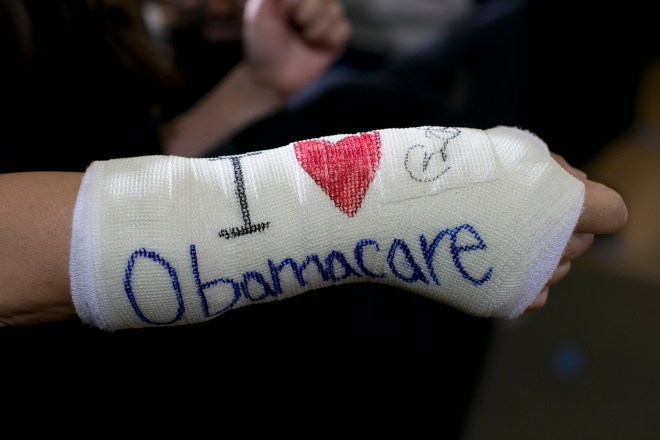
(Photo: President Obama spoke at Faneuil Hall to bolster support for his national health care law in Boston on October 30, 2013. Cathey Park, of Cambridge, displayed a cast on her broken wrist with ‘I (heart) Obamacare’ written on it. When U.S. President Barack Obama finished his speech, he shook hands with the crowd and signed her cast, next to the heart. By Yoon S. Byun/The Boston Globe via Getty Images.)

Fading Fox

Connor Simpson has some bad news for Roger Ailes:

Fox News has fallen out of favor with Republicans after two years of untouched supremacy as the party’s brand of choice across any and every medium, according to a recent YouGov survey. YouGov measures which brands are preferred by each party (Republicans, Democrats, Independents) by adding and subtracting negative feedback on a 100 to -100 scale. In 2011, Fox News led all brands [among Republicans] with 68 support points, a full 5 points ahead of the rest. In 2012, Fox News led with 64.5 support points, 1.7 points above the rest. This year? In 2013, Fox News didn’t even make the top 10.

What happened? Simpson argues the 2012 election left the network “teetering on brink of self-parody and un-truthiness”:

Public Policy Poll released in January showed a serious decline in trust during the months after the election. Only 52 percent of those who identify as “somewhat conservative,” said they trust Fox News, down from 65 percent last year. Hardline conservatives trust Fox News less, too: 13 percent said they don’t trust Fox News anymore, compared to 6 percent last year. … One can only presume this is why they’re remaking the anchor line-up with established conservative faces and bringing in giant iPads.

Is Obamacare Obama’s Iraq?

Bernstein shakes his head:

Remember, the Bush administration strongly denied anything was going wrong in Iraq—not just for weeks, but years. The “Mission Accomplished” episode is remembered because it was an apt symbol for how the White House acted. Whatever line the White House set, conservatives almost universally followed. You may recall, for example, an extended period in which the emerging insurgency in Iraq was—quite preposterously—compared to largely mythical Nazi “bitter enders.” Right up until the run-up to the 2006 elections (that is, three years into the fiasco), there was virtually no public pressure from Republicans on the White House.

Nor was this dynamic restricted to Iraq. Republicans spent much of 2008 denying the recession that had already begun; that’s how John McCain got into trouble during the presidential campaign by claiming that economic fundamentals were sound.

This blog is one of the few that – after cheer-leading Bush into Iraq – pivoted over time to stringent and bitter criticism. I hope our coverage of the ACA website and effect on the individual market hasn’t pulled any punches either. But the difference is: in criticizing Obama, I’m joined by countless Democratic writers and outlets. When I took on Bush for over-spending at home and over-reaching abroad, I was effectively alone at the start. And over the years, only a handful of apostates joined me, as the right consigned me, and them, to the “raging lefty” category, without addressing our, you know, arguments. That ended with Obama’s election when all the debt Bush piled up could suddenly be blamed on the new guy. It’s as if the Tea Party could not believe in its own principles until a Democrat was in office.

That tells you a lot about the fundamentalist psyche and movement-think in the GOP. The Republicans need to open their minds and construct a conversation about policy and principle – one that is always open to internal criticism. Doubt is a conservative virtue – and the Republicans seem to have forgotten this entirely.

You Forgot South Sudan!

IMG_0376

The Dish coalition of the willing is even larger than we thought:

After seeing the map of your world readership, I thought I’d send you a note to let you know that I have read the Dish in South Sudan, one of the blank countries – albeit, several years ago, so before both you and South Sudan became independent. I was on an assignment in Juba for several weeks in 2009 and could usually manage to get online for an hour or two a day. The last site I would go to would be yours (hosted by The Atlantic at that time). I’d load it up, close my laptop and head back to my hotel, which had been built out of a shipping container. I’d go into my tiny room, pull the mosquito net around me and open up my laptop. No need for an Internet connection or even electricity: reading the Dish by my laptop battery I was able to spend 30-40 minutes catching up on news and opinions. I just couldn’t watch any videos or read stories below the fold.

I don’t know what they are reading in Juba these days and can’t help you out with Central African Republic. But you should know that your site was very helpful in making a Sudanese shipping container feel a bit more like home.

Another reader confirms our South Sudan representation for this year:

Actually, I read the Dish from South Sudan earlier this year, but I did it through a Kenya-based Satellite ISP, so my views were probably logged as originating in Kenya.

Another sent the above photo in June 2012 (which we never posted, probably because the window frame wasn’t visible):

This is what I see from the window of my “container with a view” overlooking the Nile River at Oasis Camp in Juba, South Sudan.

I’ve been trying to upload it for a couple of days.  Hope this makes it.  I will send the view looking at my window from outside if I can – it’s a lovely place, in its own way (not the rooms, but the little bar/restaurant on the riverfront is great).

BTW, I got the news of the ACA decision here on Thursday before my husband had heard it in Michigan.  I immediately got online to check out the reax of Andrew and others (my connection works much better for viewing than for attachments). Love the site – keep it up.

And keep up the great photos. We actually posted a window view from South Sudan just after it went independent in July 2011. The photographer wrote at the time:

As you’ll see from my submission, I live on the other side of the world from you. I know the East Coast is starting to wake up when your blog starts showing up in my Google Reader. I want to thank you for keeping me up to date on what’s going on in the world! I am lucky to live and work in the newest country in the world. The picture I’m submitting comes from a unit overlooking the Nile in Juba, South Sudan.

One more reader:

I have a friend heading to South Sudan in a few days. We argue politics all the time. I’ll be sure to copy a Dish link in one of my emails to her.