Well, some days just get ahead of you. Yesterday was one of them. Not only was I late writing this post (a long Dish meeting crashed up against AC360 Later) but I also dated it to 11.30 am rather than pm. So apologies. And a quick re-post.
Having grown up evangelical, Richard J. Muow offers an explanation as to why certain Christian communities still keep their children from celebrating the holiday:
What has changed since my childhood? Well, for one thing, in those days witches and warlocks were fictional characters. Today Wicca and neo-paganism are a fairly visible presence in the religious marketplace. More significantly, Halloween is no longer mainly for kids. It has become an adult festival as well—identified in many minds as an opportunity for a bit of Dionysian abandon. And then there is the more general adult fascination, as evidenced in popular prime-time TV, with the subject matter traditionally associated with Halloween: zombies, ghouls and vampires.
So, do those recent changes mean that Christians should avoid Halloween? I’m ambivalent. Part of me wants to tell my fellow Christians to lighten up a little, keeping the focus on a day when kids can have some fun. … But the Christians who are worried about Halloween and all it stands for are struggling with different aspects of evil. They are wondering how to raise their children in a culture that often seems opposed to what they stand for. They are nervous about what reading Harry Potter and vampire stories might be doing to the souls of their offspring. They worry about obsessions with tattoos and bodily piercings, and they fear the “Goth” subculture’s influence on their teenagers.
These phenomena too are connected to what the Apostle had in mind when he told us that we wrestle with more than “flesh and blood” in our spiritual struggles. The Devil and his minions do not confine their insidious influences to “systemic” political and economic patterns. They also seduce us in other, more personal, ways.
A Cornell computer scientist and a Facebook engineer have developed an algorithm (pdf) they claim “can identify one’s spouse or romantic partner — and even if a relationship is likely to break up”:
Their key finding was that the total number of mutual friends two people share — embeddedness, in social networking terms — is actually a fairly weak indicator of romantic relationships. Far better, they found, was a network measure that they call dispersion. This yardstick measures mutual friends, but also friends from the further-flung reaches of a person’s network neighborhood. High dispersion occurs when a couple’s mutual friends are not well connected to one another.
The researchers were able to identify who was dating whom with 60 percent accuracy, much better than the 2 percent accuracy they’d get from random guessing. High dispersion also seems to be correlated with longer relationships. The study found that couples were 50 percent more likely to break up in the next two months if the dispersion algorithm failed to guess that they were dating.
The scientists also looked at metrics such as how many times a user viewed another’s profile, attendance at the same events, and messages sent. Dispersion turned out to be the most overall accurate metric for determining romantic relationships. The researchers used multiple sets of anonymous data, including a large data set from 1.3 million Facebook users.
Judith Shulevitz shudders at how easy it’s become to be a one-mother NSA:
For the iPhone I will soon be buying [my son], I can get an iPhone Spy Stick, to be plugged into a USB port while he sleeps; it downloads Web histories, e-mails, and text messages, even the deleted ones. Or I can get Mobile Spy, software that would let me follow, in real time, his online activity and geographical location. Also available are an innocent-looking iPhone Dock Camera that would recharge his battery while surreptitiously recording video in his room, and a voice-activated audio monitor, presumably for the wild parties he’s going to throw when his father and I go out of town.
Had such science-fiction-worthy products somehow become acceptable while I wasn’t watching? Apparently they had.
When ZDNet conducted an online debate about parental espionage a few weeks ago, 82 percent of respondents agreed with the statement that parents “should be able to observe the full data feeds of what their children post and receive via Facebook, text, email, and any other application or service used on their devices. It is a parent’s right to ‘violate’ their child’s notion of ‘privacy.’” When a media researcher interviewed 21 parents in three Canadian cities in 2011, only three said that they had faith in their children and that they found such hypervigilance “harmful.”
Nora Caplan-Brickler wonders if teenagers might be better at monitoring each other than adults ever could be:
There’s already good evidence that letting teenagers police themselves can work. An organization called Students for Sensible Drug Policy has long advocated “Good Samaritan Policies” (or “amnesty” policies), which can encourage kids to report their own and their friends’ binge drinking and drug abuse by pledging that they won’t get in trouble for calling 911. Good sex-ed policies can create a similar environment around reporting harassment and assault (though offering anonymity or amnesty in those cases is more ethically jumbled). A study at Cornell in 2006 showed that amnesty policies had increased the number of 911 calls—some life-saving—while the level of drinking and debauchery stayed constant. When it counts, asking kids to play NSA on one another can work.
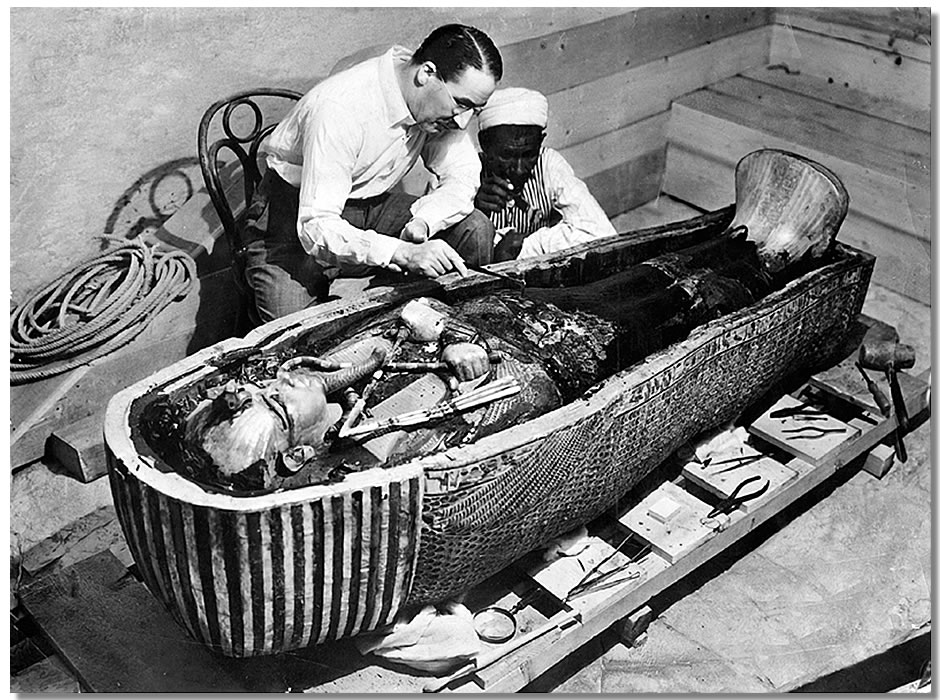
Jo Marchant traces the legend of King Tut’s curse, which took root as soon as the pharaoh’s mummy was discovered in 1922 by archaeologist Howard Carter and his financial backer, George Herbert, the fifth Earl of Carnarvon. The latter died in Cairo two weeks after the excavation:
The idea of the mummy’s curse was already a popular story, but Carnarvon’s demise (and [superstitious novelist Marie] Corelli’s apparent prediction of it) turned it into one of the great legends of the age. Rumours quickly spread that Carter had found warnings in the tomb itself. There were reports of a clay tablet, allegedly found over the tomb’s entrance, that read: ‘Death shall come on swift wings to whoever toucheth the tomb of Pharaoh.’
According to the stories, Carter buried it in the sand in case it scared his labourers into stopping their work. The whole situation was a gift for journalists who, four months after the tomb’s discovery, were desperate for more Tutankhamun-related news. Once the curse story took off, they began running daily updates, roping in scholars to debate whether evil spirits were to blame for Carnarvon’s demise. Ernest Budge, a curator at the British Museum, dismissed the theory as ‘bunkum’. The adventure writer Rider Haggard complained that it served only ‘to swell the rising tide of superstition which at present seems to be overflowing the world’. Carter himself apparently said that his answer to the curse was ‘spherical and in the plural’.
But plenty of respected names supported a paranormal explanation. The Oriental scholar J C Mardrus (known for his translation of the Thousand and One Nights) suggested that ‘dynamic powers’ killed the Earl. Impatient with the argument that, were spirits really guarding the tomb, they would have taken out Carter, too, Sir Arthur Conan Doyle insisted: ‘One might as well say that because bulldogs do not bite everybody, therefore bulldogs do not exist!’
(Image: Howard Carter opens the innermost shrine of King Tutankhamen’s tomb near Luxor, Egypt, 1923, via Wikimedia Commons)
Ben Richmond believes the European Union deserves credit for driving pharmaceutical companies out of the lethal-injection drug market. For example, the American company Hospira announced that it would stop manufacturing sodium thiopental in 2011:
Without ruling out a change of heart in leadership at Hospira, who for their part said they never intended for their products to be used like that, one reason for this crackdown was that sodium thiopental manufacturing was moving from North Carolina to Italy, where it would fall under the jurisdiction of the EU’s “Torture Regulation.” The law “establishes specific trade arrangements covering certain types of equipment and products,” which could be used for torture, capital punishment, “and other cruel, inhuman or degrading treatment or punishment in non-European Union (EU) countries.” To import sodium thiopental, Hospira would have to prove that it wouldn’t be used in capital punishment, which the company didn’t think was possible.
A similar case in the Show-Me State:
Missouri was planning on using the anesthetic propofol for a lethal injection for the first time, until the drug’s German maker, Fresenius Kabi, objected, claimed that doing so would lead to a disruption of the drug’s export to the United States. … Missouri’s governor noted that ultimately the American courts will determine whether or not we have the death penalty, not laws in Europe. However, those American courts may say that under European export laws, there is no constitutional way to keep the death penalty around.
This is a masterwork of dimensional insight into an icon who sought to flatten and flatter himself as much as possible and to shroud his exceptional artistry in exceptional artifice, a man woven of paradoxes, who, despite his chronic failings of private self-control, exerted his every faculty on controlling his public image. And yet, somehow, Teachout manages to peel away these protective layers and expose the flawed human being beneath them by elevating rather than diminishing Ellington’s humanity, enriching rather than discrediting his legacy.
From Teachout’s book:
Ellington was especially attached to the idea of serving as a spokesperson for African Americans — an aspiration admirable enough on the surface, but only if unbridled from ego and self-inflation, something of which Ellington was far from innocent given the amount of personal publicity he poured into his objective. … And yet beneath the persona Ellington projected lay a person of swelling imperfection — he shamelessly “borrowed” creative material from his band musicians without sharing the royalties or accolades, and had ceaseless extramarital and extra-extramarital affairs, cheating on his wife Edna with his longterm lover Evie, on whom he cheated with countless other women. (So intense were the private passions around his publicly muzzled affairs that, at one point, Edna attacked him with a razor after finding out he had been sleeping with another woman, reportedly his Black and Tan co-star Fredi Washington. What Edna didn’t know was that Duke had a regular habit of checking into several hotels, handing out keys to different women, only later deciding which hotel room he wanted to ravage for the night.)
Angela Watercutter praises Kimberly Peirce’s new film adaptation of Stephen King’s Carrie for giving its female lead agency and self-awareness, unlike most horror films:
[T]he men in the audience … identify with her as she wreaks her revenge. Why? King has a theory: “One reason for the success of the story in both print and film, I think, lies in this: Carrie’s revenge is something that any student who has ever had his gym shorts pulled down in Phys Ed or his glasses thumb-rubbed in study hall could approve of.” In other words, [film professor Carol J.] Clover writes, a young man who’s been humiliated in a locker room can identify with a young woman pelted with tampons in a gym shower; King also suggests the “possibility that male viewers are quite prepared to identify not just with screen females, but with screen females in the horror-film world, screen females in fear and pain.” The new version of Carrie states this almost flat-out, using Carrie’s eventual prom date, Tommy Ross, who relates her locker-room torture to his own experiences being bullied in grade school.
Devon Maloney identifies bullying as the film’s true monster:
This is the reason one remakes Carrie in 2013: to reframe unadulterated, schmaltzy horror into a more nuanced, realistic terror, the one that leaves you, on the one hand, oddly charged if you’ve ever felt been a victim, or scouring your mental Rolodex for the Carries of your own teenaged past if you were one of the kids dishing it out. This Carrie does what it ought to do: It proves that every generation needs its own cautionary tale about preying on the vulnerable until its circumstances are no longer relevant.
On the other hand, Eli Yudin and Carey O’Donnell see Carrie’s abusive, fanatical mother (played by Julianne Moore) as “the real horror of the movie”:
Our first glimpse of the twisted matriarch is in the very opening of the movie, as Moore gives birth to her daughter alone on her bed. She cries out to God, believing her labor is punishment for a sin she committed (premarital sex), and is convinced she is dying. When she first looks down at the infant between her legs, she views her as an immediate threat and raises a pair of scissors above the baby. However, Margaret spares her daughter after she looks into the baby’s eyes, and immediately cradles her, giving us a perfect summary of their relationship. Moore captures this love/hate seesaw wonderfully: she hates Carrie for being the physical reminder of what she views was her most dire disobedience to God, but realizes that Carrie provides her with the only remaining trace of humanity left in her, a mother’s unconditional love for her child.
Rather than [actor Piper] Laurie’s operatic Margaret [from Brian De Palma’s 1976 adaptation], Moore’s religious rants are hushed, coo-like, making for a more menacing contrast when she hits her daughter in the face with books, drags her into her “prayer closet”, and digs her fingernails and sewing tools into her own flesh. She’s a ghoul in every sense of the word, one that Peirce makes clear Carrie is so desperately trying not to become.
But Richard Corliss pans the move, saying “virtually ever scene in Peirce’s film is a pallid duplicate of De Palma’s”:
After Carrie’s transformation on prom night, when the event is called off due to high body count, she goes walking through the town’s streets like a Godzella unchained. De Palma showed [actor Sissy] Spacek dispatching [actors Nancy] Allen and [John] Travolta with a killer gaze that sent the bad kids’ car into an eight-turn rollover and a quick burst into flames. Peirce draws out the comeuppance, delaying Carrie’s climactic confrontation with her mother. It’s just unnecessary, like the rest of the movie.
If not religion, as Marx famously claimed, then what? Rosie Blau ponders the question:
Myriad alternative religions flourish. Football fans flock to stadiums in rain or snow and spend thousands on season tickets. Celebrity-gossip magazines thrive while other forms of print struggle to survive. Money must be another contender—so many lives are filled with dreams of it, pursuit of it, spending it. It’s a faith with many faces: credit cards that let us buy more than we can afford; houses for which we borrow and borrow; lottery tickets that we know make little sense. Perhaps this is Marx’s ultimate defeat: is capitalism now the opium of the people?
There is also the ever-expanding realm of mass distraction. In 1957 Edward R. Murrow, an American journalist who helped to fell McCarthy, labelled television the opiate of the people, in despair at its passive audience and poor programmes. Americans still watch more than four hours a day, despite being equally addicted to other screens. More than a billion people use Facebook, and mass communication by phone, text and e-mail means we are never alone, always “in touch”—or perhaps, as Marx might see it, forever out of touch with our true selves.
Lottie Moggach suggests that the “new opium” is the Internet. Rory Stewart offers “our children” as a response.
 Well, some days just get ahead of you. Yesterday was one of them. Not only was I late writing this post (a long Dish meeting crashed up against AC360 Later) but I also dated it to 11.30 am rather than pm. So apologies. And a quick re-post.