Edible Heritage

Matt Goulding reports on a push to add traditional Japanese cooking to the UNESCO’s list of “intangible world heritages”:

Most people know UNESCO as the cultural arm of the United Nations dedicated to protecting important landmarks and features in the physical world: Angkor Wat, the Grand Canyon, the Taj Mahal. But in 2008, they expanded their heritage protection program to include intangible cultural artifacts – as they describe them, “traditions or living expressions inherited from our ancestors and passed on to our descendants.” To date, they’ve added 257 items to their list of safeguarded customs, from well-known cultural staples like Brazilian Carnival to more obscure traditions like the gong culture of the Vietnamese highlands. Along with the petition to safeguard Japanese cuisine, there are 31 other proposals being examined this fall by the world body, including Korean kimchi-making, Turkish coffee culture, and the Belgian tradition of shrimp fishing on horseback.

Goulding notes that while “preserving a building or a monument is relatively straightforward, the objective of the intangible heritage program is considerably more opaque”:

UNESCO officials are careful not to use the words protect or preserve, as it implies freezing or impeding growth. What’s at hand is even more delicate: educating communities on the importance of their greatest cultural traditions, without stunting their development or dictating their future.

Face Of The Day

NSA Director Keith Alexander Discusses Cybersecurity

U.S. Army Gen. Keith Alexander, director of the National Security Agency and commander of U.S. Cyber Command, speaks during a conference at the Ronald Reagan Building in Washington, DC on October 30, 2013 . General Alexander spoke about cybersecurity at a conference hosted by Bloomberg Government. By Mark Wilson/Getty Images.

Somewhere Mark McKinney is smiling.

Buying A Bottle Of Cognitive Bias

Earlier this year, Alex Mayyasi reviewed research on individuals being unable to tell the difference between expensive and cheap wine during blind taste tests. His bottom line:

Since a $5 wine can so easily be mistaken for a $50 wine, we encourage you to unabashedly reach for wine on the bottom shelf.

Felix Salmon, commenting on the same research, makes the opposite recommendation:

The more you spend on a wine, the more you like it. It really doesn’t matter what the wine is at all. But when you’re primed to taste a wine which you know a bit about, including the fact that you spent a significant amount of money on, then you’ll find things in that bottle which you love. You can call this Emperor’s New Clothes syndrome if you want, but I like to think that there’s something real going on. After all, what you see on the label, including what you see on the price tag, is important information which can tell you a lot about what you’re drinking. And the key to any kind of connoisseurship is informed appreciation of something beautiful. …

This explains, I think, why rich people tend to be so fond of fine wine: it’s the most consistently reliable way that they can convert money into happiness.

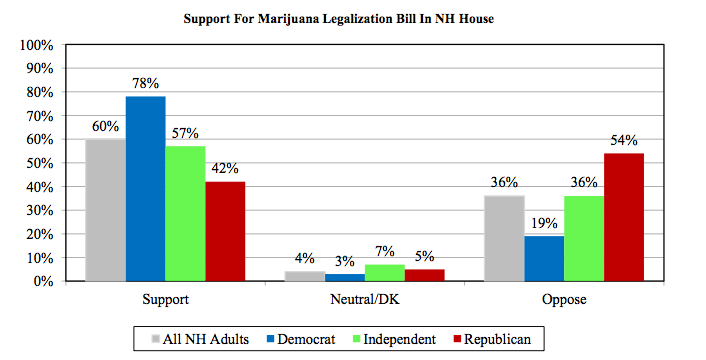
60% Of New Hampshirites Back Legalization

Screen Shot 2013-10-30 at 2.00.41 PM

It might make for a more interesting primary season in 2014. But, of course, the politicians are resisting. The poll (pdf) was taken just a few days before the New Hampshire House of Representatives Criminal Justice and Public Safety Committee voted 11-7 against recommending the passage of HB492 yesterday, a bill to regulate and tax marijuana like alcohol. Living free in New Hampshire remains an aspiration.

The Purges Must End

Matt Steinglass defends the latest from Ponnuru and Lowry by arguing that “Republicans who attack the tone and tactics of tea-party politics, without explicitly disagreeing on policy grounds, are not dissenting in a merely cosmetic fashion”:

The subordination of policy to tactics is a feature of apocalyptic-extremist factional politics. It’s a mistake to think that extremist parties are characterised by ideological rigidity; in fact, on any question on which there can be internal competition in such parties, there tends to be a succession of changes in position. Each shift produces apostates who can be purged on the basis of previously holding positions that have now been revealed as incorrect, and this provides opportunities for advancement to lower-ranking members.

A party caught up in this dynamic can’t take any policy positions on which it might be able to compromise with the opposition, or win new constituencies outside of existing insiders; the compromise would be a death sentence for the members who agree to it, and allegiance to new constituents is suspect in the eyes of existing ones. The GOP has to wrench itself out of this internal political spiral in order to make concrete moves on policy or even on the kind of image it wants to project to non-conservatives, and it makes sense for worried Republicans to take up this problem as an issue in its own right.

I tend to agree with Matt. To turn the current abstract, rhetorical performance art into a civil, even if passionate, conversation within the party is essential. Hence my post yesterday on exactly this element in a civilized conservatism. You begin within the party; with any luck, you can then begin having a conversation with those outside it. Focusing on tone first – and then policy, as Mike Lee has put it – is the right set of priorities. It unwinds the fundamentalist psyche propelling so much of this.

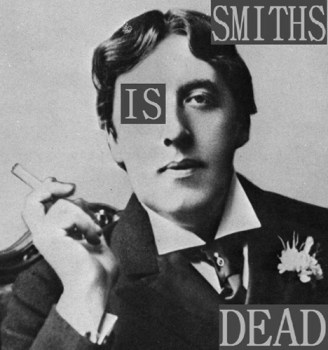
The Smiths’ Wilde Side

Moira Donegan studies the creative and personal similarities between Morrissey and his idol and muse, Oscar Wilde:

As two Irishmen, they pretended to be more English than the English. $T2eC16dHJHEE9ny2sr(GBQ6CV(8q0!~~60_57 Morrissey had little of the formal education whose affectations he adopted; Wilde was absent from the rituals of heterosexual sociality whose ridiculousness he mimed. They were outsiders, and therefore they perhaps had the luxury of disinterested observation. But such an analysis overlooks what is perhaps the emotional crux of their work, the core that becomes lucid only after repeated readings. For though they each lay claim to certain forms of social exception, neither Morrissey nor Wilde is wholly comfortable or unqualifiedly smug in his position as an outsider. Both men’s work is tinged, too, with a desire for belonging.

The problem with using humor to conceal your anxieties is that it tends to be a pretty weak disguise.

In jokes, the psyche often rears its head where it’s not supposed to. This might be why there is a sincere and disquieting bitterness detectible in these men’s work beneath all the snark and sheen. Why would Morrissey quip, in “Cemetery Gates,” that Keats and Yates are on your side, if he had no desire to demonstrate the erudition that is held as a standard of worthiness by the sort of people who admire Keats and Yates? Why would Wilde write When I was young I thought that money was the most important thing in life; now that I am old I know that it is, if he did not wish to show himself to be a self-conscious member of the leisure class? One of the prices of upward mobility—be it an upward mobility of wealth, culture, education, or just social popularity—is the twinging shame of knowing that you’re not quite a native in this new strata of yours. It can be difficult to shake the dark suspicion that you will be rejected as readily as you were welcomed, once your new admirers discover that you’re a fraud.

Recent Dish on Wilde here and recent coverage of Morrissey’s new autobiography here.

(Image of a Smiths-Wilde T-shirt via eBay)

Yglesias Award Nominee

“If our generation of conservatives wants to enjoy our own defining triumph, our own 1980 — we are going to have to deserve it. That means sharpening more pencils than knives. The kind of work it will require is neither glamorous nor fun, and sometimes it isn’t even noticed. But it is necessary. To deserve victory, conservatives have to do more than pick a fight. We have to win a debate. And to do that, we need more than just guts. We need an agenda,” – Senator Mike Lee, who recently threatened to destroy the entire global economy to make a point.

Hey, it’s a sign that the fever may be subsiding.

The Mass Delusion That Wasn’t?

Today is the 75th anniversary of Orson Welles’ War of the Worlds broadcast. Marc Wortman calls it “arguably the most widely known delusion in United States, and perhaps world, history”:

The New York Times front page story the next morning reported that “a wave of mass hysteria seized thousands of radio listeners throughout the nation…[leading them] to believe that an interplanetary conflict had started with invading Martians spreading wide death and destruction in New Jersey and New York.” But what made so many Americans so gullible? It was a case of the jitters, a nation primed to jump at the word “Boo!”

Jefferson Pooley and Michael Socolow calls this episode of hysteria a “myth”:

The supposed panic was so tiny as to be practically immeasurable on the night of the broadcast. Despite repeated assertions to the contrary in the PBS and NPR programs, almost nobody was fooled by Welles’ broadcast.

How did the story of panicked listeners begin?

Blame America’s newspapers. Radio had siphoned off advertising revenue from print during the Depression, badly damaging the newspaper industry. So the papers seized the opportunity presented by Welles’ program to discredit radio as a source of news. The newspaper industry sensationalized the panic to prove to advertisers, and regulators, that radio management was irresponsible and not to be trusted. In an editorial titled “Terror by Radio,” the New York Times reproached “radio officials” for approving the interweaving of “blood-curdling fiction” with news flashes “offered in exactly the manner that real news would have been given.” Warned Editor and Publisher, the newspaper industry’s trade journal, “The nation as a whole continues to face the danger of incomplete, misunderstood news over a medium which has yet to prove … that it is competent to perform the news job.”

Ways Obamacare Could Go Wrong

Kate Pickert highlights one:

Hundreds of thousands—if not millions—of people who purchase coverage independently are now receiving letters from insurers canceling policies that do not comply with new Affordable Care Act (ACA) regulations. In cancelling such plans, some insurers are telling customers they will be automatically enrolled in alternative ACA-compliant coverage unless they object.

This could be a major snag in the ACA’s plan to subsidize insurance purchased on the individual market. New tax credits, available to individuals earning less than 400 percent of the federal poverty level, or about $46,000 per year, can only be accessed through new ACA insurance marketplaces. Those who purchase coverage outside the exchanges cannot claim subsidies, even if they qualify for them, according to the Centers for Medicare and Medicaid Services, the agency overseeing implementation of the ACA. Automatic enrollment directly through an insurer would avoid the exchanges, and the subsidies, entirely.

Scott Gottlieb identifies another potential problem with the ACA:

The potential woes stem from an oversight made by the architects of Obamacare.

Under the law, insurers who offer policies inside the Obamacare exchanges are required to treat their enrollees inside and outside the exchange as a single risk pool. Among other things, this provision was meant to reduce the chance that insurers would steer healthier patients into plans sold outside the exchanges.

But the law doesn’t prevent insurers from offering plans exclusively outside the exchange. If they are entirely outside the exchange, they get to create their own risk pool, and aren’t subject to the same pricing that burdens plans inside the exchange. (See this Commonwealth Fund Brief for a fuller explanation)

As the pool inside the exchange becomes older, sicker, and costlier, more plans will have an economic incentive to get out of the Obamacare market altogether.

Once outside, they are free to price their products to match a better risk pool.

Other provisions will further encourage plans to drop out.

Obviously we need to make some fixes to the law. But how can we when the House will only vote to repeal it? I remain gobsmacked that the president did not meticulously prepare his core domestic policy initiative. I know the broader project makes sense, but is he really trying to prove that in practice, technocratic government is an oxymoron?