
Hoback Junction, Wyoming, 9.55 am
Hoback Junction, Wyoming, 9.55 am
A little boy wanders on stage with Francis and won’t let him go.
I’m struck by a simple fact: this happened to Jesus a lot, and his response – even more revolutionary in his day – was Francis’: “Let the children come to me and do not prevent them; for the kingdom of God belongs to such as these.”
From raping children to seating them on the papal chair. Know hope.
“I voted against it, but once it passed I certainly determined that I would try to do everything I could to make sure that New Yorkers understood it, could access it, and make the best of it,” – then-Senator Hillary Clinton in 2006, on the Medicare D entitlement pushed by the GOP, which had some terrible start-up glitches and problems.
Why is there not a single Republican in the Congress able to be as pragmatic and patriotic as Hillary Clinton about something that is now the law of the land?

A reader responds to a recent post:
I was one of your dawdling freeloaders. But I finally caved, and it wasn’t your coverage of the debt-crisis that did it. While politics are somewhat similar around the world, as a Canadian, I have been simply shocked by Congress and the insane behaviour on display. Riveting reading, and I could not get enough. But in the middle of it all, with pending economic annihilation, you added to your delightful octopus post. Sweet relief – a sign of intelligent life! I raised my debt-ceiling and subscribed.
You can join her [tinypass_offer text=”here”] for just $1.99/month. Previous Dish on the wonders of the octopus here, here, here, and here. Below is more coverage for our new subscriber and others:
This time last year, one unlucky Seattle octopus was reportedly beaten to death by a local diver and then brought home to be eaten for dinner. The story riled cephalopod fans near and far and has been covered extensively in the press, including a feature story this past weekend in The New York Times Magazine.
The diver, a teenager who was collecting his first octopus for part of a school project as well as for dinner, had been made the villain of the infamous encounter. He was, however, abiding by the law and had a fishing license to collect marine life in the area. And accounts of the incident do suggest he was following the rules prohibiting instruments that would “penetrate or mutilate the body,” such as a spear or knife. In fact he appears to have gotten the octopus very much by hand; he was described as “punching” the octopus repeatedly—for nearly half an hour—before overpowering it and carrying it to his truck.
From this, I can only think of the words of fictional film news anchorman Ron Burgundy, I’m not even mad; that’s amazing.
The octopus in question was a giant Pacific octopus (Enteroctopus dofleini) and this particular one was estimated to be about six feet long and weigh 80 pounds. The diver describes the initial encounter with the octopus in which he goaded it into attacking him. It then grabbed his body with its suckered arms and pulled out his regulator—a situation that seems like it could easily have turned deadly for the teen instead of the octopus. … Although octopuses usually go after prey smaller than themselves, they can use their strength to overpower substantial adversaries, including sharks. In fact, it was also in Seattle, at the Seattle Aquarium, that a giant Pacific octopus was filmed killing a shark a few years ago.
Seen here:
Lindsay Abrams looks for the larger lesson in the Seattle story:
Locals took up arms against Mayer’s actions — but at the same time lavished praise on a high-end restaurant renowned for its, yes, giant Pacific octopus. And so the foodie community was tasked with an uncomfortable dilemma: “Should it save the giant Pacific octopus or just eat it?”
“Mayer’s real offense,” writes [NYT magazine writer Marnie] Hanel, “may have been forcing a community to realize that just because they’ve embraced local fare doesn’t mean they’re necessarily ready to see, in gory detail, it slaughtered or hunted or punched out and dragged from the bay.” It’s a local lesson that we can all identify with — even ethically raised meat, animal rights activists will remind you, is eventually slaughtered, and slaughter is rarely not brutal. When we’re forced to truly consider just where our food comes from, things invariably get more complicated.
For more on that theme, check out our recent thread “The Abatement of Cruelty“. Update from a reader:
As a Seattle-area scuba diver, conflating the GPO [giant Pacific octopus]/Mayer story and the locavore movement is 100% BS. In all the conversations I’ve had with divers about this story (even all the way in Australia!), food sourcing came up precisely zero times. Never even heard of the restaurant in Pioneer Square mentioned. Plenty of scuba divers here will hunt locally for Dungeness crab and ling cod when they’re in season. I find crabbing lots of fun but avoid spearfishing myself.
What riled up people so much is that Cove 2 is probably the most popular dive site in Seattle. It’s one of several shore diving sites where you know exactly where to find the GPOs and have a good chance of spotting one. We all appreciate the intelligence, strength, and odd beauty of these magnificent animals. Then some schmuck gotta roll up and play Great White Hunter. It was an incredibly stupid and selfish thing to do, and he’s straight up lying if he says he had no idea how popular Cove 2 was. This was local democracy in action. Small but very concerned interest group lobbies for change and gets it.
And you know what? I prefer watching starfish eat a dead octopus. Or watching a live octopus grab at my camera. I can live entirely without ever eating one. If you have to spend several winters beating the meat to make it edible, it’s probably not worth the effort.
This stupid New York Times story has me honked off like a goose now. Thank you.
(Image of Alexis Diaz‘s graffiti via Colossal)

Putting aside Obama’s egregious bullshit about Americans being able to keep their current coverage, Jonathan Cohn argues that the non-group health insurance market is in great need of Obamacare’s reforms:
By nearly everybody’s reckoning, the ”non-group” market is the most dysfunctional part of the American health insurance system. The dysfunction takes two primary forms. First, insurers have been selective about whom they would cover and how—charging higher premiums, covering fewer services, or simply denying benefits outright to people with pre-existing medical conditions. About half of all Americans have at least one such condition, according to official estimates, so roughly speaking about half the population couldn’t reliably find comprehensive, affordable coverage if they had to buy it on their own.
The second big problem with the non-group market has been the lack of protection it provides even those people who think they have good insurance. At worst, plans in the non-group market border on fraud. They are “mini-med” plans that cover no more than a few hundred dollars of bills, which will last you about ten minutes if you visit the emergency room. But even the better, more respectable plans can exclude whole categories of services, like maternity care, rehabilitation, mental health, or prescription drugs. Typically they also have high deductibles and co-payments.
These policies may seem alluring, because they don’t cost much upfront. But these premiums are notoriously unstable. From time to time, insurers will “close” blocks—in other words, they stop letting new people into the plan—and then jack up rates once a few of the insured get sick.
Sarah Kliff also has a useful primer on the subject. The problem for the ACA, it seems to me, is that many Americans who have bought cheap and light insurance on the individual market are seeing their premiums go up to account for the minimal standards of the ACA, but have real difficulty now in finding out if ACA subsidies will make up some or most of the difference. That’s because of the website clusterfuck. What amazes me about the Obama administration’s gross incompetence on this is that it should have been their strong suit. Obama’s key demographics – young, minority – are precisely those the ACA needs to reach and enroll to work; and Obama’s own record in his campaign infrastructure was of innovative and flawless website management. He had all the advantages for making this work, and blew it.
Nonetheless, it’s obviously impossible for the government to be as flexible as campaigns in hiring talent and these large reforms are infinitely more complex than any campaign.
And as I noted last night, plenty of Republicans were once talking about inevitable glitches and the need for patience after their much more expensive Medicare D entitlement got off to a rocky, protracted start. Romneycare took months and months to enroll everyone. And since this is now the law – do Republicans fully grasp that fact? – it has every chance of getting on track eventually.
Today, we were told the following about the president’s management of this:
Aides said that Mr. Obama had been fixated on details of the law’s carrying out and that advisers did not withhold information but were likewise surprised by the scope of the problems. “From the moment the health care bill was signed into law the president was very focused on making sure it was implemented correctly,” said Dan Pfeiffer, a senior White House adviser. “In just about every meeting, he pushed the team on whether the website was going to work. Unfortunately, it did not, and he’s very frustrated.”
Mr. Pfeiffer insisted that the president wants to hear what he needs to hear and would not accept advisers’ keeping negative information from him. “He’ll know if you don’t tell him the bad news he needs to hear, and that’s the quickest way to be on the outside looking in,” Mr. Pfeiffer said.
So he was fixated on the details but unable to manage the critical website construction to avoid what Sebelius this morning called a debacle. I don’t think that’s more reassuring than the trope of a “bystander president.”
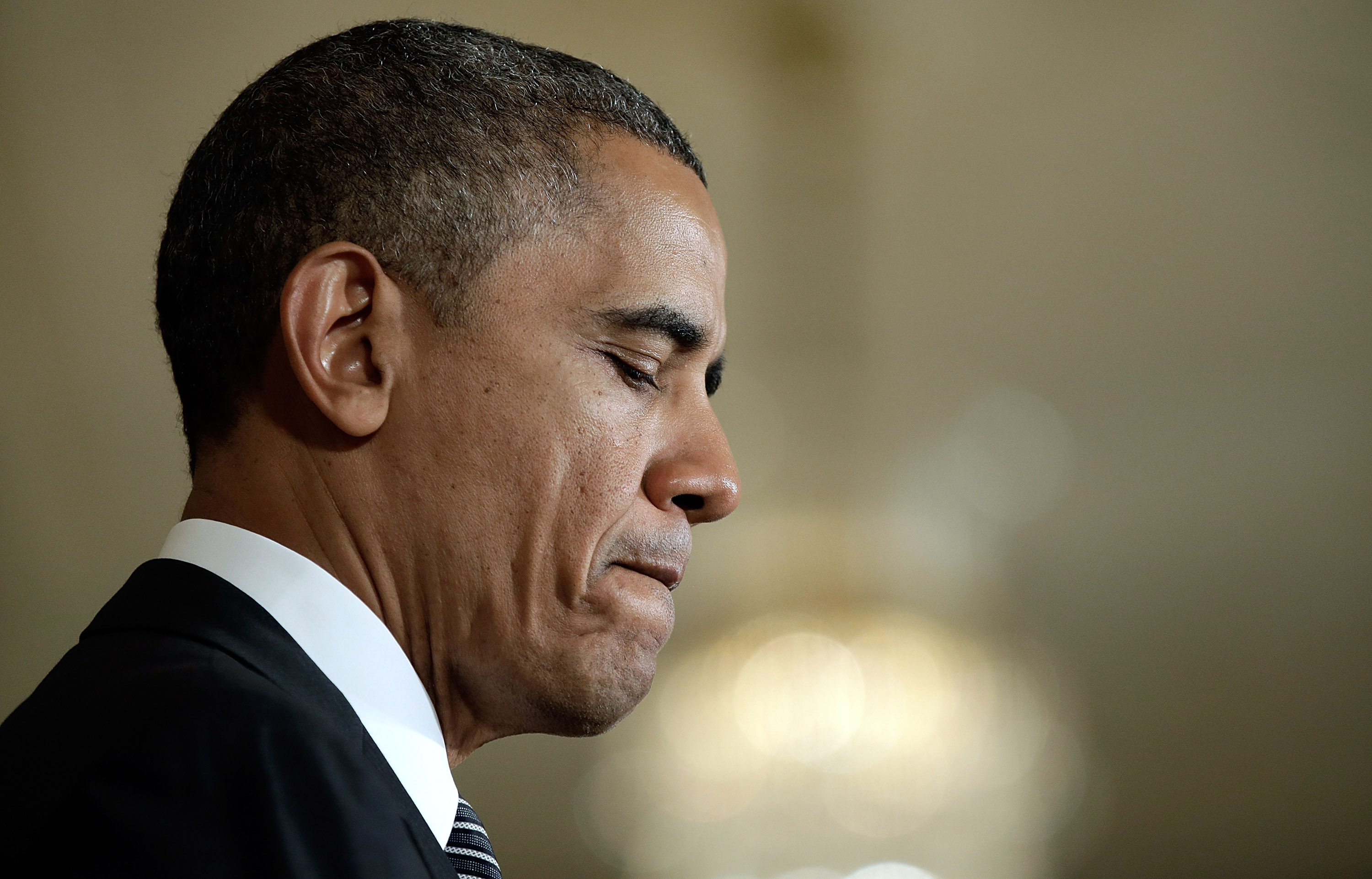
A reader writes:
I’d like to push back a bit on your harsh criticism of the president as being dishonest in his statements selling the ACA to the American public. For starters, the man is a politician and anybody who expects complete honesty from politicians is just setting themselves up for constant disappointment. Secondly, he was attempting to sell something that he honestly believed was going to help the vast majority of Americans. Does anybody really think that the best way to go about that sale was to wonkishly explain every in-and-out and why it was better than the status quo for a large majority of the population? The details were out there for those who were curious, but most people needed a sound-byte to help them understand the plan and the one he used happened to be true for all but a few percent of them.
And of course because of the increased competition of the marketplaces and generous subsidies, a lot of people who are forced to switch plans will actually end up saving money while getting more comprehensive coverage. As an example (which I originally found via The Dish): Eric Stern found that multiple Hannity guests complaining about losing their private insurance will actually likely save a crapload of money buying on the exchange.
I’d also like to address Ross’s point that the ACA “cancels plans, and raises rates, for people who were doing their part to keep all of our costs low.”
I think this is a misunderstanding about what drives healthcare costs. It’s probably true that a lot of healthy people buying bare bones plans are saving themselves a bit of money in the short run. But, because of their minimal coverage, they are also probably under-consuming certain types of healthcare. Now that 1) makes them less healthy in the short term which is bad for them and might be bad for their productivity and 2) makes them less healthy in the long term which will likely result in them consuming more high cost healthcare later in life. This will result in greater lifetime health costs (and more tax payer spending on Medicare).
Contrary to what the right may think, the people who wrote the law didn’t just add in the minimum requirements because they like bossing people around. The intent was to improve health outcomes and lower costs in the long run.
Another is more blunt:
This “Odd Lies of Barack Obama” stunt really pisses me off, using the same line you used for Sarah Palin. You know that’s a load of crap.
My family now has health insurance. But a few years ago we didn’t, because we simply could not afford it. At that time in New Jersey the cheapest plan I could find for a 3-person family was around $800 a month (now it’s over $1,000/month). And it was such a limited, crappy plan that it didn’t even include coverage for chemotherapy (if you read the fine print). NO CHEMO. Now, I don’t know about you but in my mind the main reason to have health insurance is for disasters and life-threatening or chronic illnesses. I mean really, I don’t need to pay $800 a month so I can save 50 bucks on maybe 10-15 doctor visits a year for all three of us, or save a couple hundred bucks on a year’s worth of prescriptions. That’s insane. Yet it’s the business model that insurance companies used freely for years.
But no one in the GOP, including Chris Christie, gave a rat’s ass. Not too many in the media cared either. But Obama did. And he changed the system so that insurance companies can’t sell crap plans anymore. They have to meet a reasonable standard. Or fold. Wow, what a liar that Obama was. He didn’t mention that some insurance companies chasing in on shitty, rip-off plans were going to choose “die” instead of meeting reasonable standards. Well I don’t give a damn.
Seriously. How about “The Odd Lies of America” instead? How about the absolute lie for decades that we had a great health care system in this country. Because no system that is unaffordable to tens of millions of its citizens is anything more than horrible and appalling. And no system that allows insurance companies to sell plans that won’t help the client with a cataclysmic disease – and hides that information in the weeds – is anything but disgusting.
Another spins:
Just one quick point, which may help put this in perspective. People who don’t currently have insurance cannot “keep” their plan either. They have to “upgrade,” too. Is this so different from the small minority of people who have a plan with holes in their coverage, who are forced to upgrade to a basic level of comprehensive coverage?
Another dives into more detail:
I find it difficult to get too excited about this, though it does seem evident that he either spoke the line without thinking through the implications, or knowingly and grossly oversimplified. Here’s why I don’t find it scandalous (albeit optically terrible right now):
1. It seemed evident to me at the time that he was primarily addressing concerns about employer-provided coverage and about keeping a plan that includes your favored doctor. This may or may not actually be the case, but that’s how I heard it. Yeah, I get that the quote itself is considerably broader, and nobody ought to be surprised that it’s been understood as a universal statement.
2. Health plans, as Frakt notes, churn extensively. Obviously Obama meant “… to the extent that your insurer continues to offer your plan.” No, seriously: this needs to be really obvious. Just because everyone is now blaming every price increase and coverage change on the ACA doesn’t mean it’s true.
3. The minimum coverage requirement was always going to require some plans to end; the question was only how many. Always. This, again, was obvious from the beginning.
4. He didn’t say “If you like your premium, you can keep it.” But that is what the upset is about, isn’t it? The upset certainly isn’t about the improved coverage, the lifting of annual and lifetime caps, the bar to medical underwriting, or the requirement that plans actually cover the drugs we might need.
5. I fundamentally disagree with the notion that it’d be just hunky-dory to let people stay on crap plans with high out-of-pocket maximums, little or no drug coverage, huge exclusions (like maternity and mental health care), etc. There are two problems allowing these crap plans to continue:
First, they are precisely the sort of under-coverage that’s likely to leave people back on the mercy of the emergency room and the bankruptcy court in the event of major illness. (Or pregnancy.) The point of all this is to end that. We can only end that by mandating that everyone buy coverage that actually covers your potential medical conditions and treatments. (Suppose, for example, that someone with a crap, limited-formulary plan contracted HIV. They might as well just go pre-register at the bankruptcy court.) The individual mandate isn’t just a mandate that you buy anything called “health insurance,” it’s a mandate that you buy adequate health insurance.
Second, allowing crap plans to persist would leave open the door to market failure through adverse selection. Those most likely to choose crap plans with lousy coverage would be the young and healthy. Expanding the risk pool doesn’t just mean we get everyone into the pool of insureds – it means we get everyone paying in as well, on a comparable basis. So, yeah … it’s a tax on the healthy to support the sick. But that’s what all insurance is.
(Photo: Win McNamee/Getty)
Charlie Cook thinks it’s in the Senate – and could be permanent:
The reason next year is so make-or-break for Senate Republicans is because in 2016, when all of the seats they won in 2010 come up—they netted a six-seat net gain that year—there will be 24 GOP seats up, compared with only 10 for Democrats, leading to some serious Republican overexposure. Seven of the 24 GOP senators up are hailing from states that Obama carried in 2012. After having had plentiful Democratic targets in 2012 and 2014, it will be Republicans in 2016 who will have the most incumbents in the crosshairs.
Kilgore chimes in:
2016, moreover, being a presidential election year, is likely to produce the kind of relatively high turnout that tends to help Democrats disproportionately. So for those Republicans who did not consider 2012 a “now and never” opportunity after which conservatives would be submerged in a wave of dusky looters, 2014 is a very big deal. When one seeks a radical counter-revolution overturning decades of “socialist” policies, control of the entire federal government is a must. The Senate could be gone for a good while if GOPers don’t win it back next year.
Larison adds:
If Republicans do gain control of the Senate after the midterms, it’s also quite possible that their majority will be so small that it could quickly be wiped out when some of the class of 2010 has to run during a presidential election year. Republicans are running into a recurring problem where they have to run up huge wins in the midterms just to be able to absorb their failures in the presidential years, so that even an average midterm performance becomes inadequate.

Nate Cohn claims that the Virginia governor’s race has little bearing on national politics:
Over the last few weeks, it’s become fashionable to suggest that the shutdown dealt a significant blow to Cuccinelli. Nate Silver has already treaded this ground, but I’m going to retread it. I just don’t see the evidence. McAuliffe already built a modest but clear lead, founded on a massive favorability gap and a massive advertising advantage. He was going to win. Period.
Enten agrees:
Ken Cuccinelli was a sitting duck before any shutdown hit. His favorable ratings had been dropping since way back in July, and smart analysts like Sean Trende were predicting his defeat from May onwards. One could argue that the ideology that brought Republicans into a showdown with President Obama harmed them significantly in Virginia; the shutdown itself, however, shows no real effect.
Greg Sargent, who posts the chart above, differs:
Multiple observers — see Mark Murray and Taegan Goddard for examples — argue Virginia is increasingly resembling the country as a whole.
A detailed demographic case along these lines has been advanced by Ronald Brownstein, who has argued that McAuliffe’s probable success is being powered by the growth of an emerging Democratic coalition that will likely be crucial to Democrats in statewide and national races in the future. This “coalition of the ascendant,” as Browntsein calls them, includes minorities, young voters, and college educated whites, particularly women.
Brownstein argues that McAuliffe’s apparent success in riding this coalition — which entails staking out socially liberal stances that swing state Dems have historically downplayed out of fear of alienating culturally conservative downscale whites — could have major implications nationally.
Kilgore’s two cents:
Truth is, after 2010 confirmed the heavy shift to the GOP of the groups most likely to turn out in mid-terms and off-year elections, I figured it would be a good long while before a Democrat would win the governorship in a “purple” state with off-year elections like Virginia. There’s got to be a non-trivial reason for McAuliffe’s apparently easy win, and while it may perhaps be personal to Cuccinelli, there’s no reason to conclude that without post-election evidence.
Conrad Black goes one more round against the crazy far right history of Diana West. I’m cheering for Black. Because it means, for the first time in a long while, that there can be enemies to the right in the Republican universe.
Bernstein lists eight ways Republicans have hurt the healthcare law:
I definitely don’t think the president and his administration should be let off the hook for the very real problems that have plagued the program this month.
Nevertheless, it’s worth noting that whatever their own responsibility for what’s gone wrong, the White House shares responsibility with the Republicans who have spent three years actively attempting to undermine the law. I’m not talking about repeal votes, which (while silly after a while) were totally legitimate, or about running against the program in subsequent elections, which was again entirely fair. No, I’m talking about actions designed — usually openly — not to make the law work better in their view, but to make it harder for the law to work well.
While some of these had obvious direct effects, most of them did not. And it’s hard, in most cases, to draw a direct causal line between disruptive actions and specific malfunctions in the Web site. Nevertheless, it’s hard to believe that any of these actively helped make the program run smoothly, and very easy to believe that the cumulative effect had at least some part to play in the October fiasco.
Aaron Carroll makes similar points:
There have been books, webinars and meetings explaining how to sabotage the implementation of Obamacare. There have been campaigns trying to persuade young adults not to use the exchanges. It is, therefore, somewhat ironic that many of the same people who have been part of all of this obstructionism seem so “upset” by the fact that people can’t easily use the exchanges.

