Illuminating The Christian Imagination

Aaron Cline Hanbury explores the enduring popularity of C.S. Lewis:

One of the few men who did attend Lewis’s funeral was the English theologian and philosopher Austin Farrer. In his eulogy that day, Farrer effectively described the combination of logic and emotion—of fact and imagination, of prose and poetry—that made Lewis’s writings resonate with many demographics of readers: Farrer said, “There lived in his writings a Christian universe that could be both thought and felt, in which he was at home and in which he made his reader at home.” In other words, readers found—and still find—that Lewis narratives both answer intellectual questions and satisfy spiritual longings; Lewis demonstrates the importance of images and stories for the life of faith, without forgetting the necessity of reasoned, coherent belief, as well.

But Lewis’s appeal clearly reaches further than his Christian audience and draws appreciation from adherents of other faiths and the non-religious. There’s a profound reason for that.

As the flamboyant, avant garde theater critic Kenneth Tynan, a proud proponent of amorality, wrote in his diary after reading Lewis’s novels, “How thrilling he makes goodness seem—how tangible and radiant!” And after reading a work of nonfiction, he wrote, “C.S.L. works as potently as ever on my imagination.”

In honor of his achievements as a writer, officials of Westminster Abbey announced last month that they will honor Lewis in the prestigious Poets’ Corner alongside literary figures such as Geoffrey Chaucer and Charles Dickens. The memorial stone displays Lewis’ famous summary of his faith: “I believe in Christianity as I believe the sun has risen. Not only because I can see it but because by it I can see everything else.” This vision for a Christian lens to the world permeates Lewis’s stories, because, for him, the best stories hinted at the deep structures of reality, helping humanity in the journey for truth and significance. Good stories point to an ultimate story. And as Farrer—but few else—might have predicted, Lewis appears more relevant today than ever.
Previous Dish on C.S. Lewis here, here and here.

Quote For The Day

“What is a saint? A saint is someone who has achieved a remote human possibility. It is impossible to say what that possibility is. I think it has something to do with the energy of love. Contact with this energy results in the exercise of a kind of balance in the chaos of existence. A saint does not dissolve the chaos; if he did the world would have changed long ago. I do not think that a saint dissolves the chaos even for himself, for there is something arrogant and warlike in the notion of a man setting the universe in order. It is a kind of balance that is his glory. He rides the drifts like an escaped ski. His course is the caress of the hill. His track is a drawing of the snow in a moment of its particular arrangement with wind and rock. Something in him so loves the world that he gives himself to the laws of gravity and chance. Far from flying with the angels, he traces with the fidelity of a seismograph needle the state of the solid bloody landscape. His house is dangerous and finite, but he is at home in the world. He can love the shape of human beings, the fine and twisted shapes of the heart. It is good to have among us such men, such balancing monsters of love,” – Leonard Cohen, Beautiful Losers.

The Ecumenical Mother Of God

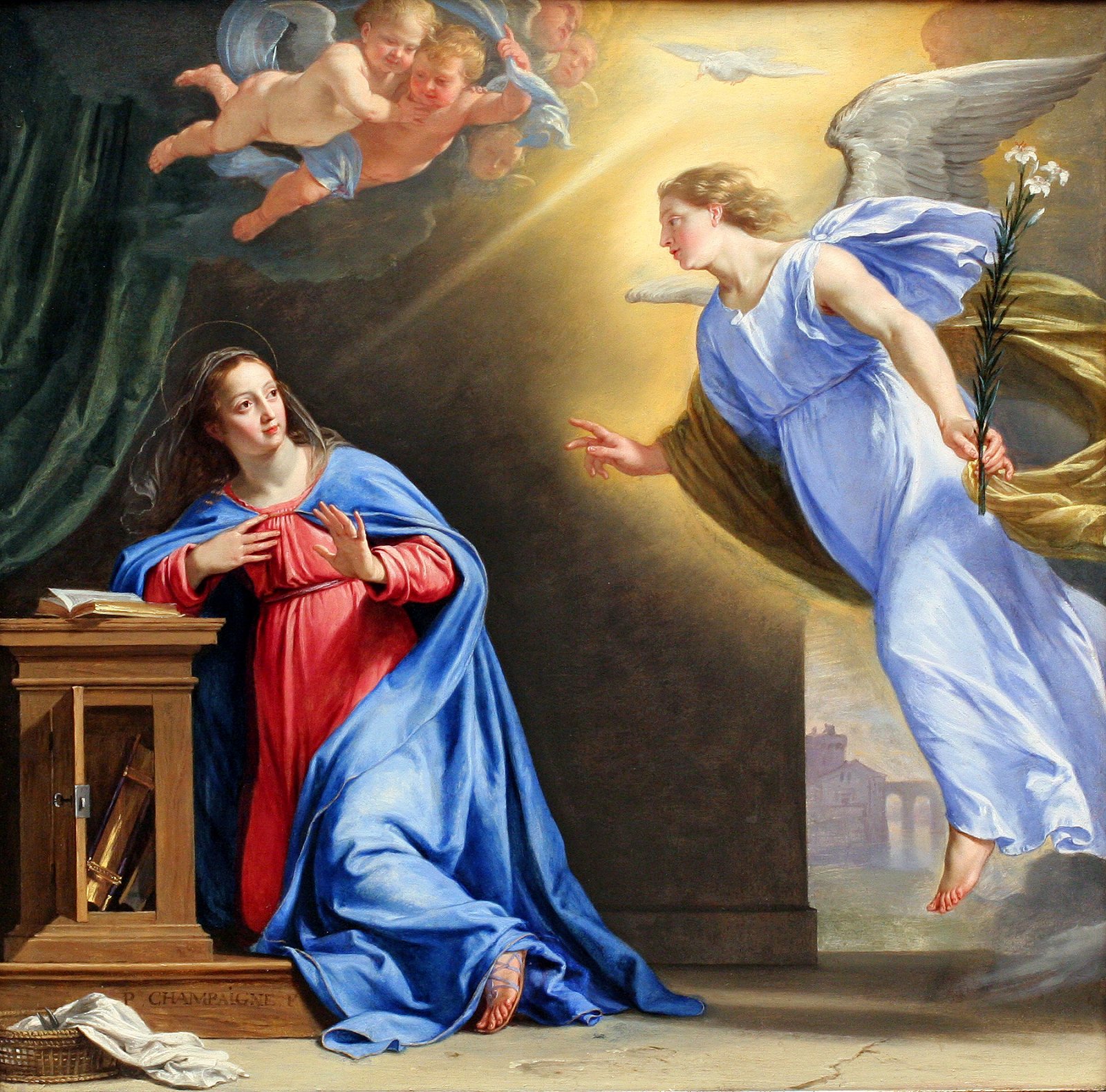
L'_Annonciation_de_1644,_Philippe_de_Champaigne.

Timothy George, a Baptist theologian, uses the Christmas season to encourage Christians of various denominations to honor Mary:

In this season of the year it is good to remember that Mary belongs to all Christians—Orthodox, Catholic, and Protestant alike. All generations, and presumably all denominations, are meant to call her blessed (Luke 2:48). This, despite the fact that doctrinal teachings and devotional practices related to Mary (or, from another perspective, the lack of such) still constitute serious barriers to full visible unity among Christians. …

We can begin by recognizing that Mary is the person and the place where God has chosen for his glory—his radiant shekinah glory—to enter most deeply into the human story, which is the story of every one of us. By welcoming Jesus into her womb, Mary provided sanctuary—a hospitable space, if you will—for the uncontainable God in the midst of a hostile world. As T. S. Eliot put it in “Dry Salvages,” she is “the hint half guessed, the gift half understood. … Here the impossible union of spheres of existence is actual, here the past and future are conquered, and reconciled.”

(Image: The Annunciation by Philippe de Champaigne, 1644, via Wikimedia Commons)

Face Of The Day

Druids Celebrate Winter Solstice At Stonehenge

A man wearing a pagan mask poses for a photograph as druids, pagans and revelers gather, hoping to see the sun rise as they take part in a winter solstice ceremony at Stonehenge yesterday, December 21, 2013. Despite the rain and wind, a large crowd gathered at the famous historic stone circle to celebrate the sunrise closest to the Winter Solstice, the shortest day of the year – an event claimed to be more important in the pagan calendar than the summer solstice, because it marks the ‘re-birth’ of the Sun for the New Year. By Matt Cardy/Getty.

Proofs Of God

Nathan Schneider, author of God in Proofunpacks them:

Annie Besant, later to become a famous Theosophist, once referred to God-proofs as “puffing divine smoke rings,” a thing that men do “over the walnuts and wine after the ladies have left.” Literary critic Susan Sontag surmised, “Jerking off the universe is perhaps what all philosophy, all abstract thought is about: an intense, and not very sociable pleasure, which has to be repeated again and again.”

In the 1990s, feminist scholar Nancy Jay argued that sacrifice rituals across cultures help create a male-only lineage that writes women out of the history and power structure of a tradition. The same might be said of arguments about the existence of God. By turning to the lineage of proofs, men have sought to cover over the real sources of their religious belief: the whispers of their mothers, the rituals of their communities, the need to feel loved. Through the experience of trying to prove, thinkers have sought to escape the bonds forged in other kinds of experience.

A Poem For Sunday

merrill2

“Dead Center” by James Merrill:

Upon reflection, as I dip my pen
Tonight, forth ripple messages in code.
In Now’s black waters burn the stars of Then.

Seen from the embankment, marble men
Sleep upside down, bat-wise, the sleep bestowed
Upon reflection. As I dip my pen

Thinking how others, deeper into Zen,
Blew on immediacy until it glowed,
In Now’s black waters burn the stars of Then.

Or else I’m back at Grandmother’s. I’m ten,
Dust hides my parents’ roadster from the road
Which dips—into reflection, with my pen.

Breath after breath, harsh O’s of oxygen—
Never deciphered, what do they forbode?
In Now’s black waters burn the stars. Ah then

Leap, Memory, supreme equestrienne,
Through hoops of fire, circuits you overload!
Beyond reflection, as I dip my pen
In Now’s black waters, burn the stars of Then.

(From Collected Poems © 2001 by The Literary Estate of James Merrill at Washington University.  Reprinted by kind permission of Alfred A. Knopf, Inc. Photo by Lisa Birtch)

Has The Novel Lost Its Faith? Ctd

Last year around this time, Paul Elie dropped a debate-spurring essay (NYT) on the decline of Christian novels in America, which the Dish covered here and here. In a new interview with the magazine Dappled Things, Elie furthers the discussion about faith in fiction:

DT: The [Catholic] faith is in decline in culture—at least on the face of it anyway. After all that’s one of the reasons Pope Benedict called for the Year of Faith. That same lack of faith, it seems fair to say, is reflected in at least three kinds of readers out there. You have a readership with a fragile faith, a readership antagonistic to the faith, and a readership that’s simply indifferent. So if you produce a fiction that seeks to challenge the reader—the first sort of reader will pull away from the work because he feels threatened; the second will reject it outright as either unbelievable or even inhuman; and the third will simply shrug their shoulders and remain unmoved. How does a work of fiction which proposes a fictional component then capture these sorts of readers?

PE: I don’t go along with that idea at all.

I’m not sure I got it from publishing or writers, but I see the book is something written by one person sitting alone in a room and read by one person sitting alone in a room. To ponder that is to realize the variety of readers. Not only is it hard to break readers down into three groups in terms of their religious disposition, and many readers don’t know where they stand on these issues. …

Flannery O’Connor says you can do whatever you can get away with, but nobody has ever gotten away with much. She also said about her novel Wise Blood, “That belief in Jesus Christ is to some a matter of life and death has been a stumbling block for readers who prefer to think of it as a matter of no great consequence.” She was writing from the situation you speak of but she figured out how to do it. She figured out how to shape everything in the novel to sympathize with Hazel Motes, who is indignant about the abuses of Christianity which then lead to his attention to doctrinal impurity in Christianity. In so doing, he gives us a grasp of what an authentic Christianity would be. It makes you identify with that in spite of yourself as the reader. That’s what O’Connor was trying to do anyway.

The Whole World Was His Monastery

What made St. Francis of Assisi so revolutionary? Reviewing the political theorist Giorgio Agamben’s recently translated investigation of monasticism, The Highest Poverty, Nathan Schneider emphasizes that St. Francis dreamed of a way of living “beyond the reach of ordinary politics” – not by retreating from the world, but through engaging it:

The Franciscan emphasis on poverty, for Agamben, represents a critical extension of the Giotto_-_Legend_of_St_Francis_-_-15-_-_Sermon_to_the_Birdsmonastic rules. Clare of Assisi, who led the female branch of the Franciscan movement, insisted that Francis had given her not a rule at all but merely a “form of life.” He taught his followers by example and by preaching, eschewing the decrees one might hear from a monastery’s abbot. When his followers failed to listen, he didn’t police or punish. “I do not want to become a persecutor to pursue and frustrate them, like the power of this world,” Francis reportedly said.

Rather than isolating himself in a monastery and relying on scripted liturgies, Francis lived in the world but not of it. He discovered, by trying to follow the example of Christ, that poverty could liberate one from the world’s principalities and powers even more completely than a cloister. He stressed that his brothers should wear the simplest of clothes, and eat what is placed before them, and claim ownership over nothing. They should never handle money. As one Latin formula put it, he aspired to “the abdication of every right,” a life entirely outside the law and the legal economy.

The cover of Highest Poverty shows Giotto’s famous picture of Francis preaching to birds; “even toward little worms he glowed with exceeding love,” it was said. Even today, the annual Feast of Saint Francis is when people bring their pets to church to have them blessed. But for Francis the birds were not pets; he referred to animals as his siblings not just out of affection but because, before the law, he sought to be equally exempt.

Read my Deep Dish essay, in which St. Francis figures decisively, here.

(Image of Legend of St Francis, Sermon to the Birds by Giotto, from the Basilica of San Francesco d’Assisi, via Wikimedia Commons)