Red States’ Gift To Blue States

As Republican Governor John Kasich bravely goes rogue in Ohio, Don Taylor runs the numbers on the Medicaid expansion:

By choosing not to expand Medicaid, the poorer, mostly politically “red” states are redistributing money toward the richer, mostly politically “blue” ones (there are exceptions; red Kentucky is both expanding Medicaid and has one of the best functioning State exchanges). Further, those States that are expanding Medicaid have also tended to set up state-based insurance exchanges, which are currently operating much better than the federal one, meaning that income based subsidies associated with the purchase of private health insurance may flow less freely to poorer states, at least in the short term. And there is a court case that could stop the flow of such subsidies to states not operating their own exchange all together. I have not tried to estimate the magnitude of these sources of redistribution from poor to rich states under different scenarios because things are so fluid, but the Medicaid numbers outlined are potentially just the start.

The bottom line is that if the current State Medicaid expansion decisions persist, the unintended story of the ACA will turn out to be the redistribution of money from poorer States, to richer ones, an outcome imposed by the poorer states, upon themselves.

Drum thinks the red states are going to have to come around eventually:

No matter how, um, passionate the tea partiers are about Obamacare, at some point it’s going to be clear that it’s here to stay. Maybe that’s a year from now, maybe it’s two. And when that finally happens, the scorched-earth opposition is going to deflate and all those red states are going to start taking another look at all the money they’ve given up. It may take a while, but I suspect that within a few years virtually every state will finally decide that there’s not much point in continuing to hold out. One by one, they’ll all belly up to the bar and sign up.

Reihan reluctantly agrees:

Rejecting the Medicaid expansion may well be the right policy, as Avik Roy and Grace-Marie Turner have argued. A number of states, including Arkansas and Wisconsin, have sought to use the insurance exchanges as an alternative to the Medicaid expansion, and the case for doing so seems fairly strong.

But the political cost of rejecting the Medicaid expansion will prove very high, for advocates will, as [Michael Greve anticipates], argue that rejection represents a senseless “loss” of federal dollars. Given that taxpayers in states that reject the expansion won’t get back the federal taxes they pay to finance the expansion, states will forgo a tangible (if flawed) benefit in exchange for the intangible satisfaction of possibly helping to unravel a deeply problematic law. This might seem like a decent trade while the future of Obamacare is in doubt. It won’t seem quite as attractive if the law proves durable.

Trende sizes up the politics of the court case Taylor mentions:

Here’s where the proponents of the suit may be too clever by half. It’s assumed that, if the courts block the subsidies for people on the federal exchange, Republicans will dig in, the government will have to declare hardship exemptions from the mandate for those who can’t afford insurance without subsidies, and that the framework will collapse.

But a different approach is at least as plausible: This is an election year, and Democrats will likely mount a full-bore assault on state legislators, governors, and congressmen in states without exchanges. The arguments would almost write themselves: Why won’t you let people in our state have the same benefits that people get in New York? Why won’t you set up a marketplace where our citizens could get insurance for one-tenth the price? I’m not sure such a campaign would be as unsuccessful as a lot of Republicans imagine.

“Bankruptcy Sisters”

Liz Carter considers why 2 Broke Girls – a sitcom about young Brooklynites who dream of opening a cupcake shop – has become a surprise hit in China:

Perhaps Chinese viewers prefer 2 Broke Girls because they can empathize with the characters, who work hard for low pay. In 2012, onlyworkthe average Chinese took home a little less than $4,000 of income, according to official figures. One fan commented on Weibo, China’s Twitter, that she wanted to be like Max and Caroline. “Although they are poor,” she wrote, “They work hard together to achieve a shared dream.”

While wages are much higher in China’s urban areas, the country’s income gap and the rising cost of living have many worried that hard work will not translate into success, or even security. For these people, 2 Broke Girls represents the dream of a meritocracy. One Weibo user wrote that she felt 2 Broke Girls was about girls “at the lowest tiers of society” pursuing their dreams “with bravery and determination.”

Millions of Chinese, especially university students and recent graduates facing a tough job market, admire the protagonists’ optimism and positive attitude in the face of adversity. … “I don’t just watch 2 Broke Girls for fun,” one viewer explained on Weibo. “I am studying the spirit with which they pursue their dream. At the end of every episode, when they count how much they’ve saved, I feel an indescribable positive energy.”

Previous Dish on the sitcom here.

Spy vs Spy, Ctd

How credible is it that Obama was unaware that the NSA was tapping the phones of 35 world leaders? I don’t know. But the evidence is mounting that it is not credible. Ed Morrissey, for one, doesn’t buy it:

[W]ho exactly would be the customer of this data, once collected?  Here’s a hint: It’s not going to be the undersecretary of agricultural development at the USDA.  The only reason to surveil Angela Merkel is to provide real-time intelligence to the highest level of government about the intentions of the German Chancellor. Furthermore, that intelligence would have to be specified as to its source for the policymaker to validate it for its consideration. If that policymaker is not Barack Obama, then perhaps we should be asking who exactly is making decisions at the top level of government.

The idea that Obama didn’t know about this program is absurd on its face.  That doesn’t mean it started with Obama, and it’s almost assured that it didn’t.  However, more than four years after taking office, Obama can’t seriously think that anyone will believe that he just found out about this NSA effort from the funny papers.

Jack Goldsmith is also highly skeptical:

I have a hard time believing that the President in his many hundreds of intelligence briefings – scores of which surely involved intelligence about allied leaders in run-ups to various diplomatic and political meetings – did not know that some of the information was gleaned through collection against the leaders themselves.  (I am not saying that the White House is lying about what the President knew – only that its statement about the President’s ignorance is extraordinary, and that I suspect that someone in the White House knew.)

A new LA Times story backs him up:

The White House and State Department signed off on surveillance targeting phone conversations of friendly foreign leaders, current and former U.S. intelligence officials said Monday, pushing back against assertions that President Obama and his aides were unaware of the high-level eavesdropping.

Ambers thinks is possible that Obama wasn’t told about the NSA’s activities:

If no one at NSA ever presumed that the flap potential from an operation like this was huge enough to notify the new president, then those who accuse the NSA of buying into its own hubris are in good standing. The NSA has not thought strategically about the geopolitical and real-world ramifications of the enormous post-9/11 expansion of its power and capabilities, and the agency is going through hell right now because one of its own employees, for whatever reason, decided to call its bluff. …

Bugging the phones of foreign leaders is not illegal, and there may have been a time when the risk of doing it was worth the reward to the policy-makers who ordered it. But the NSA, for whatever reason, never reassessed this risk calculation, perhaps assuming that the secret would never get out, and so there really wasn’t any need to tinker with a communications channel that might be important in the future.

And then it leaked.

And now, President Obama, the policy-maker, is screwed.

Shafer expects the story to blow over:

It may be that Merkel’s public carpet-calling of Obama is just for domestic show, as she tries to figure out what the country’s next government will look like. Or maybe in a weak moment, she said something in a text message that she forgot could be monitored. Who among us hasn’t? And if we haven’t, it’s only a matter of time before we do. But as scandals go, this seems like a Snapchat moment: it’s designed to disappear.

The Gains Of The Godless

Herb Silverman, founder of the Secular Coalition for America, steps back to appreciate the recent progress of nonbelievers:

Some groups are primarily interested in lectures and book clubs, some in socializing, some in good works, some in protesting, some in political action, and some in all of the above. There are also many virtual atheist groups, who enjoy discussions even though they never meet. … However, the movement has become larger than formal organizations alone, perhaps because of the increasing number of “nones,” those who don’t identify with any religion. According to a recent Pew Survey, this demographic has risen to 20 percent, and even higher among millennials.

Emily Suzanne Clark surveys the historical advance of atheism in the public square:

The first [landmark] moment was the revolutionary deism of the late eighteenth century and into the early American republic. Thomas Paine and later tributes to Paine were more of a diffuse threat to Protestant hegemony than an organized force but these later tributes testify to the lingering influence of Paine.

In the earlier colonial era, there was both a legal and a social privileging of belief, namely Christian belief. One need only think of Paine’s influence and how his lack of “proper” belief and his association with the French Revolution cost him his reputation. The bridge between this first period in public atheism to the next could be easily seen in the visual culture tributes and memorializations to Paine, specifically in Watson Heston’s cartoons in the Truth Seeker. One particular cartoon contrasted Paine as the defender of liberty and a tyrannical John Wesley; while one stood for American patriotism, the other was a symbol of corrupt power.

The second moment was the liberal secularism of the late nineteenth century. This group imagined themselves vis-à-vis the idea of America as a Christian nation. The National Liberal League and the American Secular Union advocated for a secular republic in which religious freedom applied to the irreligious as well as the religious. These groups vocalized a number of demands including the taxation of churches, the end of religious chaplains in public spaces, the removal of the bible from public schools, and the repeal of Sabbatarian laws.

The Self-Parody Of Wes Anderson, Ctd

Actual parodies are almost too easy:

As a complement to The Wes Anderson Collection, a new book of analysis and interviews by Matt Zoller Seitz, the author created several video essays on the director’s oeuvre. Elsewhere, Seitz lists “24 things I learned while writing my book about Wes Anderson”:

3. It is important to him that viewers imprint their own values and experiences on his films and not worry too much about what he personally is trying to communicate.

Back in 2010, I did a video essay on The Darjeeling Limited for the movie’s Criterion Blu-ray edition. Wes’ only note was that he wondered if there was some way to make the narration sound less authoritative, because he didn’t want people thinking that my interpretation of his work was in some sense the “official” or “approved” interpretation. It was important to Wes that every viewer feel that his or her own take on the film was equally valid. So I re-recorded the audio track of the video essay to make it sound more extemporaneous—as if I was just making up the thoughts off the top of my head and they were just one guy’s opinion. The finished piece expressed exactly the same thoughts as the first version, but the tone was warmer and more casual, and hopefully communicated to viewers that it was just one way of looking at the movie.

Similarly, during the writing of The Wes Anderson Collection, Wes repeatedly told me it was important to communicate to readers, through tone and design, that the seven critical essays were my take on his work, that he himself neither approved nor disapproved of their observations, and that readers should feel that their own take was just as valid.

Here is a profile Seitz wrote of Anderson in 1995, just after he completed his first film, Bottle Rocket. Recent Dish on the director here and here.

National Review Tries To Tame The Tea Party

Ramesh Ponnuru and Rich Lowry offer muted criticisms of the Republicans who shut down the government. Money quote:

There is no alternative to seeking to expand the conservative base beyond its present inadequate numbers and to win the votes of people who aren’t yet conservatives or are not yet conservatives on all issues. The defunders often said that those who predicted their failure were “defeatists.” Yet it is they who have given in to despair. They are the ones who entertain the ideas that everything has gotten worse; that the last few decades of conservative thought and action have been for nothing; that engagement in politics as traditionally conceived is hopeless; that government programs, once begun, must corrupt the citizenry so that they can never be ended or reformed; that the country will soon be past the point of regeneration, if it is not there already.

Effective political movements create the conditions for their own success. Conservatism has not done enough of that, but when it has prospered it has never been moved by despair. The apocalyptic style of politics holds that the future of the country is at stake. That is true, which is why conservatives need to get to the work of persuading and electioneering — and drop the fantasy of a shortcut.

Bernstein thinks “the problem is a bit deeper than Ponnuru and Lowry want to pretend it is”:

They really only attack the obviously suicidal: the awful Senate candidates, the shutdown strategy that had no chance of victory. Their solution is that the party should work hard to win elections in order to implement their agenda, which is all very well and good. However, it also masks something real going on here. The “True Conservative” agenda that the radicals and most mainstream conservatives claim to want, at this point, has become so radical that it probably is at least a modest electoral problem — and even more so, it would be a massive governing problem, both in practical and electoral consequences.

Drum wants to know what strategy Lowry and Ponnuru (L&P) suggest:

OK, but how will conservatives win more elections? L&P explicitly disavow the notion of the party turning left, suggesting only that they’re skeptical of “the idea that moving in the opposite direction will in itself pay political dividends.” But if they have no concrete suggestions—either in policy or tone or messaging or something—then this is just mush.

Humphreys counters:

[T]here is an alternative explanation. L&P are probably more in touch than is Drum (or me) with the pulse of Tea Party at the moment. L&P may have concluded that the alienation, rage and self-indulgence in that corner of the world are such that persuading Tea Partiers that elections matter is indeed a significant task of its own, much as it was with some leftist factions in the 1960s and 1970s. You can’t tell people how to do something that they don’t want to do in the first place. If you feel that the country is lost, that your values have been rejected and the entire system is corrupt, politics can become simply an outlet for rage. That may be the ledge the Tea Party is on, post-government-shut-down humiliation.

Erick Erickson’s response to L&P is a good example of the Tea Party mindset:

Like much of the Republican Leadership, National Review wants to win majorities before unleashing hell, but history shows us repeatedly that Republicans never unleash hell once they have the majority. They become well-fed denizens of power, using it to reward friends and influence people, instead of willingly surrendering it to shrink the leviathan.

Even Scott Johnson of Powerline thinks Erickson “doesn’t make much of an argument.”

Ashes To Ashes, Dust To Dusty

photo(3)

A reader writes:

Andrew, I know the desolation you feel regarding Dusty’s ashes. My husband and I have three little bags sitting on our étagère. We’ve never been able to part with them, and over time additional bags will be added. Ultimately we decided that the when last of us leaves this Earth, our ashes will be combined (husband + wife + pets) and scattered together as a family unit. Maybe it sounds crazy, but for us it’s comforting to know we’ll be going to our great beyond together.

If you and your husband can’t deal with Dusty’s ashes today, then she still comes home with you. And there’s no shame in that.

Another:

I didn’t know this was a thing until I read the email of the day. My beloved Jack Russell’s ashes sit on a shelf in my living room despite my promise and desire to free him again into the backyard he so loved, his territory. My father’s ashes sit in a beautifully hand carved box in my mother’s kitchen. I feel like I’m being smothered every time I look at it. I desperately want to put him back into the cycle of life on this planet as he would want, but I don’t want to ask my mother. Most of all I don’t want to face what is in that box—my dear dad, and one day me, and one day everyone I love. Everyone, period. Perhaps we should have a day when all Dish-heads let go of those we are holding onto?

Another:

You know, some time ago I lost my greyhound after more than ten years. After he was cremated I took some of his ashes and left them at all his favorite spots on the beach and in the village. I was going to carry a little of his ashes in a little box but decided to take a tiny pinch and … swallow it. I guess I never told anybody because they would think it’s weird, but it helped me a lot.

More readers share their remembrances:

When my husband had a massive stroke four years ago, my only comfort was my black lab-mix, Max. But three weeks later, Max died of a heart attack. I was never so lonely. When his cremains were given to me, I broke down in tears all over again. In the lonely 4-1/2 months that my husband was in the hospital, then the convalescent hospital, then finally the rehab hospital before coming home for good, Max’s Ashes kept me company on a small side table in the family room.

I never buried him, as I had promised myself I would do once my husband came home. I couldn’t bear it, because I realized that even in death Max had saved me from a worse loneliness in a cold dark empty house during my husband’s convalescence. Now, with two dogs in the house, both rescues and both spoiled and loved, I have no shame in telling you that Max’s Ashes remain in a tasteful cedar box in a place of honor in the living room. (And I am crying as write this …)

Another:

I’ve been following this thread with such empathy.  I couldn’t scatter the ashes of two of my most beloved – I still have them with me in beautiful, handmade, clay jars that I picked up in my travels.  A few years ago, a dear friend picked up a jar and turned it upside down to see where it was from, only to scatter bits of “Tequila” on top of the bureau I had inherited from my grandmother.  She was so puzzled.  I had to make light of it. How was she to know that this jar held all I had left of an itty bitty kitten I had loved so dearly, one that I scooped up out of a cardboard box in the main office of a school in Rochester and flew home to Boston in an abandoned lunchbox from the lost and found?

I’m currently in the process of selling my home.  Realtors tell you to put away the of pictures of yourself and your family so other people can envision themselves living in “your space.”  I did that.  And then I realized just how many pictures I still have displayed of my beloved creatures – Fuzzy Guy, Tequila, Harley, Cosmo, Frito, Lucy … they’re all over my house, and I still find such comfort in having them near me, even though some of them are no longer physically with me.

Take your time, Andrew.  Some things don’t need to be rushed.

Update from a reader:

You got to me again today, Andrew. I wrote you on August 5th telling you of losing my Dusty the same day you lost yours. His ashes sit on a shelf in my living room and I honestly don’t know what I’ll do with them. I just know for now, I need them. I think some of the reluctance to distribute them in the places he loved will just bring to the fore front that he is gone. I’m just not ready for that closure yet. Maybe I’ll never be. No rush.

Another:

Our friend said she had “our Buffy” cremated and kept her ashes in the trunk of the car because “she loved going for rides in the car and that way she is always happy”!

Another:

Thank you for writing so eloquently about death. I wanted to tell you what someone told me and which I took very much to heart two years ago: it’s okay to postpone decisions right now.

My baby daughter’s ashes are still in a tiny urn on my dresser. I don’t know if they will ever go much further away from me than that. No one has ever said anything critical to my face, but if they did, I would say, “Well, at least I’ve stopped carrying her around in my purse”. Giving myself permission to be a crazy grieving mother and to take my time letting go really did save my life. Having her nearby when I sleep continues to comfort me today.

You helped Dusty on her own timeline when she needed it, even when you weren’t ready. Now it’s okay to be on your own timeline for a bit. She’ll wait for you.

The View From Your Window Contest: Winner #177

vfyw_10-26

A reader writes:

Hmmm. Mansard roofs, post-frost, Eastern-type mountains, deciduous forest. My gut tells me it’s somewhere in Quebec – that low, white building is typical of government buildings across Canada – and the New England towns I’ve been through are usually older in their admin infrastructure. The lack of a US flag anywhere also suggests north of the border; but if it is Quebec, where is the church spire? I’ll guesstimate it is somewhere north of Montreal in the Laurentians, trending east towards the Ottawa River.

Another:

I usually don’t play these contests, but the scenery looked so familiar that I had to try. It appears to be the Southern Appalachian Mountains. With the changing leaves (and photo probably taken several weeks ago), it seems like a higher elevation. Institutional building in background, a college or university. My guess is Boone, NC at Appalachian State University.

Another:

Overlooking the campus of Western Washington University.  I don’t often enter, but I came close with the Vietnam entry sometime back.  And while this picture could be in New England, for some reason I think it’s right up the road here in Washington.

Another:

Republic, Washington? I was there about this time last year digging fossils at the site of the Stone Rose Interpretive Center. It’s a beautiful little town.  It also has a great brew pub.

Another:

This is too easy.  It is the village of Karzakan in Bahrain.  I was a Peace Corps volunteer near here.  The mountain is Jabal ad Dukan with smoke from the riots from the oppressed Shia majority being put down by the minority Sunni led by the former Irish/American chief of police John Timoney.

Another:

Breaking Bad casts a long shadow (or I am just far too obsessed with it)!  I learned from the show that New Hampshire is the Granite State.  There seems to be a granite cliff beneath the road.  The trees and mountains and style of houses also seemed right.  The backs of those buildings behind the trees on the left could be the ones I found in a Google image search of towns in the White Mountains – they are in Plymouth, NH.

Another gets the right town:

I lived in Montpelier, Vermont for several years. And of course the photo is recent because of the fall colors. I would guess that you’re looking down on the town from a ridge to the ESE, but I need to walk the dog now. Maybe I’ll get a mention for an early response.

Another points to a notable fact:

I don’t have time to go running around Google Earth this weekend, but I got an immediate “Vermont” vibe from this photo, so I will randomly guess Montpelier, the smallest capital in the USA. Less than 10,000 people! Talk about small government.

Another reader:

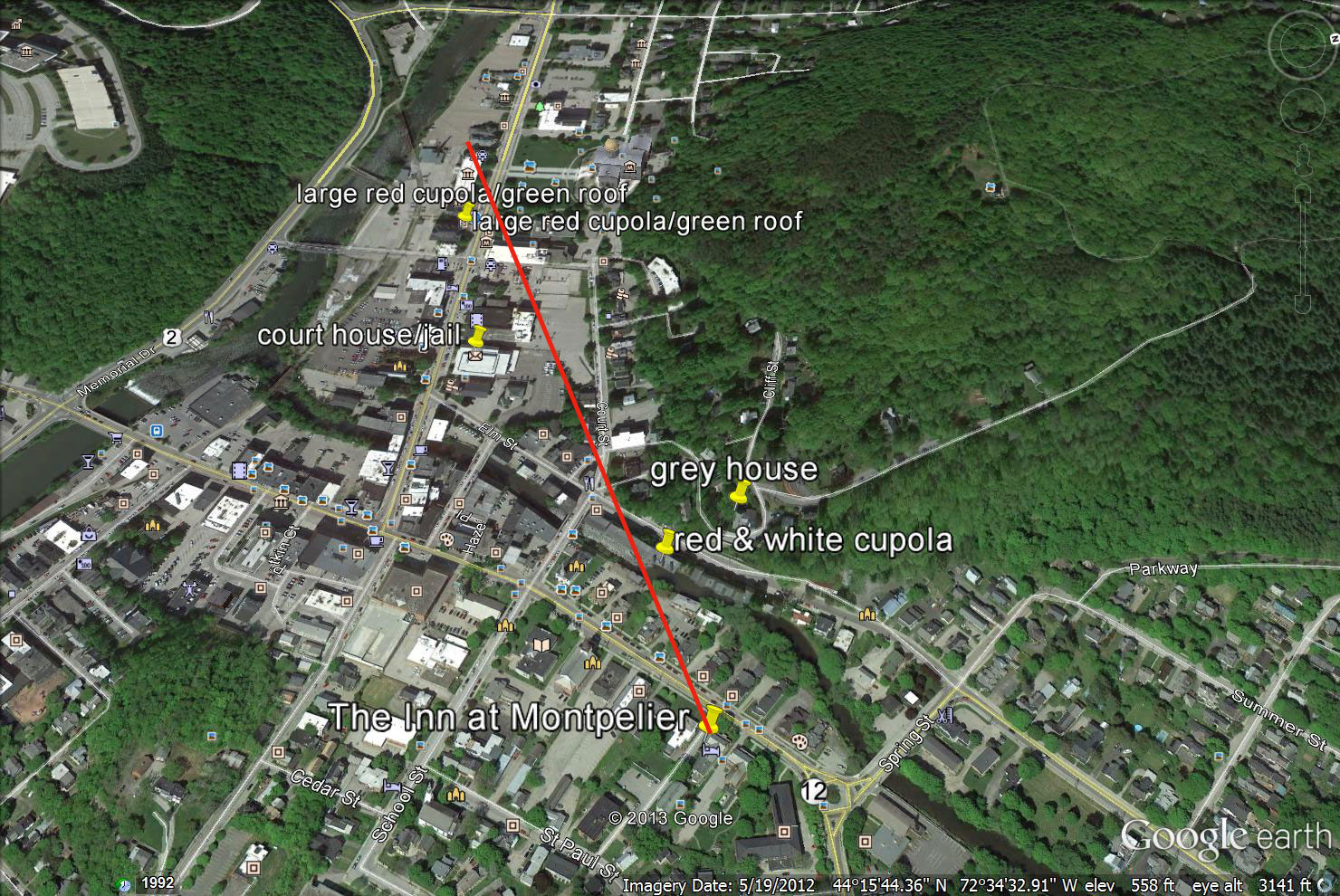
The photo was taken from somewhere on North Street or possibly near the St Augustine cemetery. The first clue is the rock-slide repair near #8 Cliff Street. The second is the, let’s say “distinctive” white federal building on the lefthand side. The clincher is the cupola on the bank building at 110 Main Street. If I had to guess, I’d say closest to 179 North Street, but can’t say 100%. You can also see the top of the recently restored Washington Country Courthouse bell tower (red and white) in the lower left quadrant.

A visual entry:

diagram_vfyw

Another:

I’m the reader who responded to your previous Vermont VFYW contest (Winooski) with comments about the power of Vermont’s sense of place.  It’s now officially been 30 years for me in California, but the power of that sense of place has not faded.  Upon looking at the photo, I immediately taken to Vermont, and after a few seconds of looking at topography and buildings, I recognized the city (I grew up about 10 miles away).

This is a photo of Montpelier, Vermont – the nation’s smallest state capital.  The gold capitol dome is hidden by the hill on the right side of the photo, and the large (by Montpelier standards – five stories!) buildings in the distance line State Street.  The real challenge here is figuring out where the photo was taken from.   I can tell the general area and narrow the options down to a few streets, but Google street-view isn’t much help.  Thus, I am left looking at a topographic map and guessing the street that this was taken from.  I’m going to guess Ewing Street.  Number 24 Ewing Street.  However, the photo could certainly have been taken from Cross, Mechanic, or North Streets (or perhaps a few others I have not named).

It’s been lots of fun spending part of my day traveling the streets of Montpelier, if only remotely.  This contest is always a great time.

Another nails the right address:

So the hard part for most people is the easy part for me.  That is obviously a picture of Montpelier, VT, taken within the last few weeks. Lots of lovely old New England architecture in that shot but, for me, it’s the post office in the center left that really gives it away:

The Federal Building - U.S. Post Office and Court House Montpelier

Of course, my wife’s from there, I was married there, and we spend half our holidays there (in Montpelier that is, not at the post office) so I have a bit of a leg up. The tricky part is determining which window that shot is taken from. You can see the buildings of State street on the right and the house on Cliff street in the center but the statehouse is obscured by the trees on Hubbard hill. So it’s looking out from somewhere in northeast Montpelier, near the St. Augustine cemetery.

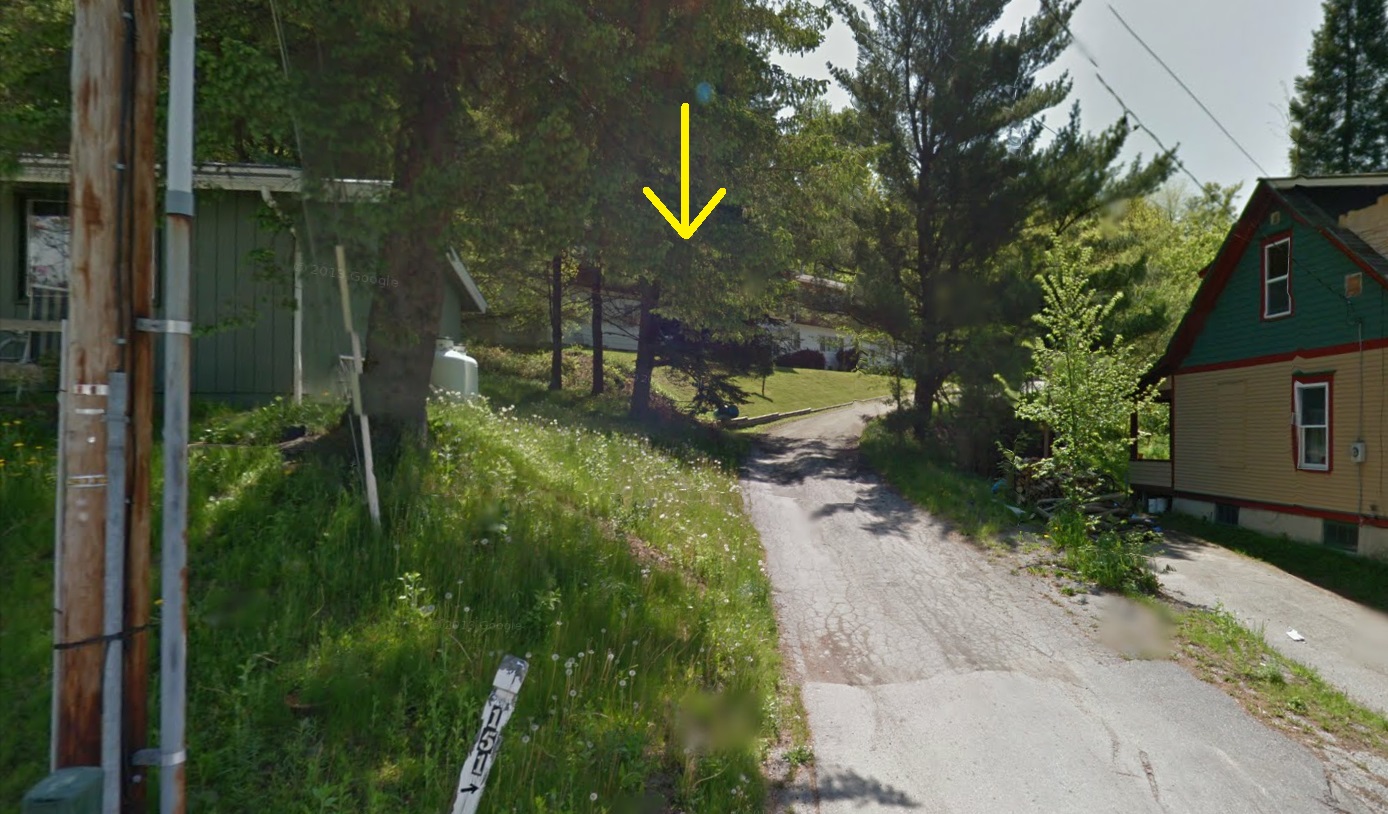
I can’t quite find the spot that would have those houses in the foreground from that elevation with that vista. Too many trees for Google to help me much here. I’m going to take a flyer and say it’s from these apartments at 151 North St:

vfyw_Montpelier

Fun facts: smallest state capitol (8,000 people, total!) and the most lawyers per capita of any city in the U.S.  Unfortunately they also currently have the misfortune of running one of the least functional state healthcare exchanges.

151 North it is.  Only one other reader got that address, and he breaks the tie by having participated in 12 total contests (compared to the previous reader’s 5):

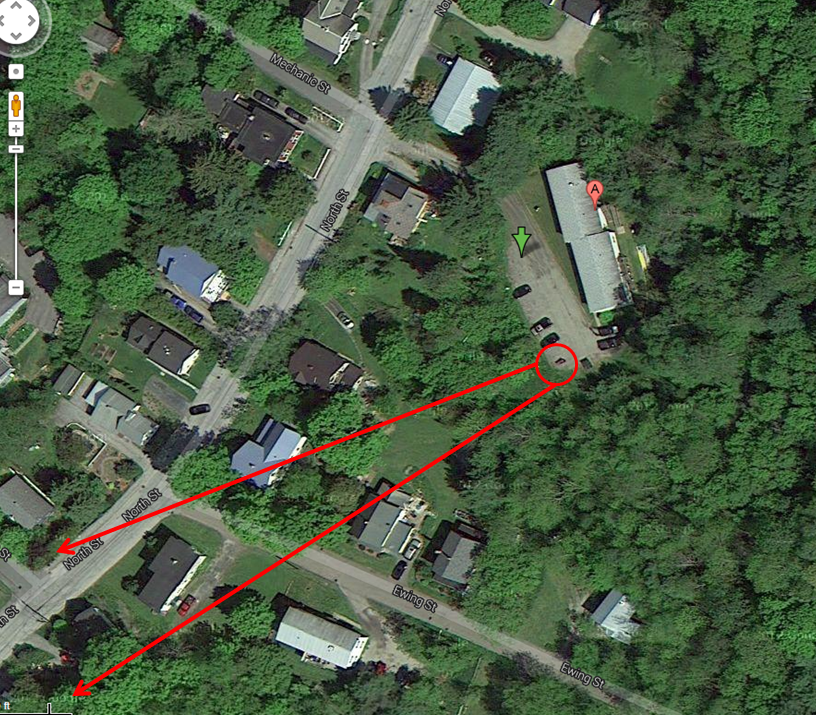
This was a tough one.  Didn’t take long to nail the town once I saw the post-peak fall foliage and the presence of a few large, office-style buildings in a downtown area meant that I didn’t spend hours searching through every sleepy mountain town on the east coast.  No, the real issue was nailing down the right “window”.  I have window in quotes because I’m pretty sure that this was taken from outside.  The picture below shows my guess at a location, the parking lot of an apartment complex at 151 North St. From that location you can clearly see the gap in the trees from which it might have been taken.

imageVT

From the submitter:

I noticed you ran my shot from the 14th for the VFYW contest today.  I realized I didn’t give the address, since I didn’t know you’d use it for the contest: 151 North Street in Montpelier, Vermont.  And I live on the second floor, which I’m sure some of your freaky-good window sleuths have figured out already.

Our VFYW grand champion is freaky-good:

You’d think that having gone to college an hour away from this week’s location it would have been a quick find for me, but it actually took a small search. That’s because I’ve only been to Montpelier once, and the only thing I remember, the capitol building’s golden dome, is hidden from view here by a hill. This week’s view looks west-south-west from the second floor of 151 North Street, a multi-unit apartment building. A best guess as to the correct apartment would be Unit #8:

VFYW Montpelier Actual Window Marked - Copy

Update from a reader:

How sad is it that I work out of Montpelier and I couldn’t get the window?  I mean, the red line on the “visual submission” diagram misses my office (not just my building) by about 20 pixels. I guess some people just aren’t cut out for VFYW.

(Archive)

Spy vs Spy

Readers know I cannot quite summon up the ability to be shocked, shocked! that governments spy on each other. That includes allies. So what are we to make of the revelations that even the phones of foreign leaders have been monitored, deeply damaging relations with our closest European allies? I think we can conclude that the apparatus set up by Bush and Cheney in 2002 has not been dismantled by the Obama administration, with the vital exception of torture, and that Obama himself has essentially allowed the NSA to do whatever it wants. Doubtless merkeljimwatsonafpgetty.jpgspooked by the politics of ending such surveillance and then being accused of allowing another terror attack, Obama has been in thrall to Clapper and to Brennan – and Dianne Feinstein has hardly been a vigilant and skeptical overseer.

There is a review going forward. We don’t know what it will actually conclude – although it does seem that the president has personally ordered an end to monitoring the calls of foreign leaders. We still need the kind of surveillance that can track potential terrorism, international crime, and legitimate threats to the country. But the kind of blanket, mass screening of foreign citizens’ phone call data that we have now discovered is far beyond that. The Leahy-Sensenbrenner proposal for legislation is a start to reining all this back in.

Here’s my take-away, for what it’s worth.

As more and more details emerge, the Snowden leaks look more and more justifiable in retrospect. The NSA has behaved like many powerful surveillance bureaucracies. Give them a hammer and they will search high and low for nails. When that tangibly harms the interests of the United States, rather than advancing them, it’s time for the Congress and the White House to reform and repeal the potential for abuse. We need to spy. We don’t need the massive, damaging Dyson-level vacuuming up of so much data from so many. Obama now has political cover to do this thoroughly. We’ll soon find out whether he has been seduced by the prerogatives of power, or whether he will respond to the legitimate, and now proven, allegations of widespread abuse.

(Photo of Merkel and Bush: Jim Watson/Getty.)