Disney Research is experimenting with “an algorithm that takes 3-D geometry–bumps, ridges, textures, protrusions and more–and figures out the voltage necessary to simulate those physical features on a flat display, using nothing more than a series of vibrations”:
As researcher Ali Israr explains, in its most basic form, the system involves an insulated electrode paired with an electronic driver to create the voltage patterns. It has to be configured differently depending on the display involved, but in their testing the team successfully adapted the system to several off-the-shelf touch-sensitive panels.
In its current form, the software’s most effective when working from predefined maps of physical features–objects that have been paired with coordinates for their topography beforehand. Even here, the possibilities for single-purpose devices are obvious: envision … museum kiosks that let kids feel creatures found only at the bottom of the sea. The project also offers some interesting applications for visually-impaired users. But Israr thinks the vibrating touchscreens could be adapted for more commonplace activities too–browsing through Amazon, say, or surfing the web.
A customer undertakes a massage using pythons at Bali Heritage Reflexology and Spa in Jakarta, Indonesia. The snake spa offers a unique massage treatment which involves having several pythons placed on the customers body. The movement of the snakes and the adrenaline triggered by fear is said to have a positive impact on the customers metabolism. By Ulet Ifansasti/Getty Images.
Yuval Levin warns that it could be extremely high for the federal government:
[I]n the Obamacare exchanges, the subsidy system is intended to prevent people from feeling the effect of annual premium increases after the first year. The subsidies are designed to make sure that each recipient pays only a certain percentage of his income in premium costs. That percentage stays essentially the same year after year, so if premiums get more expensive the government covers the difference.
In other words, if premiums for coverage purchased in the exchanges were to double or triple in 2015 because of severe adverse selection, people eligible for subsides would still pay the same amount they did in 2014 (assuming their incomes didn’t change) and the federal government would pay for the entirety of the increase. Subsidized beneficiaries would therefore not feel the effect and the healthy among them would not necessarily have much reason to flee the exchanges.
The Congressional Budget Office estimates that about 86 percent of the people who buy coverage in the exchanges in 2014 will receive subsidies. The technical problems limiting enrollment may mean that figure is even higher (since the incentive to enroll is much greater if you’re eligible for subsidies than if you’re not). Those individuals would not feel the effect of second-year premium spikes, which means the result of such spikes, if they were to happen, would likely not fall into the usual pattern of an adverse-selection spiral.
Instead, the sort of severe adverse selection the exchanges may experience would dramatically increase federal spending and would drive unsubsidized exchange participants (other than those in very poor health) and many insurers out of the exchanges.
Matthew Power profiles Brandon Bryant, who once operated drones over Iraq and Afghanistan from his work station in Nevada:
Bryant’s second shot came a few weeks after targeting the three men on that dirt road in Kunar. He was paired with a pilot he didn’t much like, instructed to monitor a compound that intel told them contained a high-value individual—maybe a Taliban commander or Al Qaeda affiliate, nobody briefed him on the specifics. It was a typical Afghan mud-brick home, goats and cows milling around a central courtyard. They watched a corner of the compound’s main building, bored senseless for hours. They assumed the target was asleep.
Then the quiet ended. “We get this word that we’re gonna fire,” he says. “We’re gonna shoot and collapse the building. They’ve gotten intel that the guy is inside.” The drone crew received no further information, no details of who the target was or why he needed a Hellfire dropped on his roof.
Bryant’s laser hovered on the corner of the building. “Missile off the rail.” Nothing moved inside the compound but the eerily glowing cows and goats. Bryant zoned out at the pixels. Then, about six seconds before impact, he saw a hurried movement in the compound. “This figure runs around the corner, the outside, toward the front of the building. And it looked like a little kid to me. Like a little human person.”
Bryant stared at the screen, frozen.
“There’s this giant flash, and all of a sudden there’s no person there.” He looked over at the pilot and asked, “Did that look like a child to you?” They typed a chat message to their screener, an intelligence observer who was watching the shot from “somewhere in the world”—maybe Bagram, maybe the Pentagon, Bryant had no idea—asking if a child had just run directly into the path of their shot.
“And he says, ‘Per the review, it’s a dog.’ ”
Bryant and the pilot replayed the shot, recorded on eight-millimeter tape. They watched it over and over, the figure darting around the corner. Bryant was certain it wasn’t a dog.
If they’d had a few more seconds’ warning, they could have aborted the shot, guided it by laser away from the compound. Bryant wouldn’t have cared about wasting a $95,000 Hellfire to avoid what he believed had happened. But as far as the official military version of events was concerned, nothing out of the ordinary had happened. The pilot “was the type of guy to not argue with command,” says Bryant. So the pilot’s after-action report stated that the building had been destroyed, the high-value target eliminated. The report made no mention of a dog or any other living thing. The child, if there had been a child, was an infrared ghost.
Previous Dish on drones here, here, and here. A thread examining the morality of drone warfare is here.
Some people might point to the respective team’s stadium capacity: Busch Stadium in St. Louis holds 46,861 while Fenway Park in Boston clocks in at 37,400. There are fewer tickets in Boston, therefore the tickets are more expensive. Supply and demand, it’s simple economics. But take a closer look at the two metro regions, and it becomes quite clear – to borrow a phrase from noted St. Louis luminary Nelly – that it must be the money.
“Personal income in Boston per person is $55,000 annually in the metro area,” Brian Goff, distinguished professor of economics at Western Kentucky University, told me. “For St. Louis, it’s $43,000.” St. Louis, Goff said, has a total personal income of $117 billion annually. Boston’s more than doubles that, with $250 billion. There’s just more money to go around in Beantown. As Tim McLaughlin wrote at Reuters earlier this week, someone earning $100,000 after taxes in Boston is equal to $65,000 in St. Louis.
The Boston metro area boasts 4.5 million people and St. Louis, 2.6 million. They are equally crazed baseball cities with rabid fan bases. That means a pool of two million more people who might want tickets to the fall classic out East. (This doesn’t even include the Red Sox fans scattered all over New England outside the Boston metro region.)
Update from a reader:
I think there’s an added wrinkle here: you’re not necessarily looking at the population as a whole, but at the upper part of the population.
Yes, there are a lot of die-hard Sox fans here (myself included). Back in 2004, a lot of us would have paid nearly anything to go to Game 6 of the Series (which the Sox swept in 4). But I think the average guy making $60K or even 100k is not going to blow 2% of his annual income on three hours at the ballpark.
For a segment of the population, however, $2000 is a margin of error. Hotshot lawyer? Tech millionaire? Loaded undergrad? These are the types who are going to throw thousands of dollars at a playoff ticket. And I’d imagine that there are a lot more of these types in Boston than Saint Louis. Plus, in Boston, season ticket holders snap up most of the playoff tickets, so there are even fewer seats to go around.
So, yes, while partly supply and demand (and who the supply and demand is). If this were a larger market, then there would be more supply and prices would be lower. If this was a commodity (like, say, a regular season ticket, which are plentiful), there would be no reason to push up the price exorbitantly. But because of the scarcity and the nature of the goods, there is only enough supply to satisfy the very top of the market. And that very top is willing to pay a lot of money.
Laurie Garrett provides a primer on the rapidly developing field of synthetic biology, or synbio:
To understand how the field of synthetic biology works now, it helps to use a practical example. Imagine a legitimate public health problem — say, how to detect arsenic in drinking water in areas where ground-water supplies have been contaminated. Now imagine that a solution might be to create harmless bacteria that could be deposited in a water sample and would start to glow brightly in the presence of arsenic. No such creature exists in nature, but there are indeed creatures that glow (fireflies and some fish). In some cases, these creatures glow only when they are mating or feel threatened, so there are biological on-off switches. There are other microorganisms that can sense the presence of arsenic. And there are countless types of bacteria that are harmless to humans and easy to work with in the lab.
To combine these elements in your lab, you need to install an appropriate software program on your laptop and search the databases of relevant companies to locate and purchase the proper DNA units that code for luminescence, on-off switches, and arsenic sensing. Then, you need to purchase a supply of some sort of harmless bacteria. At that point, you just have to put the DNA components in a sensible sequence, insert the resulting DNA code into the bacterial DNA, and test to see if the bacteria are healthy and capable of replicating themselves. To test the results, all you have to do is drop some arsenic in a bottle of water, add some of your man-made bacteria, and shake: if the water starts to glow, bingo.
John List and Uri Gneezy conducted a series of experiments to evaluate discrimination against disabled people seeking car repairs:
[W]e recruited several men between the ages of twenty-nine and forty-five to act as our secret agents. Half these men used wheelchairs and drove specially equipped vehicles. The other half were non-disabled, but in all cases the individuals hopped into a specially equipped vehicle for the disabled with a fresh ding on the side and headed to Chicago-area repair shops.
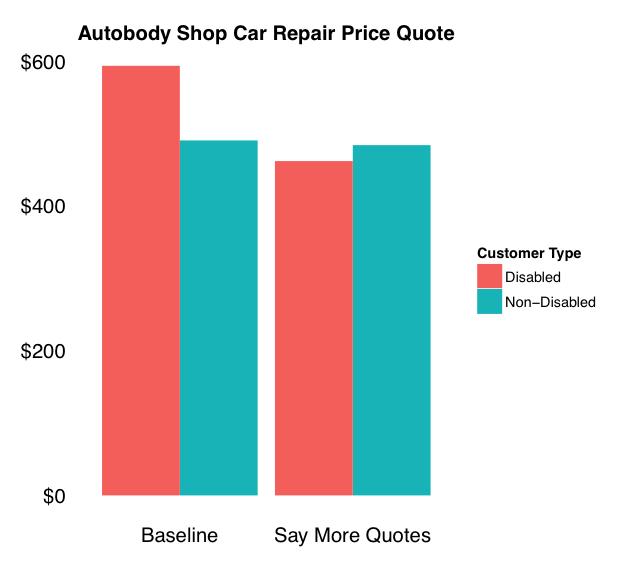
When our secret agents got to an auto repair shop they simply asked for a price quote to fix their car. What we found initially was shocking. The disabled were given quotes 30 percent higher than the quotes given to non-disabled for the exact same repair!
Curious about the extent to which car repairman were motivated by hatred or just profit motive, though, we did one run of the experiment where both types of our secret agents got a quote and told the repairman that they were, “getting three price quotes today.” What did this extra sentence do? Well the figure shows that for the able-bodied subjects, their price quotes didn’t change at all, but for the disabled they plummeted. Furthermore, the difference in prices for the disabled and abled disappeared.
On the facial hair front, a few news items: some slow, sensuous, mutual beard caressing from the Red Sox last night; and a new exhibit at the Morgan Library in New York of Leonardo’s drawings, many of which are from the Biblioteca Reale in Turin. A reader also sent me a video of bears in the wild that, for some unaccountable reason, I hadn’t yet seen.