Hot Houses

In the wake of Mt. Etna’s most recent eruption over the weekend, designer Kieren Jones suggests channelling lava flows into architectural molds:

At present, the method for mitigating the destruction of lava flows is to place large concrete blocks in the predicted path of the flowing lava and spraying it with sea water in order to try and cool this molten material. … Instead of placing large concrete blocks in its path, I propose to create large casting beds into which the lava can flow, creating building blocks for future shelters. Not only would these casting beds protect the population at the base of the volcanoes but they will also provide them with a constructive material in which to aid the recovery of a community post-eruption.

Ian Steadman appreciates the idea but doubts its feasibility:

Using volcanic rock as construction materials isn’t new, of course. The communities that live beneath volcanoes take full advantage of all that hard, pretty granite and basalt lying around everywhere in large brick-sized chunks, using it to build their homes. What’s different here is reversing the process – instead of carving out the shape you want from the rock after it cools, you make the shape first and then dig it out of the ground. … There’s beauty in the thought of turning this destructive force into something creative. However, as the Etna example shows, volcanoes are dangerous, difficult things to try and control.

Invading Our Space

As of October 28, the newly discovered asteroid 2013 TV135 – which now occupies the top slot on NASA’s near-earth object watch list – has a 1-in-28,000 chance of striking Earth. While Eric Holthaus assures us that “we are almost assuredly safe from this errant geological space wanderer,” he nevertheless wonders what a direct hit would look like:

According to the Earth Impacts Effects Program, a joint project of Imperial College London and Purdue University, 2013 TV135 would carry the energy of about 3,300 megatons of TNT if it were to strike. That’s roughly equivalent to 60 percent of the world’s remaining nuclear weapons detonated at the same time, in the same place. The result would surely be impressive:

The crater would be about twice the width of Manhattan, and about as deep as the newly constructed Freedom Tower in New York is tall. More than one hundred million cubic meters of rock would be instantly vaporized on impact. The shaking produced would be equivalent of a 7.0 earthquake. If you were standing about 60 miles (100 km) from the impact site, within two minutes you’d be pelted with debris up to about two inches in size. Within five minutes, the air blast generated by the heat of the impact would create hurricane force winds, shattering your windows. If you were standing within about 20 miles away (30 km) – for reference, New York City is roughly 20 miles wide – the effects would be much more serious. The average fragment size headed your way would be about the size of a dishwasher, and within 90 seconds wind speeds would top 500 miles per hour.

The good news:

Thankfully, in the very unlikely case that NASA can’t rule out this kind of a strike in 2032, we’ll have nearly two decades to deflect 2013 TV135 onto a safer course. Scientists have been investigating ramming dangerous objects with spacecraft, among other tactics. If it comes to that, let’s just hope world governments can agree more quickly about exactly what to do than they have on the much more real threat of climate change.

Fukushima Isn’t Over

William Pesek reports on this weekend’s 7.3-magnitude earthquake:

As Tokyo shook early Saturday morning and loud shrieks from mobile-phone earthquake-warning alarms filled bedrooms around the city, one word immediately sprung to mind: Fukushima. Those who don’t reside 135 miles away from the worst nuclear crisis since Chernobyl won’t understand this reaction. But the first thing most of Tokyo’s 13 million residents do once things stop wobbling is check if all’s well at the Fukushima Daiichi plant still leaking radiation into the atmosphere and the Pacific Ocean. Worse, a fresh spate of accidents there make some wonder if the Marx Brothers are in charge. …

It’s been almost three months since Prime Minister Shinzo Abe pledged to step in to help the hapless Tokyo Electric Power Co. end the crisis. It’s been two months since his office went even further, saying it was laying out “emergency measures” to take control of the disaster recovery. It’s been seven weeks since Abe told the International Olympic Committee not to worry about that little nuclear situation up north to secure the 2020 Games. And, well, we’re still waiting for and worrying that the next quake will cause a fresh meltdown.

Update from a reader:

I just wanted to point you to this counterpoint to all the media frenzy over Fukushima.

It is worth repeating the author: while 18,500 people died from the earthquake and tsunami, not a single person has died from radiation poisoning. Of the 110,000 cleanup workers, less than 0.1% have developed cancer. Especially interesting to me (as an engineer) is the NYT use of “quadrillions of becquerels” because it sounds like an enormous quantity of radiation. If you do the conversion (I’ll spare you) this converts to a brick of radioactive material that would fit inside a 1 gallon paint can.

The most dangerous radioactive substance released from Fukushima was Iodine-115, which had a half-life of 8 days … which means it has long since become a non-issue. Nuclear reactors continue to be incredibly safe, and the media does us a disservice by over-stating the dangers; nuclear power plants should be part of a clean energy portfolio.

Another reader:

As your reader who wrote in, I’m also an engineer. I also have a friend who is getting his PhD in nuclear engineering at Purdue and have regularly picked his brain on this topic. I’ve also worked with radioactive materials in labs during the course of my undergraduate work and professional life.

All this adds up to me being continually irritated with the media when they talk about radiation. My biggest contention is that it’s phrased as general radiation and the type is not included. The type of radiation is quite important. From Health Canada: “The becquerel (Bq) is named after the French physicist A.H. Becquerel. This unit measures radioactivity in a substance. It doesn’t consider the type of radiation emitted or what its effects may be. One becquerel equals one nuclear disintegration per second. This is a very small unit, so multiples are often used.”

Telling me something has x number of becquerels is meaningless unless I know what type of radiation it is. A more useful unit is a sievert (Sv), which incorporates the effect of ionizing radiation. Further, within ionizing radiation, there are three main types of emitters: alpha, beta, and gamma.

Alpha particles cannot penetrate dead skin or clothes, so they’re most dangerous to the eyes and ingestion/inhalation. Plutonium-235 and Uranium-238 are alpha emitters. Beta particles are more dangerous and are more of a chronic problem than acute and are worst when ingested/inhaled. Carbon-14 and Iodine-131 are beta emitters. Gamma rays are generally the worst of the bunch as they can travel much further than alphas or betas. Cobalt-60 and Cesium-137 are gamma emitters.

Then we also must consider the half-life of the particle, as noted by your previous reader. A compound that has high potency but breaks down quickly is not as dangerous as a compound with half the strength but lingers for years to centuries.

So, you have to put it all together to know whether it’s bad for you. I guess that’s too difficult for the media to understand and it’s much simpler to quote a huge number that seems made up. As your previous reader said, nuclear energy is extremely safe and should be part of the green movement to cleaner energy. Also, coal plants can emit more C-14 than nuclear plants, so if you’re near a coal plant you’re getting hit with more beta particles more than someone who works in a nuclear plant.
The Best Of The Dish Today

photo(2)

Poor Kathleen Sebelius. We took another whack today at her lack of accountability … and then a reader who actually knows something about website development let her off the hook.

Ducks have feelings too. Which is more than you can for these asshole husbands from the not-so-distant past. Or Ted Cruz’s sucking on the teat of the federal government for a large chunk of his his healthcare, while opposing Medicaid expansion.

I weighed the debate between Bill Keller and Glenn Greenwald … and came out on Glenn’s side, just.

What if Buzzfeed had chronicled the Twentieth Century? What if you could really feel with your fingers what is on a flat-screen? Yes, online sex is gonna get even better.

The most popular post of the day was Keller vs Greenwald? Why Not Both? Second: My round up of the weekend’s Dish (and a memorial service in Provincetown).

See you in the morning.

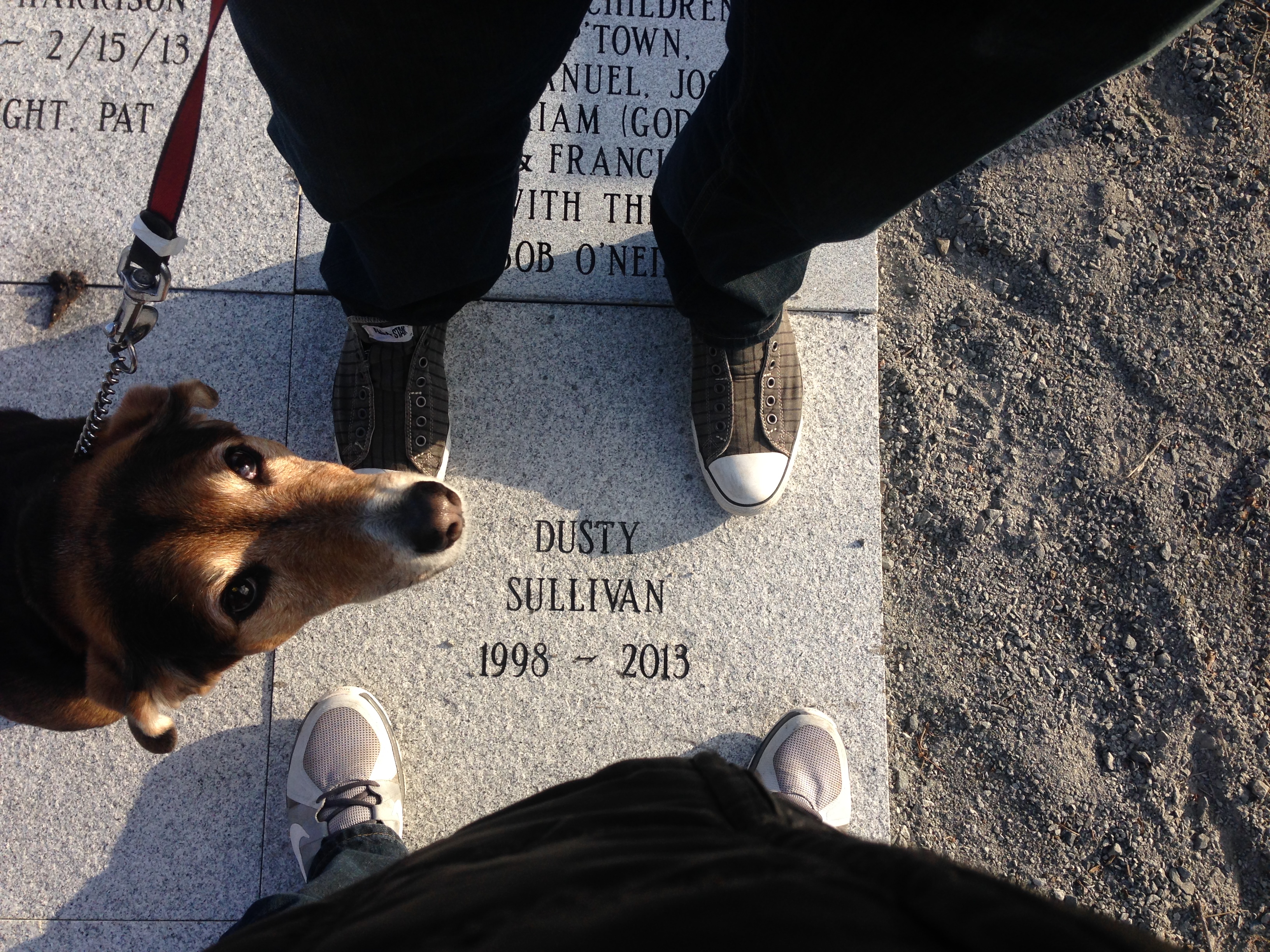
(Photo: me, Aaron and Eddy today, at Dusty’s memorial stone at the Pilgrims’ First Landing Park in Provincetown, Massachusetts.)

Mourning Your Own Death

Writer and director J.C. Chandor describes the real-life trauma that informs his latest film, All is Lost, about a man stranded on the open seas:

I had a very intense near-death experience when I was quite young. I was in a horrible, horrible car crash. I had gone from no one in my family ever dying when I was around or aware of it, when I was 19, to experiencing that. One of my best friends, who was driving me in a car with my three other friends, he fell asleep on a highway. We were on a trip, and it rolled the car seven or eight times. Unfortunately, the driver passed away. I was like—slam!—confronted with believing that I was dead. It was very intense. You know, pulling myself out of the wreckage of a car, pulling myself onto the grass on the median of a highway. It was very, very intense. I had been shielded from deep, emotional thinking almost throughout my whole life up to that point.

But then over the next 20 years of my life, I started to drift away. Almost like the reverse of what normally happens. The longer I got away from that event, I started to fall back into certain traps. Both of my grandmothers died in the years prior to me writing this, and I did have a very different view and experience with that. I ended up reexamining what, at one point in my life, I was very in touch with. I had lost that. By losing touch with that, I had started to take certain parts of my own life for granted.

My feeling was that there’s something fascinating about a guy toward the end of his life, who has presumably lived a pretty good life up until that point, just—what will you do to continue to fight for those days? What is it really like when you mourn your own death?

In an earlier interview, he made the connection explicit:

“This guy is essentially me in a weird way,” he said of the film’s central – and sole – character. “Someone asked me if it’s about my dad dying – my dad’s still alive. It’s about me dying. These are my feelings about this.”

Cracking The Brain’s Code

Scientists are inching closer to the ability to scan brains for thoughts, dreams and memories through a series of processes known as “brain decoding.” Much of the research came out of advances from simpler work with MRI scans:

Decoding techniques interrogate more of the information [than MRIs] in the brain scan. Rather than asking which brain regions respond most strongly to faces, they use both strong and weak responses to identify more subtle patterns of activity. Early studies of this sort proved, for example, that objects are encoded not just by one small very active area, but by a much more distributed array.

These recordings are fed into a ‘pattern classifier’, a computer algorithm that learns the patterns associated with each picture or concept. Once the program has seen enough samples, it can start to deduce what the person is looking at or thinking about. This goes beyond mapping blobs in the brain. Further attention to these patterns can take researchers from asking simple ‘where in the brain’ questions to testing hypotheses about the nature of psychological processes — asking questions about the strength and distribution of memories, for example, that have been wrangled over for years.

Debate is already underway over how we might harness these techniques for market research – or the legal system, as demonstrated by the crime scene test in the above video:

No Lie MRI in San Diego, California … is using techniques related to decoding to claim that it can use a brain scan to distinguish a lie from a truth. Law scholar Hank Greely at Stanford University in California, has written in the Oxford Handbook of Neuroethics (Oxford University Press, 2011) that the legal system could benefit from better ways of detecting lies, checking the reliability of memories, or even revealing the biases of jurors and judges. Some ethicists have argued that privacy laws should protect a person’s inner thoughts and desires as private, but Julian Savulescu, a neuroethicist at the University of Oxford, UK, sees no problem in principle with deploying decoding technologies. “People have a fear of it, but if it’s used in the right way it’s enormously liberating.” Brain data, he says, are no different from other types of evidence. “I don’t see why we should privilege people’s thoughts over their words,” he says.

Email Of The Day

Dusty in ivy

A reader writes:

In all sincerity, Andrew, “Tomorrow” is the saddest thing I’ve ever seen you write.

I had a roommate for ten years who died just this past May. His ashes are setting on a shelf in my library just a few feet from me and I know he wanted me to plant them under a rose bush. It’s like I can’t decide which rose to choose. None are beautiful enough. I don’t want to let go.

I still haven’t been able to do it today. Next time I get to Ptown. I leave tomorrow.

The Marriage Equality Oasis In Oklahoma

It’s on tribal land. Mark Joseph Stern has the story:

Thanks to the death of DOMA, the federal government will also recognize [Darren Black Bear and Jason Pickel’s] marriage and provide them with a bounty of benefits. When DOMA was in force, it also applied to tribes; despite their general sovereignty, tribes could not compel the federal government to recognize gay marriages among Native Americans. With that roadblock abolished, Black Bear and Pickel should begin receiving federal marriage benefits immediately. …

Although this aspect of American marriage law remains vague for now, it may well be settled in the near future, as more and more tribes accept and even embrace same-sex marriage. Ron Whitener, executive director of the Native American Law Center at the University of Washington Law School, notes that many tribes have been quick to embrace gay rights, especially gay marriage. Homosexuality, Whitener says, has “a cultural presence among traditions of tribes,” and gay people are oftentimes considered “more spiritual” than heterosexuals. There’s also “a certain amount of ceremonial and sacredness about homosexuality among some tribes,” says Whitener,” leading to greater acceptance of gay tribal members.

Not all tribes, of course, are so progressive. Whitener believes that tribes in which Christianity plays a bigger role are more homophobic, while those with less exposure to the Bible are more tolerant of gays.

What Does It Mean To “Own” Digital Art?

This embed is invalid


That question was on people’s minds a few weeks ago at the  first-ever digital art auction, at Phillips in New York City. Katheryn Thayer has more:

Though digital art is shared, liked, retweeted and embedded free-of-charge all over the web, the 20 pieces Lindsay Howard selected for this exhibition demonstrate a new level of comfort with bringing digital art offline and traditional media online. And, unlike the digital art shared and spread online, these pieces pulled in prices of $800 to $16,000 each.

The pieces [ranged] from Rafael Rozendaal’s interactive HTML and Javascript website ifnoyes.com to Molly Soda reading emails into a webcam for eight hours straight, “performing her online celebrity as a mirror that reflects Internet culture.” Rozendaal’s site sold for a final price of $3,500 and bidding on Soda’s video closed at $1,500. … The final sale of 16 of the 20 pieces totaled $90,600, a modest sum for fine art auctions. Regardless, the inclusion of digital art in a fine art auction shows changing attitudes towards new media that are so often found for free online.

In an interview, the curator explained what bidders got for their cash:

[Rafael Rozendaal] has this contract, it’s called the “Art Website Sales Contract,” which stipulates that the collector who purchases this piece must renew the domain annually, maintain the work, and keep it online, which is of primary importance. In exchange, the collector’s name goes in the title bar just above the URL, so it says ifnoyes.com in the collection of whatever the name is of the collector. … For the animated GIFs and videos, the collector will receive a USB drive with those files on them or a Mac Mini with the files on them. We wanted to keep the costs down for the auction and keep everything below $20,000, so we’re not including any of the hardware. But some galleries will sell you the whole monitor, which is really great and convenient.

But Molly Osberg contends that digital art is “impossible to really own, in the ‘hanging an original Picasso in your antechamber’ sense”:

This isn’t to say that digital work can’t move into the highbrow arts market. Artists like Cory Archangel, with his video game modifications and computer-generated works, have been catapulted to fame for their screen-based projects. The Cooper Hewitt museum recently acquired a piece of code as part of its permanent collection, MOMA now houses 14 video games, and members of Rhizome, which received 20 percent of the proceeds from Paddles ON [the auction], have sold GIF files at the world-famous Armory show in New York. … But the question of ownership — and how you get someone to pay notoriously high art-market prices for something as relatively immaterial as Molly’s webcam video or a 24-second YouTube clip – is still unsolved, and what the organizers of Paddles ON repeatedly called “the elephant in the room.”

(Video: Ilja Karilampi’s New York Minute)