Experimental musician Tim Hecker collaborated with Sabrina Ratté on the above music video, which draws on found footage documenting the “Botafumeiro” in the Cathedral of Santiago de Compostela. From an interview with Ratté:
Did your choice of the Botafumeiro footage depend mostly on the aesthetics of the footage, or does it also signify something religious, spiritual, mystical, or otherwise?
I personally appreciated the formal aspect of the original video. As I was working with the footage, I enjoyed the organic and hypnotic rhythm of it, the soft light coming from the windows and the architectural glimpses we get of the cathedral. The smoke of the burned incense was the inspiration to use the video feedback technique. It has the same kind of fluid movements, and both seem to dematerialize matter and transform it into some kind of entity free from the constraints of gravity… I was also interested by the rawness of the footage, the unstable camera movements creating interesting accidents. There is absolutely no message behind this video.
Ann Friedman believes in not just choosing your friends, but actively courting them:
[M]ost of our courtship narratives are still romantic, which really tends to obscure the importance of friendship’s early stages, and downplay the thought and skill that goes into cultivating meaningful platonic relationships. We tend to second-guess ourselves when we feel that jolt of friend attraction.
A woman I know who recently moved from Houston to Los Angeles was telling me about a woman she met and really wanted to befriend.
“It seems like she has so many friends already though,” said the new girl in town. “Do you think she’d mind if I asked her to hang out?” “You have to ask her!” I said. I have heard many women describe the first time they met a friend and just knew they were destined for years of inside jokes and hang times on the couch and late-night party antics.
“Nearly all friendships are based on a spark of mutual attraction. Some people describe platonic love-at-first-sight stories, wherein they were instantly drawn to a new acquaintance and just knew they would befriend her,” says Carlin Flora, author of Friendfluence: The Surprising Ways Friends Make Us Who We Are. Still, she says, “We often drift into friendships, especially when we’re young and in a work or school setting that makes it easy to automatically ramp things up without having to make a concerted effort to develop the friendship. The main point of my book is that we should be more conscious of how and whom we befriend, since these people have a huge impact on our life trajectories.”
Sonia Tsuruoka analyzes William Ernest Henley’s famous poem “Invictus.” Originally written about Henley’s battle with tuberculosis, the poem now serves as “something of an intellectual heirloom for activists beating back the tides of institutionalized oppression”:
“Invictus” isn’t a political poem in the usual sense: it’s meditative rather than militant, assuming the quietness of a prayer rather than the pomp and circumstance of a battle cry. Even more remarkable is the sense that its rhymed quatrains comprise much more than an effortless execution of form, conveying a host of revolutionary philosophical implications. In particular, the lines “I am the master of my fate / I am the captain of my soul,” remind us of Henley’s outspoken — and highly controversial — atheism, which remain a source of individual empowerment in a “place of wrath and tears.” Likewise, “whatever gods may be” are rendered obsolete by the poem’s progressive notions of self-determinism, in what should be interpreted as the triumph of human resilience unaided by divine benevolence.
Henley avoids the usual discourse on order and disorder, instead finding an exhilarating freedom in the absence of divine control, not to mention the kind of empowerment one might expect to derive from godlessness. Fate, in this case remains undecided rather than assigned, a series of events governed by free will and its lifelong struggle against the “fell clutch of circumstance.” Henley’s frightening, if awe-inspiring, revelation that no one can or will write our destiny for us explains “Invictus’” unrivaled popularity in political circles — for how else should political activists understand themselves if not as writers of their own history? No wonder innumerable modern revolutionaries, including Burmese opposition leader and Nobel Peace laureate Aung San Suu Kyi, have cited Henley’s 19th century poem as a “great unifier that knows no frontiers of space or time,” a heartfelt iteration of “struggle and suffering, the bloody unbowed head, and even death, all for the sake of freedom.”
James Poniewozik was blown away (paywalled) by Time Of Death, a new documentary series from Showtime:
Death on TV is not exactly rare. AMC’s guts-spattered zombie series The Walking Dead drew over 20 million viewers for its Season 4 premiere. Shootings and serial killers abound. Life is cheap on TV, or rather death is–it’s plentiful, showy, devoid of realism or consequence. But ordinary death is a blank spot in our pop memory, one we’ve filled with monsters and explosions. After a steady diet of Hollywood deaths, real ones–the labored breathing, the body becoming a slack husk–seem uncanny, alien.
In a later post, he focuses on an individual’s story:
One of the subjects who volunteered for Time of Death was Lenore Lefer, a 75-year-old therapist with pancreatic cancer, who in her professional life specialized in grief counseling for survivors. She wanted to do the series, she said, because we live in a culture that denies and avoids death. (The producers—the Magical Elves group, better known for reality shows like Top Chef—give participants a lot of space to talk about the filming itself, and stop the cameras when they request it. Lenore herself asked that cameras not be present at the moment of her death, to give space to her family.)
I think she’s right, and I suspect we’d plan for and deal with death better if we weren’t so good at avoiding it. But watching Time of Death also gave me a greater appreciation for all the entertainments we’ve developed to displace our fear of death. At one point during my binge-watch of the six episodes, I took a break to watch a screener of The Walking Dead, and its over-the-top gory re-killings were a strange kind of relief; never had I appreciated phony Hollywood death so much. (I wonder, in fact, if people who work around death for a living—nurses or hospice-care workers, say—need a similar kind of escape.)
Kate Bernheimer, editor of the new anthology xo Orpheus: Fifty New Myths,assembles a collection of her favorite retellings of the story of Orpheus. Among them is “The Lyre of Orpheus,” the 2004 song by Nick Cave and the Bad Seeds, featured above:
The title song of Nick Cave and the Bad Seeds’ 2004 double album, “Abattoir Blues/The Lyre of Orpheus,” presents the myth as a twisted fairy tale, set to a languorous blues-rock tune: Orpheus builds a lyre from a block of wood and a wire, accidentally kills Eurydice when he plays it for her, and eventually falls down a well, into Hell, where he’s reunited with her. “Orpheus went leaping through the fields,” Cave sings in his baritone twang. “Strumming as hard as he did please/Birdies detonated in the sky/Bunnies dashed their brains out on the trees…” It’s the plaintive chorus—“Oh, momma! Oh, momma!”—that clinches this version for me. Cave’s music always has a particularly primal, post-human tone; its grungy, sadistic lift suits Orpheus’s predicament better than any more conventionally beautiful song could.
The evil ones, according to C.S. Lewis. Micah Mattix finds this passage from his A Preface to Paradise Lost that explains why:
Satan is the best drawn of Milton’s characters. The reason is not hard to find. Of the major characters whom Milton attempted he is incomparably the easiest to draw. Set a hundred poets to tell the same story and in ninety of the resulting poems Satan will be the best character. In all but a few writers the “good” characters are the least successful, and every one who has ever tried to make even the humblest story ought to know why. To make a character worse than oneself it is only necessary to release imaginatively from control some of the bad passions which, in real life, are always straining at the leash; the Satan, the Iago, the Becky Sharp, within each of us, is always there and only too ready, the moment the leash is slipped, to come out and have in our books that holiday we try to deny them in our lives. But if you try to draw a character better than yourself, all you can do is to take the best moments you have had and to imagine them prolonged and more consistently embodied in action. But the real high virtues which we do not possess at all, we cannot depict except in a purely external fashion. We do not really know what it feels like to be a man much better than ourselves. His whole inner landscape is one we have never seen, and when we guess it we blunder.
I’m genuinely perplexed what Lewis is talking about. Is he under the impression that the history of literature is bereft of heroes? Presumably, those would be people possessed of “high virtues” if the phrase has any meaning at all. I suspect Achilles wouldn’t pass muster for him as “good” – but if he’s not possessed of “high virtues” then I don’t know what the word means. Or does he think that bourgeois virtue is pale and boring? Is he under the impression that Dorothea Brooke is an uninteresting character? Or Leopold Bloom? Or John Ames?
And what about those evil characters? Iago, yeah, he’s a pretty rotten piece of fruit. But is Othello evil? What about Anna Karenina? Or Captain Ahab? For that matter, is Edgar really less-interesting than Edmund? Really? Are you sure?
And dare I mention in this regard Huck Finn’s own estimation of his damnedness, versus our own estimation of his heroism?
Saying “all it takes” to write a successful character is to release one’s own pent-up desire to do evil is akin to saying that “all it takes” to make a hit movie or television show is to show a little skin. Which is to say: it isn’t correct at all. Writing a successful villain is extremely difficult – because writing any kind of successful character is extremely difficult.
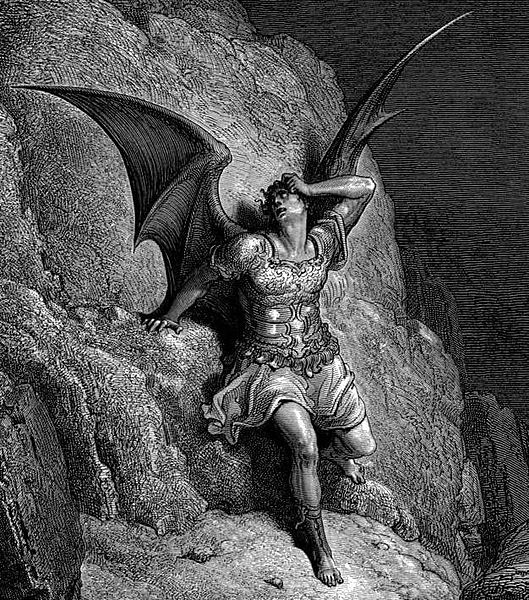
(Depiction of Satan, the antagonist of Milton’s epic poem, by Gustave Doré circa 1866)
Eric W. Dolan spots a remarkable recent homily from Pope Francis, a riff on these lines from the Gospel of Luke: “Woe to you, scholars of the law! You have taken away the key of knowledge!” He interprets the phrase as a critique of Christians who turn belief in God into an ideology. From the Vatican Radio transcript:
“The faith passes, so to speak, through a distiller and becomes ideology. And ideology does not beckon [people]. In ideologies there is not Jesus: in his tenderness, his love, his meekness. And ideologies are rigid, always. Of every sign: rigid. And when a Christian becomes a disciple of the ideology, he has lost the faith: he is no longer a disciple of Jesus, he is a disciple of this attitude of thought… For this reason Jesus said to them: ‘You have taken away the key of knowledge.’ The knowledge of Jesus is transformed into an ideological and also moralistic knowledge, because these close the door with many requirements.”
… “The faith becomes ideology and ideology frightens, ideology chases away the people, distances, distances the people and distances the Church from the people. But it is a serious illness, this of ideological Christians. It is an illness, but it is not new, eh? Already the Apostle John, in his first Letter, spoke of this. Christians who lose the faith and prefer the ideologies. His attitude is: be rigid, moralistic, ethical, but without kindness. This can be the question, no? But why is it that a Christian can become like this? Just one thing: this Christian does not pray. And if there is no prayer, you always close the door.”
“The key that opens the door to the faith,” the Pope added, “is prayer.” The Holy Father warned: “When a Christian does not pray, this happens. And his witness is an arrogant witness.” He who does not pray is “arrogant, is proud, is sure of himself. He is not humble. He seeks his own advancement.” Instead, he said, “when a Christian prays, he is not far from the faith; he speaks with Jesus.”
As you know, I have been skeptical of Pope Francis, but this sermon of his really spoke to me. I had made an ideology of my Catholicism. I hadn’t meant for it to be that way, but that’s what happened. It came about mostly because I was rightly (I still believe) concerned with the loss of the sense of the holy, and of morals and doctrines, in contemporary Catholicism. But I made the cardinal error of ceasing to pray, or to pray as often or as well as I should have. I mistook talking and thinking about the faith for being serious about the faith. Ideologization helped make my faith brittle. I’ve found that the Orthodox approach to faith makes it much harder for people like me to make the ideologue’s error, though the temptation is always there.
It is hard to be mindful of right doctrine, and right morals, while at the same time remembering that the purpose of the Christian faith is not to learn how to behave morally. But it’s necessary. I am certain that Francis is onto something when he talks about how serious prayer — by which he means an encounter of the soul with the living God — is the antidote to ideological religion.
Read the extensive Dish coverage of Pope Francis here and here.
“In a circle of true Friends each man is simply what he is: stands for nothing but himself. No one cares two-pence about anyone else’s family, profession, class, income, race, or previous history…That is the kingliness of Friendship. We meet like sovereign princes of independent states, abroad, on neutral ground, freed from our contexts. This love (essentially) ignores not only our physical bodies but that whole embodiment which consists of our family, job, past and connections. At home, besides being Peter or Jane, we also bear a general character; husband or wife, brother or sister, chief, colleague, or subordinate. Not among our Friends. It is an affair of disentangled, or stripped, minds. Eros will have naked bodies; Friendship naked personalities.
Hence (if you will not misunderstand me) the exquisite arbitrariness and irresponsibility of this love. I have no duty to be anyone’s Friend and no man in the world has a duty to be mine. No claims, no shadow of necessity. Friendship is unnecessary, like philosophy, like art, like the universe itself (for God did not need to create). It has no survival value; rather it is one of those things which gave value to survival,” – C.S. Lewis, The Four Loves.
Before the Iron Curtain, before the sadder
Century, the one I was born into as
A little Cosmonaut, creeping in bomb shelters
With Mr. White, the school custodian
Who shoveled the coal while I occupied the alcove
Of my ways, it was so warm inside.
That ice age was a little one, a few hundred years about
One thousand years ago. That was all before buttons
And their holes had been considered closure,
Before there was a left shoe from the right.
My mother’s hair was ginger-colored, somewhere where
It’s even colder than it will ever be again.
Everything I ever wished for—
A Dalmatian bounding spotted through the snow.
Reviewing the philosopher A.C. Grayling’s Friendship, Stuart Kelly questions his brushing aside of Christianity’s contributions to the theory and practice of philia:
Grayling being a notable anti-theist, it is no surprise that he treats Christian views of friendship as an opportunity to take a few pot-shots at some large fish in a particularly small barrel. By doing so, he misses the chance to comment on a radical difference. In Cicero, for example, there is a vexed discussion of whether or not it is possible to be a true friend to someone who holds different political or ethical beliefs. The idea of treating people as if they were friends already seems to me to be a more profound shift in the concept than Grayling admits. He may have some fun with the idea that the infinite, self-sufficient deity should require being chums with sinners, but it is at the expense of realising that in religious ethics there is the very openness that he wishes for in terms of contemporary secular friendship. He praises the notion that “children in kindergarten will be unconsciously friends with anyone at all, of any persuasion, background, colour, faith or political family”. That one might consciously choose to befriend despite difference seems to me to be a religious rather than a philosophical proposition. The “as if” (treating people as if they were friends) is a leap of faith, not a cold piece of ratiocination.
Read my own thoughts on Christianity and friendship here.

 The Dish

