Ben Myers describes worshiping God “as a way of sharing the common lot with everybody else”:
I go to church sometimes not needing comfort for my own private griefs but seeking consolation for the slow unfolding trainwreck that is called human history. I go to church sometimes hoping to find forgiveness not for myself but for my ancestors, my parents, my children and their children who will one day be born and will have to live (who knows how?) in whatever diminished world that I bequeath to them. I go to church sometimes not to be reconciled to anybody in particular, but because for fifty thousand years the land beneath my feet was home to other peoples, and I am hoping by some miracle to be reconciled to them. I go to church sometimes not seeking peace within my own soul but hoping to find relief from the raging violence that has boiled in the blood of all my brothers since the time of Cain.
I go to church and take bread and wine not necessarily because I feel hungry but because the common human condition is, at bottom, hunger and thirst and nothing more. It is the hunger of my mothers and fathers that I am feeding when I take the consecrated bread. When I take the cup it is the burning thirst of Adam that I slake. It is for the whole huge accumulated mass of human arrogance and stupidity and meanness that I hang my head in shame and say, Lord have mercy.
Recently the Dish noted the forthcoming publication of the prayer journals Flannery O’Connor kept as a graduate student and fledgling writer. In a two-part essay, A.G. Harmon unpacks a number of Connor’s entries, including this one about her literary ambitions:
I want very much to succeed in the world with what I want to do. I have prayed to You about this with my mind and my nerves on it and strung my nerves into a tension over it and said, “oh God, please,” and “I must,” and “please, please.” I have not asked You, I feel, in the right way. Let me henceforth ask You with resignation—that not being or meant to be a slacking up in prayer but a less frenzied kind, realizing that the frenzy is caused by an eagerness for what I want and not a spiritual trust. I do not wish to presume. I want to love.
Harmon’s commentary:
O’Connor’s desperate calls for heavenly intervention are deeply resonant. Our pleas of please are all but screamed, as though God’s attention must be captured; as though he must be distracted somehow, since there’s no other explanation for the breathtaking speed with which the ever-towering failures come.
But what the writer speaks of here is that such tumult is not the right way to approach God on these matters. It smacks of a demand upon God, suggesting that his concession must be granted, given how deeply earnest the prayers are and how terribly hard the supplicant has worked.
Whether O’Connor was ever able to achieve the state she sought is unknowable, and moot, since her prayers were answered anyway. But it is the coupling of love with resignation that takes lesser souls like mine aback. That correlation—that if one loved more, he would not presume so much—implies that love allows for trust regardless of how things fall out; and trust does not exhibit itself in panic, in screams, in claims of desert.
Read Harmon’s second installment on O’Connor’s prayer journals here. Previous Dish on O’Connor here, here, and here.
Blue Is the Warmest Color, the Palme d’Or-winning film by Abdellatif Kechiche, continues to draw controversy for its NC-17 sex scenes. But not every theater is taking notes from the MPAA:
[The recommendation from the MPAA ratings board that “no children will be admitted”] is only, in the end, a recommendation, without legal or contractual force. And at least one theater has decided to flout it. The IFC Center in Greenwich Village — part of the IFC family, which includes Sundance Selects, the label that submitted “Blue” to the ratings board in the first place — will not turn away curious youngsters. In an e-mailed statement, John Vanco, senior vice president and general manager of the IFC Center … announced that “high school age patrons” would be admitted.
A.O. Scott, whose 14-year-old daughter viewed the film (twice), offers advice to parents:
You have your own rules, and your own reasons for enforcing them, and naked bodies writhing in ecstasy may not be something you want your kids to see. But in some ways, because of its tone and subject matter, “Blue” is a movie that may be best appreciated by viewers under the NC-17 age cutoff. It’s a movie about a high school student, after all, confronting issues — peer pressure, first love, homework, postgraduate plans — that will be familiar to adolescents and perhaps more exotic to the middle-aged. In spite of linguistic and cultural differences, the main character, moody, self-absorbed and curious, will remind many American girls of themselves, their friends and the heroines of the young adult novels they devour. The content of the film is really no racier that what is found in those books, but our superstition about images designates it as adults-only viewing.
Alyssa Rosenberg applauds Scott for “talking publicly about the value of introducing your children to challenging culture, instead of focusing solely and obsessively on the potential dangers”:
So often, pop culture’s treated as if its only possible impact on young people who consume it (and too often, older people, too) is deleterious. And it’s absolutely true that films, television, books, comics, video games, and even museum installations can be frightening, confusing, upsetting, and challenging.
But they can also provide flashes of profound recognition that make viewers, readers, and players feel less alone in the world. They can stun you with beauty, or wound you with ugliness. They can level you with humor. Loving something can provide profound connections to people who share your affection for it. And even when a piece of culture profoundly disturbs you, it can open up the world to you, and reveal big truths that you’d previously avoided. These are risks that are worth taking.
Daniel D’Addario agrees that teens “can handle some on-screen sexuality – and they might just be enriched by art.” Michelle Dean praises the film but questions whether its depictions of lesbian sex are realistic. For Stephanie Zacharek, the question is: “At this point, what reasonably curious person doesn’t want to see Blue Is the Warmest Color? But what’s going to happen when people trek out, revved up for lots of hot lesbian sex, and find something else?”
[S]ome will see Blue Is the Warmest Color as pure horndog bait, yet another degradation of the female image made by a guy with his dirty-minded camera. Others—more, I hope—will see a story about the universality of desire and heartbreak. Love will tear us apart again. For better or worse, that truth is more enduring than politics.
Richard Corliss calls the film “unmissable” and suggests other filmmakers take note:
Instead of wondering why there is so much whoopee in Blue Is the Warmest Color — and it’s actually not that much: about nine minutes in the nearly three-hour film — one might ask why there is so little in most other movies. Considering that sex is an activity almost everyone participates in and thinks about even more, it’s startling and depressing to think about how few movies connect their characters’ lives with their erotic drives.
The movie goes on for three hours without an emotional letup — it’s finally overwhelming. People who’ve been through a terrible recent breakup—or can conjure up the sense memory of one — should approach Blue Is the Warmest Color with care. It might not just open old wounds. It might show you wounds you didn’t know you had.
Ha! I read your post while sitting in a John Deere 4440 tractor, waiting for a truck driver to pull into the field so I can load him with corn. Having recently split with my extremely cool poet GF who lives in a loft studio three hours away in the Twin Cities, I admit to having considered the “rural singles” type website. It’s a little hard to explain to a woman why I have no time for anything but harvest, or planting, or why I now have a whole bunch of free time since it rained, when I previously said there was no way I was available for that thing she wanted to do.
I think I’ll take my chances on another city woman. It might be easier to find her with a Dishhead Match service. Put me down for a smart, literate, open-minded woman 40-60. Tattooed and/or pierced and willingness to drive on muddy roads would be a bonus. I can offer grass-fed beef and all the locally grown vegetables she can eat.
Accepting profiles here. Another reader quotes me:
“What’s missing [from dating sites]? One word: serendipity.” This is a common refrain among people of (ahem) a certain generation. Its only flaw is that it’s dead wrong.
Serendipity will always be at the heart of falling in love. All online dating does is compress the time scale so that there are shorter gaps between opportunities for serendipity.
I am a recent entrant into the online dating world. I met a wonderful person not long ago with whom I’ve found some unexpected and profound spiritual/emotional connections. None of the salient aspects of ourselves showed up in our respective profiles or in the algorithm that introduced us. And, prior to meeting this person, I’d been on plenty of dates with people who I guessed going in would be better matches. What was missing in those instances? One word: Serendipity!
Another is on the same page:
I adore you and your blog, but this bit: “What’s missing? One word: serendipity. Which is how I met my husband. I have to say it has a charm all its own – but it’s sooo retro.” is more than a little self-congratulatory.
Online dating is no more and no less than a way to meet people – just like bars, college, work, church, and every other way people have met their mates throughout the course of human existence. I would think that you of all people would recognize that it’s possible for serendipity to exist online – isn’t that pretty much your business model?
I tried both Match and EHarmony off and on for five years. Believe me, I exhausted the friends/family/church/school connections years ago; if anyone who knew me knew of a marginally appropriate mate, we were introduced. I’d join a site for six months, get frustrated, quit, then a year later realize I was still looking and join up again. About a year ago I got back on Match and a few months later met someone who is so freaking perfect for me that I can only call it a miracle. (We’ve also used the word serendipity, thank you very much.) And this wonderful man, my favorite person on the planet, proposed on Saturday. Yay!
You’ve met on a very personal, and occasionally intimate level, the biggest of the big in modern music. How did you do that?
I was in the right place at the right time with the right look and the right taste. Mick Jagger came up to Miss Mercy at a Burritos gig and said, “Please introduce me to your pretty friend.” That’s how I met Mick. Jimmy Page’s road manager came up to me at a Bo Diddley gig and handed me his phone number and said, “He’s waiting for you in room 605.”
I didn’t have to go after these people. I was in the GTOs, I had an all-girl group, I was hanging out with Zappa, and I was in the thick of everything in Hollywood. People wanted to meet us. Early on, of course, I chased the Beatles, I tried to meet the Stones—and I did meet a couple of them when I was with Captain Beefheart—but I was just in the right place at the right time, but with the right attitude and the right love of the music, and my appreciation of what these people were doing was completely sincere. …
Before your book the word “groupie” conjured an opportunistic…
It still does. I’m still trying to retrieve that word. My most recent book, Let’s Spend the Night Together, was about a bunch of other groupies. I’m still trying to set that word straight, because all it means is just a music lover who wants to be near the band. Period. That’s all it means, in whatever capacity. Sexual? Sometimes yes, but also friends, helpers, assistants, guides… we wanted to uplift and enhance these people who moved us so much. That’s all that a groupie is. They are music-loving muses.
Lux Alptraum profiles James Darling, who “isn’t like most up-and-coming porn performers”:
As it happens, he’s a trans man (meaning he’s a man who was born in a female body), and that greatly limits the amount of work he can get. Trans women looking to perform sex work have numerous options, but for trans men, it’s a different story. Unlike “t-girls” and “shemales,” who’ve long been pornographic staples, trans men didn’t enter the porn world’s awareness until the early 2000s, when pioneering porn performer Buck Angel debuted as “the man with a pussy.” To this date, Buck is the only trans man to ever have been recognized by any of the major porn awards shows.
More than six years after Buck took home the award for Transsexual Performer of the Year, the number of porn studios willing to work with trans men is still in the single digits. Major porn studios don’t know how to market transmale content, which appeals to an audience not targeted by more traditional genres of porn. The filmmakers who pick up the slack tend to be members of the queer community who are looking to create the content they’re personally interested in seeing. Most, if not all, of those studios are indie ventures with small budgets and infrequent shoots, making it hard for Darling to pick up regular work. If he shoots once a year for the handful of companies that are trans man-friendly, that’s about four or five scenes—enough to establish a porn presence, but not nearly enough to make a living.
In the meantime, Darling’s day job? Pizza delivery man.
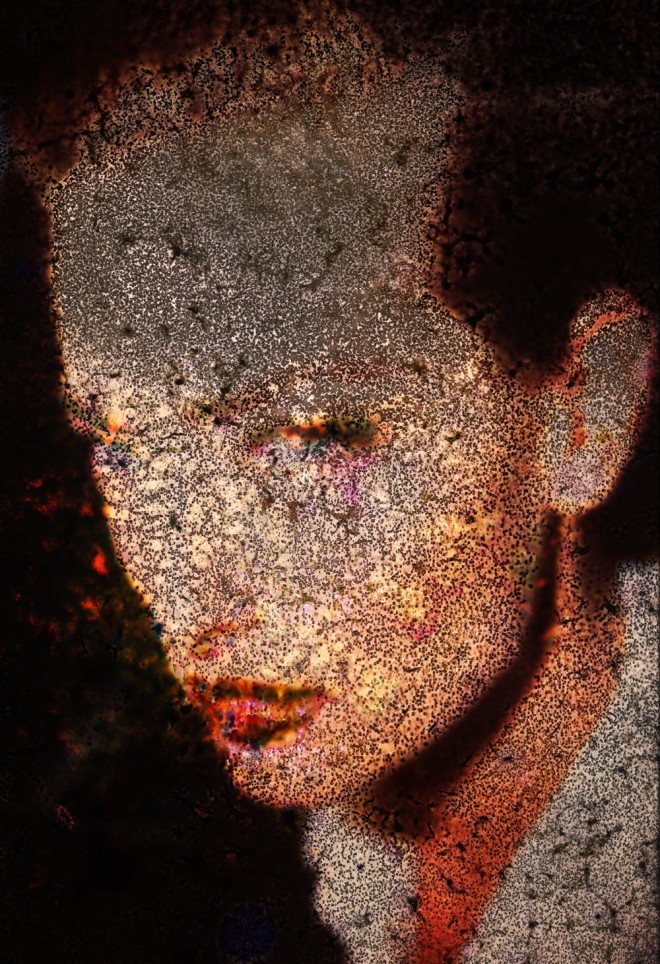
Doug Beirend explains the “hauntingly distressed images from Dutch photographer Rohn Meijer“:
The idea for the project came after Meijer discovered a batch of slides in his basement that had been exposed to moisture for 15 years. Most people might have tossed them, but Meijer saw that the moisture had created a pleasing crystallized effect, so he decided to experiment. He began developing a cocktail of water and other chemicals — a formula he prefers to keep secret — that would interact with the silver nitrate on the back of the negative and enhance the crystallization. To keep the negatives as saturated as possible, he built a homemade, hermetically sealed container for them to stew in.
Now that investors can put their money in athletes, bitcoin, and “motifs“, Kevin Roose declares, “the age of bullshit investments is back”:
Some of these bad ideas spring from the normal irrational exuberance that comes with an economic bounce-back, and the fact that many investors are more willing to jump into murky waters than they were in 2008. But there are other factors in play, too. The JOBS Act, for one, was a post-crisis law that was meant to make it easier for companies to raise money. … Thanks to the JOBS Act, there are now crowd-funding bazaars that make gambling in the markets as easy as picking a Spotify playlist. There’s also the newest West Coast fund-raising trend, the venture capital syndicate, which makes it possible for average shmoes with little to no market expertise to enter into highly risky investments with early stage start-ups, and which has put the sentence “Miley Cyrus could be the next big tech investor” within the realm of the possible.
Meanwhile, as Florida’s economy shows signs of recovery, Wendell Cox explains what made the state so vulnerable to the real estate crash:
Florida’s restrictive land-use policies (better known as “smart growth” or “urban containment”) helped inflate its property bubble to massive size, making its bursting all the more economically painful. Such growth policies limit urban expansion, prohibiting new housing except in small sections of already dense metropolitan areas. As Brookings Institution economist Anthony Downs argues, these policies can destroy the competitive supply of land, driving land prices up (other things being equal) as demand rises sharply in relation to supply. These higher prices get passed along to prospective homeowners in higher home costs—often made even pricier by various other regulations and fees. The rapidly escalating housing prices, in turn, create the potential for extraordinary profits for speculators—or property “flippers”—who, jumping into the real-estate market in considerable numbers, increase the excess of demand over supply, driving prices higher still, until a bubble begins to expand. It’s no surprise that markets with more restrictive land-use policies have much greater housing-price volatility, as research by economists Edward Glaeser and Joseph Gyourko has shown.
If I dismiss the ordinary — waiting for the special, the extreme, the extraordinary to happen — I may just miss my life. … To allow ourselves to spend afternoons watching dancers rehearse, or sit on a stone wall and watch the sunset, or spend the whole weekend rereading Chekhov stories—to know that we are doing what we’re supposed to be doing — is the deepest form of permission in our creative lives. The British author and psychologist Adam Phillips has noted, “When we are inspired, rather like when we are in love, we can feel both unintelligible to ourselves and most truly ourselves.” This is the feeling I think we all yearn for, a kind of hyperreal dream state. We read Emily Dickinson. We watch the dancers. We research a little known piece of history obsessively. We fall in love. We don’t know why, and yet these moments form the source from which all our words will spring.
On what makes writing “as necessary as breathing”:
It is in the thousands of days of trying, failing, sitting, thinking, resisting, dreaming, raveling, unraveling that we are at our most engaged, alert, and alive. Time slips away. The body becomes irrelevant. We are as close to consciousness itself as we will ever be. This begins in the darkness. Beneath the frozen ground, buried deep below anything we can see, something may be taking root. Stay there, if you can. Don’t resist. Don’t force it, but don’t run away. Endure. Be patient. The rewards cannot be measured. Not now. But whatever happens, any writer will tell you: This is the best part.