Morrissey By Morrissey

John Harris determines that the Smiths’ frontman’s Autobiography – the first page sung above, by voice artist Peter Serafinowicz – is strongest when it focuses on the singer’s upbringing and musical journey, rather than personal rivalries and legal battles:

For its first 150 pages, Autobiography comes close to being a triumph. “Naturally my birth almost kills my mother, for my head is too big,” he writes, and off we go – into the Irish diaspora in the inner-city Manchester of the 1960s, where packs of boys playfully stone rats to death, and “no one we know is on the electoral roll”. In some of the writing, you can almost taste his environment: “Nannie bricks together the traditional Christmas for all to gather and disagree … Rita now works at Seventh Avenue in Piccadilly and buys expensive Planters cashew nuts. Mary works at a Granada showroom, but is ready to leave it all behind.” And when pop music enters the story, he excels. … And then [musician] Johnny Marr pays him a visit, and his life takes off – while, in keeping with an unwritten rule of celebrity memoir, Autobiography takes a serious turn for the worse.

Boyd Tonkin calls the 450-page memoir a self-pitying screed, and ridicules Penguin for publishing it as a part of their “Classics” series:

The droning narcissism of the later stages – enlivened by the occasional flick-knife twist of character sketch, or character assassination (watch out, Julie Burchill) – may harm his name a little. It ruins that of his publisher. For the stretches in which in his brooding, vulnerable, stricken voice uncoils, particularly across his Mancunian youth, Morrissey will survive his unearned elevation. I doubt that the reputation of Penguin Classics will.

Mostly agreeing, Jessica Winter nonetheless sees moments of genuine insight:

Autobiography is at times so relentlessly whiny and misanthropic that it’s startling when Morrissey shares a flash of sober self-awareness. “Undernourished and growing out of the wrong soil,” he writes of himself circa 1984, “I knew at this time that a lot of people found me hard to take, and for the most part I understood why. Although a passably human creature on the outside, the swirling soul within seemed to speak up for the most awkward people on the planet.” That was once true—exhilaratingly true, true enough to save a life. But Autobiography only speaks up for its author, and never more than in his next line. “Somewhere deep within,” he confesses, “my only pleasure was to out-endure people’s patience.”

Oliver Lyttelton rounds up the “most Morrissey-y” passages. John Crace delivers a CliffsNotes version:

At school, I am the futile pupil brutalised by neo-fascist inquisitors who do not understand the subtleties of sublime rhyme. My only valent talent is for athletics, my event the 20-kilometre walk on water. Blood laced with disgrace flows from my hands, feet and side. “Oh, Steven,” says my Mother Mary. “What have you done to yourself now?” I feel forlorn in my crown of thorns. Death death death unbreath is all around me. Nancy laughs, her wild smile frozen for ever as a bus loses control on a pothole and crushes her against the grimey cor blimey door of the Rover’s Return. Gloria Gaynor sings I Won’t Survive. Life is thus.

The “Anti-Gatsby”

Tim Kreider praises John Williams’s Stoner as “a great, chronically underappreciated American novel”:

“Stoner” is undeniably a great book, but I can also understand why it isn’t a sentimental favorite in its native land. You could almost describe it as an anti-“Gatsby.” … Gatsby’s a success story: he makes a ton of money, looks like a million bucks, owns a mansion, throws great parties, and even gets his dream girl, for a little while, at least. “Stoner”‘s protagonist [William Stoner] is an unglamorous, hardworking academic who marries badly, is estranged from his child, drudges away in a dead-end career, dies, and is forgotten: a failure. The book is set not in the city of dreams but back in the dusty heartland. It’s ostensibly an academic novel, a genre historically of interest exclusively to academics. Its values seem old-fashioned, prewar (which may be one reason it’s set a generation before it was written), holding up conscientious slogging as life’s greatest virtue and reward. And its prose, compared to Fitzgerald’s ecstatic art-nouveau lyricism, is austere, restrained, and precise; its polish is the less flashy, more enduring glow of burnished hardwood; its construction is invisibly flawless, like the kind of house they don’t know how to build anymore.

“Part of Stoner’s greatness is that it sees life whole and as it is, without delusion yet without despair,” continues Kreider:

Stoner realizes at the last that he found what he sought at the university not in books but in his love and study of them, not in some obscure scholarly Grail but in its pursuit. His life has not been squandered in mediocrity and obscurity; his undistinguished career has not been mulish labor but an act of devotion. He has been a priest of literature, and given himself as fully as he could to the thing he loved. The book’s conclusion, such as it is—I don’t know whether to call it a consolation or a warning—is that there is nothing better in this life. The line, “It hardly mattered to him that the book was forgotten and served no use; and the question of its worth at any time seemed almost trivial,” is like the novel’s own epitaph. Its last image is of the book falling from lifeless fingers into silence.

The Zeitgeist Of Kids’ Books

In a review of the New York Public Library’s exhibit The ABC of It: Why Children’s Books Matter, Paula Marantz Cohen ponders the capacity of children’s literature to defy social expectations:

There are … examples of pedagogy in support of civic causes — children’s books from the 465px-Cendrillon_story Russian Revolution and the Chinese Cultural Revolution, books associated with Irish Independence that makes use of fairy tales, a beautifully illustrated Hebrew alphabet book to teach children the language of a not-yet-created Jewish state. There are samples from W.E.B. Dubois’s monthly magazine for African-American children, The Brownies’ Book, published from 1920 to 1921, to teach black children pride in their identity.

Yet it is noteworthy that some of our most beloved children’s books don’t teach anything and can’t be linked to an agenda of any kind. It is also interesting to see those that caused a stir in their day for failing to toe a line of one sort or another. A recessed space contains books that have been controversial or censored: Pippi Longstocking, for its character’s rebelliousness, The Diary of Anne Frank for its narrator’s sexual explicitness, A Wrinkle in Time for overstepping the bounds of secularism when first published and for being unconventionally spiritual more recently. There is a copy of Garth Williams’ 1948 A Rabbits’ Wedding, castigated in its time for representing the marriage of a white rabbit and a black one. What looks like iconoclasm or perversity in one era can become unobjectionable and even desirable to teach in another — and vice versa. My reflex is to think that children are the best arbiters, being naturally drawn to what is good and true, but I may be indulging in a Rousseau-ist idealism here. After all, children are also fascinated by the sadistic and the gross — all those disturbing Grimm’s fairy tales, not to mention Jon Scieszka’s Stinky Cheese Man.

Recent Dish on children’s lit here, here, and here.

(Image: book cover of Cendrillon, c. 1930, via Wikimedia Commons)

The DSM-5 As Dystopian Novel

That’s how Sam Kriss interprets the latest edition of the American Psychiatric Association’s signature publication:

This is a story without any of the elements that are traditionally held to constitute a setting or a plot. A few characters make an appearance, but they are nameless, spectral shapes, ones that wander in and out of view as the story progresses, briefly embodying their various illnesses before vanishing as quickly as they came – figures comparable to the cacophony of voices in The Waste Land or the anonymously universal figures of Jose Saramago’s Blindness. A sufferer of major depression and of hyperchondriasis might eventually be revealed to be the same person, but for the most part the boundaries between diagnoses keep the characters apart from one another, and there are only flashes. On one page we meet a hoarder, on the next a trichotillomaniac; he builds enormous “stacks of worthless objects,” she idly pulls out her pubic hairs while watching television. But the two are never allowed to meet and see if they can work through their problems together.

This is not to say that there is no setting, no plot, and no characterization. These elements are woven into the encyclopedia-form with extraordinary subtlety. The setting of the novel isn’t a physical landscape but a conceptual one. Unusually for what purports to be a dictionary of madness, the story proper begins with a discussion of neurological impairments: autism, Rett’s disorder, “intellectual disability”. The scene this prologue sets is one of a profoundly bleak view of human beings; one in which we hobble across an empty field, crippled by blind and mechanical forces whose workings are entirely beyond any understanding. This vision of humanity’s predicament has echoes of Samuel Beckett at some of his more nihilistic moments – except that Beckett allows his tramps to speak for themselves, and when they do they’re often quite cheerful. The sufferers of DSM-5, meanwhile, have no voice; they’re only interrogated by a pitiless system of categorizations with no ability to speak back. As you read, you slowly grow aware that the book’s real object of fascination isn’t the various sicknesses described in its pages, but the sickness inherent in their arrangement.

The View From Your Window Contest

vfyw_10-26

You have until noon on Tuesday to guess it. City and/or state first, then country. Please put the location in the subject heading, along with any description within the email. If no one guesses the exact location, proximity counts.  Be sure to email entries to contest@andrewsullivan.com. Winner gets a free The View From Your Window book or two free gift subscriptions to the Dish. Have at it.

The Decay Of Pompeii

Ingrid D. Rowland remarks that “Pompeii is not only the graveyard of an ancient Roman city; it is also, and especially, the graveyard of modern good intentions” due to lack of funding for site preservation and maintenance:

Some of this destruction is inevitable. Pompeii was so well preserved because it lay dish_pompeii buried for seventeen centuries. Having its extraordinary ruins unearthed has meant exposing them to the normal processes of aging that all cities face—wind, rain, plants, animals, gravity, entropy, chaos—without the normal defenses that homeowners provide by caring for the places they inhabit. Furthermore, Pompeii was not by any means an intact city when Vesuvius destroyed it in the year 79. A devastating earthquake had already struck the region in 62, and many of its buildings were still under reconstruction when the volcano erupted in a rain of pumice pebbles. There were earthquakes after the eruption, too, as the emptied mountain settled back down for another few centuries of inactivity. Thus the soil of Pompeii has preserved not a city interrupted in the course of normal life, but one caught in a state of total panic, and whose buildings had already been severely damaged.

What can be done to stop this decay?

On a geological time scale, not much. On a human scale, a great deal. In Massimo Bray, Italy finally has a Minister of Culture and Tourism who means business (one of his predecessors, Sandro Bondi, was mostly known for his soupy poems in praise of former Prime Minister Silvio Berlusconi). There is reason to hope that the waste and neglect that have brought the buried city to its present calamity will stop, at least to some extent, with a more responsible Italian government in charge and a new preservation law on the books.

(Photo of excavation of plaster casts of bodies at Pompeii by Flickr user TyB)

A Poem For Saturday

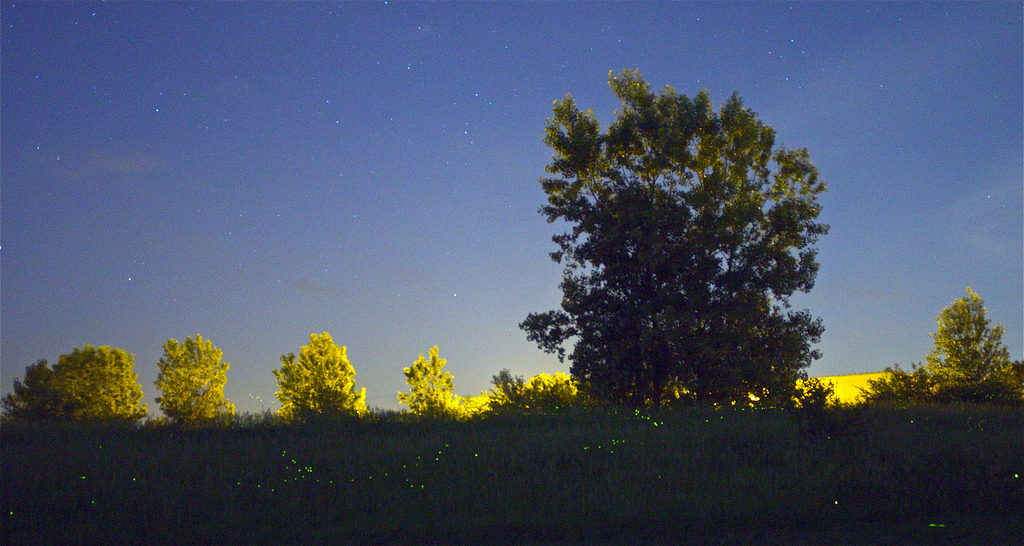
fireflies

Last week, we posted three poems by Frank Bidart, one of the five nominees for this year’s National Book Award in poetry for his new collection, Metaphysical Dog. This week, we’ll post poems by another nominee, Lucie Brock-Broido, whose new book, Stay, Illusion, is praised by Dan Chiasson in this week’s New Yorker  for its “frolicsome gravity.” Our first selection from Brock-Broido is “A Girl Ago”:

No feeding on wisteria. No pitch-burner traipsing
In the nettled woods.  No milk in metal cylinders, no
Buttering.  No making small contusions on the page
But saying nothing no one has not said before.
No milkweed blown across your pony-coat, no burrs.
No scent of juniper on your Jacobean mouth.  No crush
Of ink or injury, no lacerating wish.
Extinguish me from this.
I was sixteen for twenty years. By September I will be a ghost
And flickering in unison with all the other fireflies in Appalachia,
Blinking in the swarm of it, and all at once, above
And on a bare branch in a shepherd’s sky.  No Dove.
There is no thou to speak of.

(From Stay, Illusion © 2013 by Lucie Brock-Broido. Used by permission of Alfred A. Knopf, a division of Random House, Inc. Photo by David DeHetre)

Goth Keeps Going

This embed is invalid


As the British Film Institute heads into its season of Gothic fiction, Roger Luckhurst wonders what keeps the genre so fresh in pop culture:

The gothic has offered a sinuous line of cultural commentary since Horace Walpole wrote The Castle of Otranto in 1764. It falls in and out of favour, but never quite goes away, because its metaphors of haunting and the undead prove so adaptable. Today, horror seems urgent again in an era of profound insecurity. George Romero updated the zombie as an emblem of consumption. The metaphor has now moved back closer to its slave plantation origins, imagining modern masses sapped of every ounce of living labour. Zombie contagion, despite Brad Pitt’s best efforts to ruin the genre in World War Z, remains an effective way of thinking about global interdependence and fragility.

It doesn’t take much to see aristocratic vampires as pulp versions of plutocrats supping on the blood of the merely-human, parasites hoarding wealth across the centuries. The Occupy movement even had a cross-over with the imagery of monstrous horror: Octopi Wall Street was a slogan and internet meme. Elsewhere, nasty and demonic things crawl out of war zones in the films Outpost or even Iraq in Adam Baker’s undead shocker, Juggernaut. But then the gothic, right from its nightmare beginnings, was about colonial anxiety and fears of what comes back to haunt from nefarious doings overseas.

Revisiting the works of Edgar Allen Poe, Sam Jordison pushes back against all the goth-love, finding the genre too moody and meandering:

Even the most famous stories, such as The Fall of the House Of Usher, left me cold. And not cold in a chills-up-the-spine sense: just a bit bored.

The image of the house reflected in the black tarn is admittedly impressive. So too is the description of the crumbling house itself, and the “minute fungi” that cover its exterior. But the symbolism quickly becomes overbearing: the pathetic fallacy of the awful weather, the gothic archways, the wild guitar playing, the gloom, the doom, the adjectives pertaining to gloom and doom, the decayed trees. Too much! And that’s before we get to the dialogue: “‘I shall perish!'” said he. ‘I must perish in this deplorable folly.'” You said it.

It’s possible to defend Poe as a pioneer. Here we can see the model of haunted houses ever since. Generations of writers, not to mention special effects teams and film directors, have been inspired by him. Then again, his scary buildings and emotional weather patterns aren’t a patch on those described by Emily Brontë in Wuthering Heights, while his gothic excesses don’t compete with those conjured by writers such as Matthew Lewis and Ann Radcliffe half a century earlier.

So why do we still read Poe? Is he simply a curio – an early American writer with a crazy personal life? I hesitate to say that, for I still haven’t read enough, for a start. And even though I’ve frequently been bored, I’ve found odd moments fascinating, and gloriously weird. What is this thing about female corpses, for instance? Good job he was born before psychotherapy.

Previous Dish on gothic appeal here and here.

France’s Fiscal Failures

Milton Ezrati claims that the French economy is in “profound decline”:

French authorities mostly have either denied the situation’s severity or blamed it on Germany’s push for budget austerity throughout the euro zone. There is no shortage of critical remarks to make about the German approach, but it can hardly explain France’s economic problems. France, after all, hardly has imposed much austerity. It has promised to do so but otherwise has asked of itself none of the sharp government spending cuts evident elsewhere in Europe’s periphery. On the contrary, French government spending has continued to grow, rising almost 4 percent during the last two years. Government in France now constitutes some 57 percent of the entire economy, well above the euro zone’s average. Meanwhile, Paris recently sidestepped the need for more strictures, receiving permission from the EU bureaucracy to continue wider budget deficits than EU rules allow until 2015 at the earliest. Nor can French officials honestly blame German austerity when their nation’s economic slide has beginnings long before the current crisis or Berlin’s response to it. France, quite simply, has been underperforming the rest of Europe for over a decade.

He blames “ill-conceived policies that have hamstrung business with oppressive taxes, stultifying labor regulations, and a raft of product and production controls”:

Taxes are the most straightforward and immediate economic burden. Payroll levies in France amount to 38.8 percent, and with the added burden of business income taxes and the value-added tax (VAT), employers in France pay the government the equivalent of almost 64 percent of their payrolls. This is a much heavier weight than firms in other countries must bear. Germany, for instance, imposes a tax wedge on its business of about 53 percent, high compared to the 38.5 percent imposed by the United States, but still more than 10 full percentage points less than France. Harder to quantify but no less a burden on French business is the notorious complexity of the French tax code, which, business surveys indicate, rivals even that of the United States. Its myriad loopholes, set against the high statutory tax rates, tempt managers to divert time to tax planning that they might better dedicate to production and sales.