The City As Canvas

Joe Winkler observes the fallout from Banksy’s month-long New York campaign and argues those attempting to preserve or restore the art are missing the point:

In the last two weeks, owners of buildings with Banksy art have taken to hiring guards, putting up plexiglass, rolling gates, and ropes to create lines, all of which is practical and perhaps understandable but undermines much of the purpose of these 30 days. All of these protections simply turn these outdoors, public pieces into indoor museum pieces, introducing a sterility that subverts the spirit of the project. These tactics isolate the art from the bustling environment. The viewer becomes passive, just another viewer waiting in line, no longer a participant. From a theoretical perspective, this all seems backwards. The owners of the building, from the perspective of the actual graffiti art, ought to hold no more rights than the community in deciding what to do with the graffiti.

Meanwhile, NPR interviewed a woman whose building in Williamsburg was tagged by Banksy. Her thoughts:

It leaves us in a sticky place … he’s putting artwork on our wall that now we’re expected either to protect or let it be destroyed, and we can’t sell it. And we don’t necessarily want to sell it; we don’t know yet. But I have been approached by a gallerist, and this is something that this gallery specializes in. They could come, take down the wall, put it up for auction … and that could be the route that we go. It puts us in a conundrum, I mean, we believe — I think we truly believe — that this art is for the public. But we’re also not equipped to serve the public’s needs.

Recent Dish on Banksy’s New York adventure here and here.

Early American Pirates

In a review of Robert Spoo’s Without Copyrights, Greg Barnhisel describes how early copyright laws led to British dominance in American reading habits:

In the 19th century, the so-called “reprint industry,” which mined previously published books, largely British, dominated American publishing. And while reprinters bore most of the fixed costs facing any publishing concern (labor, materials, advertising, distribution) they had one great competitive advantage: they didn’t have to pay their authors. Until 1891, US law extended copyright protection only to works by American citizens, so these reprinters made a business model out of selling British books, generally without ever contacting (much less entering into an agreement with) their authors. It’s hard to think of a more obvious example of “piracy” than this, and authors from Dickens to Wilde fumed about their vast lost revenue. …

Frustrating as it was to aggrieved British authors, the law had some justification. The US was a large but largely under-booked nation in the early 1800s. In keeping with the spirit of the US Constitution’s Copyright Clause, which emphasizes that the real goal of copyright is not first and foremost the protection of an author’s rights but the promotion “of Science and useful Arts,” the law subsidized the production and dissemination of books. A lot of books. A lot of cheap books that would, Congress hoped, spread across (and educate) our widely dispersed and unschooled nation.

A Hellenistic YOLO

This embed is invalid


Classicist Armand D’Angour, who is reconstructing the music of ancient Greece, discusses the 1,800-year-old ditty heard above:

One complete piece, inscribed on a marble column and dating from around 200 AD, is a haunting short song of four lines composed by Seikilos. The words of the song may be translated:

While you’re alive, shine:

never let your mood decline.
We’ve a brief span of life to spend:
Time necessitates an end. …

Dr. David Creese of the University of Newcastle has constructed an eight-string “canon” (a zither-like instrument) with movable bridges. When he plays two versions of the Seikilos tune using Ptolemy’s tunings, the second immediately strikes us as exotic, more like Middle Eastern than Western music.

George Dvorksy summarizes some qualities of ancient Greek music:

In the ancient Greek tongue, voices went up in pitch on certain syllables and fell on others; the accents indicated pitch, not stress. Some of the music during this period used subtle intervals such as quarter-tones. And sometimes the melody didn’t conform to the word pitches. Interestingly, Euripides was considered an avant-garde composer who frequently violated long-held traditions of Greek folk singing by neglecting word-pitch.

Global Warming Groupthink

Judith Shulevitz psychoanalyzes climate change deniers:

Risk assessment by groupthink is reasonable, if not rational, because, at the personal level, it costs nothing. If you misconstrue the nature of a global threat, your mistake won’t hurt you much, because you can’t save yourself anyway. But if you contradict your friends or powerful members of your group—that could cost you dearly. (Incidentally, Kahan sees evidence of scientific groupthink on both sides of the ideological spectrum.) [Yale psychology professor Dan] Kahan’s most provocative finding, though, is that people better at “cognitive reflection,” or slow, probing thought, are actually more likely to arrive at predetermined conclusions about risk, not less. The urge to maintain status within one’s social network is so powerful, Kahan told me, that well-educated people will use their information-gathering and computational skills to marshal a more impressive body of evidence in support of whatever identity it is (freethinking skeptic, caring mother hen) that earns them brownie points in their troop. On his blog, he once called these strong in-group effects “tapeworms of cognitive illiberalism” and a dispiriting omen for democracy.

Europe’s Anti-Roma Racism

Roma children laugh in front of the came

Joshua Keating zooms in on Europe’s sudden wave of anti-Roma sentiment:

The biggest international story is that of “Maria,” the blond, blue-eyed girl removed by police from a couple during a raid on a camp in Greece when they became suspicious that she looked nothing like her darker-skinned parents. DNA tests confirmed that the child was not related to the couple, sparking a continentwide search for her biological parents. The couple say the girl was not abducted, that it was “an adoption that was not exactly legal but took place with the mother’s consent.” This could be plausible, though further investigations have shown that the couple had used multiple names to register 14 children in three different cities, perhaps as part of a government benefits scam. Greek authorities have ordered an investigation of thousands of birth certificates issued in the last five years, and three more Roma have already been arrested in a similar case case on the island of Lesbos.

While it certainly seems like something not-quite-aboveboard was going on here, the case has raised fears that the case of the “blonde angel,” as she has been called in the Greek media, could reignite old myths of Gypsies kidnapping white children. When ancient prejudices combine with the tabloid media’s fixation on missing blond children, it’s hard to imagine anything good coming from it.

A backlash against Roma appears to be taking hold, with a blonde Roma girl in Ireland separated from her parents until DNA tests proved her to be their biological daughter. Filip Borev points out that the mixed heritage of Roma can produce fair skin and hair, and that the panic speaks to something deeper:

Don’t get me wrong, blond hair is somewhat a rarity among Roma populations. What is rarer, however, is the “pure blood” or tatcho Romany. Indeed, there is nothing more the Romany like to do than fight among themselves over who is the purest Gypsy, but one only needs to take a glance at Britain’s Romany community to realise there has undoubtedly been a great deal of intermarriage. My genes would best be described as a melting pot – my mother is part Bulgarian Roma, part Romanichal (English Romany), and my dad is part Romanichal, part Irish Traveller – thus, it was hardly surprising when I was born a blue-eyed milk bottle.

The notion of the baby-snatching Gypsy is an old racist stereotype. Since I was born it has been a running joke within my family that I was stolen. My mum’s engagement to a Roma man resulted in three considerably darker-skinned siblings. Among my Roma family I couldn’t have stood out more, but lucky for me I can now hand down the “stolen baby” joke to my younger brother who was born with strikingly blonde hair. In the current environment, however, I must ask just how funny this joke is.

Okasana Marafioti bemoans the long history of discrimination against Roma in Europe:

The stereotype of Gypsies as child snatchers is centuries old, but ask anyone if they can give you a specific incident, and they will scratch their heads. More disturbing historical facts have survived, including records of more than 133 anti-Gypsy laws enacted in the Holy Roman Empire at around 1551, which made being a Gypsy punishable by death, and authorities systematically took Romany kids from their parents and placed them in “proper” homes, a trend that continued well into the first half of the 19th century.

Rachel Shukert adds:

One doesn’t like to descend into comment sections, but a perusal of those on these latest stories is like peering into something out of the Malleus Maleficarum, or Borat. Americans, who for the most part see gypsies as something you dress up as on Halloween when your mom forgot to get you a real costume, express utter bafflement, while Europeans, who never tire of calling Americans out on their racism, insist on the toxicity of these people—their essential, unchanging, criminal nature; it’s who they are, they insist. It’s their culture. They can’t be changed, so they have to—somehow—be gotten rid of. (My favorite thread managed to both laud Hitler for killing the Roma along with the Jews, while blaming the Jews for the Roma not getting any credit for the Holocaust. And also, did you know we’re both capitalists and Bolsheviks? Blah blah blah.)

(Photo: Roma children laugh in front of the camera in a camp on the outskirts of Rome on September 8, 2010. By Christophe Simon/AFP/Getty Images)


Black History Sans White Saviors

Wesley Morris reviews 12 Years A Slave. How the film upends the racial dynamics of Hollywood:

There is a kind of audacity in something like Lincoln, in which important white men get discursive about the moral quandary in which slavery mires the country. That debate required men to search their souls and vote accordingly. But after enough of these movies, you’re just hot with insult. You have to stop accepting apologies, accepting, say, The Help, and start demanding correctives, films that don’t glorify whiteness and pity blackness, movies — serious ones — that avoid leading an audience to believe that black stories are nothing without a white voice to tell them that black people can’t live without the aid of white ones.

[Director Steve] McQueen and [screenwriter John] Ridley turn that dynamic inside out. Their movie presents the privilege of whiteness, the systematic abuse of its powers, and black people’s struggles to get out from beneath it. A different movie might have taken this story and turned it into a battle between Epps and the white men who feel a duty to free Northrup. That’s what we’re used to. There have been complaints that the movie is too violent, that it depicts too many lashings, too many cruelties, too much interracial abuse, that all the gashes on all the backs (what Toni Morrison poetically described as chokecherry trees) are just too much. But that’s a privileged concern.

Peter Malamud Smith is troubled with Northrup representing the institution of slavery as a whole:

12 Years a Slave is constructed as a story of a man trying to return to his family, offering every viewer a way into empathizing with its protagonist. Maybe we need a story framed on that individual scale in order to understand it. But it has a distorting effect all the same. We’re more invested in one hero than in millions of victims; if we’re forced to imagine ourselves enslaved, we want to imagine ourselves as Northup, a special person who miraculously escaped the system that attempted to crush him.

Isaac Chotiner counters:

[I]f Hollywood ever did make a movie called 200 Years, Millions of Slaves, how much would you wager that writers like Smith would be denouncing Hollywood for de-personalizing slavery? Doesn’t Hollywood realize that actual individuals suffered? Doesn’t Hollywood grasp that the evils of slavery went beyond statistics? Secondly, 200 Years, Millions of Slaves is not a movie. Movies focus on individuals or groups of individuals. How would one even conceive of Smith’s project? Smith even seems to backhandedly acknowledge as much, writing, “Maybe we need a story framed on that individual scale in order to understand it.” Maybe we do! In the meantime, we should evaluate 12 Years a Slave on its own terms.

Healthcare Needs The Healthy

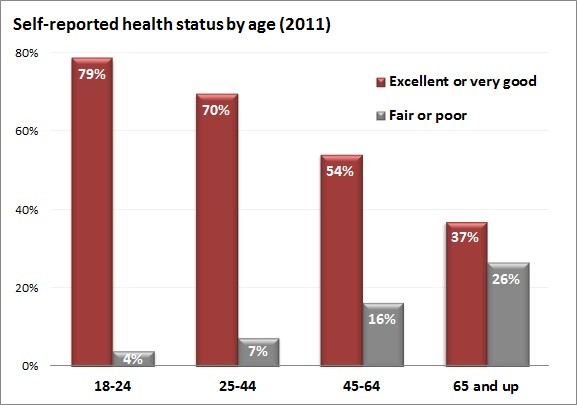
Health Status By Age

Waldman illustrates why the young must sign up for Obamacare for it to succeed:

The truth is that while we talk about the importance of young people being in the risk pool, what matters isn’t their age but their health. On average, young people will be healthier longer, but every year the system needs plenty of healthy people of whatever age they might be. When you ask them, the young are much more likely to report being healthy, with self-reported health declining the older you get.

Emma Roller covers efforts to get the young to enroll:

Mothers make the health care decisions in 80 percent of families, and they’re the most effective “messengers” to persuade their kids to sign up for health care. Anne Filipic, who leads the nonprofit group Enroll America, says men may be the ultimate target for groups promoting the exchanges—they are more skeptical of health insurance and tend to visit the doctor less—but they’re focusing on women because of their decision-making role. “The messenger matters a lot,” Filipic says. “The most effective thing we can do is get moms and women the information, so in their day-to-day conversations they can be spreading the word.”

Enroll America surveyed young people and asked who they were most likely to trust talking to them about health care. For young women, “someone like me” was the most persuasive messenger. For young men, it was their mom, followed by their spouse or girlfriend. That’s why the Obama administration has promoted the exchanges on mom-friendly media like allrecipes.com, Good Morning America, and Elle magazine.

Free To Hate

While discussing the Ender’s Game controversy, Rauch argues that hate speech is necessary for social progress:

To make social learning possible, we need to criticize our adversaries, of course. But no less do we need them to criticize us. … Some of the things [Orson Scott Card] has said are execrable. He wrote in 2004 that when gay marriage is allowed, “society will bend all its efforts to seize upon any hint of homosexuality in our young people and encourage it.” That was not quite a flat reiteration of the ancient lie that homosexuals seduce and recruit children—the homophobic equivalent of the anti-Semitic blood libel—but it is about as close as anyone dares to come today.

Fortunately, Card’s claim is false. Better still, it is preposterous. Most fair-minded people who read his screeds will see that they are not proper arguments at all, but merely ill-tempered reflexes. When Card puts his stuff out there, he makes us look good by comparison. The more he talks, and the more we talk, the better we sound.

Why he hopes the Ender’s Game boycott will fail:

I can think of quite a few reasons why boycotting Ender’s Game is a bad idea. It looks like intimidation, which plays into the right’s “gay bullies” narrative, in which intolerant homosexuals are purportedly driving conservatives from the public square. It would have little or no effect on Card while punishing the many other people who worked on the movie, most of whom, Hollywood being Hollywood, probably are not anti-gay (and many of whom almost certainly are gay). It would undercut the real raison d’être of the gay-rights movement: not to win equality just for gay Americans but to advance the freedom of all Americans to live as who they really are and say what they really think. Even if they are Orson Scott Card.

Above all, the boycott should fizzle, and I expect it will fizzle, because gay people know we owe our progress to freedom of speech and freedom of thought.

How Much Is A Little More Life Worth?

The cost of cancer drugs has skyrocketed:

Cancer Drugs

Stephen S. Hall covers the phenomenon:

What is sobering about this booming business is that, as a group of oncologists wrote earlier this year, “most anti-cancer drugs provide minor survival benefits, if at all.” They often (but not always) reduce the size of inoperable tumors, but they rarely eradicate the disease.

For relatively uncommon malignancies like testicular cancer, some forms of leukemia, and lymphoma, drugs effectively cure the disease; for the common “solid tumor” cancers (lung, breast, colon, prostate, and so on), which account for the vast majority of annual cases, drugs buy some time—precious time, to be sure, but time usually measured in weeks and months rather than years. And even though many of the newer drugs are less toxic, they often still have to be given with older drugs whose side effects include nausea, hair loss, fatigue, and decreasing blood counts. One anti-cancer drug produces a skin rash so severe and disturbing, according to [Leonard] Saltz [head of the gastrointestinal oncology group at Memorial Sloan-Kettering Cancer Center], that some patients have been asked by employers not to come to work. …

In 1994, the median survival rate for someone with advanced colon cancer was eleven months, according to Saltz, and the lifetime costs of the drugs used to treat the average patient would be about $500 at today’s prices. By 2004, the median survival rate had increased twofold, to 22 months, but Saltz says the drug costs had increased hundreds of times for that extra eleven months.