How Many Wiki Editors Do We Need?

Tom Simonite sees the online encyclopedia getting sclerotic:

The volunteer workforce that built the project’s flagship, the English-language Wikipedia – and must defend it against vandalism, hoaxes, and manipulation – as shrunk by more than a third since 2007 and is still shrinking. Those participants left seem incapable of fixing the flaws that keep Wikipedia from becoming a high-quality encyclopedia by any standard, including the project’s own. … The main source of those problems is not mysterious. The loose collective running the site today, estimated to be 90 percent male, operates a crushing bureaucracy with an often abrasive atmosphere that deters newcomers who might increase participation in Wikipedia and broaden its coverage.

But he acknowledges that the decline of participation is largely due to the anti-vandalism measures introduced in 2007, when high-profile hoaxes seemed to pose an existential threat to the project:

The project’s most active volunteers introduced a raft of new editing tools and bureaucratic procedures intended to combat the bad edits. They created software that allowed fellow editors to quickly survey recent changes and reject them or admonish their authors with a single mouse click. They set loose automated “bots” that could reverse any incorrectly formatted changes or those that were likely to be vandalism and dispatch warning messages to the offending editors.

The tough new measures worked. Vandalism was brought under control, and hoaxes and scandals became less common. … But those tougher rules and the more suspicious atmosphere that came along with them had an unintended consequence. Newcomers to Wikipedia making their first, tentative edits – and the inevitable mistakes – became less likely to stick around. Being steamrollered by the newly efficient, impersonal editing machine was no fun. The number of active editors on the English-language Wikipedia peaked in 2007 at more than 51,000 and has been declining ever since as the supply of new ones got choked off. This past summer, only 31,000 people could be considered active editors.

The Classical Remix

A portion of Max Richter’s dazzling take on Vivaldi’s The Four Seasons:

In a wide-ranging essay that connects Kanye West to Beethoven, Michael Markham discusses the similarities between classical music and today’s popular genres:

Vivaldi’s generation reveled, without embarrassment, in instant emotional gratification. Its most popular form of music, Opera seria, was not like later Romantic opera. It did not present a deep unified story in the Wagnerian sense, and instead provided little more than a series of 40 or so fragmented emotional moments, each represented by a static aria that crystallized a single mood.

Baroque-era audiences treated the productions as live “best of” concerts, wandering in and out of the theater, choosing to listen only to the excerpts that touched the right mood for them that night. Baroque composers were trained to enhance such evocative mood-experiences even when writing instrumental concertos. The constant nervous pulse (that for much of the 20th century led to Baroque music being called “sewing machine” music) invigorates in the same way modern rock or hip-hop does; the cascading sequences and recurring fragments of melody produce a pop-like repetition that pulls the listener back again and again to the same emotional starting point. …

The form of the Vivaldian concerto is based on the idea of the reoccurring “hook.” It is similar in this way to the verse-chorus-verse-chorus progression of our own pop songs. [Composer Max] Richter’s own comments on his music reveal this connection to today’s composition: “I was pleased to discover that Vivaldi’s music is very modular. It’s pattern music.” So is Richter’s, as well as that of many of the most prominent composers of both “classical” and “pop” minimalism (not to mention trance, hip-hop, dance, house, etc.) of the last 20 years — from Brian Eno and Meredith Monk to Kanye West, Gotye, Nico Muhly, and John Luther Adams.

Is Layaway Worth It?

Alex Tabarrok is perplexed by the popularity of the purchasing plan:

The typical layaway plan requires a deposit of 10 to 15 percent of the price of the good, say a new TV. If the consumer pays the balance over the following 10 to 12 weeks (i.e., by Christmas) they can pick up the good. If the consumer doesn’t pay the balance, they get a refund of payments made less a service fee. Walmart and Kmart advertise their layaway plans heavily. I am shocked, however, that so-called consumer advocates also have good things to say about poor people lending big corporations money:

Consumer advocates say layaway is a great way to manage a major purchase and stick to a budget, allowing consumers to spread the cost of an item over a number of payments without running up a lot of costly debt. …“The fees, if any, are generally nominal and probably much lower than the interest you’d pay if you purchased those things with a credit card and didn’t pay off the bill for several months,” said Tod Marks, senior editor and shopping expert at Consumer Reports.

Stop the insanity! The relevant comparison is not to buying on credit but to saving. Instead of lending Walmart money, get yourself an old-fashioned piggy bank and avoid the cancellation fee and the hassle of going to the store to make the periodic payments.

Erik Loomis defends layaway with a real-world example:

Let’s imagine a situation for layaway. You are 11 years old. It’s July. Your family doesn’t have much money. Getting new school clothes is a big deal because you don’t get very many new clothes in a year and you want to wear them on the first day of school. Your parents are really worried about this. They want to buy you the new clothes. They also know that they will have a really hard time actually saving the money to purchase them all at once. So they put them on layaway at the Target or Walmart and make the payments, hoping to have them all paid off before school starts.

How would I come up with this scenario? Because I was that 10 or 11 year old and my parents used layaway to get me those new clothes I wanted. In fact, in the scenario I am recalling, they actually couldn’t make all the payments and I really wanted those clothes and somehow we talked the store into giving us some of the clothes up front and breaking up the layaway, which probably only worked because I was there and nearly hysterical that I would have to wear old clothes on the first day of school. In a so-called rational economic world, layaway might not make sense. In the real world that actually people live and operate in it makes a ton of sense, even if it is bad economics.

Meanwhile, Drum contends that “the economic case against layaway is thinner than it seems”:

Suppose you put a $300 item on layaway for four months. What’s the opportunity cost? Roughly speaking, it’s the interest you could have earned on that money, which for most of us is around 2 percent or less these days. That’s a grand total of one dollar over the course of four months. Frankly, if layaway really does provide a psychological prod to make the payments, it’s not a bad deal at all.

Orange Suit, White Collar

A finding that may surprise you:

In the forthcoming December 2013 issue of Justice Quarterly, Michael Benson and his co-researchers argue that white-collar offenders adapt to prison just as well as other types of offenders, and in some categories, do even better.

One reason they adapt:

“Prisons are bureaucracies that have rules and regulations,” Benson says. “People from middle-class and white-collar backgrounds understand rules and bureaucracies. I did an interview for my dissertations where I talked to a small number of white collar offenders. Before they went they were scared to death. They imagined all these bad things happening. Once they get there, after the initial shock passed, they realized it’s just a big organization. Follow the rules, be polite to people, don’t go outside your space, and you’ll be fine.”

This Guy Again!

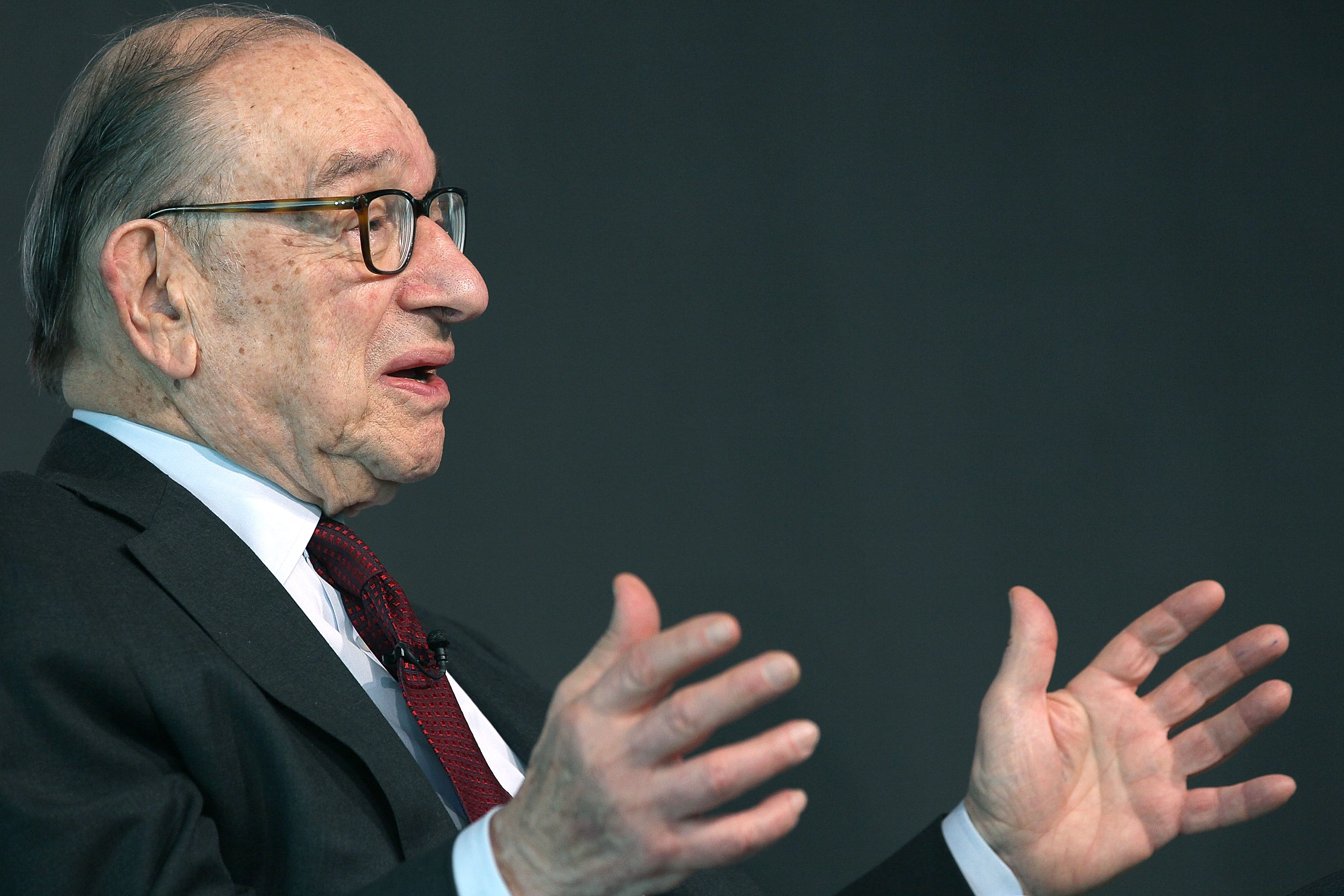
Former Federal Reserve Chair Alan Greenspan Speaks At Bloomberg News Economic Summit

Alan Greenspan is making the TV rounds in support of his new book, and Daniel Dayen is baffled by his warm reception:

So far [on his media tour], he’s gone virtually unchallenged. He has said the 2008 financial crisis “was the first time ever that markets were broken and could not fix themselves” (ever hear of the Depression?), and that he “could have caught a number of different crises” during his tenure at the Fed (which begs the question of why he didn’t). Journalists have asked such penetrating questions as, “You were knighted. Does that come with a title or anything?” …

[A]nyone who’s paid attention to the economy the past few years knows how ridiculous it is to fete Greenspan, the main architect of the policies that led to the Great Recession. If we lived in a just world, we would put him on trial, not on television. And his penalty should be to scrounge up the funds to pay JPMorgan Chase’s $13 billion fine with the Justice Department. After all, that fine penalizes JPMorgan Chase for duping investors into purchasing mortgage-backed securities it knew were stuffed with garbage loans. And nobody in America duped more people – investors, homeowners, you name it – into buying bad loans than Alan Greenspan.

That’s a little too harsh, it seems to me. Greenspan has, after all, admitted his own errors – which is more than most on the right have done. He has been extremely candid about his intellectual blindspot. He is in some degree responsible for the economic collapse, but not in the same way as those bankers who knowingly deceived their customers, and took on risks no one should ever dream of taking on. There is a difference between sins of omission and commission.

And besides, writers have been more critical: Yglesias calls Dayen “too soft” on Greenspan, while Krugman describes The Map and the Territory as “a really terrible book on multiple levels.” Plus, the NYT and WaPo reviews have hardly been complimentary. In some ways, I think going out there with a book is an act of minor courage. Better then refusing to concede error, and throwing spitballs at others dealing with the mess.

(Photo by Mark Wilson/Getty)

Will The GOP Overplay Its Hand?

Drum wonders whether Republicans can capitalize on the Obamacare fiasco:

There’s plenty of meat available in an investigation of the Obamacare rollout. But a good investigation will go slowly, taking pains not to drown officials in a blizzard of subpoenas while they’re in the middle of fighting a fire. A good investigation will also focus a lot of its effort on real issues of procurement and how the federal government handles IT projects. It won’t be just a fishing expedition for emails that might be embarrassing to Obama staffers. …

Can Issa restrain his attack dog personality enough to understand that? Will the tea party caucus allow it? Or will the whole thing quickly devolve into a barrage of subpoenas that are so obviously politically motivated that no one takes them seriously anymore? We’ll see, but I’d put my money on the latter right now.

Waldman places the same bet:

If you’re a Republican member of Congress, this is coming at a critical time, because it’s around now when your potential primary opponents are deciding whether they want to run against you in next year’s election. That gives you an incentive to prove to the folks back home that you’re as conservative as the nuttiest Tea Partier. It isn’t hard to do, really—all that’s necessary is to go on television and tell the Fox News host that you’re deeply concerned that Healthcare.gov was intentionally made to work improperly as a pretext for the socialist Obama administration to collect all our DNA to facilitate herding us into FEMA concentration camps (or something like that). Which helps make your primary challenge less likely, but doesn’t serve the party’s larger purpose of convincing the American public that the GOP is not, in fact, a party of extremists who don’t care about governing.

Quote For The Day

“Our side is winning on gay marriage for a very simple reason, which is that millions of mothers think, ‘I didn’t choose for my kid to be gay, but since he is, I hope he settles down with the right person.’ I have never, ever heard a mother say ‘I didn’t choose for my kid to want multiple mates, but since he does, I hope he settles down with the right three or four women.” Isn’t it time writers like [Mona] Charen and [Ryan] Anderson dropped this trope?” – Wally Olson.

Hewitt Award Nominee

“Someone had posted something with a picture of Barack Obama and across it said ‘traitor.’ And, you know, I don’t always agree with the guy, I certainly didn’t vote for him but I gotta defend him on this one. I just don’t think it’s right at all to call Barack Obama a traitor. There’s a lot of things he’s done wrong but he is not a traitor. Not as far as I can tell. I haven’t come across any evidence yet that he has done one thing to harm Kenya,” – Larry Pittman, North Carolina state representative.