Ted Cruz’s Taxpayer-Subsidized Health Insurance

government shutdown debt ceiling

He gets his coverage from his wife’s Goldman insurance policy, which, like all employer-sponsored insurance, is given a juicy tax break. His office does not seem to grasp this elementary fact:

“Ted is on my health care plan,” said Mrs. Cruz, who has worked in Goldman’s investment management division for eight years. Catherine Frazier, a spokeswoman for the senator, confirmed the coverage, which Goldman said was worth at least $20,000 a year. “The senator is on his wife’s plan, which comes at no cost to the taxpayer and reflects a personal decision about what works best for their family,” she said.

No cost to the taxpayer? Nuh-huh:

In fact, the Senator and Mrs. Cruz are probably* getting a bigger tax break than the cost of coverage of a typical, non-elderly Medicaid beneficiary, or even two … (* I don’t know the Cruz’s income with certainty. I think it’s safe to assume it puts them in one of the higher marginal tax rate brackets. A Senator’s salary is $174,000. Ms. Cruz is a managing director at Goldman Sachs.)

Having put the knife in, Austin Frakt wiggles it a bit. Read the whole thing.

Update from a reader:

Ted Cruz released his tax returns during his Senate primary campaign. In 2010, his wife made $360,290 working for Goldman Sachs. Ted made well over $1 million as a partner in his Houston law firm.

So he’s almost certainly costing the taxpayers more than a typical Medicaid beneficiary. Worth knowing.

(Photo by Melina Mara/The Washington Post via Getty Images)

The Decline And Fall Of Christianism, Ctd

The invaluable McKay Coppins – that rare political reporter who understands people of faith – homes in on another aspect of the phenomenon I noted yesterday: the impact of Pope Francis on the evangelical religious right. They’re not happy:

Bryan Fischer, a senior analyst at the American Family Association and devout Christian, said he was “disappointed and alarmed at some of the things the pope said” — a sentiment shared by many of the protestant culture warriors on America’s religious right. “It raises questions in our mind because the Catholic Church has always been a faithful shoulder-to-shoulder ally to social conservatives in the fight to protect unborn human life” and the sanctity of marriage, Fischer said. “We simply have questions of whether we’ll be able to count on the Catholic Church to be comrades-in-arms to continue to fight these battles.”

Fischer is way out there, of course, a near-pathological opponent of homosexual civil equality. But Coppins finds some nervousness among more careful spokespeople like Russell Moore of the Southern Baptists and Tony Perkins. Beneath their statements you can see a clear fissure developing along the ancient Catholic-Protestant fault-line, especially as it relates to politics. Francis is blunt on that:

I say that politics is the most important of the civil activities and has its own field of action, which is not that of religion. Political institutions are secular by definition and operate in independent spheres.

That re-statement of Christianity – as opposed to Christianism – along with Francis’ reframing of evangelization – “Proselytism is nonsense” – could almost be designed to infuriate Protestant Christianists. McKay finds a large fish in a small barrel:

Away from the gaggle of reporters, Tracy Pyland, a born again Christian and Maryland mother of five who came to the conference with her husband and two youngest children, was less diplomatic when asked about the pope’s recent comments. “That’s infuriating. That man needs to read his Bible,” she said.

She hastened to add, “I don’t mean any disrespect, but that man garners a lot respect and he should earn that respect. He should not have done that… He’s not doing the job he was given, which is to represent Christ in a positive light.”

For Christianist Protestants, Francis has not cast the positive light on Christianity the way, er, Bryan Fischer and Tony Perkins and Brian Brown have. That’s not a slight disagreement with most American Catholics. It’s a chasm of difference.

Update from a reader:

I’m very glad you have singled out my fellow Mormon McKay Coppins as a very smart political reporter with lots to say concerning faith and people of faith.  I’ve been a fan of his since he began to work at Buzzfeed – Ben Smith certainly knew what he was doing when he hired him from the Washington Times.

I’m sure Ben knew that Mr Coppins’ shared Mormon heritage would be a valuable asset on the Romney campaign trail, helping to explain, debunk or affirm Romney’s beliefs by someone who really knows his Mormon theology. He was also invaluable in deciphering Mormonism’s distinct (and at times quirky) culture, and that was just as important in my opinion. And his journalism seemed to stay very much in the center of the facts, he did it with a sensitivity to his own faith, as well as those of other Republicans in the race. How much of this perfect meshing of reporter and  was part of the Ben Smith/Buzzfeed plan and how much of it was serendipity I don’t know, but it really was the most consistently solid reporting on the Romney campaign that I read.Screen Shot 2012-11-28 at 10.29.47 AM

I wondered how he would fair after the election without a prominent Mormon to have to explain to a still wary nation, but I shouldn’t have. He’s been excellent since then as well, and has become a standard in my rotation.

I would like to think that part of his success speaking to and about people of faith has something to do with his Mormon upbringing (hell, he’s named after Mormon prophet David O. McKay, for crying out loud) and I want to recognize that there’s a strain of Mormon youth that are very much in the same mold as McKay, one that’s willing to talk up an often criticized biography of the Prophet Joseph Smith and to encourage other Mormons to be open to receiving criticism of their faith while searching diligently for truth, serving their fellow man and embracing the real stories of Mormons of the past and the new stores of today.

The fact that he looks like Truman Capote is a bonus.
Handyüberwachung!

I’m indebted to Roger Cohen for the new German word. It means spying on other people’s cell-phones, and it’s now overwhelmingly associated with the United States (even though Piers Morgan and other Brit tabloid machers pioneered it).  In light of complaints from France and Germany, Ambers defends the agency:

Make no mistake: For the NSA, giving the U.S. president valuable information to the exclusion of every other country and leader in the world is not a morally ambiguous goal. It’s THE goal. It’s not controversial.

In order to map out out the geopolitical space within which the president will act, he needs to have solid intelligence, a good guesstimate, on what other countries are going to do and how they will respond to whatever he decides to do. The president wages war, conducts diplomacy negotiates economic treaties, imposes sanctions, and works to promote U.S. interests abroad. Strategic intelligence should inform all of these decisions, not simply those that involve the military.

So why the uproar? I think it’s partly because of a cultural gap between Europe and the US. Privacy is much more sacrosanct on the European continent than in the US or Britain – and in Germany undergirded by the memory of the Stasi’s surveillance. Merkel grew up in that climate in East Germany and to find the US doing what the Soviet client state once did is, well, almost as stunning as seeing the US use Soviet military installations to torture prisoners using Communist torture techniques.

But it’s less the principle of maximizing the president’s intelligence here than the specific method: wire-tapping. Beinart wishes America would consider foreigners’ perspectives:

American foreign policy has been most successful when the U.S. has been more, rather than less, sensitive to other countries’ pride. A good example is the Marshall Plan, which the United States funded but let the nations of Western Europe design, even though they organized their postwar economies in ways that looked socialistic to American eyes. Another is NATO, which at least in theory meant that the U.S. had obligations to smaller, weaker European nations, not just the other way around.

In the unipolar era that followed the Soviet Union’s demise, the U.S. didn’t show this kind of deference very often. Many conservatives, and some liberals, thought it didn’t need to. But that unipolar era is ending. In a world where other countries have more power relative to the U.S., it’s increasingly dangerous to believe we can do things to them we would never tolerate them doing to us.

Cohen has some great reporting from the German side of things:

Even before this furor, Germany was incensed by what it has perceived as a dismissive U.S. attitude. A senior official close to Merkel recently took me through the “very painful” saga of the Obama administration’s response to Syrian use of chemical weapons. It began with Susan Rice, the national security adviser, telling the Chancellery on Aug. 24 that the United States had the intelligence proving President Bashar al-Assad’s use of chemical weapons, that it would have to intervene and that it would be a matter of days. German pleas to wait for a United Nations report and to remember Iraq fell on deaf ears. Six days later, on Friday Aug. 30, Germany heard from France that the military strike on Syria was on and would happen that weekend — only for Obama to change tack the next day and say he would go to Congress.

I hear very similar complaints from my British Tory friends. For all Obama’s re-positioning of the US as a partner, not a hegemon, in practice, the disdain for allies’ particular interests can seem as dismissive as Rumsfeld or Cheney. I’m not sure how to fix this substantively, unless the Congress reins in the NSA. But a little more respect for our European allies would surely help.

Will Democrats Campaign On Cannabis?

https://twitter.com/mattyglesias/status/392726776914640896

 
Bernstein feels that there is “now a very good chance that a fair number of ambitious Democratic politicians are going to sign up for full legalization as a way to differentiate themselves in Democratic primaries”:

Matt Yglesias suggests that Hillary Clinton will be among them. I think that’s perhaps premature, but maybe not. The way this probably will unfold is that a fair number of candidates will take a legalization position, and some may even try to run hard on it, in 2014 elections and especially Democratic primaries. If it’s perceived to be successful, then expect Clinton’s competitors for 2016 to flirt with or perhaps even embrace the position. Only after that — or at least, only after it’s clear that it will happen — would I expect Clinton to go along. As a strong front-runner (and assuming she’s running), expect Clinton to avoid positions that she perceives as dangerous in a general election, but also expect her to match Democrats who embrace issues that could divide the party.

On the Hillary Clinton question, I just want what Matt’s smoking. Clinton is such a cautious, establishment figure I doubt she’d ever be able to back such a clear stance. But newly minted senator Cory Booker has already said  he wants to work with Rand Paul on drug reform. Steinglass sees the liberaltarian “relationship between Mr Booker and Mr Paul [as] a template for how the legalisation movement is likely to play out at the level of partisan politics”:

Mr Booker has endorsed medical marijuana and ultimately wants to “go beyond that” to decriminalise marijuana use entirely. As a Republican, Mr Paul has had to tread a much more careful line; he has said he opposes legalising marijuana, even for medical use, but wants to eliminate prison terms for users, and to leave other questions up to the states. The bill he introduced in March, along with Pat Leahy, the Democratic senator from Vermont, is pretty modest. It would give courts a “safety valve” to waive federal minimum sentences for non-violent offenders in cases where the punishment would be unreasonable.

Due to the residual strength of anti-drug sentiments in the GOP, it may be difficult for Mr Paul to go much further than that. Mr Booker, meanwhile, just won an election on a platform of legalisation. Given the partisan divide among voters, and the potential to exploit legalisation as a wedge issue dividing Republican libertarians from traditional conservatives, Democrats are likely to make this issue a battleground over the next few years.

The Bully Pulpit Is Overrated

Dan Hopkins thinks most political messaging typically falls on deaf, partisan ears:

In part, the myth of messaging relies on the idea that there are lots of voters who are at once engaged with politics and without strong party loyalties. But as John Sides has pointed out, such voters are few and far between, since it is the strong partisans whose rooting interest keeps them tuned into C-SPAN. Just as you don’t find a lot of people at football games who will root for whichever team plays the better game, the core audience for contemporary politics doesn’t have many attentive, neutral voters who are simply listening for the best argument. Instead, the voters who follow the ins and outs of politics most closely are those with a strong commitment to a party, making them very unlikely to abandon that party at the turn of a phrase.

Jonathan Bernstein calls out political staffers for exaggerating the power of political messaging:

Within those candidacies/offices, there are a number of people — the communications operation, probably polling, media, maybe more) who have a direct interest in believing that the words that politicians say have a direct effect on public opinion in a way that really matters.

What Web Surfing Has Replaced

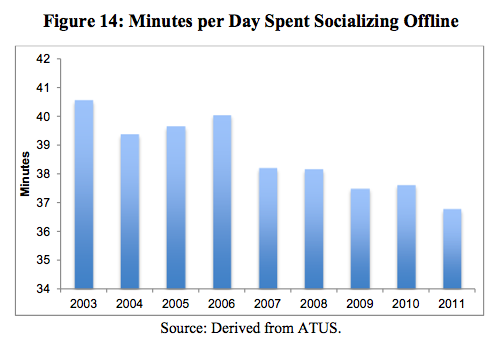
Minutes Socializing

A new paper by Scott Wallsten attempts to find out:

I find that, on the margin, each minute of online leisure time is correlated with 0.29 fewer minutes on all other types of leisure, with about half of that coming from time spent watching TV and video, 0.05 minutes from (offline) socializing, 0.04 minutes from relaxing and thinking, and the balance from time spent at parties, attending cultural events, and listening to the radio. Each minute of online leisure is also correlated with 0.27 fewer minutes working, 0.12 fewer minutes sleeping, 0.10 fewer minutes in travel time, 0.07 fewer minutes in household activities, and 0.06 fewer minutes in educational activities.

When your work is entirely online, the social isolation can even intensify further. One reason I cherish my time in Ptown every summer is that it forces me to have much more physical and personal interaction. Walking down Commercial Street is impossible without bumping into friends, new and old, all the time. And they tend to be on vacation so are more prone to stopping and chatting. It re-humanizes me after so much typing alone onto a screen. The rest of the year, I engage with far more people virtually than I do physically. And that can rob life of its essence. If you’re not careful you begin to live online.

Ben Richmond ponders the effect on socializing:

Even though the segment of time most affected is the biggest—watching TV—Wallsten also points out that there’s a visible social shift.

“Other offline leisure activities that involve interacting with other people are crowded out by online leisure: attending parties and attending cultural events and going to museums are all negatively correlated with online leisure,” he writes. “In short, these results based on ATUS data suggest that a cost of online activity is less time spent with other people.”

Of course, the most popular activity for online leisure is social networking, so worries that we’re all becoming hermits should… tempered, I guess. The nebulous nature of the internet is exactly what makes quantifying if what happens online comes at the expense of something else, because “being online” is terribly descriptive of what you’re doing.

Simone Foxman chips in her two cents:

Although Wallsten can’t prove that more computer time causes less sleep, for instance, he concludes, “that online activities, even when free from monetary transactions, are not free from opportunity cost.” This trend is particularly strong among young people. For example, every minute 15- to 19-year-olds spend online leads to 18 fewer seconds doing educational activities. For Americans 20-24 years old, however, the same minute of online leisure is only associated with losing about seven seconds of educational activity. For older Americans, the impact is even smaller. This data suggests—though does not definitely prove—that teenagers are more likely to devote time that would otherwise be devoted to educational activity to surfing the web or instant messaging than do slightly older young adults.

What’s The Problem With Political Ignorance?

Ilya Somin’s new book argues that such ignorance among Americans makes small government preferable. Sean Trende prefers to look on the bright side:

[A] relatively low-information electorate has helped produce one of the most prosperous, most free societies in world history. This country has adopted many policies that economists seem to deem beneficial: tax rates have fallen, deductions have been reduced, and global trade has grown. We’ve become more tolerant with regard to racial, gender, ethnic, and sexual minorities. Sometimes this has come with a push from the courts (but see Gerald Rosenberg’s The Hollow Hope), but there’s no doubt that the will of the people has played a key role as well. I might hope for a more educated populace, but at the end of the day, I’m not sure American electorate is so broken that it demands the sort of fix that Ilya suggests.

Somin defends himself:

In calling the United States successful, we have to ask, “relative to what?” The answer, of course, is relative to other nations, nearly all of which are either democracies that also suffer from problems caused by political ignorance, or dictatorships.

I do not deny that dictatorships are, on average, much worse than democracies. But the relative superiority of the United States compared to dictatorships and most other democracies is not relevant to the issue I raise in the book: whether democracies would suffer less damage from political ignorance if they limited and decentralized their governments more than they do at present.

During most of its history, the U.S. government was both more limited and more decentralized than most other democracies. The large size, limited central government, and numerous diverse jurisdictions of the United States gave Americans numerous opportunities to vote with their feet. And the informational superiority of foot voting over ballot box voting is, of course, a central thesis of my book. Extensive opportunities for foot voting, rather than ballot box voting, historically made the United States unusual.

Earlier Dish on Somin’s book here.