Political scientist Amanda Murdie suggests that it makes a big difference:
Before coming to Mizzou, I taught in Kansas State’s Security Studies program. The program was mainly comprised of Army officers from the Command and General Staff College at Fort Leavenworth. The first time I taught a grad course on government repression, I called the course “Global Human Rights.” Not a single soldier signed up. The second time I taught the course I called it “Human Security.” The course maxed out and most of the enrollees were active-duty military. The content of the course was exactly the same.
But civilian academia appears just as biased:
My coauthors and I submitted a paper to a human rights journal last fall where I used a human security frame. The content of the paper concerned how military interveners and NGOs influence government respect for freedom from torture, political killings, etc. – clearly a traditional human rights topic. It also focused on how outside interveners influenced development and health outcomes, which are also both human rights and human security concerns. The paper was rejected based solely on a referee report that stated that our use of the “human security” frame meant that we didn’t know the existing human rights literature.
Update from a reader:
When I was in college at Columbia in the early 1990s, I signed up for a class called “Utopias: Quest and Community” in the religion department. On the first day, four other students showed up. The professor (Gillian Lindt) was shocked. “I taught the exact same class last year, and over 100 students signed up.” The year before it was titled “Cults.”
No amount of camera tricks can conceal the fact that the Aeromobil looks downright unsteady as it struggles to keep its balance while gliding barely a few meters off the ground. The clip then ends with an oddly ominous quote from automotive pioneer Henry Ford in which he states, “Mark my word: A combination airplane and motorcar is coming. You may smile, but it will come.” I know the crescendo nature of the presentation was obviously meant to kindle a soul-affirming kind of excitement, but I can’t help but feel an unnerving sense of doubt (especially considering that the project has been in development for about 20 years).
[T]rying to hybridize a car and airplane can be akin to figuring out how to cross-breed a catfish with an eagle. The point being that they’re two completely different animals and the unique attributes that serve particular functions make it trickier to incorporate others. As evidenced by Aeromobil’s video, one of the most vexing issues is coming up with an adequate control and stability system in what’s primarily a road vehicle.
“Most prototype flying cars lack two key ingredients needed for success: They don’t look very good, and they fly even worse,” writes Stephen Pope of Flying magazine. “The new Aeromobil 2.5 out of Slovakia at least has overcome one of these shortcomings. From certain angles, the styling of this flying sports car is simply stunning. Unfortunately, based on the video of its maiden flight, it would seem that stability in the air continues to be a major challenge for roadable aircraft.”
Lindsey Catherine Cornum offers measured praise for Thomas King’s The Inconvenient Indian, writing that “while King’s history is unique in that it is an Indian history actually written by an Indian, it repeats familiar colonial moves—it is still very obviously intended for settlers to read”:
Unlike narratives such as [Dee Brown’s] Bury My Heart, King works to make clear that the injustices of American and Canadian settlement on this continent are not some distant tragedy but a continual process of dispossession and assimilation that continues to the present-day. In general, King is opposed to the word tragedy, perhaps the most common descriptor of Indian history and people. Tragedies are exceptional events, and King pushes the reader to see the injustices committed on behalf of settler governments not as aberrant but necessary to their structure as settler institutions. He presents the catalog of injustices, from the massacres and broken treaties to the residential schools and sexual assaults, but unlike white historians such as Brown, he does not leave them in the past. …
Yet even though King has shown Indians to be more than a collection of past tragedies, there is still very little about his narrative that offers Indians much agency.
King himself notes, “Native history in North America as writ has never really been about Native people. It’s been about Whites and their needs and desires.” It’s unclear whether King is self-consciously describing his own work or not. But most of The Inconvenient Indian is spent exploring images imposed on Indians, laws applied to Indians and horrible acts committed against Indians, and very little on Indian resistance movements. It seems he may have fallen into the same trap. This may be a genuine reflection of what it means to be an Indian. The Indian was born at the moment of contact with whites, and for a long time Indians have been caught in that gaze. King’s book, in fact, recreates some of that gaze to narrate a convenient story to a white audience. But what might an inconvenient Indian do to break from this whiteness and create a truly Indian history?
Reflecting on his book, King summed up his philosophy of inquiry:
Whenever I travel around on book tours and speaking engagements, one of the questions I get asked all the time is, what do Indians want? I’ve never had a good answer for that question, and I must say that this has bothered me. And then one day I realized that it was the wrong question to ask. I realized that if you want to get to the heart of Native/non-Native history, the question you have to ask is, what do Whites want?
His answer? “Land. Whites want land”:
Sure, Whites want Indians to assimilate, and they want Indians to understand that everything that Whites have done was for their own good because Native people, left to their own devices, couldn’t make good decisions for themselves. All that’s true. From a White point of view at least. But it’s a lower order of true. It’s a spur-of-the-moment true, and these ideas have changed over time. Assimilation was good in the 1950s, but bad in the 1970s. Residential schools were the answer to Indian education in the 1920s, but by the twenty-first century governments were apologizing for the abuse that Native children had suffered at the hands of Christian doctrinaires, pedophiles, and sadists. In the 1880s, the prevailing wisdom was to destroy Native cultures and languages so that Indians could find civilization. Today, the non-Native lament is that Aboriginal cultures and languages may well be on the verge of extinction. These are all important matters, but if you pay more attention to them than they deserve, you will miss the larger issue.
The issue that came ashore with the French and the English and the Spanish, the issue that was the raison d’être for each of the colonies, the issue that has made its way from coast to coast to coast and is with us today, the issue that has never changed, never varied, never faltered in its resolve is the issue of land. The issue has always been land. It will always be land, until there isn’t a square foot of land left in North America that is controlled by Native people.
Previous Dish on The Inconvenient Indianhere. Update from a reader:
I always looked on America’s guilt over the native Americans as an odd accident of history. Since the dawn of man, tribes have driven other tribes off of their land, killing each other in the process. One can look pretty much anywhere to see this throughout history. The land that makes up Israel has to be the example that most Christians at least know best. How many different groups have come in a taken that land at the point of a sword and killed or driven out the people that were there?
The native Americans were killing each other over land before the Europeans arrived and continued to do so after the Europeans arrived. So why is there so much guilt over it? I’d claim there are two factors. 1) The government that was responsible is still in power. Unlike other places in the world, people can claim that they were always there (they weren’t) or that was several revolutions ago; the current government would never do something like that. 2) It was so one sided. The native Americans never really had a chance. They had no written language(s), not even Bronze Age technology. Their numbers were their only real advantage and even that was diminished by diseases they had no immunity to brought by the Europeans. We cannot even claim that it was a fair fight.
Jonathan Cohn defends Obamacare’s disappointing initial sign-up numbers by looking at Massachusetts’s experience:
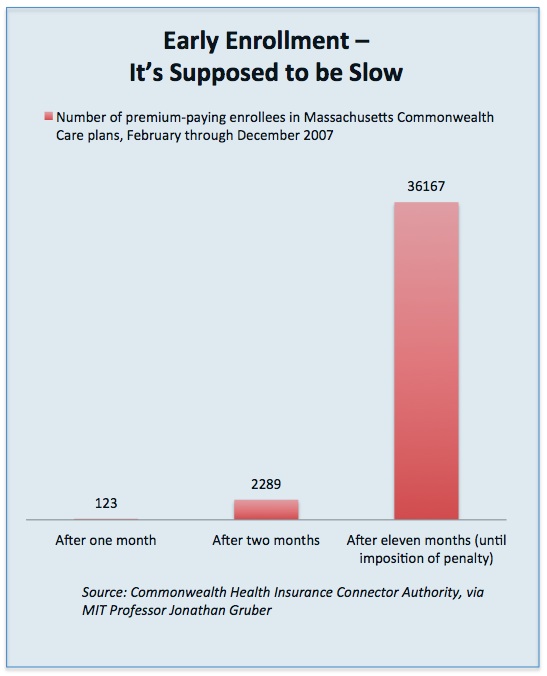
If you want to get a real sense of enrollment patterns among people choosing to shop and buy plans, it’s better to exclude the people getting free care. (In the Massachusetts plan, that would mean people who ended up enrolling in what were called “Type I” and, with some exceptions, “Type IIA” plans.) Jonathan Gruber, the MIT economist who was an architect of the Massachusetts health reforms, has provided me with those numbers. The results? Of the 36,167 people who eventually enrolled in premium-charging plans from Commonwealth Care, 123 signed up in the first month. That’s right—one hundred and twenty-three, or about 0.3 percent. Over the first two months, the number was a bit larger—2,289. But that’s still just 6.3 percent.
The analogy to Obamacare is far from perfect, in that Commonwealth Care didn’t include wealthier people who didn’t qualify for subsidies. (In the Massachusetts scheme, they essentially had a separate exchange—and enrollment there began half a year later.) Also, the Massachusetts open enrollment period was twice as long. So it’s reasonable to expect that, with a fully functional website, early enrollment in Obamacare private plans would be higher than those numbers above suggest. But the general point stands. Very few people sign up for insurance in the first few months. Most wait until much later in the game.
Given Healthcare.gov’s back-end problems, the low number of sign-ups might be better than the alternative. Kliff introduces us to the 834 form:
It is a technical, back-end reporting tool that consumers never see. It is meant to be read by computers, not human beings. It’s the form that tells the insurer’s system who you are and what you need. And it might be the new health-care law’s biggest problem. … Some in the industry believe HealthCare.gov’s traffic problems have been a blessing-in-disguise for the program: If applicants were being able to sign up easily but the 834 forms were coming in with this many errors the results could be disastrous.
Robert Laszewski explains why the 834 forms must be fixed before other parts of the website:
I almost have the sense that HealthCare.gov is in de facto shutdown. Here’s why: Government has to fix the back end before the front end. The demand here is real. I don’t think anyone can dispute that millions of people want to sign up. So if they fix the front end for consumers and thousands of people or hundreds of thousands of people being enrolled before they fix the back end, we’ll have a catastrophic mess.
When insurers are getting 10 or 20 or 50 enrollments a day they can clean the errors up manually. But they can’t do that for thousands of enrollments a day. They have to automate at some point. So I think the Obama administration doesn’t want to cross the red line to shut the system down, but I think this is effectively a shutdown in which they don’t say they’ve shut it down but it basically is shut down.
Now that there are Arabic, Chinese, and Russian alternatives to “.com”, Leo Mirani predicts a “digital land rush”:
Until yesterday, there were only 22 gTLDs [generic top-level domains], all in the Roman script. Now there are 26, and .website, .fish, .discount and .lawyer are also on their way. The four new domains are .онлайн and .сайт (Russian for “online” and “site”), .شبكة (Arabic for “web”) and .游戏 (Chinese for “game”). The new gTLDs present a huge opportunity for speculators – sometimes uncharitably referred to as domain squatters – who register hundreds of domains in the hope that someone, someday, will pay big money for them.
ICANN has taken steps to prevent the most egregious of such cases.
To begin with, 629 words and phrases are off limits entirely. These include addresses that could be used for the International Committee of the Red Cross, the International Olympics Committee and dozens of obscure intergovernmental bodies such as the International Olive Oil Council. Moreover, registrations for the new gTLDs will open to the public only after a “sunrise period” of at least 30 days, which is reserved for trademark holders to register their domains on new gTLDs. … There is no restriction on common nouns, however. That means the Arabic, Russian and Chinese Internet are about to create a few new millionaires, if past experience is anything to go by.
“Duck Dynasty’s” bearded male stars offer a symbolic reaffirmation of traditional values onto which many Americans threatened by social change can latch.
So where are all the big-bearded Republican candidates? And, er, how do you account for Brooklyn? Meanwhile, a runner-up for Beard of the Week:
Late yesterday, the administration announced a six-week individual mandate delay. Originally, even though open enrollment lasts through the end of March, individuals would have needed to buy health insurance by February 15th in order avoid a penalty. Sarah Kliff reported the news:
They are allowing anyone who purchases coverage during open enrollment (up through March 31) to not face a tax penalty for those three months they spent uncovered. This is only true for people who buy coverage through the marketplace.
How much this change had to do with HealthCare.gov’s technical problems isn’t totally clear. On the one hand, it certainly helps alleviate some of the time pressures on the administration if it can give shoppers six additional weeks to purchase coverage. On the other, it’s easy to see this change getting made in any situation. It’s confusing to have two separate deadlines, one when the individual mandate kicks in and another when shopping ends. Either way, now those two dates are the same. The mandate kicks in and open enrollment ends for exchange shoppers on March 31.
Chait bets that “the two deadlines for enrollment and avoiding a penalty, probably would have happened even if HealthCare.gov wasn’t a glitchy mess.” Drum isn’t so sure:
I’m a little surprised the administration is taking this action so soon. After all, if the Obamacare website is up and running by mid-November, that should still leave plenty of time for everyone to meet the old deadline. This suggests that the White House has already concluded that fixing the online application process is going to be a long slog.
Meanwhile, Democratic Senator Joe Manchin will submit legislation to delay the individual mandate by a full year. Chait unpacks the politics of this move:
It’s a pure political maneuver by vulnerable Democrats to insulate themselves from an unpopular national story. And as political theater, it’s a fairly clever maneuver. President Obama could simply veto a legislative delay if it passes. It would have been harder for him to veto a bill delaying the individual mandate if it were tied to reopening the federal government or lifting the debt ceiling. The individual mandate lets red state Democrats engage in some relatively harmless distancing rituals.
If Manchin wants to delay the mandate because he doesn’t like it, he should say so, and he should admit [that] he doesn’t like the law, period, because, otherwise, he’s saying he likes the law, but not the parts that make it work, and that would be a really dumb thing to argue.
Yesterday, friend-of-the-Dish Maria Popova’s wonderfully curated website and newsletter, Brain Pickings, turned seven. There’s really nothing quite like it on the web – a labor of love that consistently turns up the most enriching literary and cultural artifacts, from the daily routines of famous writers to the 100 ideas that changed graphic design. When I look around the web for sites that really do value intelligent content over page-view whoring and advertizing-disguised-as-editorial, Maria’s singular blog perches head and shoulders above the rest.
I’m in awe of her intellectual range and boundless capacity for reading, reading, reading. She is a walking rebuttal to the idea that new media cannot sustain and further deep reading and writing. I see that as the great challenge editorially online – finding a way to harness the energy and curiosity of the web to lead away from ADD listicles and GIFs and toward more long-form reading, complicated thought and intelligent, informed conversation.
Here’s how Maria describes the remarkable growth of her venture:
On October 23, 2006, I sent a short email to a few friends at work — one of the four jobs I held while paying my way through college — with the subject line “brain pickings,” announcing my intention to start a weekly digest featuring five stimulating things to learn about each week, from a breakthrough in neuroscience to a timeless piece of poetry. “It should take no more than 4 minutes (hopefully much less) to read,” I promised.
This was the inception of Brain Pickings. At the time, I neither planned nor anticipated that this tiny experiment would one day be included in the Library of Congress digital archive of “materials of historical importance” and the few friends would become millions of monthly readers all over the world, ranging from the Dutch high school student who wrote to me this morning to my 77-year-old grandmother in Bulgaria to the person in Wisconsin who mailed me strudel last week. (Thank you!)
Later in the post, she offers seven lessons she’s learned from seven years of writing. One of them? “Allow yourself the uncomfortable luxury of changing your mind”:
Cultivate that capacity for “negative capability.” We live in a culture where one of the greatest social disgraces is not having an opinion, so we often form our “opinions” based on superficial impressions or the borrowed ideas of others, without investing the time and thought that cultivating true conviction necessitates. We then go around asserting these donned opinions and clinging to them as anchors to our own reality. It’s enormously disorienting to simply say, “I don’t know.” But it’s infinitely more rewarding to understand than to be right — even if that means changing your mind about a topic, an ideology, or, above all, yourself.
Maria gets both the perils and the promise of web journalism. She seems instinctively to understand what I was forced to learn by daily blogging for a decade and more: a mind is a wonderful thing to change.
In an interview with Fox and Friends this morning, the former Alaska governor promoted her new book about the left’s “war on Christmas” and argued that all Christian holidays should return to the traditional versions practiced by Jesus.
“It makes me so gosh darn angry,” Palin explained. “The liberal left in this country has targeted Christian holidays and is trying to secularize them right out of existence. When Jesus celebrated Easter with his disciples there were no Easter bunnies or egg hunts. There were no Easter sales at department stores or parades in the street. Easter was a special time of prayer and Christian activism. Jesus would gather all the townspeople around and would listen to their stories about the meaning of Easter in their lives. Then he would teach them how to love one another, how to protest Roman abortion clinics and how to properly convert homosexuals.”
I know this counts as a relapse, but I just. couldn’t. resist.
Of the three other polls taken this year, only Pew’s found a majority who believe use of marijuana should be made legal.
Pew’s 52% was far less than Gallup’s 58%, and it, at least, followed the more linear trend of support building slowly over a few years that one might expect. The other two polls conducted in 2013 actually found that more people than not wanted recreational use of marijuana to stay illegal. A survey conducted by Fox News had the number in favor of legalization only at 46%, with 49% opposed. And a Public Religion Research Institute* survey matched the Fox News poll, with 45% in favor of marijuana legalization and 49% opposed
But:
That said, it seems to me that we’re likely heading towards a society in which marijuana will be legal. All pollsters have support for marijuana legalization jumping by about 20 points over the past 20 years. A few more polls that look like the ones from Gallup and Pew will convince me that a majority favor marijuana legalization now.
Just kidding about the downer part. He’s right to focus on all the polls, and not just one, and to see the deeper long-term shifts as the real news here.