Aatif Rashid contrastsThe Newsroom with the recently canceled BBC series The Hour:
Unlike The Hour, [The Newsroom] doesn’t take the inherently liberal agenda of journalism seriously. Journalism has always been a liberal institution, and while this may give some credence to the conservative argument about a liberal media bias, it makes sense when one considers that the function of a journalist is to reveal information that the existing power structures won’t reveal, to in a sense challenge the dominance of the institutions by giving a voice to the voiceless.
The Hour takes this liberal agenda seriously. Journalists like [The Hour‘s] Freddie go out of their way to depict immigrants in a climate of xenophobia, gay people in a climate of homophobia, or anti-war protestors in a climate of war mongering. Additionally, The Hour tackled the issue of government censorship directly in its first season, pitting the new team of journalists against government ministers trying to influence the coverage.
The Hour is also not afraid to skirt the extreme liberal edge of politics (namely, communism). Not only are Freddie’s liberal views tinged with Communist ideas (he considers quoting Marx in his interview), but the first season also contains a significant plotline about a potential Communist spy in the BBC. When this spy is finally revealed, however, the show doesn’t sanctimoniously glorify his downfall but allows him a more subtle and conflicted exit. “I don’t know why they don’t suspect us more, journalists,” the spy says to Freddie. “We’re thrust into world events, life changing events. They expect us not to be changed.” It’s a sentiment worthy of John le Carré and a piercing look at liberal journalism with The Hour‘s characteristic nuance.
Previous Dish on The Newsroomhere, here, and here.
Elyn Saks is an expert in mental health law and a MacArthur Foundation Fellowship winner, which she used to create the Saks Institute for Mental Health Law, Policy, and Ethics. She is also Associate Dean and Orrin B. Evans Professor of Law, Psychology, and Psychiatry and the Behavioral Sciences at the University of Southern California Gould Law School. Saks lives with schizophrenia and has written about her experience with the illness in her award-winning, best-selling autobiography, The Center Cannot Hold: My Journey Through Madness, published by Hyperion Books in 2007.
You can also watch her TED Talk about living with mental illness here.
What should we ask Elyn? Let us know via the survey below (if you are reading on a mobile device, click here):
Lily Rothman watches the above trailer and snarks, “If there was ever any question whether director Wes Anderson’s next film, The Grand Budapest Hotel, would look like a Wes Anderson film, those doubts are hereby assuaged.” Marc Tracy, on the other hand, applauds the director’s dependable style:
Consistency is today the hallmark of our most valuable artists. There is so much stuff produced now—so many movies and albums and books and articles and magazines and browser tabs and Internet memes and hashtag jokes and autotuned crying babies and athlete Instagrams and museum shows and, yes, blog posts. Sometimes word of mouth (or extremely good publicity) guides us to what we should be devoting our ever-diminishing quantity of attention to; occasionally we might be really lucky to happen upon the thing itself. Most of the time, though, we miss what is great, and what is good is not fully appreciated, divorced as it is from a larger context. Increasingly, everything, even works of art, feel like really good BuzzFeed posts: Charming, satisfying, and completely self-contained.
Works produced by artists like Anderson are different. There is inherent virtue to their having a dominant style, even if any individual one is bad. It gives us something to talk about (and to read books about: New York’s Matt Zoller Seitz has a brand-new volume on Anderson). It gives us someone to argue over. It gives us a context in which to enjoy something.
Ian Johnson investigates how the Chinese government has shifted from Marxist sloganeering to more of an American-style nationalism:
Propaganda posters have a long tradition in Communist China, beginning with posters in the 1950s that celebrated the new revolution and urged support for the Korean War. … Xi Jinping’s China Dream posters are linked to this earlier era of Communist sloganeering. The difference is that while the old posters touted Communist values, the new ones largely replace them with pre-Communist Chinese traditions—drawing on traditional folk art like paper cutouts, woodblock prints, and clay figurines to illustrate their message. This is a redefinition of the state’s vision from a Marxist utopia to a Confucian, family-centric nation, defined by a quiet life of respecting the elderly and saving for the future. … Almost all the art used in the posters, with its depictions of traditional dress and poses, used to be derided by the Party as belonging to China’s backward, pre-Communist past; now, these aesthetic traditions are a bulwark used to legitimize the Party as a guardian and creator of the country’s hopes and aspirations.
(Photo: A group of Chinese workers walks past a ‘Chinese Dream’ promotion billboard in Beijing on September 2, 2013. By Wang Zhao/Getty Images.)
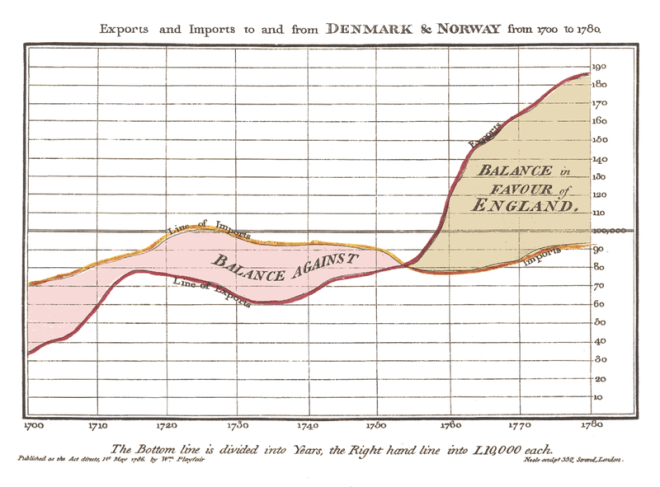
Scottish engineer William Playfair was the first to start designing charts in ways that illustrate clear visual patterns, rather than mere rows and columns:
In the decades after Playfair, Europe came alive with infographic innovation. In 1826, Charles Dupin created a so-called “thematic map” using shading to show the varying levels of illiteracy across France. The German geographer Heinrich Berghaus made this technique famous in the mid-nineteenth century with dozens of works depicting the planet’s climate, animal life, and anthropology. Later in the century, Charles Booth published a map that showed the stunning extent of poverty in London, helping to promote social reforms. Even Florence Nightingale, the mother of modern nursing, invented a new kind of chart to show seasonal changes in casualties during the Crimean War. Called a polar-area chart, it’s still used today.
(Image: William Playfair’s trade-balance time-series chart, published in his Commercial and Political Atlas, 1786, via Wikimedia Commons)
Bilge Ebiri outlinesKill Your Darlings, a new romantic thriller about the interlocking lives of Beat icons Allen Ginsberg, Lucien Carr, Jack Kerouac, and William Burroughs:
Together, the four of them begin to breathlessly explore the creation of a new creative movement, to be called the New Vision, which will rejuvenate American literature and tear down the stuffy, hidebound morality and culture all around them. The nation might think it’s fighting fascism abroad, but these guys are convinced the real fascists are here at home, hiding in the ironclad poetic rules of meter and rhyme, and in the sexual mores governing society. “Let’s make the patients come out and play,” they proclaim. “We need new words, new rhythms!”
What’s that you ask? Oh, right, the murder. While all this is happening, there’s also an older gentleman by the name of David Kammerer (Michael C. Hall), who expresses a bit too much fondness for Lu [Carr]. For all his sophistication, the man is clearly obsessed, pathetically, with this beautiful young boy. He also appears to have given Lu some of his bolder ideas, so the notion of said ideas now being shared with the likes of Ginsberg and Kerouac (all of whom Kammerer sees as potential romantic rivals) clearly drives him nuts. The film opens with Lu dropping Kammerer’s bleeding body into a river, so I’m not really spoiling anything when I say that the story builds up to the older man’s death. Is it a murder, or a blood sacrifice in the name of art? Is he the darling being killed, or is there something more symbolic going on here?
Andrew O’Hehir considersDarlings a solid entry in the recent wave of Beat Generation films, including 2010’s Howl, last year’s On The Road, and the upcoming Big Sur, which hits theaters next week:
One could argue that “Kill Your Darlings” could use a bit more unpredictable or hostile Ted Cruz energy, some sense of the threat the young Beats (who didn’t call themselves that until the ‘50s) posed to the social order. … But despite its unsure moments, “Kill Your Darlings” has considerable advantages over both Rob Epstein and Jeffrey Friedman’s “Howl” and Walter Salles’ ambitious, hit-and-miss adaptation of Kerouac’s iconic “On the Road,” which featured Sam Riley and Kristen Stewart. For one thing, it actually has a plot, a crisp, compact (and mostly true) narrative that unfolds during the latter years of World War II, when Ginsberg first came to New York and met Lucien Carr.
But Jordan Larson suggests that all of these films have missed the mark:
[W]hat’s most problematic about these films isn’t their artistry but their authenticity. … One could argue that these films are only trying to honor the spirit of the Beat Generation, but can you separate the “essence” of a story or a movement from what its progenitors really said and did, and at what point in their lives? Neal Cassady and Jack Kerouac were grown men who were also alcoholics, misogynists, and womanizers who killed themselves with substance abuse. Pretending Kerouac’s life was some sort of consequence-free dream not only does a disservice to viewers, but to the Beats, as well.
A.A. Dowd has mixed feelings about the new film but lauds the depiction of the young, brilliant lovers:
The saving grace of Kill Your Darlings is its sordid romantic angle, a narrative thread that pulls the film away from wink-wink allusions and into more serious emotional territory. At heart, this is a love triangle, one that drops a smitten Ginsberg between the charismatic Carr and the latter’s stalkerish benefactor, David Kammerer, similarly bewitched by the young, sexually ambiguous heartbreaker. Even before the scenario explodes into violence—culminating in a true-crime climax built from hard fact, hearsay, and invention— [director John] Krokidas has mined it for fine speculative melodrama.
It was another great day for marriage equality – with New Jersey expanding human freedom and dignity as of 12.01 am. Tocqueville predicted the sweep, and I insisted on the multiple truths of the Matthew Shepard story. The president failed to truly cop to the disastrous launch of the Affordable Care Act, while insisting he was mad as hell about it. (Joe Klein, who has long criticized Obama for not getting his hands dirty in running the executive branch, must be smiling ruefully somewhere.) As the deal to secure Syria’s WMDs appeared to be working, Israel’s possession of both nuclear and chemical weapons isolated it still further.
Maria Popova offers high praise for David K. Randall’s Dreamland: Adventures in the Strange Science of Sleep. Below is an excerpt from Randall detailing the work of psychology professor Calvin Hall, who began collecting records of people’s dreams in the 1950s:
By the time he died in 1985, Hall had synopses of more than fifty thousand dreams from people of all age groups and nationalities. From this large database, he created a coding system that essentially treated each dream like it was a short story. He recorded, among other things, the dream’s setting, its number of characters and their genders, any dialogue, and whether what happened in the dream was pleasant or frightening. He also noted basics about each dreamer as well, such as age, gender, and where the person lived.
Hall introduced the world of dream interpretation to the world of data. He pored through his dream collection, bringing numbers and statistical rigor into a field that had been split into two extremes. He tested what was the most likely outcome of, say, dreaming about work. Would the dreamer be happy? Angry? And would the story hew close to reality or would the people in the dream act strange and out of character? If there were predictable outcomes, then maybe dreams followed some kind of pattern. Maybe they even mattered.
Hall’s conclusion was the opposite [of] Freud’s:
far from being full of hidden symbols, most dreams were remarkably straightforward and predictable. Dream plots were consistent enough that, just by knowing the cast of characters in a dream, Hall could forecast what would happen with surprising accuracy. A dream featuring a man whom the dreamer doesn’t know in real life, for instance, almost always entails a plot in which the stranger is aggressive. Adults tend to dream of other people they know, while kids usually dream of animals. About three out of every four characters in a man’s dream will be other men, while women tend to encounter an equal number of males and females. Most dreams take place in the dreamers’ homes or offices and, if they have to go somewhere, they drive cars or walk there. And not surprisingly, college students dream about sex more often than middle-aged adults.
Now that we’ve entered the era of smartphones and big data, dream research looks more promising than ever. Taylor Beck describes a new campaign that aims to create “the world’s largest database of dreams”:
Shadow: Community of Dreamers is a mobile app, crowdfunded with $50,000 on Kickstarter, which will wake people, collect dream reports by typing or talking, anonymize them and beam them into a searchable, analyzable online set. … “We can measure how global events affect mankind’s unconscious,” says Shadow adviser and Spanish neuroscientist Umberto León Domínguez, PhD, a researcher in the sleep and circadian rhythms lab at the University of Madrid School of Medicine’s Psychiatry department. The wars in Iraq and Afghanistan, natural disasters, terrorist attacks, elections, and the World Cup are examples of events Domínguez thinks impact people’s dreaming. Data collected on Shadow will show scientists how events like births, deaths, celebrity marriages, and pop cultural breakthroughs like documentaries or marketing campaigns affect global dreaming, too.
“They would rather not see [marriage equality] on the table [in 2016]. They’re focused on economic issues and trying to win … I can see [Christie’s move] playing well to a great deal of them,” – a high-level GOP fundraiser, speaking of the party’s New York donors.