The View From Your Window Contest: Winner #176

vfyw_10-19

A reader writes:

The temple looks like something from Thailand or Cambodia, but since everyone will guess that I am going slightly further afield, to northern Borneo. Kuching, Malaysia? Total guess this week.

Another:

Manila, Philippines? That looks straight out of Apocalypse Now. I bet Kurtz is out there somewhere.

Another:

Mitt Romney’s deck from his secret condo at the Kali River Rapids ride, Animal Kingdom, Walt Disney World, Orlando, Florida. It includes a car elevator.

Who? Another gets the right island:

Somewhere in Bali. Best I can do this week; busy, busy. Spent a good part of Sunday afternoon touring Southeast Asia, but none of the architecture seemed to match. Temples in Bali looked like a perfect match, but in the “land of 10,000 temples,” I wasn’t able to nail down the right one.

Another tries to:

I haven’t submitted an entry recently and wanted to get back on the bandwagon. My bet is that you’ll get a lot of Bali guesses on this one, so I wanted to throw my hat in that ring. I’ve been to Bali a few times, so it seemed obvious to me, but I haven’t been able to pin the location down. This isn’t one of those really iconic spots on the island, so I’m going to guess at the Jagantha temple in Denpasar, Bali, Indonesia.

Another:

One of the more frustrating things about the VFYW contest is also its most fun: Every week I discover a million things that I didn’t know I didn’t know.

I was confident this was Thailand or maybe Cambodia. Browsing Google images, I assumed the architecture was Buddhist. But nothing looked quite right. At some point in my searching, I saw a building that looked very similar. Google’s header was “Hindu temple.” So, I don’t know if I should be ashamed of this or not but I had no idea that Hinduism spread that far south to the point of having so many shrines and temples. I was also struck to see how unique these Hindu structures in Bali were compared to those elsewhere in Indonesia.

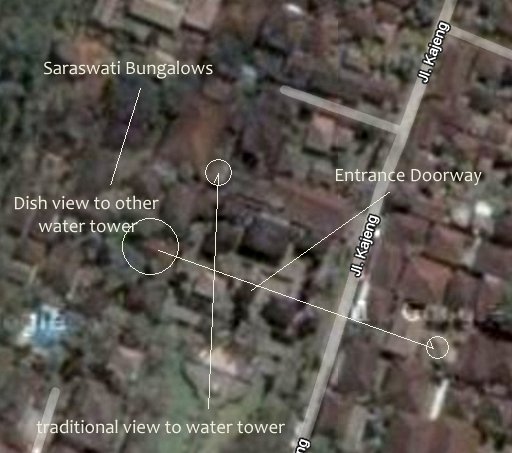
I believe this week’s photo is a view of the Puri Saraswati temple in Ubud, Bali, Indonesia. If you use this image for reference, I think we’re looking at the left entryway, from a building behind the trees a bit to its right (our left). There’s a cafe there but this is an upper level and there’s a fabric curtain so I’m going to guess it’s one of the Puri Saraswati bungalows on site. I am having a helluva time finding a layout or picture of that corner and I’m hungry so that’s as far as I’m getting.

So anyway, thanks for the weekly lessons!

P.S. I just received the VFYW book from my Lviv win and while flipping through it spotted my submission from my parents’ living room. My dad is a longtime Dish reader, and the person who originally encouraged me to become one – I can’t wait to show him!

Another reader photo:

IMG_8214(1)

I started going through my photos of my Bali trip and stumbled on to photos of the same place that’s in your contest photo. The temple is conveniently right next to a Starbucks, where I was able to cool down in air conditioned comfort after trekking all over Ubud (a bit of relief after constantly saying “No, Thank You” to yelled offers of “Taxi, Madam?” from nearly every man I walked by!).

Another:

I’m looking forward to stories of aggressive Temple monkeys snatching glasses off a tourist’s face, pictures of manly men with bushy beards in sarongs at the Temple gates (required attire if you want to be respectful), and idyllic honeymoons spent in Losmen (guest houses) overlooking the temples and rice fields of this arty, scenic, and culturally diverse tourist destination.  Although I’ll be prepared to be depressed by the faux authenticity of it all.  Even on my first visit in 1984 this place was beginning to be overrun – they were just starting to realize the commercial possibilities of bussing tourists around to watch the spectacle of a Hindu cremation ceremony.  By my next visit a decade later, the hot ticket was three-fer tours with a puppet show, a fire dance, and a cremation in a four-hour package.

Still a lovely place, with a population that lives its religion daily, and well worth a visit.

A visual entry:
solution

More than 100 readers recognized the right temple, and close to a dozen guessed the exact room in the hotel, but the following reader guessed a difficult window in the past without winning, among a dozen total entries. So she’s the winner this week:

Pura Sarawiti Bungalows is the place.  And it has some upstairs rooms, which is important, since the view is clearly from the second floor.  And we are clearly looking at the roof of the bar and eating area on the blog.  BUT … the room number. So I’m figuring I need to choose a random room number likely for the 2nd floor, but I find on Travelocity that the rooms have names, not numbers.  Yudistira appears to be on the first floor, many of the rooms are on the street side (unfortunately for those guests), Arjuna gets mixed reviews, but is in back, Agung seems like a possibility.  Gatotkaca has the most beautiful view and overlooks the water palace and dance performances.  I’m going with that one (and guessing it’s the window on the far right in this picture.  Nothing is above it, and to the right is an outdoor area.)  If I needed back up names, I’d say Agung and Arjuna are the other possibilities, but I’m going with Gatotkaca.

From the submitter:

The hotel is the Puri Saraswati Bungalows right in the center of Ubud, about 30 meters east of the Museum Puri Lukisan where the exhibition I’ve curated is running. (By the way, puri means palace and pura means temple.) All the rooms are named for Mahabharata heroes. The photo was shot looking north from the easternmost window of Gatot Kaca, the second floor room of the bungalow that also has Yudistira on the ground floor. The gate is the side entrance to the Pura Taman Saraswati in the southwest corner. Saraswati is the god of science, culture, education, literature, arts and music. She’s a busy lady in Bali.

(Archive)
Just How Badly Did The GOP Lose The Shutdown?

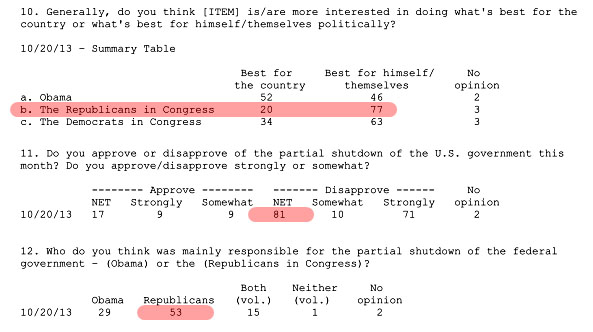
Drum highlights these numbers from a new ABC/WaPo poll:

abc_poll_shutdown

He adds:

Ted Cruz and his fellow tea partiers have done tremendous damage to the Republican Party brand. If I were sociopathic and didn’t care about my country, it would almost be enough to make me hope that they do it again a little closer to Election Day.

The question before the House, though, so to speak, is whether something shifted in the national psyche this past month. Did this stunt that brought the global economy to the brink of a catastrophic collapse deeply alter the public’s views of politics in ways that will last? My hope is yes, unless the Obama administration’s rank incompetence on its highest domestic priority might rescue the GOP from the oblivion it so richly deserves. What gives that hope some evidentiary clout are, to my mind, the following pieces of polling evidence: Independents now favor the Dems over the GOP by 46 – 35 percent; only one in five think Republicans are “interested in doing what’s best for the country,” while 77 percent think they’re “interested in what’s best for themselves politically.” As Sargent notes, among independents, that number is a staggering 14-83. Among moderates 18-81. Among seniors – yes, seniors – 24-74.

So you have a big majority blaming the GOP for the shutdown and near-default; and you have a massive majority (80 percent) believing the shutdown and near-default were bad for the country; and you have a massive majority believing that the GOP is a cynical exercize in partisanship as opposed to a party offering solutions to public problems in good faith.

Now, I’ve reluctantly come to believe all of this over the past ten years or so, but never has there been such an amen chorus. It could be that we just had an aha! moment about the degeneracy of the political right that could shape future politics the way the Gingrich shutdown did. For me, it makes backing Republicans next year unthinkable – and electing a Democratic House a win-win for the country and, perversely, for the cause of GOP reform in the long run. Could that judgment begin to entrench itself among the public as a whole?

Nate Cohn also analyzes the post-shutdown polling:

Last night, two surveys from CNN and ABC/Washington Post showed Democrats building an 8 point lead on the generic ballot; if Democrats could win the popular vote by such a wide margin, they would be well positioned to retake the House. But those 8 point leads might not be as strong as they look. These are polls of registered voters, not likely voters. And once the pollsters apply likely voter screens, the Democratic edge will narrow.

“The Best Thing Going For The GOP”

Hurricane Sandy New Jersey Relief Fund Press Conference

That’s what Ambers calls Chris Christie:

There is nothing he has done — not one thing — that would render him unacceptable to a majority of the 2016 electorate. (Yes, he’s against gay marriage. He’s made it clear, by his actions Monday, that he is not prepared to litigate the issue nationwide, that he understands his personal views are on the wrong side of history, and that he will not expend political capital on an ideological crusade in order to please the Republican base.) If the GOP primary sorts out into a Ted Cruz/Rand Paul revanchist wing and a common sense governing conservative wing, Christie can probably make it through the gauntlet of the GOP nomination contest. And about his size: it still marks him as a regular guy, and his surgery to reduce it is probably enough to satisfy any lingering concerns about his hardiness.

I agree. What makes Christie so potent a figure is his relative moderation compared with the GOP’s current fire-breathers and his Jacksonian, bullying persona. The latter is critical to winning over the South, which might otherwise be repelled by an urban Northeastern pragmatist. The Jacksonian wing of the GOP – think Zell Miller or Dick Cheney – loves a fighter, cheers a brawler, and would swallow whatever disagreements they have with Christie on social issues because of his attitude. And they would love that attitude delivered to the door of Hillary Clinton if she were the Democratic nominee. The real danger of that match-up, of course, would be the gender gap. One flash of the bullying, condescending alpha male in a debate – and I mean something much more inflammatory than “you’re likable enough” – and women voters could recoil, especially if he’s up against the first female candidate for president.

But his response to the shutdown and default crisis was pitch-perfect:

All you need to do is look about 200 miles south of here to see the mess that Republicans and Democrats have made of our national government and we should haul all their rear-ends to Camden today to see how bipartisanship works and government works together.

Weigel analyzes Christie’s decision to withdraw his appeal to New Jersey’s marriage equality ruling:

If marriage was hurting Christie, it wasn’t showing up in public polls. But anything that hurt his margin, and by extension his potential coattails for Republicans in legislative races, was more damaging to Christie’s future than a cave on gay marriage. The Republican primary votes who’ll meet the governor in 2015 will already assume he’s more moderate than they are.

Allahpundit thinks along the same lines:

Electability is, after all, 95 percent of Christie’s argument for the GOP nomination three years from now. It’s not enough to win reelection, which is a lock; he wants to run up the score to show national Republicans that he’s the only guy in the field who can make Hillary worry. Christie’s dream scenario (which he’d never admit to, of course) is that he wins by 25 points in Jersey while true conservative Ken Cuccinelli ends up getting blown out in purplish Virginia. That one-two punch will give a lot of conservatives who dislike Christie pause in ruling him out categorically for 2016.

(Photo: By Michael Loccisano/Getty Images)

Dick Morris Award Nominee

“The growth of the Internet will slow drastically [as it] becomes apparent [that] most people have nothing to say to each other…. By 2005 or so, it will become clear that the Internet’s impact on the economy has been no greater than the fax machine’s,” – Paul Krugman, 1998.

Cheney’s Ticking Time Bomb

ku-bigpic

A reader writes:

I just watched Sanjay Gupta’s interview with Dick Cheney about his new book chronicling his long-time heart problems that finally led to a full transplant a few years ago.  While the headlines have been harping on the “terrorist could’ve hacked his defibrillator”, the striking thing to me was just so sure he was that his extensive list of health problems didn’t have any effect on his decision making. And he sure didn’t like Sanjay’s questions; he most likely presumed he’d be getting softball questions.

One excellent fastball:

[O]n March 28, 2001, Vice President Cheney wrote a “pending” letter of resignation because he suspected he might at any moment become incapacitated by health problems. This was surely a surprise for those affiliated with the Bush campaign who had vetted Cheney’s health before asking him to run. But Cheney’s cardiologist was a big fat liar and told the Bush campaign cardiologist that Cheney “was in good health with normal cardiac function.”

When Gupta asked Cheney to explain the doctor’s false claims, Cheney responded, “I’m not responsible for that.” Gupta answered, “But sir, you saw it.” And then Cheney, refusing to address the lie, dug in: “Listen to me, I think the bottom line is: was I up to the task of being vice president? And there’s no question. I think based upon the fact that I did it for eight years that they were right.”

The transcript from Gupta’s interview is here. Last night he popped on AC360 Later to discuss the interview, prompting my reaction in the video seen below. It’s rare to hear a dispassionate case for the war crimes of Dick Cheney on cable news, so check it out. I didn’t pull any punches:

This embed is invalid

The Administration Can Delay The Mandate Itself

According to Nicholas Bagley and Austin Frakt:

As things stand, the rules the [HHS] secretary has put in place provide for an individualized application process. But nothing in the law prevents her from tweaking that approach. If necessary, she could draft a new rule instructing nonfunctional exchanges — including the federally operated ones — to issue blanket certifications on behalf of all of the uninsured in their states. With those blanket certifications, the penalty would be waived — and all without congressional action. With luck, it won’t come to that and the exchanges will all be operational long before mid-February. But if they aren’t, the Obama administration could spare the uninsured from being punished just because government officials couldn’t build a few websites on time.

Chait welcomes this news:

The real upside here is that, because it doesn’t require Congress, the administration could use a mandate delay to actually improve the functioning of the law, as opposed to using it to destroy the law, as Republicans in Congress have suggested.

The Republican’s mandate-delay plan was to pass a fixed-length mandate delay — they proposed this before any website failures became public — as a condition for reopening the federal government, and then just continue to trade mandate delays for bills reopening government, so that the mandate would be delayed indefinitely. That’s rank sabotage.

Delaying the individual mandate only for states that can’t get the exchanges working, and reinstituting it when the exchanges come online, would be a way of making the program work. Again, that option is a long way off. But it’s there if the need arises. The fact that Obama has the power to do it, and doesn’t need to rely on a Congress bent on repealing the law, probably kills off Congress’s enthusiasm for delaying the mandate.

Sarah Kliff is wary of delaying the individual mandate:

Delaying the individual mandate only in states with glitchy Web sites could, in a weird way, make the federal health-care coverage there a whole lot worse. Without the requirement to purchase coverage, fewer healthy people would likely sign up, and more sick people would flood the system. That, in turn, would likely lead to higher premiums next year in those states that are already having problems with HealthCare.gov. They would, after all, have to figure out a way to cover the costs of their very sick enrollees pool.

A slightly different option would be to extend the open enrollment period, as many investors already expect. The current period, which stretches from Oct. 1 through March 31, was set in Health and Human Services regulations. It doesn’t show up anywhere in the Affordable Care Act. Extending the open enrollment period would give people more time to enroll in coverage, but could still leave them vulnerable to at least part of the individual mandate penalty.

But extending the open enrollment period would, apparently, require action from Congress.

Yglesias Award Nominee

“You have to explain to people, people like me, that the rest of the world doesn’t think the way we do. That’s upsetting for people. But if we want to have our party be effective, we have to accept opinions like that,” – Susan Geddes, an Iowa Republican activist and devout social conservative, on marriage equality.

The Premium On Legal Weed, Ctd

Obama Admin. Unveils New Policy Easing Medical Marijuana Prosecutions

A reader writes:

Just a reality check:  Most coffee shops in Amsterdam charge between 10 and 15 euros per gram ($13 – $20) – and on rare occasions, more than that – for their highest quality weed, which, after conversion in dollars, is equal to or higher than the per gram street price for comparable weed in NYC or Washington D.C.  Perhaps medicinal marijuana users will feel pain from excessive taxation (assuming medical usage is not exempted from that), but for the recreational user, $15 – $20 per gram is a small price to pay for being able to obtain and consume high quality pot legally, without risk of incarceration.

I have bought any number of bottles of wine for $300 or more.  And some wines costs thousands of dollars per bottle because of scarcity.  I guaranty that each expensive bottle of wine that I have purchased was consumed within 8 hours, and pissed into the toilet shortly after that.  Whereas that ounce of high quality weed that I bought for $450 a month ago, and have used at every opportunity outside of work since, is still going strong.

Another reader:

I’ve followed the Dish since ’08 and I’m happy today to join your illustrious list of [tinypass_offer text=”subscribers”].Thank you for all you do; you dish_crop have given me a deeper appreciation of poetry and divinity, not to mention politics. Regarding your short thread on “The Premium On Legal Weed”, enclosed is a pic of me in my medical cannabis grow catching up on the news after getting back from a seminar held for potential applicants to the new state-run marijuana market by the Washington State Liquor Control Board.

I’m not sure how many “industry voices” you get to hear, but as someone who has extensive knowledge growing the highest quality medicinal cannabis, and as someone who is considering his options and the merits of my state’s foray into unknown waters, I thought you might be interested in a “boots on the ground” report to go with the “ivory tower academics thinking they’re businessmen” side of the story I’ve seen so much of lately.

Your readers should know that the report Jacob Sullum references in Forbes about over-taxing leading to really expensive marijuana was made by Mark Kleiman’s company BOTEC. Washington State hired BOTEC as its lead consultant to draft the new rules.  And so along comes Kleiman in his Oct. 19 post writing that legal cannabis will be much, much cheaper than illegal cannabis.  He says, “Anyone who’s worried about the price of cannabis is spending far too much time stoned”.  Are his BOTEC analysts a bunch of stoners then? Because he seems to contradict the findings of his own report to the state of Washington.  To a small business owner weighing cost and benefit, blogger Kleiman seems to be talking from the opposite side of his mouth that he uses when he’s playing consultant Kleiman.

A lot of economists and policy wonks throw around a lot of predictions, but the fact is, nobody knows what will happen with the price of legal marijuana.  Let me share my outlook from what I’ve learned in the six years since I started growing and selling for a living.

Consumers of course want cheap weed.  Kleiman notes Colorado dispensaries selling $5 grams (untaxed). But guess what Mark?  That’s nothing; today it’s even cheaper than that!  In Seattle you can get it for $2 or $3 a gram; the product is called Mexican schwagg.  This is the stuff smuggled over the border in semi-truck tires, usually mostly seeds and stems, state of the art circa 1974.  Point being, consumers already have this choice in the black market but few buy it because its very poor quality.

The current black market may be illegal, but it is definitely an efficient one.  It’s a market that has been in place in Seattle for a very long time, and if there’s one thing Seattleites have learned to love with their improved coffee, improved microbrews and culinary culture, it’s improved buds.  Consumers expect better but want it cheaper, ’twas ever thus.  It’s more realistic to say cheap weed compared to what?  Cannabis comes in many grades. To not mention that we already have super cheap crappy weed seems to me disingenuous, or maybe he doesn’t know.

The conventional wisdom is that once marijuana’s fully legal, the prices will crash.  This may happen.  But based on what I’ve researched and lived, I’m siding with Mr. Sullum’s concern, for the following reasons. First, I seriously doubt how much cushion the black market provides to price support.  Can you name a commodity used by hundreds of millions, maybe billions of people daily that has maintained the same price since 1988? How about illicit drugs?  An eighth ounce bag of decent smoke has cost $40 on the street for 25 years.  I think gasoline was about a dollar a gallon in ’88.  Here in Seattle, home of Hempfest, it’s practically legal already, leading to wholesale prices that have already fallen 25-50% since medical dispensaries really took off about four years ago.  The War On Drugs has been a failure, most would agree, illicit drugs of all stripes have had their real prices go down.  You could say this war is also a failure at keeping prices high.  It’s not a stretch to think maybe illegality isn’t the big reverse price subsidy to the pot industry some people think it is.

People make a good point that economies of scale will bring down costs of production and distribution, and I definitely believe this to be true, to a small extent.  But I also think it’s true consumers I serve have been rightfully spoiled by the high level of product development lately; they expect the best.  When Kleiman equates weed to tea in a teabag or Marlboros in a pack, the practical product equivalent is freeze dried coffee or rot gut in a pop top can.  That’s because marijuana, unlike most plant crops, as you probably know, has trichomes, which break with handling; they’re fragile; they taste bad when grown poorly and keeping them in the good condition discerning buyers expect takes some work and skill. Nice flowers command the price they do because of the labor involved.  Demand is high because most growers aren’t very good at it.

I also think it’s probably safe to say that big factory grows (which already exist and supply the medical market) will probably have the same problems they already have in their quest to equal the quality of smaller ma-and-pa farms.  Budweiser doesn’t make an India Pale Ale.  Legal production may offer efficiencies to lower the price a little on some grades of product, but probably not the better ones, because here in western Washington it is practically legal already and broadly tolerated, even encouraged.  The big price shake-out has probably already occurred courtesy of the medical marijuana market.

Considering these views of price history, current consumer product expectations, a practically already legal environment, the comparative difficulty in producing and the high market demand for quality buds, we now have a very diverse existing market about to be taxed and heavily regulated for the first time. BOTEC’s reports say about 40% of the consumer’s new price will be excise taxes.  For growers, there are also new compliance costs, new testing costs, new security costs, difficulty obtaining banking services, difficulty writing off expenses on federal taxes, difficulty finding suitable real estate (some landlords here are bumping rents 20-40% if you’re cannabis related) etc., etc.  Market efficiencies will most likely not offset these new administration and tax expenses.

Kleiman blogs that this time next year the legal market’s prices will be much, much lower than prices in medical dispensaries today.  That’s a pipe dream. Real prices might decline in five years time, as they gradually have since the late ’80s, but if the Feds come in and add an excise tax on top of the states’, all bets are off.

Regarding this reader’s complaint that “blogger Kleiman seems to be talking from the opposite side of his mouth that he uses when he’s playing consultant Kleiman,” Jacob Sullum explains why Kleiman has changed his tune:

When I interviewed UCLA drug policy expert Mark Kleiman about marijuana legalization in Washington a couple of months ago, he worried that the state-licensed stores will have trouble competing with black-market dealers and medical marijuana dispensaries. He called the projected price advantage for those alternative sources “a big problem,” adding, “The legal market is going to have a hard time competing with the illegal market, but a particularly hard time competing with the untaxed, unregulated sort-of-legal market.” Kleiman, whose consulting firm, BOTEC, was hired to advise Washington’s marijuana regulators, now says he is more optimistic, partly because of the Justice Department’s August 29 memo suggesting that federal prosecutors will refrain from interfering with legalization as long as regulations are strict enough, which Deputy Attorney General James Cole issued a few days after I talked to Kleiman. “I think the DoJ announcement makes a big difference,” Kleiman says in an email message. “Of course things could change. But if they don’t, we’re going to see prices drop like stone.”

Kleiman adds that BOTEC’s June 28 projections suggesting that marijuana in state-licensed stores will cost two to three times what it costs in the black market were based on the assumption that legal pot would be grown indoors, which imposes additional regulatory and logistical burdens. But the Washington State Liquor Control Board later decided, perhaps partly in response to BOTEC’s projections, to allow outdoor growing as well. “Marijuana as a dirt-farmed licit product will be dirt-cheap,” Kleiman says.

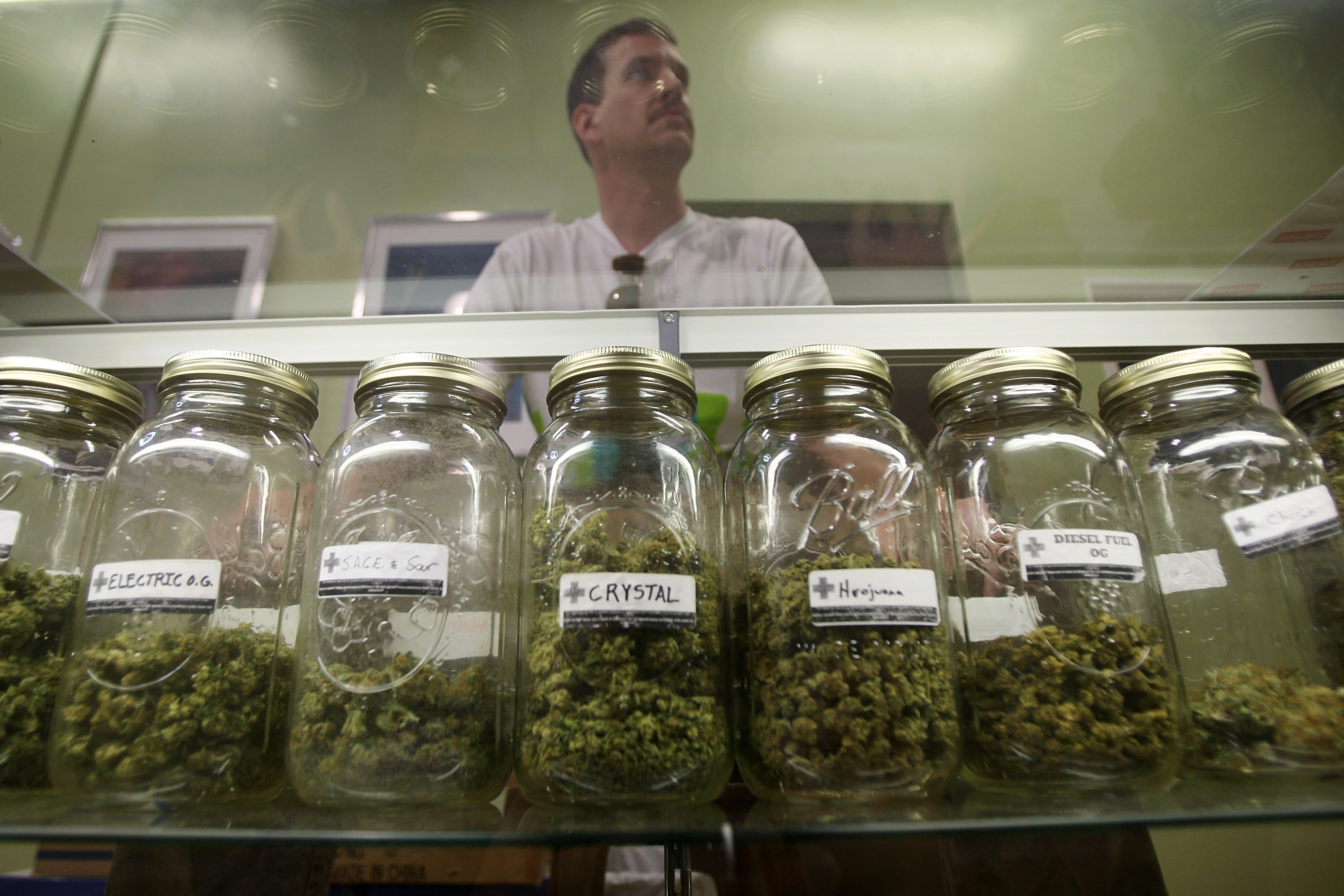
(Photo: Dave Warden, a bud tender at Private Organic Therapy (P.O.T.), a non-profit co-operative medical marijuana dispensary, displays various types of marijuana available to patients on October 19, 2009 in Los Angeles, California. By David McNew/Getty Images)

The Rape Double-Standard, Ctd

A few male readers add the factor of unconsciousness to the thread:

I’m reminded of an incident that occurred while I was backpacking in South America in 1995. I was staying at a hostel in Chile with a friend, and went out for the night with a couple of local girls, one of whom lived/stayed at the hostel. We got real drunk. We danced and flirted. We went back to the hostel. I woke up with this girl on top of me, basically having sex with me. And to this day can’t remember what exactly happened – I just know it wasn’t consensual (on my part). I just shrugged it off, but it definitely wasn’t OK. If this was a guy (me?!) doing this to a girl, I think that it would be judged much more harshly. I don’t know what this says other than what you other contributors have said – there are a lot of shades of grey.

Another:

Well, here’s another similar story for the thread. First of all, this was years ago, when I was in college. And I was absolutely not traumatized by it at all.  In fact, it was pretty awesome.  But it could have been different …

So, this girl and I were just sort of starting to see each other.  Not “dating” per se, but we had had sex once or twice before.  In other words, a new, not-yet-committed kind of relationship. (Ultimately, it never really went past this stage.)

We were at her parent’s house for her birthday party.  Her parents let her have the place to celebrate – which was actually pretty cool of them.  You know, a safe place to drink, etc.  And not a crazy-big party or anything.  A lot of her friends from high school, maybe one or two others from college.  So she was pretty much the only person I knew there, but I was her (informal) date for the party of course.

Anyway, later in the evening I got a pretty bad headache.  One of those (thank God) rare ones that makes you not care about anything.  So I bowed out and turned in, and assured her nothing was wrong – just a migraine from hell, gotta go to sleep.  Sometime later I woke up (no idea how much later) and we were having sex.  My headache was completely gone, so – as I mentioned – the sex was awesome.  And strange, to wake up in the middle of it like that.

So, it was implicit, I guess, that it was okay for her to have sex with me that night.  But really what happened was: she was drunk and horny, and just decided to fuck me.  Didn’t ask first, didn’t even wake me up; just moved my boxers out of the way, got me hard, and climbed on top.  And then I just happened to wake up.  (I mean come on, how could I not?  But ‘waking me up’ was way down on her priority list.)

Reverse the roles and that’s maybe-rape, and maybe just creepy as hell.  But your previous reader is right – there are all kinds of shades of grey on this topic.  And I think in a situation like this – the difference between “cool” and “creepy” – is also the difference between trauma and no trauma.  I mean, how society defines this particular act also influences how we, individually, would define it.

Another story, with a different angle:

I am a male. A large male. A strong male. A not “unbelievable pussy” male. I am a former bouncer in a bar, and have been in more brawls than anyone outside of security/bouncing would normally be in. I take martial arts. I can take pretty much anyone down.

I was in a marriage with an unstable woman who became more unstable as the marriage proceeded. For the record, we had two kids and I tried to make things work and get her to go to counseling – which she would go to and work on sometimes, but not enough. My wife would at times demand sex when I wasn’t interested. I knew that the pain that would follow if I refused. She would make the next month of my life a living hell.

I was coerced into having sex out of fear of a month of emotional pain and emotional abuse and screaming and yelling – and sometimes physical violence – from her to me. I never hit her ever, even if it was part of my personality to hit a woman (which it isn’t), my mom would have killed me if I’d ever even raised a hand.

I called myself “the hairy dildo” to my friends as I lamented the demands and threats my wife made. Is it marital rape? Or something in between rape and bad sex?

I know that I feel awful about being used and forced in that context – that sex had the love and connection part removed for her to get her rocks off – especially because if I ever wanted sex and she said no, that was the end of anything; I respect that boundary. The one time in our 18-year relationship that I “wheedled” my way into sex that she really didn’t want to have (but she explicitly said yes to) she took to calling “rape”. After our marriage ended, she told people I had maritally raped her in that instance. When I challenged her on her claim, she said, “but I really didn’t want to, so technically that’s rape.”