Jessica Love flags a new paper that indicates “our responses to poems that defy our formal expectations may also have an emotional component.” Researchers presented study participants with limericks that, in their final lines, violated a formal property of the poem, such as rhyme scheme, expected rhythm, proper syntax, or overall poem coherence:
[R]esearchers measured participants’ pupils as they listened to the poems. Here, they found that the rhyme violations—and only the rhyme violations—caused the pupils to dilate.
Now, as behavioral measures go, pupil dilation is pretty new, and nobody can argue with any confidence how it should be interpreted. But an earlier study pegged it to mental effort: the faster the mind spins, the more the pupils react. So first the researchers reasoned that rhyme violations in limericks simply elicit more surprise or confusion (and thus require more mental work to overcome that surprise or confusion) than other sorts of violations. But no, a closer look at responses to individual poems revealed that even those rhyme violations that received relatively “ok” ratings still caused pronounced dilation, while other types of “highly anomalous” violations did not. This led researchers to their next preferred interpretation: above and beyond evoking surprise, rhyme violations in limericks pack a singularly emotional wallop.
Ramesh Ponnuru talked to a senator “who requested anonymity so he could describe the party’s problems candidly”:
At a Senate Republican lunch the day of the vote, someone mentioned that the party wasn’t ready to run the Senate: If Republicans had held a majority in both the House and the Senate, they wouldn’t have been able to pass anything in either chamber. The senator thinks such a turn of events would have been “incredibly damaging.” He heard a similar sentiment from the other chamber of Congress: House Republicans from his state have told him how much happier some of their colleagues would be if they were in the minority and could just lob spitballs at the Democrats. “We have to really think how we become the governing party,” he says.
Similarly, Chait argues the Tea Party’s goals are divorced from policy and governing:
On the surface, demanding an end to Obamacare in return for reopening the federal government was an insane negotiating strategy. Attempting to analyze these demands in strategic terms misses the point. It’s not a plan to achieve a defined legislative end. It’s a demonstration of dissent from a political faction that has no chance of winning through regular political channels. The problem they are attempting to solve in each case is not “how do we achieve this policy objective?” but “how can we express our outrage?”
That’s how Binyamin Appelbaum describes today’s jobs report. Neil Irwin’s analysis:
Choose your non-inspiring adjective, possibly in Yiddish, and it nicely describes the long-awaited September jobs report. It wasn’t terrible by any stretch — the nation added 148,000 jobs, and the unemployment rate edged down a tenth of a percent to 7.2 percent. But it is far short of the kind of robust jobs recovery that Americans have been waiting for these last four long years.
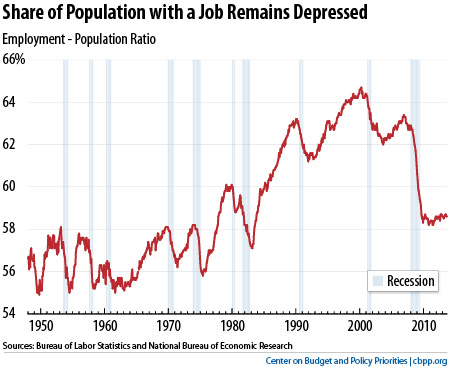
The only positive, if it could be called that, is the decline in the unemployment rate to 7.2%, a near-five year low, from 7.3%. Before rounding, the drop was barely noticeable. Meanwhile, the labour force participation rate held at a multi-decade low of 63.2%.
We should be doing better than this. And if it weren’t for the fiscal cliff deal and the sequester and all the other austerity measures we’ve put in place since 2010, we probably would be. These numbers might very well be double what we’re actually seeing. This, as always, is a self-inflicted wound.
Mary Clarke was raised by a very wealthy father in Beverly Hills, whose business she ran for a while after his death. She married twice and divorced twice, with eight children. Always interested in charity work, Clarke, then Brenner, started to help a priest minister to the hardcore inmates of Tijuana’s La Mesa prison. It changed her life. From her obituary this week:
Ms. Brenner began providing for inmates’ basic needs, giving them aspirin, blankets, toiletries and prescription eyeglasses. She sang in worship services. She received a prison contract to sell soda to prisoners and used the proceeds to bail out low-level offenders. If a prisoner died, of illness or in a gang fight, she prepared him for burial. Inmates told how Mother Antonia once walked into the middle of a prison riot while bullets flew and tear gas filled the air. When the inmates saw her, fearless in her habit, the fighting stopped. She never seemed to stop smiling.
In due course, she decided to move into the prison itself, in a 10′ by 10′ cell in the women’s section:
“It’s different to live among people than it is to visit them,” she told The Washington Post in 2002. “I have to be here with them in the middle of the night in case someone is stabbed, in case someone has an appendix [attack], in case someone dies.”
What makes her ministry even more remarkable is that as a twice-divorced woman, the church hierarchy could never accept her into a religious order. So she simply, like Saint Francis, invented her own. She made her own nun’s habit, and simply did what she believed was God’s work. In the end, the hierarchy – just as with Saint Francis – relented and blessed her new order, The Eudist Servants of the Eleventh Hour. If you are a mature woman and are interested in their work, check out this page. The criterion for joining them is simple:
Members must, in their hearts and in their lives, bear the pain of the poor, the imprisoned, the sick, the rejected, the forgotten and the abandoned children of God.
We have been used to reading such terrible things about religion – from the fanatics who murdered so many on that September morning to the death threats against young girls seeking an education and the burning of schools and massacring of sectarian enemies. No one should deny the unique power of religion turned into an instrument of earthly power and violence. But equally, the countless moments of mercy, tenderness, self-sacrifice and courage that occur every day and that spring from the same religious impulse must always be considered alongside the bad. It was a religious vision that propelled Mary Clarke and a priest called Anthony who inspired her to call herself Sister and then Mother Antonia:
She has said that in 1969 she had a dream that she was a prisoner at Calvary and about to be executed, when Jesus appeared to her and offered to take her place. She refused his offer, touched him on the cheek, and told him she would never leave him, no matter what happens to her.
No, Christopher, religion does not poison everything. It can be used in a poisonous way, but it can also be the most powerful force for human salvation – in the present moment – that we have at our disposal.
What I love about Mother Antonia, above all, however, is her demonstration of the power of women in creating a future for Christianity. She refused to let rules about such things as divorce prevent her from ministering to those she felt need ministry. She refused to let her gender limit her in any way. She – not the male hierarchy – is the church. And she reminds us of the appalling, morally crippling, un-Christian subjugation of women in the Catholic Church.
It must end as a matter or moral urgency, and when it does, the power of women as spiritual leaders and healers may shock and surprise many but elevate us all. In the words of Mother Antonia, from inside a prison where rapists, murderers, gang-lords and hit-men resided:
Pleasure depends on where you are, who you are with, what you are eating. Happiness is different. Happiness does not depend on where you are. I live in prison. And I have not had a day of depression in 25 years. I have been upset, angry. I have been sad. But never depressed. I have a reason for my being.
(Photograph: the biography of Mother Antonia, The Prison Angel, which can be bought here.)
That’s why Jonathan Bernstein is betting against a weeks-long shutdown in January:
All three extended shutdowns in recent American history—the two Newt Gingrich shutdowns in late 1995, and the Ted Cruz shutdown this month—were deliberately planned. In 1995, Gingrich foolishly believed that Bill Clinton was a weak man who would buckle if faced with the risks of an extended shutdown. This year, at least if you accept the surface explanation, radicals believed that a long fight would spark a wave of anger at Obamacare. It’s possible, of course, that Tea Partiers or some other group will decide another long shutdown is the right plan. But don’t expect prolonged shutdown (more than two or three days) to be the natural result of a normal budget stalemate. It doesn’t seem to happen.
Even if we avoid another shutdown, Collender has low expectations for the budget negotiations:
[W]hy does anyone think that the 2014 sequester that will occur on mid-January unless Congress and the White House agree on a deal to stop it will be enough to get everyone to compromise? Everyone also hated it the first time around but it was the best alternative compared to all of the others. Not only will that still be the case in January 2014, it will be even truer this winter with the primaries and general election being only months rather than years away.
That’s not to say that a budget deal can’t or won’t happen in December and January. But it does say that, if there is a deal, it will be much smaller and far more symbolic than significant. It will be the kind of deal where everyone declares victory and goes home.
Charles Casillo profiles John Rechy, the gay hustler-turned-writer whose groundbreaking debut novel, City of Night, just turned 50:
“I want to be known as a writer with a unique life who has transformed that life into literature,” Rechy says. With City of Night he succeeded. City of Night blends Rechy’s poetic vision with his journalistic eye for detail, and he makes his misfit characters yearnings, burnings, and alienation feel universal. The book documents its time, a time when homosexuality was illegal, and still described in medical books as a mental illness. It is one of the best firsthand accounts of what it was like to be gay in the mid-20th century — ostracized — separate from the mainstream world. It reveals, through its characters, how young men couldn’t admit, even to themselves, that they were what society deemed perverted. Rechy recalls. “I remember on a New York subway I saw a man reading a book; I could recognize it right away as City of Night although he had wrapped a different jacket around it.”
The essay also includes a revealing anecdote about Rechy:
“Theres just two ages anyway,” a character in City of Night observes, “youngman and oldman.” After its publication, Rechy, his age murkily sandwiched somewhere between those two extremes, led a bizarrely divided life. He continued hustling the streets and the parks even as he published a steady stream of books — fifteen to date. Simultaneously he became a respected teacher at UCLA and in private workshop classes he gave from his home. Sometimes his carefully compartmentalized worlds collided, as on the evening he was standing shirtless on Hollywood Boulevard, his muscular torso on full display, when one of his students happened to pass by. “Good evening, Professor Rechy,” the bemused student shouted, “Out for an evening stroll?”
Byron York thinks immigration reform can come back from the dead. Drum, on the other hand, can’t find a pulse:
[W]ould the business community like to see a comprehensive bill pass? Sure, probably. Is it a huge priority? No, not really. Are they willing to go along with the obvious reality that it can’t pass the House? It sure sounds like it.
Waldman wants Democrats to revive the immigration reform debate, even if it’s doomed:
The thing is, even if Obama were sure there was next to no chance of succeeding in passing reform, there are few things he could spend time talking about over the next few months that would do more damage to his opponents.
Think about it this way: What’s the GOP’s biggest problem right now? It’s the widespread perception that they’re a bunch of extremists who are willing to throw sand in the gears of the political system to fight anything Barack Obama wants to do, no matter the damage to everyone else, and even the sane people in the party don’t have the courage to stand up to Tea Party nuts. And what happens if we have a debate about immigration?
Well, you’d see a lot of establishment Republicans saying, “This is something we really should do.” And then you’d have a bunch of conservative Republicans saying, “No, no, no!” and making outlandish demands. And I’d rate the chances at somewhere around 99 percent that along the way some of those Tea Partiers will say some ugly things about immigrants that get lots of attention and cause Karl Rove and the rest of the national Republican establishment no end of agita.
Ezra chuckles at how, when it comes to tackling immigration reform, the GOP is “so scared that Obama is trying to destroy them that they’re destroying themselves”:
The unifying excuses for the GOP’s failure to move on immigration reform is that it’s all the Democrats’ fault. York quotes an unnamed Republican lawmaker saying, “Everyone has seen the bad faith exhibited by Obama and Reid during this fiscal fight and I can’t imagine anyone making the case that a final [immigration] product would reflect conservative principles in any fashion.” That’s similar, of course, to Labrador’s contention that Republicans should abandon immigration because Obama is trying to destroy the Republican Party.
The irony is that if you talk to White House officials, their belief has long been that immigration reform might be possible precisely because it would help the Republican Party politically and because the Senate was able to craft a bill that conservatives like Marco Rubio found ideologically congenial. They’ve even tried to keep Obama distant from the process so the Senate Republicans who participated would get much of the credit. If the price of immigration reform is a more competitive Republican Party in 2016, it’s a price the White House is happy to pay.
Up to 85 percent of many insects have same-sex sex. Scientists trying to figure out if this is due to the same evolutionary reasons for widespread homosexual behavior across many species have decided it’s just about confusion. The dudes think other dudes are chicks – yes, all ants look alike even to ants – and they fuck anything that moves and looks fuckable:
“Insects and spiders mate quick and dirty,” Dr. Scharf observes. “The cost of taking the time to identify the gender of mates or the cost of hesitation appears to be greater than the cost of making some mistakes.” … Almost 80 percent of the cases of homosexual behavior appeared to be the result of misidentification or belated identification of gender. In some cases, males carry around the scents of females they have just mated with, sending confusing signals to other males. In other cases, males and females look so similar to one another that males cannot tell if potential mates are female until after they have mounted them.
So many Justin Biebers, so little time. But species with high rates of homosexual sex also tend to be more generally horny, with a penchant for humping beer bottles and … well, basically anything. So you can put it down to bonobo-levels of sex. Or we may not understand it fully yet:
It is also possible, however, that sexual enthusiasm in bugs is related to other evolutionarily beneficial traits, the researchers say.” Homosexual behavior may be genomically linked to being more active, a better forager, or a better competitor,” says Dr. Schart. “So even though misidentifying mates isn’t a desirable trait, it’s part of a package of traits that leaves the insect better adapted overall.” To confirm their theory, the researchers plan to study the conditions that make homosexual behavior more or less likely in bugs. They also want to look more deeply into male resistance to homosexual mating.
Yeah: what about bug homophobia? At what point does the buggered bug turn around and say, “Hey, wait a minute …”?
Joan Walsh wants Obamacare supporters to hold their fire on the failures of Healthcare.gov. Beutler strongly disagrees:
Generally, I think Healthcare.gov’s early failures have provided the left an opportunity to prove that it is in better epistemological shape than the right, and the left has taken it. That’s good for liberalism, and good for the people who write about domestic politics from the left.
But the upshots aren’t entirely abstracted from the technocratic challenge of making Obamacare work. Liberals are contributing to the ongoing public relations fiasco, but that’s a good thing for the law. If the only people making noise about Healthcare.gov were its avowed enemies, decision makers in the administration would be much more likely to create false bases for denying the extent of the challenges. If Ezra Klein and Ryan Lizza say Healthcare.gov is a giant mess and the stakes for fixing it enormous, they’re likelier to listen, and respond as best they can.
Chait agrees that the “coverage of the Obamacare website debacle is a helpful illustration of the epistemic imbalance between left and right.” But he nevertheless thinks that this imbalance is distorting Americans’ impression of the ACA:
Only the negative liberal coverage has pierced the conservative information bubble, as evidence that even die-hard Obamacare lovers recognize the law is failing. … The imbalance in honesty has magnified the impact of bad Obamacare news and blunted the impact of good Obamacare news. And to date, the good Obamacare news seems to be much more significant. Rapidly falling medical inflation suggests that the law’s pay-for-quality reforms may work, perhaps much better than expected. The cost of insurance plans on the exchanges has also come in well under forecast, likewise implying positive things about the success of the markets. Those developments ultimately matter much, much more than the initial success of the website.
Of course they do. And of course it’s possible to bemoan the incompetence and mismanagement from the president on down, while also noting why healthcare reform was necessary in the first place. One thing I suspect we may be under-estimating: this debate inevitably features a couple of core issues. The first is how people with pre-existing conditions can keep insurance over a lifetime. The second is how you restrain costs without the ACA’s pay-for-quality reforms and market competition. You can emphasize both – because the reason for the frustration is because these hugely popular and valuable ideas are not getting the real-time experiment they deserve because of the president’s grotesquely negligent mismanagement of his most important domestic policy legacy.
I have faith in the judgment of Americans, and do not share the agitprop tendencies of Joan Walsh. What matters is the truth. What matters when things go wrong is transparency. What truly worries me is less the website’s failure than Obama’s defensive, secretive posture in response to it. Take the hit as hard as you can now. Explain the fail fully. And move relentlessly forward.