The Führer’s “Performing Flea”

In a 1982 review from TNR’s archives, Samuel Hynes evaluated a biography of P.G. Wodehouse, the British humorist behind Jeeves and Wooster.  He zeroed in on Wodehouse’s lowest moment, when he provided broadcasts for German radio after being captured during WWII.  But Hynes wrote that “as Fascist propaganda [the broadcasts] were surely no more useful than [Ezra] Pound’s were”:

Still, it’s not surprising that the British took a harsher view, and considered that Wodehouse had given comfort to the enemy. He was never tried, but the incident darkened his life, and made him an exile until his death. Even long after the war he could get no assurance from the British government that he would not be prosecuted if he returned to England, and so he ended his days at Remsenburg, on Long Island, though at the last moment the British did relent enough to offer him a knighthood (the Queen Mother’s work, no doubt).

The whole episode is a sad one, reflecting only discredit on everyone connected with it. It is interesting, though, for what it suggests about Wodehouse the man, and also about the kind of writing of which he was so much a master. Throughout the German years, and for long afterward, Wodehouse behaved like one of his own characters—like the imbecile Bertie, or Lord Emsworth, that “vague and woolen-headed” peer whom he admitted he resembled. He never really did understand what he had done that was wrong, and though he regretted having broadcast, it was only because it had offended his readers. The moral issues of the war seem never to have penetrated his woolen head.

Update from a reader:

As is often the case, Orwell got there first. In his wonderful essay “In Defence of P.G. Wodehouse” (July, 1945), he makes the argument that Wodehouse was really only guilty of stupidity and to charge him with treason, etc. was “untenable and even ridiculous.” Orwell believed the that fascism was a distinctly modern (i.e. interwar) phenomenon. Orwell’s contention is that Wodehouse’s mind never moved beyond 1914 (nor did the mental universe of any of his characters, including the knee loving “fascist” Roderick Spode). To Orwell’s mind, Wodehouse was a Victorian who couldn’t even comprehend fascism and Nazi tyranny, let alone be complicit in it. It’s interesting that this is also his argument for why Kipling, that “good bad poet,” was also innocent of fascism – his mental universe never grew beyond the summer of 1914. 

(Video: “P.G.Wodehouse faces the music from his wife, Ethel, following the reception of his broadcasts on German radio during WWII.”)

The Rape Double-Standard, Ctd

A reader writes:

I think one of the things that is being missed by most of the contributors to this thread is that male-on-female rape is rarely about sex.  Typically, it’s an assertion of power on the part of the male, not a desire to get off sexually without seeking the consent of the other.  But in most of the stories sent in by your male readers about non-consensual sex, the dynamic seems different.  In none of those stories does it seem like the female is trying to exert power over the male; it seems like the females just want to get off.  Maybe that’s why the guys respond so differently to being “violated.”

Another reader:

Interesting conversation you’ve been having about the many forms of rape and how we as a society perceive them. I actually think language is posing an obstacle here. Look at “killing”. All killings end with the same result: death. But look at how many legal names we have for it. There’s murder (and even murder one and murder two), manslaughter and involuntary manslaughter. There’s also justifiable homocide, killing in self-defense, suicide, euthanasia, assassination, killing during war – all these distinctions and definitions to describe a variety of traumatic acts that end in the same exact result: death.

And yet we use the word rape to describe a widening range of actions with a vast range of outcomes.

We use rape to describe a man hiding in the bushes, pouncing on a woman in the dark and penetrating her while holding a knife to her throat. And we now also use it to describe a man buying a woman too many drinks at a bar and having sex with her while she’s conscious but inebriated. Both acts are wrong, but do they really deserve to be described with the same word?

Yes, we do sometimes distinguish between rape and statutory rape, but even there, when a male authority figure coerces a young child into sex, is that the same thing as a high school senior smoking a joint with his sophomore girlfriend and engaging in sex that is seemingly consensual, even if the law doesn’t recognize it as such?

And now we bring in the variety of male-victim rapes, many of which are certainly as traumatic as those of the female variety. However, having a stronger man force himself upon you and penetrate you is not the same thing as waking up to find your girlfriend using your sleep-induced erection for her pleasure without your permission. I was once the “victim” of the latter, some 15 years ago. Prior to that, had you asked me, I would have said that waking up to such a scenario might be fun. But it wasn’t. It was annoying, disturbing and felt like a violation. I expressed my displeasure, she apologized and then I felt a little bad for making her feel bad about it. I forgot about it shortly after and never think about except at the rare times like now, when the topic is brought up.

Had it been reversed, had she woken up with me on top of and inside her, I’m pretty sure she would have been far more upset and far more traumatized. In the instance of my being violated, I think it would have been a gross overreaction for me to call the police and cry rape, but in the reverse scenario, that might be a reasonable reaction.

There is a double standard, or a multiple standard, and one of the key factors is penetration. I think I would have felt differently had there been a digit or object inside me than I felt waking up inside her. And I think the distinction is enough to give the two acts different names. One is rape and the other is… something else, maybe harassment?

As for the story that started this all, that of Chris Brown’s loss of virginity at 8 to a girl of 14, it seems there are so many distinctions that keep it from feeling like rape to my mind, and the fact that he is male is NOT one of them. First, he was underage, but so too was the girl. Second, according to his description, she did not in any way seduce him; rather the desire was mutual. And finally, while there was pressure put upon Brown, it did not seem so much to be from the girl as from his environment. You could blame those around him who applied the pressure, but then who would be the culprits … 11 and 12 year old neighborhood boys?

Did the incident in question shape Brown’s attitude toward sex and later actions? Possibly. Probably. But does that make it rape? I just don’t see it.

One more story:

Ok, you finally have provoked me to respond. I unfortunately have a lot of thoughts on this subject. For one thing, I have unequivocally been “taken advantage of” by a girl before. In my college days, back in the ’90s, I went to a friend’s apartment, and when I arrived, I was invited in by her roommate. Her roommate was extremely attractive, and in the process of waiting for my actual friend, somehow she talked me into taking a pill. Now, I liked pills back then, and this is not about my genuine lack of good judgment at a time when I was totally reckless. Besides, I think this girl could have talked me into just about anything.

Regardless, it was a Rohypnol, the infamous roofie of date rape fame. What ensued that night was a total blur. I remember bits and pieces, like ending up at a party with the girl, but not what happened at the party, or what happened when it was over. What I do remember, however, was waking up the next morning, naked in the bed with her, and then taking a shower with her (we were both late for class), as if it were perfectly normal, and wondering, “what the hell just happened?” I wasn’t upset over the thought of having been with her. I was upset that I couldn’t recall any of it. Not one bit. The most satisfaction I got out of it was seeing her naked, and wondering.

Now, I clearly was culpable in the sense that I freely popped a pill which I didn’t have any experience with. But as other readers have pointed out, had the gender roles been reversed, I would clearly have been the aggressor, and she the victim, and subject to prosecution had she desired it.

The bigger picture here is that we, as a society, are using one term, “rape,” in an overly broad fashion. Rape is a crime of sexual violation, with elements of aggression, violence and/or control. What happened to me, was not a crime of aggression, was not violent, and arguably was not about control, as I more than certainly would have had sex with the girl freely, if my consent had been solicited.

Therefore, it can not be rape. It was a non-violent exploitation, maybe even some violation of me (was the violation sexual? Or was it a violation of trust?), with a sexual component, and it didn’t live up generally accepted ethical standards, but it wasn’t rape. Unfortunately, we don’t have a criminal system that recognizes “ethical lapses” as very real, albeit misdemeanor, classes of sexual misconduct. The lack of such distinction, however, means that many people are wrongly accused and convicted over a minor ethical lapse for the same crime as legitimate menaces to society; conversely, many people are never brought to any kind of justice because (in my case) there is no way I would make an accusation of rape against that girl, even if what she did was “wrong,” and I am sure there are many examples of women who have been wronged that aren’t prepared to make a rape claim for similar reasons. And even worse, the contorted legal standard creates the terrifying reality that men in emotionally abusive relationships have to live in fear of being accused of rape, as at least one of your readers alluded to.

As usual, thank you for airing such a sensitive topic.

The Best Of The Dish Today

Upper Ojai-CA-720am

We asked whether the default debacle had wounded the GOP badly enough. I hoped so. I made a way-too-early judgment about Chris Christie’s chances of becoming president in 2017. We noted the fact that the liberal blogosphere was not spinning away the failure of healthcare.gov the way the rightwing blogosphere refused to see the errors in Iraq until it was way too late. One Republican Senator bemoaned the GOP’s current unfitness for any actual, you know, government. And we found out why male bugs bugger each other – because of epistemic closure.

I celebrated the life and spirit of Mother Antonia of La Mesa prison in Tijuana, Mexico, and made a case for the centrality of women in the future of Catholicism. We all celebrated the astonishing new majority – 58 – 39 – for legalizing a drug the US government still insanely argues is as dangerous as any substance we know of. And you’ve never seen a dog shake like this, or a cuter baby platypus.

The most popular post of the day remained Jesus Wasn’t A Republican. The second? Just How Badly Did The GOP Lose The Shutdown?

The window view above is from Upper Ojai, California, at 7.20 am. One final reader email that made my day:

I finally became a subscriber today, after months of ambivalence. I have no particular interest in religious matters, grand bargains, or matters of facial hair. But your unequivocal characterization of Cheney as a war criminal on CNN compelled me to support you financially. If you continue to do for the prosecution of war crimes (including the crime of “looking forward, not backward”) what you’ve done for gay marriage, then I’ll multiply my contribution ten fold over the next couple of years – and tell my friends to do the same.

I will continue to campaign for full awareness of the war crimes of Dick Cheney and for accountability – including from those in the current administration – yes, I’m talking to you, Mr Brennan – who continue to aid and abet the denial. And, as you might have noticed on some other topics, I tend not to give up. You can support that effort quite simply: by [tinypass_offer text=”subscribing here”].

See you in the morning.

A 60-40 Majority For Marijuana Legalization!

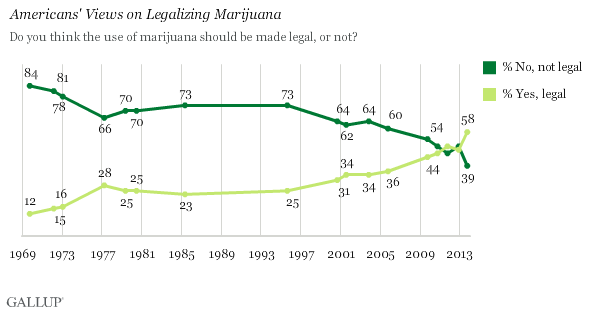
Gallup polled Americans on marijuana and found that “for the first time, a clear majority of Americans (58%) say the drug should be legalized”:

Gallup Marijuana

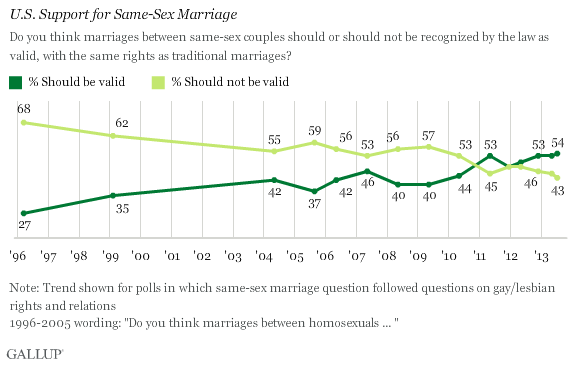
The Dish has waged many campaigns over the years, from ending torture to tackling the long-term debt, but I’m particularly proud of championing two social reforms: the legalization of marijuana and civil marriage for gay couples. They appear very different, but both are about bringing outlaws into the civil mainstream. Being gay went from being a crime to being a citizen in my lifetime. Now, smoking or vaping the harmless, ubiquitous drug, marijuana, is beginning to be thought of as indistinguishable from drinking the much more harmful, ubiquitous drug, alcohol.

jwowsa1ks020ehlt19i1la

What the two reforms also have in common, in my view, is adjusting our social norms to empirical reality. It was always absurd to think of gay people as somehow outside the norms of love, commitment and family. It is empirically insane to treat pot as having no conceivable medical use and classified in the most dangerous category there is. And yet our government proved itself incapable of adjusting to reality on both blindingly obvious questions, until the people long moved past it.

Well, Tocqueville is proven right again, isn’t he?

An experiment in two states with full legalization has revealed the pure fear behind our current criminalization of a plant, just as a single state with marriage equality almost a decade ago began a tidal wave of acceptance. Joshua Tucker sees things the same way:

If anything the public opinion swing on marijuana legalization seems a bit more dramatic … suggesting that policy change could come even faster. Splits based on partisanship are almost the same in both cases — Democrats come in at 65 percent in favor marijuana legalization, 69 percent  in favor of gay marriage, while Republican support is at 35 percent  (marijuana) and 26 percent  (gay marriage) — and in both cases, there is overwhelming support among 18-29 year olds, 67 percent  of whom believe marijuana should be legal and 70 percent  of whom think gay marriage should be legal.

More important: on this issue as with marriage equality, Independents are much closer to Democrats than Republicans, with 62 percent support. The GOP is now effectively the oldest generations’ angry veto of the younger generations’ demography, values and politics. Jacob Sullum looks at other recent polling:

Gallup’s survey asks, “Do you think the use of marijuana should be made legal, or not?” That leaves open the question of whether commercial production and distribution should be legal as well (as in Colorado and Washington). But other national polls that go beyond marijuana consumption also have found majority support for legalization.

In a Reason-Rupe survey last January, for example, 53 percent of respondents said “the government should treat marijuana the same as alcohol.” And last month a Public Policy Polling survey in Texas found that 58 percent of respondents either “somewhat” or “strongly” supported “changing Texas law to regulate and tax marijuana similarly to alcohol, where stores would be licensed to sell marijuana to adults 21 and older.” The latter finding was especially striking given the state’s conservative reputation.

And Josh Barro puts support for marijuana legalization in perspective:

More Americans want to legalize marijuana than think President Obama is doing a good job (44%), want to keep or expand Obamacare (38%), favored attacking Syria (36%), support a 20-cent gas tax increase to pay for infrastructure (29%), or like the Republican Party (28%). And legal marijuana has more than five times as many supporters as Congress does (11%).

The Obama administration is following behind, gingerly. Perhaps it’s because this president was such a hard-core stoner in his youth that he feels a little constrained in even discussing the subject. But his administration could easily revisit the – I repeat – insane classification of marijuana as the most dangerous kind of drug there is. What are they waiting for?

The Ameri-Canada Dream, Ctd

Gopnik ponders Diane Francis’s new book on US-Canada merger:

One never quite knows how seriously to take books of this larksomely utopian kind. That once famous book making an argument for the abolition of television was really meant to point out that we could do well with less—but the seemingly equally unreal “Will the Soviet Union Survive Until 1984?” turned out to be prescient. And Francis’s book, though cheerily deadpan, has some serious points to make. The really significant thing may be that the one crucial holdup to the merger is American medicine. In a section called “America’s Health Care Blind Spot,” she writes, “The US system of health care is indefensible from an economic as well as a business standpoint.” And, she adds, “If Americans had the same system as Canada or Germany the savings would total 1.079 trillion per year.” She also has some harsh things to say—again, strictly from a balance-sheet point of view—about our military. In other words, the takeaway of this free-market, business professor’s view is not that America would engulf Canada but that Canada would need to be sure America was up to grade before it could consider the merger. With all the difficulties Obamacare has had getting set up, that fundamental point is not about to go away.

Earlier Dish on Francis’s book here.

Raised In Outer Space

dish_jellies

Back in the early ’90s, NASA determined that newborn jellyfish nurtured in space are probably not fit for life back on Earth. What does that mean for us?

Jellyfish, foreign to us in so many ways, are like humans in one very particular manner: They orient themselves according to gravity. As the biologist RR Helm explains it:

When a jelly grows, it forms calcium sulfate crystals at the margin of its bell. These crystals are surrounded by a little cell pocket, coated in specialized hairs, and these pockets are equally spaced around the bell. When jellies turn, the crystals roll down with gravity to the bottom of the pocket, moving the cell hairs, which in turn send signals to neurons. In this way, jellies are able to sense up and down. All they need is gravity.

Humans, of course, are similarly sensitive. We sense both gravity and and acceleration using otoliths, calcium crystals in our inner ears that move ultra-sensitive hair cells, thus informing our brains which way gravity is pulling us. So if the space-raised jellyfish didn’t fully develop their version of gravity-sensors, the thinking goes, it’s likely that humans raised in microgravity would have similar trouble.

Previous Dish on jellyfish here and here.

(Photo by Flickr user Croswald9)

The Damage Done By Drones

A new Amnesty International report on drone use in Pakistan captures the physical and psychological damage caused by drone strikes. Friedersdorf hightlights troubling findings from it, such as this one:

“When children hear the drones, they get really scared, and they can hear them all the time so they’re always fearful that the drone is going to attack them,” an unidentified man reported. “Because of the noise, we’re psychologically disturbed, women, men, and children. … Twenty-four hours, a person is in stress and there is pain in his head.” A journalists who photographs drone strike craters agreed that children are perpetually terrorized. “If you bang a door,” Noor Behram said, “they’ll scream and drop like something bad is going to happen.”

Ben Richmond also reads through the report:

Far from solely blaming the United States, the report also points what its authors perceive as failures on the part of Pakistan—for leaving this region of its jurisdiction under-developed, and creating a vacuum to be filled by armed groups who “have been responsible for unlawful killings and other abuses constituting war crimes and other crimes under international law in Pakistan, Afghanistan and elsewhere.”

Pakistan has a poor record for bringing these perpetrators to justice without resorting to the death penalty, and the country’s neglect of the region has also failed to ensure that its residents enjoy key human rights protections.

But also Pakistan has a duty to independently and impartially investigate all drone strikes in its own country and “ensure access to justice and reparation for victims of violations,” just as the United States is obliged to investigate drone strikes and hold those responsible for innocent lives lost accountable.

Human Rights Watch also has a new report on America’s use of drones but its report focuses on Yemen. Abby Haglage analyzes:

The findings paint a portrait of a drone strike program starkly different than the one spelled out during remarks by President Obama in May of this year. “America does not take strikes to punish individuals—we act against terrorists who pose a continuing and imminent threat to the American people,” the president said, adding that terrorists would only be considered a viable target for a drone strike if capture was not feasible.

Contrary to this declaration, however, the report alleges that Obama has continued to approve drone strikes in which a target’s “imminent threat” is not defined, or the option of capture not fully exhausted. On top of potentially unlawful strikes, [report author Letta] Tayler writes, the U.S. has neither offered consolation to the families of civilians killed, as promised by former CIA Director John Brennan, nor so much as acknowledged their role in the death of innocent Yemenis.

America’s failure to acknowledge these wrongful deaths is demonizing it, Tayler concludes. “It’s gotten to the point where many Yemenis fear the U.S. more than they fear al Qaeda in the Arabian Peninsula,” she said. “When the U.S. government is considered more of a demon that one of the most notorious groups in the world…Obama has a major image problem.”

Keating puts both reports in context:

The reports come at a time when the administration is signaling its intention to shift away from the use of drones toward other counterterrorism tactics. However, as the report argues, President Obama’s few statements on the topic indicate that he favors a policy shift away from drones rather than legal guidelines on when and how they can be used.

Face Of The Day

Royal Wedding Held For Sultan Hamengkubuwono X's Daughter Gusti Kanjeng Ratu Hayu And KPH Notonegoro

A woman performs as a fool during a ceremony as part of the Royal Wedding Held For Sultan Hamengkubuwono X’s Daughter Gusti Ratu Kanjeng Hayu And KPH Notonegoro in Yogyakarta, Indonesia on October 22, 2013. Wedding celebrations will take place October 21-23 October. The wedding parade will include 12 royal horse drawn carriages and will be streamed live on the Internet so that it can be watched by people all over the world. By Ulet Ifansasti/Getty Images.

Freedom Fries

From an interview with Three Squares author Abigail Carroll:

Are there any dishes or foods that you would classify as typically, or even exclusively, “American?

A number of iconic foods—hot dogs and hamburgers, snack food—are hand-held. They’re novelties associated with entertainment. These are the kinds of food you eat at the ballpark, buy at a fair and eventually eat in your home. I think that there is a pattern there of iconic foods being quick and hand-held that speaks to the pace of American life, and also speaks to freedom. You’re free from the injunctions of Victorian manners and having to eat with a fork and knife and hold them properly, sit at the table and sit up straight and have your napkin properly placed. These foods shirk all that. There’s a sense of independence and a celebration of childhood in some of those foods, and we value that informality, the freedom and the fun that is associated with them.