Will A Death Spiral Destroy Obamacare?

McArdle worries that Obamacare is entering a “death spiral,” where young and healthy individuals don’t buy coverage and thereby drive up premiums:

[W]hat we have now is a situation where only the extremely persistent can successfully complete an application. And who is likely to be extremely persistent?

1. Very sick people.
2. People between 55 and 65, the age band at which insurance is quite expensive. (I was surprised to find out that turning 40 doesn’t increase your premiums that much; the big boosts are in the 50s and 60s.)
3. Very poor people, who will be shunted to Medicaid (if their state has expanded it) or will probably go without insurance.

Insurance that is only sold to these groups is going to be very, very expensive. Not the first year — President Barack Obama was in the Rose Garden just this morning, touting the fantastic cost savings available to the old and sick people whom Obamacare was already helping. But if those are the only people who sign up, insurers will lose a bunch of money on these policies. And then next year, they’ll ask for a lot more money.

Adrianna McIntyre, on the other hand, argues “delaying the individual mandate for a year wouldn’t provoke a full death spiral” because “there are deep-in-the-weeds protections baked into the Affordable Care Act” that “aid insurers if they wind up enrolling a population that is sicker and more expensive than projected” during Obamacare’s first few years:

Basically, today’s worst-case scenario is that HealthCare.gov takes months to fix and the mandate is delayed until 2015, resulting in widespread adverse selection. Insurers wouldn’t recoup all losses, but the risk corridor program provides their bottom line with a substantial buffer. Importantly, it doesn’t need to be budget neutral; if the math demands it, the government can pay out more than it collects through the program. This could be expensive—the CBO scored the health law as though risk corridors were budget neutral—but it could also be offset by foregone subsidies.

Insurers have a stake in Obamacare’s success; that doesn’t magically disappear if 2014 enrollment is rockier than anticipated. The the risk corridor program continues through 2016, which would allow plans to weather 2014′s uncertainty and probably keep the following year’s premiums relatively unchanged as the risk pool normalizes.

The real risk of delaying the individual mandate is long-term political fallout from Obamacare being labeled a “fiasco”, not the dreaded insurance death spiral.

Barro agrees that insurers will do everything in their power to avoid a death spiral:

Health insurers are eager to add tens of millions of new customers and have every reason to work to prevent a death spiral. Even if website problems that drag into 2014 cause the participant pool to be disproportionately sick, and insurers take a bath for one year, they will be motivated to price in a way that draws healthy participants in for 2015, so long as the website is working well by fall 2014, when 2015 enrollment starts. Still, it would be best to avoid the problem altogether.
TNR Already Did It!

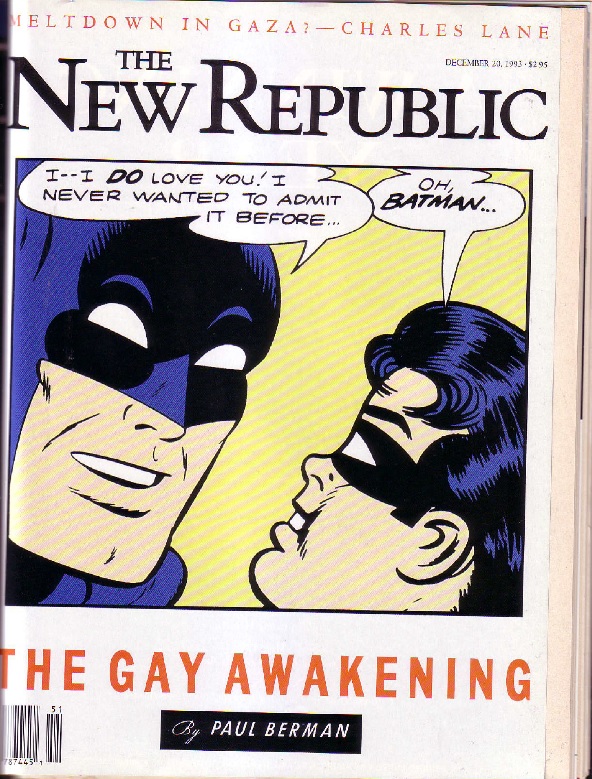
A small note. Jon Rauch’s excellent new essay on the tipping point for marriage equality appeared in American Review. It was titled “A Gay Awakening” and featured a wedding cake with Batman and Robin on top of it. But back in the day at TNR, we did one better. A superb review-essay by Paul Berman was put on the cover and I asked the legendary Chip Kidd if he’d design the image. The title? “The Gay Awakening.” The cover?

tnr_cover_gayawakening

1993 – twenty years before the American Review’s unintended homage.

Sometimes I forget just how out there I was two decades ago. I put it down to youth and inexperience.

Ending Prohibition Is Within Reach

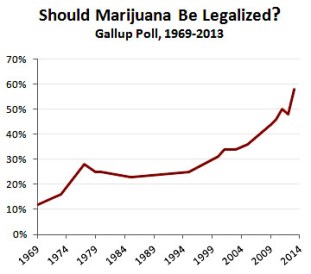
That’s Kevin Drum’s reaction to Gallup’s latest:

I have a rule of thumb that favorability ratings need to reach about 65 percent before you hit a tipping marijuana_legalpoint where a major social change starts getting codified into law nationwide. There’s nothing magic about this threshold. It’s just a general sense based on previous issues similar to this.

And as you can see, public opinion isn’t merely rising on marijuana legalization, it’s accelerating. The rate of increase has gone from about 0.5 points per year in the 90s to 1.5 points in the aughts to 4 points so far in the teens. If this keeps up, we’ll pass the 65 percent threshold by 2016 or so.

Mark Kleiman agrees that, unless the polling trend reverses, that federal legalization will happen in the near future:

If the question of whether to legalize now seems largely settled, that makes the much-less-debated question of how to legalize even more topical. Some of the smarter opponents of cannabis have figured this out, and are now looking for ways of limiting the increase in drug abuse likely to follow legal availability. However, career and ideological interests and group ties are likely to lead the majority of the active drug warriors to keep fighting what now seems like an unwinnable battle, telling one another that legalization is sure to be such a disaster that the public will demand re-prohibition. By doing so, the warriors will help to ensure that the legal system that eventually arises will be over-commercialized, under-regulated, and under-taxed.

This would simply repeat the mistake they made in opposing the medical use of cannabis. While the warriors kept chanting “Cheech and Chong medicine,” the pot advocates rolled right over them.

Mark also takes me to task for downplaying marijuana’s downsides:

Andrew Sullivan strikes a triumphal note. Hard to fault him for that. But goddammit, “less harmful than alcohol” and “not harmful to most of its users” do not add up to “harmless.” Adolescents spin out on cannabis and wreck their academic careers. People of all ages do stupid things while stoned, including driving their cars into trees and other cars. Cannabis now follows only alcohol as the primary drug of abuse reported by people voluntarily entering drug treatment.

Why take the perfectly reasonable case that cannabis should not be illegal and ruin it with the silly claim that the stuff is harmless?

Well, I was perhaps a bit too giddy last night to avoid stupid, simplistic adjectives. In The Cannabis Closet and this blog, we’ve long aired the harms that can attach to the plant. I think it should be kept from teenagers the same way we restrict alcohol (perhaps more so). What I was getting at is that there is no fatal overdose for marijuana – unlike alcohol and so many other drugs; and that almost everything is harmful in certain contexts and degrees: driving sober, for example; or skiing; or sex; or porn. My point is that in this broader context, pot is pretty harmless as these things go. But nuance eluded me last night, for which I apologize.

Krugman’s Dick Morris Award

Yes, Krugman got the Internet wrong. But Andrew Sprung rightly notes how much he has gotten right (at times to my chagrin):

He was right about the Euro. He was right about the Bush tax cuts. He was right about the Iraq war. He was right about the housing bubble. He was right about the size of the stimulus.  And, I just accidentally reminded myself, he was right about Obama’s dreams of postpartisanship. On Jan. 28, 2008, with the country in full flush of Obama fever, Krugman posted a warning that Obama ignored for the first 32-odd months of his presidency.

Cartel Tourism

In an increasingly stable Colombia, the decline of drug violence has led to the rise of drug-violence-themed tourism. Karen Catchpole eyes the market that’s developed around one-time kingpin Pablo Escobar:

Now there are at least 10 companies offering Escobar tours in Medellín – making stops at his grave, the site where he was killed, and other grisly landmarks. My guide on the $45 Escobar tour offered by Medellín City Tours, John Echeverry, says he had to think long and hard before agreeing to take the job. As we turn our backs on Escobar’s grave, Echeverry tells a story about the time that he and 44 of his classmates (including the son of Escobar’s cousin and Medellín Cartel business manager Gustavo Gaviria) were invited to Escobar’s private retreat, Hacienda Nápoles, for the weekend. “There were mini motorcycles for all of us,” Echeverry remembers. “We sat at a long table and we could have whatever we wanted.” He shakes his head. The memory has him caught, like the rest of the country, between Escobar excitement and Escobar shame.

Seeing Human History Through Herpes

A new paper does just that. George Dvorsky summarizes:

The specific virus used for the new study, which was conducted by Curtis Brandt and Aaron Kolb of UW-Madison, is the herpes simplex virus type 1 (HSV-1) which typically causes nothing more than cold sores around the mouth. It’s not lethal, but it’s incredibly virulent. It tends to run in families owing to the manner of infection, which can include simple contact like kissing or through saliva. It’s been such a part of the human story that Brandt refers to herpes as “a kind of external genome.”

For the study, the researchers compared 31 strains of HSV-1 collected in Africa, Europe, Asia, and North America. Then, by mapping the mutation patterns of the virus, they were able to reconstruct the way herpes hitchhiked on humans as they traversed around the globe. By using high-capacity genetic sequencing and advanced bioinformatics, the researchers were able to parse through the massive amount of data embedded within the 31 discrete genomic strains.

Joshua Keating adds:

In general, the paper suggests that the data “supports the “out of Africa model” of human migration with HSV-1 traveling and diversifying with its human host”. There was one North American derived strain which they found was related to the East Asian family of the virus. They estimated the “divergence time” between this strain and its relatives as around 15,000 years which corresponds “with the estimated time period in which the North American continent was populated from Asia, approximately 15,000 years BP.”

In other words, the first arrivals on the North American continent may have brought their cold sores with them.

Laughing In The Face Of Trauma

Lindy West praises the short film Meet My Rapist (seen above) as an effective comedic take on rape, especially from a victim’s perspective:

It’s a brilliant, troubling example of how “rape jokes” can be cathartic and complex and difficult and empowering—for victims and allies, not for the predatory and indifferent. As I’ve said many times before, I don’t want to ban rape jokes; I want to see more rape jokes, everywhere, targeting rape culture instead of perpetuating it. Because nothing punctures and deflates hypocrisy like humor. Nobody speaks truth to power like a sharp-toothed goofball.

The filmmaker, Jessie Kahnweiler, describes how she translated her own experience of rape into comedy:

I think the distance between making the film and the actual rape (which occurred eight years ago) and the frustration came with this feeling, like, “what the fuck, it’s been eight years and I’m STILL not over this? what the hell, man?!” The film deals a lot with my frustration and trying to reconcile being a “strong/ badass feminist” with a “hurting victim,” and being a sexual being as well. There is such a certain amount of guilt and shame around my own body with this experience, and the film was a chance to confront all these lurking fears.

My immediate reaction was just that: a reaction. I was formulating my feelings around my rape based on what other people felt and thought about it. Does that make sense? Like, I was so busy making sure my friends and family knew that I was “OK” that I forgot to ask myself if I actually was “OK.” Perhaps I used humor to skip over the pain and move straight to the hero rape victim, but obviously that shit caught up with me.

How Much Math Do We Really Need?

Long-time math teacher Gary Rubinstein confesses that he would “gleefully chop at least 40 percent of the [math] topics that are currently taught from K to 12”:

Two hundred years ago, students who finished high school learned about as much mathematical content as modern fifth graders learn today. And over the past 200 years, topics were gradually added to the curriculum until the textbooks have become giant bloated monstrosities. And though the modern high schooler ‘learns’ algebra, geometry, algebra II and trigonometry, statistics, and maybe even precalculus and calculus, the average adult still only remembers about as much as the adults from 200 ago did, or about what the average fifth grader is supposed to have learned.

His modest proposal: Make all math instruction optional after 8th grade.

Getting Real About Regret

Carina Chocano finds that those who insist we “just look on the bright side” are “not just as inhumanly opposed to emotion, but also as anti-intellectual”:

In starting to lay out the possible uses of regret, [Janet Landman, author of Regret: The Persistence of the Possible,] quotes William Faulkner. ‘The past,’ he wrote in 1950, ‘is never dead. It’s not even past.’ Great novels, Landman points out, are often about regret: about the life-changing consequences of a single bad decision (say, marrying the wrong person, not marrying the right one, or having let love pass you by altogether) over a long period of time. Sigmund Freud believed that thoughts, feelings, wishes, etc, are never entirely eradicated, but if repressed ‘[ramify] like a fungus in the dark and [take] on extreme forms of expression’. The denial of regret, in other words, will not block the fall of the dominoes. It will just allow you to close your eyes and clap your hands over your ears as they fall, down to the very last one.

Not surprisingly, it turns out that people’s greatest regrets revolve around education, work, and marriage, because the decisions we make around these issues have long-term, ever-expanding repercussions. The point of regret is not to try to change the past, but to shed light on the present. This is traditionally the realm of the humanities. What novels tell us is that regret is instructive. And the first thing regret tells us (much like its physical counterpart — pain) is that something in the present is wrong.