The Original Meaning Of Original Sin

In an overview of Judaism and Christianity, Kenan Malik contrasts their understandings of evil and sin:

The story of Adam and Eve, and of the serpent in the Garden of Eden, was, of course, originally a Jewish fable. But Jews read that story differently to Christians. In Judaism, Adam and Eve’s transgression creates a sin against their own souls, but it does not condemn humanity as a whole, and nor does it fundamentally transform either human nature or human beings’ relationship to God. In the Christian tradition, God created humanity to be immortal. In eating the apple, Adam and Eve brought mortality upon themselves. Jews have always seen humans as mortal beings.

In the Garden, Adam and Eve were as children. Having eaten of the Tree of the Knowledge of Good and Evil, they had to take responsibility for themselves, their decisions and their behaviour. This is seen not as a ’fall’ but as a ‘gift’ – the gift of free will. As the Hertz Chumash, the classic Hebrew-English edition of the Pentateuch and Haftorahs, observes, ‘Instead of the Fall of man (in the sense of humanity as a whole), Judaism preaches the Rise of man: and instead of Original Sin, it stresses Original Virtue, the beneficent hereditary influence of righteous ancestors upon their descendants’.

The story of Adam and Eve was initially, then, a fable about the attainment of free will and the embrace of moral responsibility. It became a tale about the corruption of free will and the constraints on moral responsibility. It was in this transformation in the meaning of the Adam and Eve’s transgression that Christianity has perhaps secured its greatest influence.  The true legacy of the doctrine of Original Sin is not as an explanation of evil, but rather as a description of human nature, a description that came to dominate Western ethical thinking as Christianity became the crucible in which that thinking took place.

The Religion Of Non-Achievement

In recent years, a handful of popular books have been published urging a more robust and radical expression of the Christian faith. I heartily amen the desire to take one’s faith seriously and demonstrate before the watching world a willingness to be more than just Sunday churchgoers. The unintended consequence of this push, however, is that we can give people the impression that Christianity is first and foremost about the sacrifices we make rather than the sacrifice Jesus made for us – our performance rather than his performance for us. The hub of Christianity is not “do something for Jesus.” The hub of Christianity is “Jesus has done everything for you.” And my fear is that too many people, both inside and outside the church, have heard our “do more, try harder” sermons and pleas for intensified devotion and concluded that the focus of the Christian faith is the work that we do instead of the work God has done for us in the person of Jesus.

Furthermore, too many churches perpetuate the impression that Christianity is primarily concerned with morality. As my colleague David Zahl has written, “Christianity is not about good people getting better. It is about real people coping with their failure to be good.” The heart of the Christian faith is Good News not good behavior. When Sunday mornings become one more venue for performance evaluation, can you blame a person for wanting to stay at home?

Taking Pride In Evil

Sam Harris believes that Islamic violence is more troubling than violence carried out by sadists or the mentally ill:

Take a moment to consider the actions of the Taliban gunman who shot Malala Yousafzai in the head.

How is it that this man came to board a school bus with the intention of murdering a 15-year-old girl? Absent ideology, this could have only been the work of a psychotic or a psychopath. Given the requisite beliefs, however, an entire culture will support such evil.

Malala is the best thing to come out of the Muslim world in a thousand years. She is an extraordinarily brave and eloquent girl who is doing what millions of Muslim men and women are too terrified to do—stand up to the misogyny of traditional Islam. No doubt the assassin who tried to kill her believed that he was doing God’s work. He was probably a perfectly normal man—perhaps even a father himself—and that is what is so disturbing. In response to Malala’s nomination for the Nobel Peace Prize, a Taliban spokesman had this to say:

Malala Yousafzai targeted and criticized Islam. She was against Islam and we tried to kill her, and if we get a chance again we will definitely try to kill her, and we will feel proud killing her.

(Video: A clip from a 2011 interview with Malala, prior to her attack. If you missed Jon Stewart’s remarkable interview with her last week, go here.)

Talmudic Technicalities

Adam Kirsch puzzles over some of the stranger interpretations of Talmudic ritual – such as the warning that drinking only two cups of wine invites demons and witchcraft – and surveys attempts by rabbis to find loopholes:

Just as the rabbis codify in great detail exactly what can and can’t be moved on Shabbat, or how tall an eruv has to be, or what time in the evening you can say the Shema, so they lay out the rules and exceptions about urinating between a wall and a palm tree. This is dangerous, they explain, “only when there are not four cubits of space between the two objects. However, if there are four cubits, we have no problem. … And even when there are not four cubits, we said there is a problem only when the demons have no other route besides that one. However, if they have another route, we have no problem with it.”

The ease with which magic and witchcraft find a place in the Talmudic worldview is, to my mind, both illuminating and compromising. For it suggests that the Talmud’s general commitment to exact measurement and correct action—the need to find out exactly how to behave in order to please God, down to the order in which you put on your shoes in the morning—is itself a kind of magical thinking. For the rabbis, Jews are the protagonists of a cosmic drama in which their every slightest action will be either rewarded or punished. There is something ennobling about this, but when the same kind of scrutiny is attributed not just to God but to demons and witches, it begins to seem oppressive and even absurd.

The Crack Of Noon

Berfois recently republished G.K. Chesterton’s pitch-perfect rumination, “On Lying in Bed.” An excerpt:

Instead of being regarded, as it ought to be, as a matter of personal convenience and adjustment, it has come to be regarded by many as if it were a part of essential morals to get up early in the morning. It is upon the whole part of practical wisdom; but there is nothing good about it or bad about its opposite.

Misers get up early in the morning; and burglars, I am informed, get up the night before. It is the great peril of our society that all its mechanisms may grow more fixed while its spirit grows more fickle. A man’s minor actions and arrangements ought to be free, flexible, creative; the things that should be unchangeable are his principles, his ideals. But with us the reverse is true; our views change constantly; but our lunch does not change. Now, I should like men to have strong and rooted conceptions, but as for their lunch, let them have it sometimes in the garden, sometimes in bed, sometimes on the roof, sometimes in the top of a tree. Let them argue from the same first principles, but let them do it in a bed, or a boat, or a balloon. This alarming growth of good habits really means a too great emphasis on those virtues which mere custom can ensure, it means too little emphasis on those virtues which custom can never quite ensure, sudden and splendid virtues of inspired pity or of inspired candour. If ever that abrupt appeal is made to us we may fail. A man can get used to getting up at five o’clock in the morning. A man cannot very well get used to being burnt for his opinions; the first experiment is commonly fatal. Let us pay a little more attention to these possibilities of the heroic and unexpected. I dare say that when I get out of this bed I shall do some deed of an almost terrible virtue.

“Semitic Phantasms”

Anthony Grafton praises David Nirenberg’s Anti-Judaisman intellectual history of Western anti-Semitism. On the image of Jews espoused by the early Church fathers:

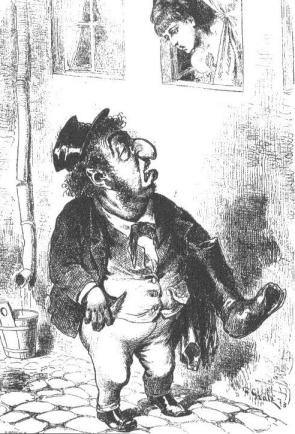
Again and again, Christian thinkers denounced their critics and enemies as “Jews”—that Antisemitic_caricature_1873 is, Christians who read too literally, or with no inspiration. And almost every one of them was denounced in his turn for the same crime of Jewish deviationism. In this world, in which imaginary Jews haunted real cities and their imaginary crimes became the object of real sermons, [St.] Jerome could find it reasonable to insist, almost in the same breath, that the Christian scholar must master Hebrew in order to understand the first half of his own sacred scripture and that Jewish liturgy and practice had lost their entire positive value with the coming of Christ, so that his own duty, as the pupil of a Hebrew teacher, was to hate the entire Hebrew race. …

The Fathers had far less to do with actual Jews than Paul or the evangelists—which is why Nirenberg’s enterprise really takes wing when he reaches them. In the fourth and fifth centuries, the Jews whom Jerome fiercely hated and Augustine drily pitied were largely abstract figures of thought rather than individuals of flesh and blood. Yet they were central to the two men’s visions of the past and the future—and their errors provided vital weapons with which Jerome could fight those who denied his readings of the Bible, and Augustine the Manicheans who did the same to his. Fictional Jews, as vivid as they were imaginary, began to fill the virtual world that the writers conjured into being. 

(Image: anti-Semitic caricature shortly after the big bang at the stock exchange in Vienna, 1873, via Wikimedia Commons)

“Blogging Isn’t Good For The Soul”

That’s what Richard Beck argues in a theologically-inflected rumination on how blogging feeds the competitive, narcissistic tendencies he finds at the heart of original sin:

One of the things I’ve learned from writers like James Alison, a theologian deeply informed by Rene Girard, is how rivalry is intimately associated with our self-concept. Specifically, most of us create, build up and maintain our self-esteem through rivalry with others. Our sense of self-worth is created and supported by some contrast and opposition to others. I am a self in that I am over and against others. Better. Smarter. More righteous. More successful. More authentic. More humane. Less hoodwinked. More tolerant. More insightful. More kind. More something.

In short, selfhood is inherently rivalrous. Rivalry creates the self. Rivalry is the fuel of self-esteem and self-worth.

… From sunrise to sunset every thought I have about myself is implicated in acts of comparison, judgement, and evaluation of others, allowing me to create a sense of self and then fill that self with feelings of significance and worthiness.

Things like blogging, given its nature, can bring these rivalrous feelings to the surface making them more transparent (if you are self-reflective). But it’s just a symptom of a deeper sickness, that the self in inherently rivalrous and that self-esteem is a feeling of significance achieved over against others.

A Poem For Sunday

absolute

“Hunger for the Absolute” by Frank Bidart:

Earth you know is round but seems flat.

You can’t trust
your senses.

You thought you had seen every variety of creature
but not

this creature.

When I met him, I knew I had
weaned myself from God, not

hunger for the absolute. O unquenched
mouth, tonguing what is and must

remain inapprehensible—
saying You are not finite. You are not finite.

(From Metaphysical Dog by Frank Bidart © 2013 by Frank Bidart. Used by permission of Farrar, Straus and Giroux, LLC. Photo by Tristan Bowersox)