“The Law Of Urination”

All mammals great and small take about 21 seconds to pee:

[I]t’s a process driven by the way mammalian urinary systems evolved to eject fluids from the body in the quickest and most efficient way allowable by physics. To make this discovery, Patricia Yang and colleagues brought their high-speed camera to the Atlanta Zoo. They filmed male and female rats, dogs, goats, cows, and elephants taking a whiz. … This allowed them to create a mathematical model of urinary systems – a model showing that mammals take the same time to empty their bladders despite considerable differences in the size of their bladders – differences in volume than can range from 100 milliliters to 100 liters.

Jacob Aron has an in-depth explanation of Yang’s work, which takes into account gravity, viscosity, surface tension, and urethral anatomy. He concludes that the research may “inspire new designs for water towers.”

Watterson Speaks

In only his second known interview since ending Calvin and Hobbes in 1995, the reclusive Bill Watterson discusses the role of the comic strip in an increasingly digital culture:

Where do you think the comic strip fits in today’s culture?

Personally, I like paper and ink better ch2 than glowing pixels, but to each his own. Obviously the role of comics is changing very fast. On the one hand, I don’t think comics have ever been more widely accepted or taken as seriously as they are now. On the other hand, the mass media is disintegrating, and audiences are atomizing. I suspect comics will have less widespread cultural impact and make a lot less money. I’m old enough to find all this unsettling, but the world moves on. All the new media will inevitably change the look, function, and maybe even the purpose of comics, but comics are vibrant and versatile, so I think they’ll continue to find relevance one way or another. But they definitely won’t be the same as what I grew up with.

So should we be on the look-out for a Pixar-produced Calvin and Hobbes movie?

The visual sophistication of Pixar blows me away, but I have zero interest in animating Calvin and Hobbes. If you’ve ever compared a film to a novel it’s based on, you know the novel gets bludgeoned. It’s inevitable, because different media have different strengths and needs, and when you make a movie, the movie’s needs get served. As a comic strip, Calvin and Hobbes works exactly the way I intended it to. There’s no upside for me in adapting it.

Go Comics recently made the Calvin and Hobbes archive available online.  This summer, Dish readers reminisced about the comic here, here, and here. More here.

The Best Of The Dish This Weekend

Baby Giraffe Born In Himeji Central Park

It was a truly rich weekend on the Dish. My personal faves: Christian novelist and writer, Marilynne Robinson, telling it like it is about too many on the “religious right”; the difference between Jewish and Christian views of the Garden of Eden; G K Chesterton on the virtue of staying in bed till noon; a philosophy of tickling – and what it tells us about human nature; this poem by Frank Bidart; and this little flight of interactive Dishness at 4 am in the morning.

The most popular post of the weekend? The Tea Party As A Religion. The second? The Sabotage of American Democracy.

But before I say goodnight, just a short note on the following video in the New York Times Vows section today:

This embed is invalid

In one story of one couple, you see the arc of gay equality and the full wonder of how far we have come in the advancement of human dignity. Just in case you succumb, as I sometimes do, to gloominess about our society and culture, remember Mr Duckett and Dr Jones and their family.

And know hope. Because it is all around us.

(Photo: An eleven-day-old newborn giraffe calf stands beside his mother named Mimi in their enclosure at Himeji Central Park in Himeji, Japan. The baby giraffe was born on October 5, 2013 and stands over 170 cm tall. By Buddhika Weerasinghe/Getty Images.)

Quote For The Day

saints

“[O]ne should strive as far as possible to let all the complexities of argument fall away as often as one can, and to make a simple return to that original apprehension of the gratuity of all things. From that vantage, one already knows which arguments about reality are relevant or coherent and which are not, whether or not one has the conceptual vocabulary to express what one knows. In that moment of remote immediacy to things – of intimate strangeness – there may be some element of unreflective innocence, even something childlike; but any philosophy that is not ultimately responsible before what is revealed in that moment is merely childish. That sudden instant of existential surprise is, as I have said, one of wakefulness, of attentiveness to reality as such, rather than to the impulses of the ego or desire or of ambition; and it opens up upon the limitless beauty of being, which is to say, upon the beauty of being seen as a gift that comes from beyond all possible beings. This wakefulness can, moreover, become habitual, a kind of sustained awareness of the surfeit of being over the beings it sustains, though this may be truly possible only for saints,” – David Bentley Hart, The Experience of God: Being, Consciousness, Bliss.

(Photo by Wesley Peyton)

The Calling Of Comedy

Will Hines explains how improv comedy can become an ascetic, almost religious pursuit:

The most popular improv advice sounds like spiritual challenges. “Follow the fear” — without even considering if that’s actually practical advice for an improvised comedy scene, you want to believe that. You’ve been hungry to have someone tell you to follow the fear. You find a way to make that advice true. You may come to improv because you like comedy, but if you stay, it’s because all this advice challenges you in a way that you’ve been hungry for. You want this to be a more interesting world, and you want to be a braver person, and then in a dingy improv classroom someone is saying it to you. It’s why you don’t mind not being paid, because you are learning. You’re growing as a person, so it seems just that you pay for it. Your shows are not a place where you give your services, but are a place where you are being taught by an audience how to be spiritually and philosophically more bold.

We believe that these improv classes are going to burn away the parts of our personality that we don’t like and leave in its place a braver, more bold person. There is no one more ready to flagellate than a newly excited improv student. “Call me out on my bullshit,” they say. “I like this teacher because they didn’t let me get away with shit.” It’s almost sado-masochistic, their desire to be corrected and fixed. But it’s because they sense a spiritual perfection. The wording of improv lessons baited them into it, and now they want it.

Jesus Wasn’t A Republican

In an interview with the novelist and essayist Marilynne Robinson, Robert Long asked her about the too-frequent identification of Christianity with the religious right in America. She doesn’t hold back:

Well, what is a Christian, after all? Can we say that most of us are defined by the belief that Jesus Christ made the most gracious gift of his life and death for our redemption? Then what does he deserve from us? He said we are to love our enemies, to turn the other cheek. Granted, these are difficult teachings. But does our most gracious Lord deserve to have his name associated with concealed weapons and stand-your-ground laws, things that fly in the face of his teaching and example? Does he say anywhere that we exist primarily to drive an economy and flourish in it? He says precisely the opposite. Surely we all know this. I suspect that the association of Christianity with positions that would not survive a glance at the Gospels or the Epistles is opportunistic, and that if the actual Christians raised these questions those whose real commitments are to money and hostility and potential violence would drop the pretense and walk away.

Looking Up At Infinity

Ross Andersen ponders how generations of people have come to terms with the vastness of the sky:

When we peer into the sky’s abyssal recesses, its blank blues and deep starlit voids, we dish_shiva catch a glimpse of infinity, and, as [philosophy scholar Thomas] McEvilley says, ‘the finite mind has difficulty processing infinity.’ The psychology of this phenomenon was described best by Pascal, the 17th-century mathematician who said the starry sky made him think of time’s crushing enormity. It made him see that human life is a microsecond, beset by two eternities, past and future. ‘The eternal silence of these infinite spaces frightens me,’ he said. And who can blame him? To look at the sky is to be reminded that oceans of space and time lie beyond the reach of our minds. Who can help but feel small under it? By showing us the true scope of the unknown, the sky forces us to confront the mysterious nature of human experience. It puts us face to face with the most basic of truths — that we are all, in some sense, existentially adrift.
Humans have devised several strategies to tame this unnerving quality, none more popular than worship. It’s easy to see why.

Making the sky into a humanlike God is a shortcut to making it legible. If you believe that there is a man in the sky, you can interpret its unpredictable cinema, its colour shifts and stormy whims, as symbolic messages, communications from the cosmic creator. You can graft human traits and desires onto the sky’s impenetrable infinities, and soothe yourself with the comforting notion that the great unknown resembles you in some important way. This philosophical trick is hard for the order-seeking mind to resist, because it leads to a coherent picture of the world. And so, since antiquity, sky gods have gushed from the human imagination, and several of them survive to this day.

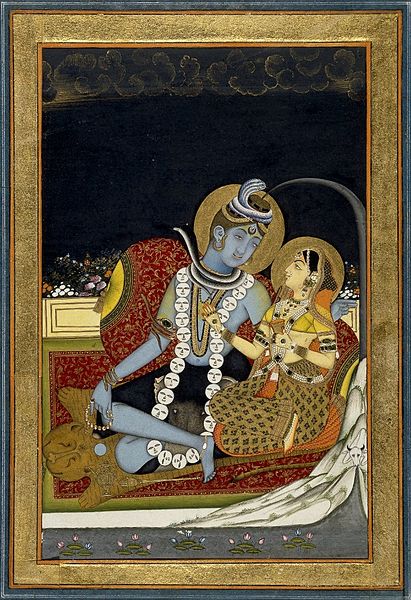
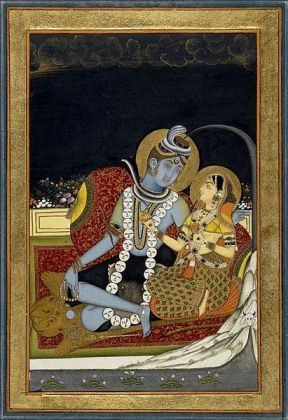
In the West, this practice goes back to the dawn of civilisation, to the Sumerians, whose most exalted deity was the sky god Anu. The Ancient Greeks followed suit by putting Zeus, the sky-father, atop Mount Olympus, and so did the Romans, who worshipped Jupiter for centuries before converting to Christ. Eastern polytheisms had their sky gods, too. Shiva, the supreme god of Shaivism, one of Hinduism’s most ancient denominations, is often described as ‘the cosmic man’. He is typically depicted wearing a crescent moon on his head, an ornament meant to symbolise the waxing and waning of creation during time’s eternal cycles. He wears, in other words, a talisman of infinity.

(Image: Shiva with Parvati, c. 1800, via Wikimedia Commons)

What Does It Mean To Be A Martyr?

The Economist expands the definition to include the experiences of those in the secular West:

Every natural disaster, forest fire, major accident or terrorist attack has its martyrs, insofar as rescuers knowingly incur mortal danger to help victims. I don’t just mean people doing dangerous jobs, but people who knowingly face specific risks to save others. For many people, the martyrs of 9/11 were the fire-fighters who were killed in the Twin Towers, including their remarkable chaplain, Father Mychal Judge.

Our news-gathering business has its martyrs too, sung and unsung. When a reporter for a leading newspaper or network perishes in the line of duty, the world usually hears about it; but most news-reporters who die on the job, bearing witness to some awkward truth, are natives of the benighted countries where they work, often as freelancers, and they lack the insurance policies, flak jackets and diplomatic protection which make the life of a rich-world reporter a bit easier.