The Abatement Of Cruelty, Ctd

Remaining thoughts on the popular thread:

In response to your Aussie reader suggesting kangaroo meat, there’s another very good option in Wild Pigs A Growing Problem In Berlinthe US, if a bit expensive and hard to find.  I’ve almost completely cut pork out of my diet for all of the reasons discussed, but being from North Carolina, giving up pulled pork permanently would be tantamount to treason.  It’s not common yet, but there is an alternative.

Wild boar have been exploding in numbers, particularly in Texas, for reasons that aren’t fully determined (more on that caveat to eating boar in a minute). They’re aggressive, dangerous, very damaging to local flora and wildlife, and incredibly delicious.  They’re also incredibly difficult to hunt, being fairly intelligent and swift of foot, which to me is a healthy challenge to our increasingly complacent collective backsides. Eating boar means you’re eating a gamier pork that needs to be reduced in numbers, and at the very least has lived its life in a natural environment. I’ve had wild boar sausage, and it was amazing.

The caveat, of course, is that there most certainly are boar that are intentionally released for hunts and which contribute to the problem.  We definitely need some way of distinguishing boar that’s killed in wildlife control and boar that’s killed after being intentionally released for sport, which turns the moral equation upside down.

Another zooms out:

I’ve been following your thread about how we can be more humane in killing the animals we eat.  It is fine for those of us who live in a place where we can actually get to a farmer’s market and find grass-fed beef that is killed humanely; however, I think there is a huge disconnect about how we feed the people who live in the United States who barely have access to a grocery store in their neighborhood much less barnyard raised chickens … and even if there were such a thing, they would never be able to afford to buy it.

In 1940, there were approximately 128 million people in the US and lots of family farms; now there are 308 million (probably more since that number is from the 2010 census) that we need to figure out a way to feed.  My dad had a grocery store in a small town and my aunt and uncle had a farm where they raised chickens, cattle and pigs.  In the fall, my dad and two uncles would slaughter a steer and a calf for meat for my dad to sell at his store.  And I am sorry, but when I saw my first calf with his neck cut, bleeding and stumbling around the barnyard until he fell over, I didn’t feel like that calf was treated humanely.  But I understood that that calf was going to feed a lot of people in my hometown (population 500) and at a not very expensive cost. The only expense my dad had was the slaughterhouse he took the animals to be cut up into smaller chunks so that he could store them more easily.  I can still remember the smell – a mix of blood and meat – that permeated the place.

So please tell me how, without factory farming, we are going to be able to feed 310 million people at an affordable price.  And please, if we all became vegetarians/vegans, don’t think that there wouldn’t be factory vegetable gardens (there already are in California and other farm states) and we would probably run out of arable land to feed everyone.  And if there weren’t factory cattle farms, we would quickly run out of space for meat too.

Now what we can do is regulate the hell out of them – which of course, our deregulating Congress wants nothing to do with.  Make sure that the conditions that the animals are kept in and the meat harvested are as safe as we can make it … chickens and pigs, too.  Of course that would mean adding inspectors and following up to make sure, etc. etc.  And how is that going to be accomplished?

I just think it’s really naïve to say that we can all just check out how our meat is harvested and not buy from certain suppliers and the market will force a change.  Until everyone makes enough money to put real pressure on the ranchers, meat producers, etc. it is not going to happen.

Another notes:

I wanted to comment on the research you cited on dog fMRI from the Berns lab that argues that “dogs are people” based on the fact that dogs show emotional processing that activates the caudate nucleus. In my own work I also use fMRI, and the caudate nucleus (part of the basal ganglia) is my primary research speciality.

I think that the methods for training and scanning dogs developed by Dr. Berns and his colleagues are very exciting and will lead to much greater understanding of the mind and brain of dogs. However, I think his emphasis on the caudate nucleus is very misleading. The basal ganglia in general, and the caudate in particular, are actually conserved across all vertebrate species, to a very remarkable degree; there is nothing special about dogs having a caudate nucleus, or using it to feel emotions. Stan Grillner at the Karolinska institute is a leader in the field and has found basal ganglia homologs in axolotl, lampreys, and pretty much every vertebrate ever tested. Even more impressive is recent research that found a basal ganglia like structure in the fly (drosophila)!

A goal of many scientists has historically been to try to find the special thing about our minds and brains that makes us human. Most of these (enlarged prefrontal cortex, ability to use tools) have ultimately been shown to not be unique to our species. So the lesson here might not be that dogs, specifically, are like humans – but that we humans are more closely related to other vertebrates, and even invertebrates, to a much greater degree than we appreciate. That lesson is certainly consistent with the moral argument made by Matthew Scully.

(Photo of a wild boar from Getty)

Rent Is Too Damn High? Don’t Blame The Artists

Ben Davis argues that artists aren’t responsible for gentrification, warning that “until there’s some understanding that gentrification isn’t just about people’s individual lifestyle choices – of artists, or preppies – but a symptom of dysfunctional urban policy, everyone is going to continue to get herded in front of rising rents every few years”:

6641537693_3af515d488_zIn the often-bitter narrative of neighborhood “revitalization,” much more depends on huge forces like average area incomes, social stratification, real-estate speculation, and rent policy than on the magic of art. (Even in artist-led gentrification’s relatively raw form in SoHo there were bigger city planning forces in play, including the Rockefellers’ concurrent push to renew Lower Manhattan.) …  The flip side is that in places like New York, with its turbo-charged real-estate market, artists aren’t really in the driver’s seat. Even in my neighborhood, Brooklyn’s increasingly uncool and preppy Williamsburg, the spectacular transformation of the last decade has not been just some natural process of rising cachet thanks to the art scene. It’s a function of very conscious and hotly contested zoning decisions.

(Photo by NOIR Visionary Studio)

Bright Young Thing

This week the 28-year-old New Zealand writer Eleanor Catton won the Man Booker Prize for her novel The Luminaries. A summary of the book:

“The Luminaries” is set in a town called Hokitika, a Maori word that means “around and then back again”, which offers a clue to the book’s real framework. Twenty characters, every one fully formed, fill the story in 20 chapters, each half the length of the one before and offering what Ms Catton calls “a prismatic view” of events. The plot is based on the signs of the zodiac, a post-modern circular mystery that is astrologically precise and encompasses whores and drunkards, hidden gold, ships and séances, a murder and a lot of mud and bad weather.

Charlotte Higgins spoke to one of the Man Booker judges, Stuart Kelly:

[H]e said that it was [Catton’s] ability to “make the novel think in a way that the novel doesn’t do normally” that set her apart; the way that, for example, she sets astrology and capitalism into play as competing systems of dealing with the world, but at the same time has produced “a rip-roaring read”. “The prize went to the true avant-gardist,” he said. “No novel has been like this before.”

Martha Anne Toll emphasizes the author’s 19th-century influences:

[Catton’s] literary ancestry derives less from her homeland and more from the British and American giants of the nineteenth century. Catton deserves their company. Nodding to Melville, she’s nailed the tormented sea captain and the revenge obsessed “Chinaman.” With so many characters taking on false identities and trying to out-cheat each other in New Zealand’s gold rush, Catton, too, has mined the seamy underside of greed and poverty so beloved by Dickens. Like George Eliot, Catton looks behind the stereotype of the whore and the opium dealer and forces us to question where the real morality lies. By the novel’s end, every character’s initial presentation has been destabilized.

Bill Roorbach appreciates that “Catton has built a lively parody of a 19th-century novel, and in so doing created a novel for the 21st, something utterly new”:

It’s a lot of fun, like doing a Charlotte Brontë-themed crossword puzzle while playing chess and Dance Dance Revolution on a Bongo Board. Some readers will delight in the challenge, others may despair. I went both ways: always lost in admiration for this young New Zealander’s vast knowledge and narrative skill, sometimes lost in her game, wishing at times for more warmth, delighted by her old-school chapter headings (“In which a stranger arrives . . . ”  “In which Quee Long brings a complaint before the law . . . ”), puzzled by her astrology, Googling everything twice and three times, scratching my head, laughing out loud, sighing with pleasure at sudden connections, flipping back pages and chapters and whole sections for rereadings, forging ahead with excitement renewed.

In an interview with Nick Clark, Catton describes what she learned from The Luminaries:

Writing the book, Catton says, became about the quest for self-knowledge. “It explored the degree to which the knowledge of your destiny corrupts a person. A lot of the characters in the book are engaged with their own pasts. What I’ve realised – partly from The Luminaries and partly just a life lesson – is the most revealing thing you can do is to surround yourself with people unlike you. And if you’re an artist the best thing is to read things that are most unlike what you are doing.”

Portraits Of Jewish Life

Chavie Lieber profiles a Brooklyn gallery featuring the work of young Hasidic Jewish artists:

The images displayed in this artistic genre herzog.hisbonenuscan often seem so synthetic: the modestly-clad woman, the Torah scrolls and their scholars—the messages of tradition almost hit you in the face. But every once in a while you’ll come across something that evokes the exact emotion you want to feel when looking at Jewish art, and you’re reminded why these same images and characters have been painted again and again by Jews for thousands of years. …
The variety of the art is expansive, from a brightly colored, four-foot splatter painting by Moully simply titled “Life,” to a cubism-depiction of the seven days of creation, to abstract ink splatters of Hasidic men dancing, to a moody charcoal sketching of children, presumably orphans, lighting Shabbat candles. Oh, and many, many drawings of the late Menachem Mendel Schneerson, the beloved Lubavitcher Rebbe, because an art exhibit blocks away from the Chabad headquarters at 770 Eastern Parkway will, most certainly, feature paintings of the Rebbe.

(Image: Hisbonenus (Meditation), by Musya Herzog)

Going Nowhere

Timothy Noah questions why so few unemployed Americans are moving for work:

Nobody has a better reason to pick up and move than someone who can’t find a job—or at least so it would seem. But while unemployed people remain likelier to migrate than employed people, they are much less likely to migrate than in previous decades. In 1956, for example, 7.6 percent of unemployed males moved from one state to another during the previous year. Subsequently that rate fell to 7 percent (1966), 5.9 percent (1976), 5.3 percent (1986), 4.4 percent (1996), 4.3 percent (2006), and, finally, 2.7 percent (2012).

He concludes that the jobless would move to the jobs … if only they could afford to live there:

Since 2009, when the recession ended, the median price of a new house in the United States has risen 13 percent, even as median household income has fallen by about 4 percent. That doesn’t pose much of a problem for a migrating architect whose income is already well above the median, and who is likelier to have existing home equity that he can transfer to another state. But for construction workers, for example, it’s likely to be a big problem, and a reason why they can’t easily move to where the best-paying jobs are. A construction worker can generally make more money in San Francisco than in suburban Fresno. But it won’t likely be enough more to make up the difference in the relative cost of living. Indeed, few working-class people earn enough money to live anywhere near San Francisco anymore, to the point that there is now a severe shortage of construction workers in the Bay Area.

The Everlasting Listicle

84 57

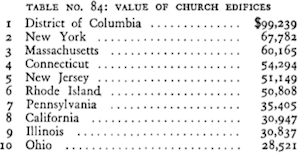
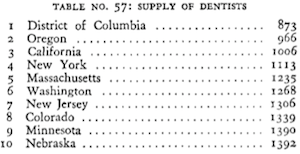
As Emily Badger notes, magazines have been ranking places to live for more than 80 years:

[C]onsider a three-part series by H.L. Mencken that ran in The American Mercury in 1931: It was succinctly headlined, “THE WORST AMERICAN STATE.” In the impressive tome, which covered some 47 pages across three issues of the magazine, Mencken and Charles Angoff methodically ranked the states (at the time, there were only 48 plus the District of Columbia) on everything from farm electrification to literacy rates to the salaries of teachers to the number of natives in Who’s Who in America. (*Blush*: They also included the local circulation per thousand people of The Atlantic Monthly). 

Matt Carmichael, editor of the website Livability.com, dug up this gem (“on microfiche!”) while working on a much more modern ranking of America’s 100 best small and mid-sized cities to live in, which he’s published today. … Mencken’s list, Carmichael notes, included some metrics we would never measure today, like the prevalence of lynchings (surprise leader: Wyoming) or death rates from typhoid fever (sorry again, Mississippi).

In preparing his own ranking, Carmichael became interested in how ideas about quality of life evolve, and not just with respect to rising living standards. “What would you have measured if you were doing a ‘best places to live’ list in 1965?” he asks. “Would it have been mall density? Or cul-de-sacs per capita?”

Amazon’s Porn Dilemma

Meghan Neal outlines the latest controversy in the e-publishing world:

Kernel magazine published an exposé last week detailing the dark corner of Amazon’s Kindle store that features [self-published] adult novels about truly repulsive topics like incest rape, pedophilia, and sexual abuse. Understandably, an uproar ensued, and retailers scrambled to take down the offending titles. But some people are worried that retails are overreacting, or that the take-downs will set a dangerous precedent for squashing free speech. Yesterday, the British bookseller WH Smith went so far as to shut down its entire website in response to the article. The site is still down as of this writing – with a landing page and apology up in its place.

The exposé notes that Amazon already has “strict guidelines for amateur authors who wish to self-publish with the Kindle Direct Publishing service”:

“We don’t accept pornography or offensive depictions of graphic sexual acts,” say the guidelines. “What we deem offensive is probably about what you would expect.” But the authors of these works are setting up fake publishing houses for themselves, which can be as simple as paying $200 for a set of ISBN prefixes, bypassing such restrictions.

PJ Vogt wishes Amazon had kept the smut on the digital shelves:

We outlaw snuff films, child porn and, increasingly, revenge porn, because actual people are harmed during their production.

Erotic fiction concerns fake characters who don’t exist in real life. You could argue that entertainment that caters to people’s darkest fantasies makes them more likely to enact them, but the science wouldn’t support you.

As for the idea that these books are just in bad taste, well, absolutely. They’re the worst. But you won’t find these books unless you’re looking for them. They don’t show up in Amazon search results, you have to go directly to their link. They’re hidden away in the digital equivalent of the video store’s curtain-covered backroom.

Meanwhile, Laura Hazard Owen wonders what a cleaner e-book marketplace would look like:

If e-book retailers truly want no porn to be sold through their sites, they’ll have to spend much more time and money than they do now implementing both automatic and human filters. They’ll also have to clarify exactly what they mean by porn, and in doing so they’ll risk alienating many authors and readers. The book industry reaped massive profits from the bestselling erotic trilogy. If that’s okay, but other porn isn’t – if, for instance, child rape porn is unacceptable – retailers will have to be much more explicit in publicly declaring what is and isn’t acceptable.

The Best Of The Dish Today

Screen Shot 2013-10-17 at 7.46.55 PM

If there is any reporter who met his moment these last few weeks, it’s been Robert Costa, who’s been timely, essential and correct. His exit interview with McConnell is interesting. Basically, it confirms there can be no bargain with the Democrats on the budget because of the GOP’s absolute insistence on no net revenue gains at all, unless they are “dynamically scored”:

When the speaker has had conversations with the president over the last three years, they have always insisted on a $1 trillion tax increase — revenue scored by the Congressional Budget Office. That’s their demand for any major entitlement reform. But we don’t think we should have to pay a ransom to do what the country needs.

So giving the Democrats something in return for entitlement reform is “ransom.” It doesn’t get much clearer than that. But this is a relief, if it holds up in the next few months:

One of my favorite sayings is an old Kentucky saying, “There’s no education in the second kick of a mule.” The first kick of the mule was in 1995; the second one was the last 16 days. A government shutdown is off the table. We’re not going to do it … [W]e’re not going to do this again in connection with the debt ceiling or with a government shutdown.

I may be misinterpreting the exchange but that sounds like future debt ceiling brinksmanship is not something McConnell supports. Sahil Kapur notes too that “a provision in the Wednesday legislation allows Congress to vote on a ‘motion to disapprove’ of a debt limit hike, without a real threat of default. That suggests the debt limit appears to be returning to its traditional place: an opportunity for the party out of power to grandstand and score political points against the president.” “Suggests” is not “proves”, but it could be something.

Looking back at today, we launched the great salsa-ketchup Drudge-Dish debate, maybe out of punchy loopiness after the last few weeks of reckless brinksmanship. But I took a moment to fisk a paragraph on Fox News’ website that revealed the stark surrealism of Tea Party absolutism. Even Grover Norquist sounded moderate as countless beards were shaven. We analyzed the votes of the Republicans in Congress, and counted the human casualties and broader economic damage they have already done to the economy since 2010. One reader told us all to cheer up, as I urged the president to return to Bowles-Simpson and backed a Democratic wave in 2014 as the best response to the excruciating legislative poop-throwing of October.

Plus: dogs that play tetherball and toddlers who behave like Republicans! And the best review of The Walking Dead I’ve ever, er, watched.

The most popular post of the day was “The Tea Party As A Religion“. The second most popular was “The Sabotage Of American Democracy.” In October, our traffic so far at the halfway point is almost as much as all of September. Blame – or credit – the Tea Party!

See you later tonight on AC360 Later and in the morning.

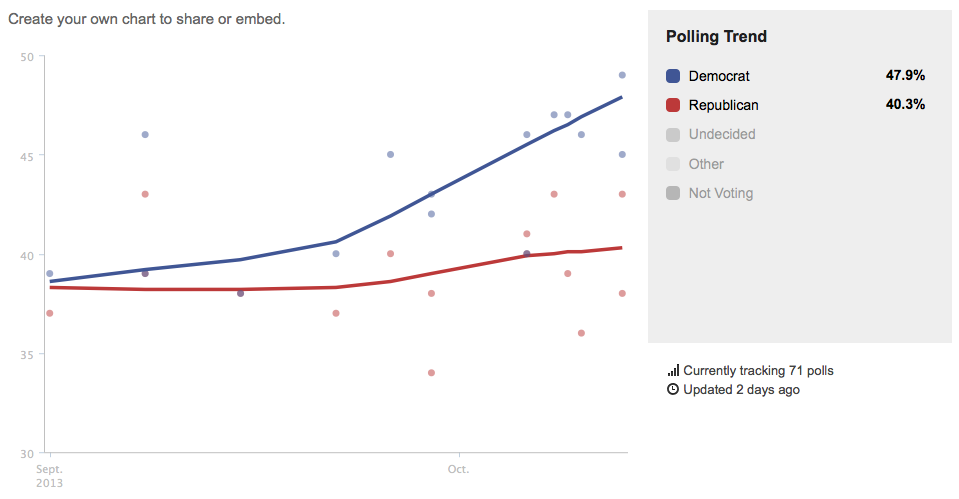
(Graph: current polling on the race for the House in 2014, less smoothing, via Pollster)

Quote For The Day II

682px-Michauxjun

“For many men, work is the effective religion, a ritual occupation and inflexible orientation which permits them to imagine that the problem of their personal death has been solved. Unamuno: ‘Work is the only practical consolation for having been born.’ My own chosen career — its dispersal and multiplication of the self through publication, its daily excretion of yet more words, the eventual reifying of those words into books — certainly is a practical consolation, a kind of bicycle which, if I were ever to stop pedaling, would dump me flat on my side. Religion enables us to ignore nothingness and get on with the jobs of life,” – John Updike.

(Illustration: Pierre Michaux’s son on a velocipede in 1868.)

Loving Israel Before It Existed

Robert W. Nicholson surveys the long history of evangelical support for Zionism, insisting it “bears no resemblance to the portrait of cardboard-cutout Jesus freaks itching for the annihilation of the Jews and using them as pawns in their apocalyptic game”:

Part of God’s covenant with the Jewish people involved bringing them back from exile and doc_42setting them once again in their own land. Since the 16th century, and despite the sheer improbability of the idea, Protestant writers spoke of a Jewish ingathering and sometimes actively promoted it. When the Zionist movement proper began in the late 19th century, and especially after the Jewish state was founded in 1948, this unlikely prophecy seemed to many to be coming true before their very eyes. Although not all Christians embraced the new state, the vast majority of evangelicals became immediate supporters; one of them was President Harry Truman, a Baptist.

In brief, evangelicals love Israel because God loves Israel.

But there is also another way of putting it. For evangelicals, Israel’s mistakes are representative of their own mistakes as imperfect individuals in need of God’s grace. They are comforted by the fact that God remains faithful to Israel; it means that God remains faithful to them.

He notes that this alliance may not last forever, as sympathy for the Palestinians rises among younger and more progressive evangelicals. While reviewing two recent books about the Bible’s place in American political rhetoric, Robert E. Brown also tracks the decline of Israel as a potent symbol of our national aspirations. Why it was attractive in the first place:

[E]arly Americans — beginning with the Puritans — were accustomed to thinking of themselves as the new Israel, bound by covenant to honor God in their public life. This mindset helps to explain why the Exodus and other biblical events were so rhetorically compelling during the Revolution, why the patriots naturally identified with the Israelites struggling under the bondage and tyranny of the Egyptians.

That didn’t last:

[T]he controversy over slavery radically undermined the moral authority — and so the mythic power — of the Old Testament. Pro-slavery apologists repeatedly trumpeted that the Old Testament sanctioned slavery, and abolitionists responded by fashioning interpretive methods that privileged the moral vision of the New Testament at the expense of the Old. The mythology of an ideal Hebrew polity that could be held out for modern emulation was substantially eroded. The Civil War dealt a final, crushing blow to American self-identity as a renewed Israel.

But the resonances remain.

(Image via Temple Emanu-El)