The Republican Crisis And The Bush Legacy

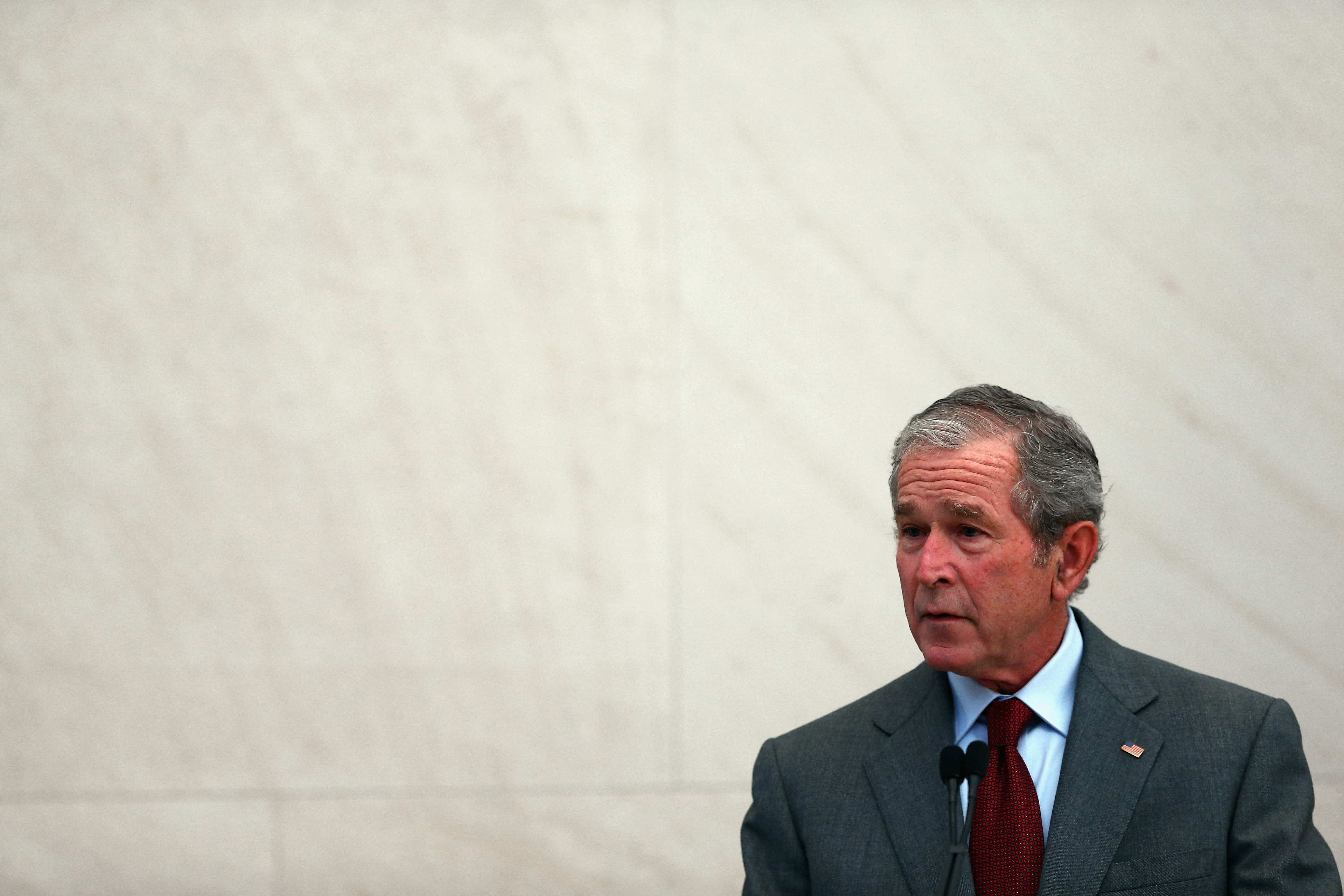
George W. Bush Speaks At Naturalization Ceremony At Bush Presidential Center

Erick Erickson announced this week his intention to primary the GOP Senators who didn’t vote to destroy the US and global economy. Even Mitch McConnell. And sure enough, McConnell’s primary opponent now has new backing – from the Senate Conservatives Fund. Larison shoots the stupid-fish in the barrel:

Having a larger number of uncompromising Republicans in the Senate probably wouldn’t have prevented yesterday’s deal, since nearly two-thirds of the Senate GOP voted for it anyway. That’s a lot of “charlatans” to defeat. Nonetheless, if a deal had been prevented thanks to Senate Republican opposition, Republicans would just as surely have “owned” the consequences of breaching the debt ceiling as they “owned” the shutdown. Those consequences would have been significantly worse for the country, and Republicans would have to start worrying about a net loss of seats in the Senate and the House. In case Erickson missed it, this would be the opposite of advancing. In other words, he wants to punish the Republicans that averted even greater disaster for the party than the failed strategy he urged them to follow.

And yet I am unsurprised. Friedersdorf focuses on the Republicans’ allergy to compromise:

Pretending that compromise is what went wrong during the Bush years helps conservatives evade responsibility for supporting an agenda many parts of which they find indefensible in hindsight.

It permits them to blame Democrats and establishment Republicans for events they themselves only rebelled against after the fact, and to delude themselves into thinking that everything will get better if only they vehemently insist on getting their way, sans compromise, all of the time.

Who wouldn’t want to believe that’s all success takes? It’s a pretty lie that talk radio hosts find it easy to tell over and over again, despite contrary evidence, because conservatives want to believe that it’s true. Reality is much harder to face. In order to mount a comeback and wield influence in American politics, conservatives need to face their own flaws, negotiate savvy compromises with President Obama and Democrats, build credibility and momentum with small gains in the short term, persuade people of their ideas and governing vision in the medium term, and implement their agenda by winning elections rather than brinkmanship. But hard truths don’t attract a large enough audience to sustain a talk radio show.

I do think the refusal to pore over the Bush-Cheney fiasco honestly remains a major block to reform on the right. The rational ones must know that Bush’s Medicare D was far more expensive than the Affordable Care Act, and, unlike the ACA, was never budgeted. They must know that domestic spending exploded under Bush, even as he refused, unlike Reagan before him, to budge on his ruinous tax cuts. They know they cannot attack Obama’s allegedly imperial presidency without confronting the much more expansive claims for executive power made by Cheney et al. They also must know somewhere in their heads that the debt we now have was not created by Obama. he just had to manage it in the depths of the worst recession since the 1930s. The debt is a function of tax cuts we couldn’t afford, wars we couldn’t afford, a new entitlement we couldn’t afford and a recession caused by an unregulated Wall Street run amok.

And on current spending, they must know that Obama’s record – partly thanks to them – is of serious deficit reduction, year after year, from over 10 percent of GDP to just over 3 percent predicted in 2016. Because acknowledging this reality means self-criticism, they cannot do it (and I don’t mean criticism of other Republicans, but of your own responsibility for the mess). But until they engage in self-criticism, especially of the Bush-Cheney administration, they cannot get to a place where they don’t need rigid adherence to purist ideology to keep their own worldview afloat. And that’s the only place – a pragmatic, sane, constructive, reality-based place – where they can rebuild their party and their message. The longer the suppression of the truth about Bush the longer the dysfunction will last.

(Photo: Former U.S. President George W. Bush speaks during a immigration naturalization ceremony held at the George W. Bush Presidential Center on July 10, 2013 in Dallas, Texas. By Tom Pennington/Getty Images.)


Why Is Obama Preventing The Release Of The Senate Torture Report?

abughraibleash.jpg

It is becoming clearer and clearer that one major power-broker in Washington is resisting the release of the Senate Intelligence Committee’s allegedly devastating report on the torture program run by the Bush-Cheney CIA. That major power-broker is the Obama administration.

You might be surprised by this, given the president’s opposition to torture and abolition of it. But the evidence is at this point irrefutable – and given extra punch by the invaluable Jane Mayer, who caught a fascinating document related to the Senate confirmation this week of Stephen W. Preston, the top lawyer at the CIA., for a new post as the top lawyer for the Pentagon. Senator Mark Udall wanted to get Preston on record about his views on the CIA’s past torture program and the reasons the CIA has given to prevent the public release of the Senate report. And he did in a series of questions you can read here.

Here’s what I got from the document and Jane’s reporting. The CIA’s own current chief counsel believes the CIA lied to and misled the Congress repeatedly about its torture program:

The C.I.A. has defended its record on keeping Congress informed. In contrast, Preston, in his answers to Udall, concedes that, during the Bush years, the C.I.A. “fell well short” of current standards for keeping the congressional oversight committees informed of covert actions, as is required under the 1947 National Security Act.

In fact, Preston admits outright that, contrary to the C.I.A.’s insistence that it did not actively impede congressional oversight of its detention and interrogation program, “briefings to the Committees included inaccurate information related to aspects of the program of express interest to Members.”

More to the point, Preston flatly disagreed with the CIA’s contention that it’s impossible to know whether intelligence procured through torture could have been achieved through civilized and legal methods. He says, in fact, that it’s perfectly possible to know this – and, indeed, the Senate Report documents the counter-factuals in excruciating, specific detail – the report is over 6,000 pages long. Since the entire legal defense of torture was premised on the idea that traditional, legal methods could not have been proven as equally effective, this point is important. It could show that the entire legal rationale for torturing prisoners was based on something even the CIA’s legal counsel believes is untrue.

Check out Katherine Hawkins’ read of the same just-released document. But for me, the obvious conclusion is that the CIA is stonewalling to prevent the full extent of its responsibility for war crimes from being known. At the head of the CIA is John Brennan, whose fervent opposition to releasing the full report is well known. But Brennan answers to the president, who has urged the release of the report.

So why the hold-up? That is the question.

Why is Obama allowing Brennan to undermine Obama’s own position? Why is the president allowing the CIA to prevent the very transparency he once pledged to uphold? I don’t know. But what I do know is that it is now Obama who is the main obstacle to releasing the Senate Report on Torture. He needs to tell his CIA director to give up his struggle to keep us all in the dark. He needs to stop dithering and tell Brennan to get out of the way of the report’s release – so we can all see, digest and understand what was done, in secret, in our name.

(Photo: Lynndie England demonstrating one of the CIA-approved torture techniques for breaking down the psyches of terror suspects, in US-run Abu Ghraib prison.)

A Note Of Thanks

After these several high-drama political weeks, I just wanted to offer some thanks to all the new Dish subscribers who signed up in October. We have had a surge of new subs that eclipses any since March, after the tsunami of initial support in January and February. We have no howler beaglemarketing department except for the Dish itself, and it’s incredibly rewarding to see simple content bringing us new readers and thereby a viable future.

I also want to thank the Dish team, whose salaries and healthcare you’re paying for, who have, despite their tender years, managed to produce well over 200 posts a week, round the clock, during frantic news cycles. Chris, Patrick, Jessie, Alice, Matt, Tracy, Chas, Brian and Brendan have no more job security than I have in this new experiment in reader-supported new media. But they work with an intensity and passion and integrity you have to see to believe. They make this look easy. It isn’t. I’m just immensely grateful so many of you seem to appreciate it, and have rewarded their hard work by actually paying for it.

If you’re still reading the Dish by bypassing our leaky meter and want to subscribe along with all these new, paying Dish readers, [tinypass_offer text=”please do”]. It takes two minutes and can cost [tinypass_offer text=”less than $2 a month”]. And thanks again to all of you who have – especially our Founding Members who helped get this whole show on the road in the first place. You rock. But you knew that already.

Update from a new subscriber:

Beats me why I waited so long to get out my credit card. Perhaps it’s because of the contrarian in me that led me to your site in the first place. I recognized in you (and those who write with you) an inability to accept the status quo wisdom as the best, last word. I just didn’t want to believe I had to be like all the others who immediately plunked down their cash to read all you offered. To me, maybe they were the lemmings. And I could get the best of the Dish by picking and skimming and finagling without bumping the meter limit. I was King of the Internets.

But I was wrong. Today, after the shutdown, after the GOP refused to pay for the things we all use – and they fucking liked it – well, I realized I wasn’t being the groovy iconoclast. I was being the winger-nut getting my stuff for free. So I gave up the ghost and paid. Glad I did. Sorry it took so long to realize that all the best misfits are inside the tent – agreeing and disagreeing with your wonderful and maddening posts.

The Tea Party As A Religion, Ctd

Tea Party Religion

Ed Kilgore responds to my take:

I think Andrew’s on the right track, but I’d add a complicating qualifier. It’s not just that these culturally threatened folk embrace their politics like it’s a religion. The actual religious outlook many of them espouse—whether they are conservative fundamentalist Protestants or neo-ultramontane Catholics—has imported secular political perspectives into their faith. They’ve managed to identify obedience to God with the restoration of pre-mid-twentieth-century culture and economics, and consequently, tend to look at themselves as the contemporary equivalents of the Old Testament prophets calling a wicked society to account before all hell literally breaks loose. So their politics reinforces their religion and vice-versa, and yes, the Republican Party, like the squishy mainline Protestant Churches and lenient do-gooder Catholic priests, are generally within crisis-distance of being viewed as objectively belonging to enemy ranks.

I’m grateful for Ed’s refinement of the thesis – and to Rod Dreher’s. My basic point is that underlying far right politics and religion is the fundamentalist psyche, which is, in modernity, a reaction to bewildering social change and economic stagnation. But the eddies here are manifold and mutually reinforcing. If your religious faith demands total assent to an inerrant set of doctrines, how likely are you to engage in conservativesoulpbc.jpgpolitical dialogue as if you don’t know all the answers and need input from others? If deviation from inerrant truth means damnation, then how easy is it to transition to a politics aimed at compromise? And by erasing the distinction between the religious sphere and the political – indeed insisting that it must never be erased – you can see how this entire syndrome reinforces itself and is very hard to counter with the usual democratic methods.

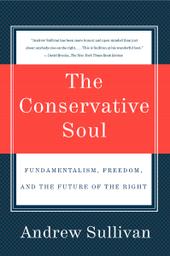
This is a complicated argument and if you want to absorb it at length, it’s the central critique of contemporary American “conservatism” in my book, The Conservative Soul. I think – but then I would, wouldn’t I? – that the book’s argument has held up almost too well in the years since it was published. But judge for yourself – it’s instantly available for your Kindle or iPad here. It both deconstructs today’s pseudo-conservatism and tries to reconstruct a conservatism of an older, deeper, wiser variety. To do that, it attempts to tackle religion as well as politics, to ponder the deep forces behind the current Republic crisis rather than the superficial ones.

Its main conclusion is that I do not believe we can have a political resolution in this country without first reforming Christianity, and distinguishing it from Christianist ideology. This is not easy, but the struggle to achieve this is winning some key reinforcements: Pope Francis and the next generation of evangelicals key among them. If some political Dishheads disdain our coverage of religion as gobbledygook – which is your right – then I hope you’ll see that the effort to reform Christianity is indirectly also a political project. It’s about saving conservatism from itself and making it humane again.

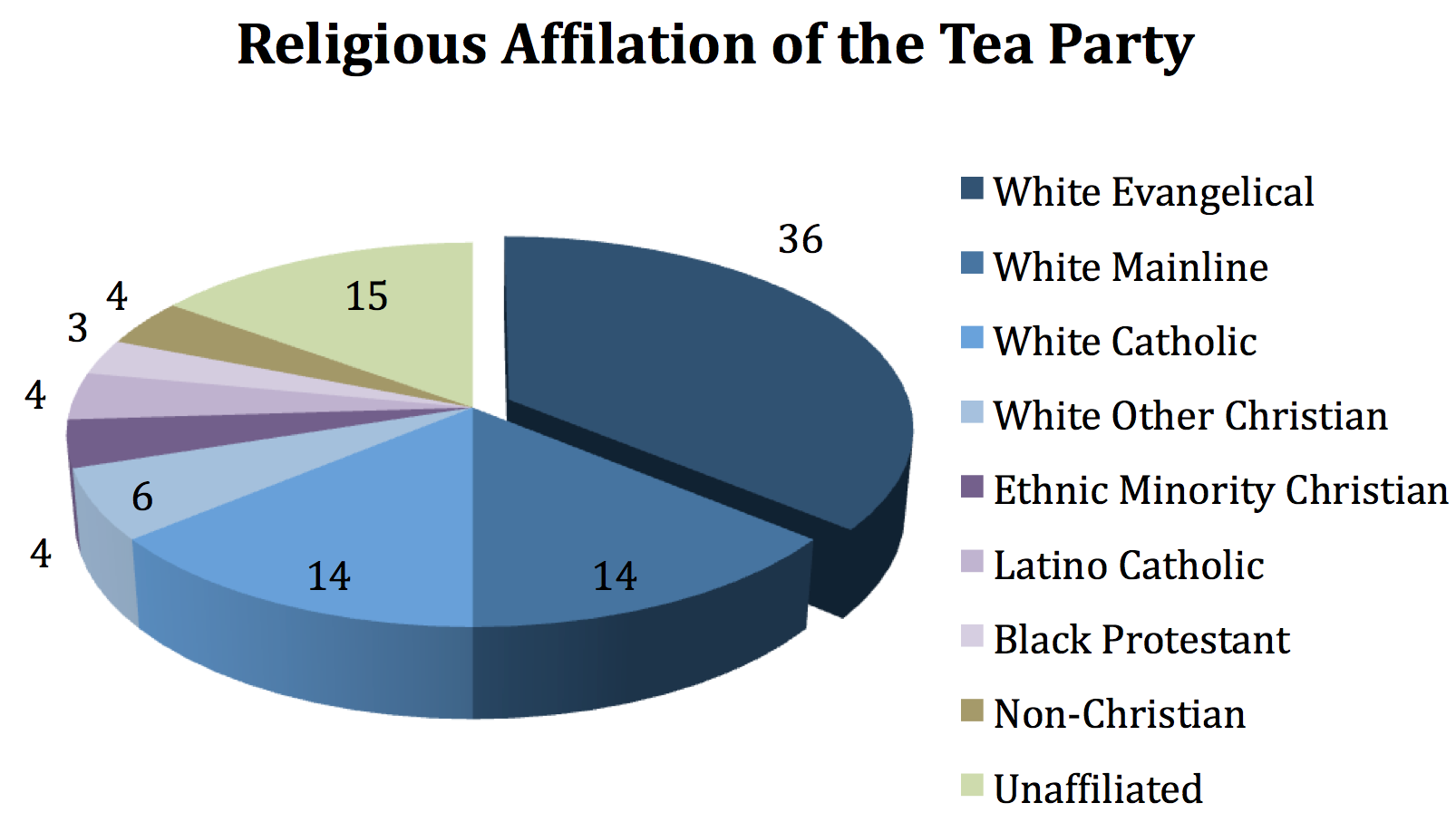
(Chart: The religious affiliations of Tea Partiers from “Religion and the Tea Party in the 2010 Election”(pdf))

The Utter Disaster Of Healthcare.gov, Ctd

Yuval Levin talked with sources in the Center for Medicare and Medicaid Services (CMS), the agency in charge of the federal health insurance exchanges. A key section of his post, which is worth reading in full:

If the problems now plaguing the system are not resolved by mid-November and the flow of enrollments at that point looks like it does now, the prospects for the first year of the exchanges will be in very grave jeopardy. Some large advertising and outreach campaigns are also geared to that crucial six-week period around Thanksgiving and Christmas, so if the sites are not functional, all of that might not happen—or else might be wasted. If that’s what the late fall looks like, the administration might need to consider what one of the people I spoke with described as “unthinkable options” regarding the first year of the exchanges.

All of the CMS people I spoke with thought the state-run exchanges are in far better shape than the federal system under their purview. But the insurers do not seem that much happier with many of those state exchanges.

Back-end data issues seem to be a problem everywhere, and some of the early enrollment figures being released by the states are not matching up with insurance company data about enrollments in those states, which suggests a breakdown in communication that is only beginning to be understood. The insurers believe that only Nevada, Colorado, Washington state, and Kentucky have what could reasonably be described as working systems at this point. Still, there is no question that on the whole the states with state-run exchanges are in better shape than those with federal ones.

Jonathan Cohn tries to look on the bright side:

[I]f these past two weeks appear to reflect poorly on the federal bureaucracy and the Administration managing it, they shouldn’t reflect poorly on health care reform itself—which, after all, has worked in Massachusetts and seems to be working in the states running their own operations. The success of states like Kentucky and New York and Connecticut and California are important for their own sake: By my count, they constitute about a fourth of the national population. But they are also important for what they show about how the law can work, once the technology piece is in place.

The Backlash Against Modern-Day America

Tea Party Views

Jelani Cobb outlines the GOP’s “Dixiecrat problem”:

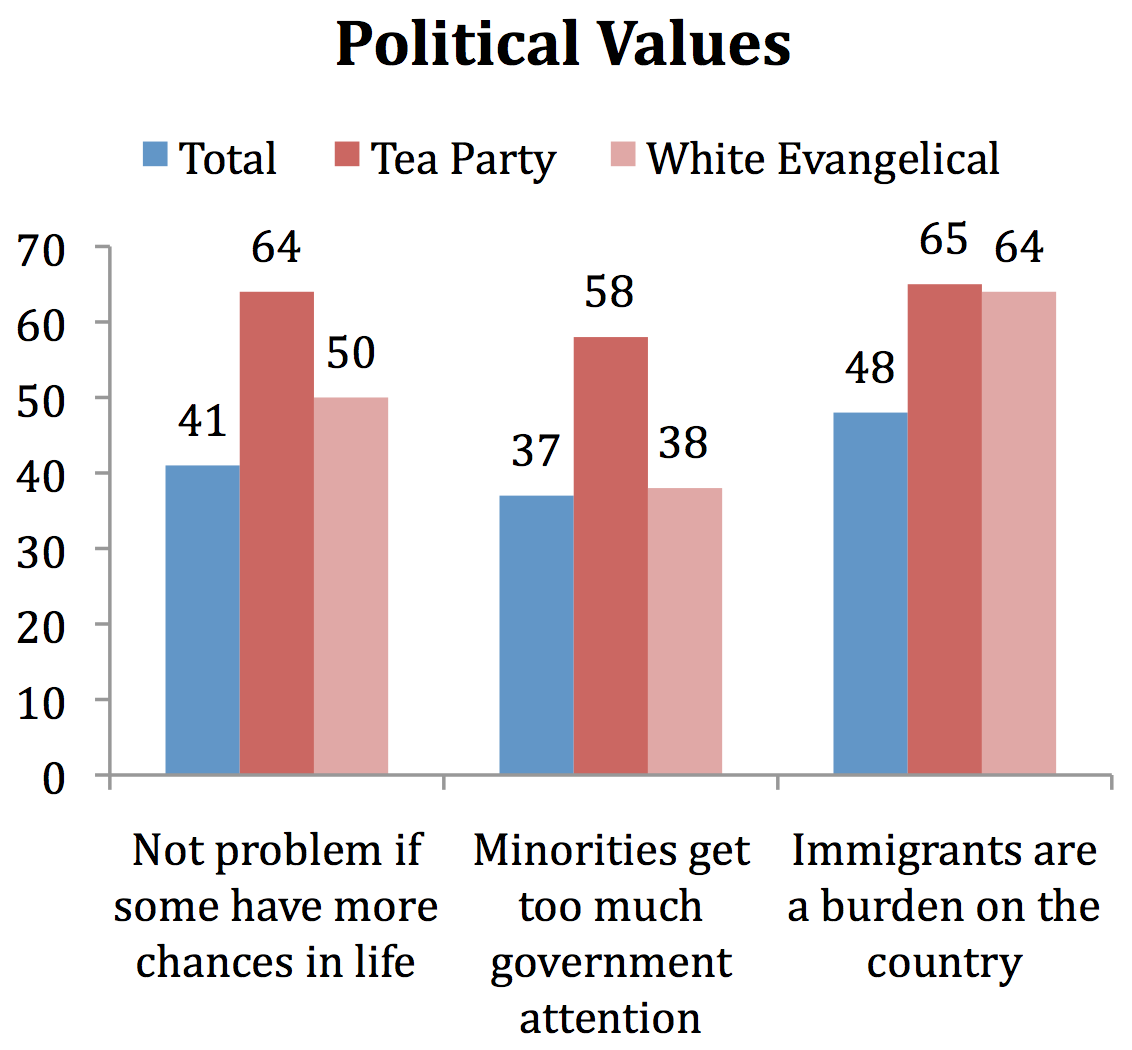
Today’s Republican Party, like the Democrats six decades ago, has had to come to terms with a demographic shift—one in which Hispanic voters are a crucial new element. We would be naïve to believe that the opposition to comprehensive immigration reform that features so prominently in current Tea Party politics is incidental to its appeal. (A 2010 survey of Tea Party supporters conducted by the Public Religion Research Institute found that fifty-eight per cent believed the government “paid too much attention to the problems of blacks and minorities”; sixty-four percent said immigrants were “a burden” on the country.) The Tea Party–inspired eruptions that have recurred throughout Obama’s Presidency represent something more complicated than a reactionary backlash to the sight of a black President; they are a product of the way he so tidily represents the disparate strands of social history that brought us to this impasse. The problem isn’t that there’s a black President; it’s that the country has changed in ways that made Obama’s election possible.

What If Obama Needs To Delay Obamacare?

Philip Klein wonders:

Obama, no doubt, wants to avoid the political embarrassment of a delay — or even the mere suggestion of one. But what happens if it’s the middle of December and enrollments are nowhere near where they need to be to make the system viable? What if, by necessity, he has to seek a delay?

The operating assumption would be that Republicans would jump at the chance to delay it. But after the past few weeks, can we really be sure that this would be the case?

It’s perfectly conceivable that if such a scenario played out, the position of the Tea Party activists and their allies in Congress would be that delaying the law for a year would be tantamount to a bailout of Obamacare.

Should Healthcare.gov fail to improve, Chait concedes that delaying the individual mandate may be necessary:

Here … is the kind of individual-mandate delay that would make sense. It would apply only to those states lacking a functioning website. (States that established their own exchanges are, in general, experiencing much better functionality than the states that boycotted their exchange and relied on the federal government to set up a site for them.) The delay would be tied to the workability of that state’s website — no reason to delay California’s individual mandate just because people in New Jersey can’t log on. And the process for making this determination would have to rest with the Department of Health and Human Services, or some other body that is trying to make the law succeed, not one that’s trying to destroy it.

Note that the individual mandate in 2014 is only a token $95 annual tax. Its main purpose is as a signaling device that everybody should get covered.

Chait is wrong about that last point:

The individual mandate’s penalty is not $95 in year one. It’s $95 or 1 percent of your taxable income, whichever is greater. So if you make $80,000 in taxable income, the penalty is $800.

Stephen Colbert Kills

Do yourself a favor and check out this clip of his remarks from last night’s Al Smith Dinner, a ghastly Catholic elite version of the White House Correspondents’ Dinner. But some choice gags:

I have great respect for Cardinal Dolan, though I do have to say, sir, it is not easy when you are wearing that outfit. In that cape and red sash, you look like a matador who’s really let himself go. Did you not see the invite? It said white-tie, not ‘Flamboyant Zorro.’

On Bloomberg:

Tiny, tiny man. The real reason he doesn’t want drink cups larger than 16 ounces is because he’s afraid he might drown in one.

On Christine Quinn:

New York City is the only place in the world where the lesbian candidate is too conservative.

Tip your waiter.

Sean Hannity Lies

A pretty definitive exposure of the mendacious agit-prop being deployed to undermine the Affordable Healthcare Act. At this point, Fox News doesn’t just have to invent their own reality, they really have to invent the people affected by it. One thing you can be sure of: there will be no response from Hannity. Because the only response would be to admit error, and, as we know, that’s a cardinal sin on the far right.

The World’s Biggest Democracy Has The Most Slaves

20131019_gdc589_1

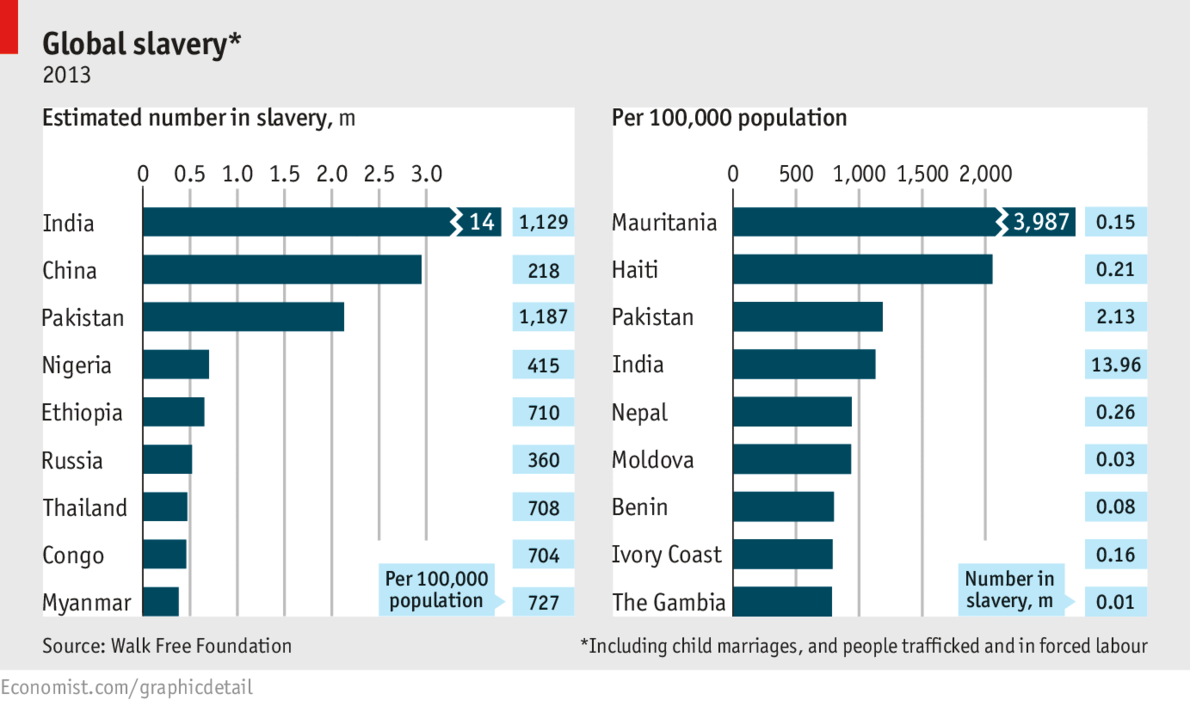
New research indicates that 29 million people are enslaved worldwide:

The [Global Slavery Index], published by the Walk Free Foundation on Thursday, ranks 162 countries and identifies risk factors for enslavement and the government responses. The research found that around 10 countries hold about 70 percent of the world’s slaves. India has the highest number of people enslaved in absolute terms, approximately 14 million, almost half the total worldwide.

Amar Toor adds that “India’s problems [are based] on an inefficient legal system and a tradition of ‘servile marriage’.” Getting an accurate picture of the problem can be very difficult:

Dark figures are calculated on the basis of random sample surveys such as the British crime survey. By asking a sample of the population if they have experienced a list of crimes in the last year, the crimes the public reports can be compared to the official records of crimes known to the police. … The frightening fact is how many slavery crimes we are failing to detect: over 90 percent in most countries.

(Chart from The Economist)