Invoking The 14th

Hertzberg hopes Obama will go there:

In the end, Obama could have no honorable choice but to invoke the Fourteenth. There is little doubt that he would prevail. The Supreme Court would be unlikely even to consider the matter, since no one would have standing to bring a successful suit: when the government pays its bills, who is damaged? The House Republicans might draw up articles of impeachment, adopt them, and send them to the Senate, where the probability of a conviction would be zero. This would not be a replay of Bill Clinton and the intern. President Clinton was not remotely guilty of high crimes and misdemeanors, but he was guilty of something, and that something was sordid. Yet impeachment was what put Clinton on a glide path to his present pinnacle as a wildly popular statesman. President Obama would be guilty only of saving the nation’s economy, and the world’s.

Emily Bazelon and Eric Posner argue along the same lines:

[L]awsuits that challenge the president’s authority to issue debt would almost certainly go nowhere. Most plaintiffs would not be able to show a personal injury from the issuing of new debt. Lacking legal standing, their cases would be dismissed. Those who got beyond this stage would be blocked by the political question doctrine: Courts would dismiss the suit on the grounds that the controversy over the debt is an inter-branch conflict between the president and Congress that is not for judges to resolve. So if some creditors sell off Treasuries or refuse to buy new debt, the smartest investors—the hedge funds and the sovereign wealth funds—would sweep in to make a killing. …

If Obama jumps the gun and lifts the debt ceiling before the public has a sense of crisis, he risks being accused of imperialism (and of being impeached). But in the end, he has plausible arguments that he has the power to save us from default. He should use that power. The country, the markets, and future presidents will thank him.
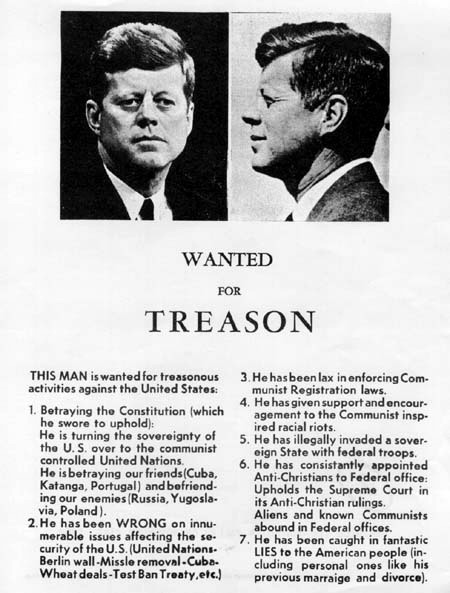
The History Of The Radical Right

Gopnik traces it:

I’ve been doing some reading about John Kennedy, and what I find startling, and even surprising, is how absolutely Wanted_for_treasonconsistent and unchanged the ideology of the extreme American right has been over the past fifty years, from father to son and now, presumably, on to son from father again. The real analogue to today’s unhinged right wing in America is yesterday’s unhinged right wing in America. This really is your grandfather’s right, if not, to be sure, your grandfather’s Republican Party. …

Reading through the literature on the hysterias of 1963, the continuity of beliefs is plain: Now, as then, there is said to be a conspiracy in the highest places to end American Constitutional rule and replace it with a Marxist dictatorship, evidenced by a plan in which your family doctor will be replaced by a federal bureaucrat—mostly for unnamable purposes, but somehow involving the gleeful killing off of the aged. There is also the conviction, in both eras, that only a handful of Congressmen and polemicists (then mostly in newspapers; now on TV) stand between honest Americans and the apocalypse, and that the man presiding over that plan is not just a dupe but personally depraved, an active collaborator with our enemies, a secret something or other, and any necessary means to bring about the end of his reign are justified and appropriate. And fifty years ago, as today, groups with these beliefs, far from being banished to the fringe of political life, were closely entangled and intertwined with Senators and Congressmen and right-wing multi-millionaires.

(Image: A famous handbill circulated on November 21, 1963 In Dallas, Texas. One day before the assassination of John F. Kennedy. From Wikimedia Commons. I sure hope the secret service keep our president as safe as humanly possible.)

Is This What The Final Deal Will Look Like?

Government Shutdown Continues Into Its Second Weekend

Noam Scheiber’s best guess:

Setting aside the hourly thrust and parry between Democrats and Republicans, here’s how the shutdown is likely to end: Senate Majority Harry Reid is going to strike a deal with his Republican counterpart Mitch McConnell at some point in the next few days. The deal will reopen the government for a medium length of time—possibly till January 15, when the next round of sequester cuts kick in—giving the two sides time to replace the sequester with something more appealing. The deal will also raise the debt ceiling—maybe for as little as a few months, maybe until after the 2014 election. Reid will give up almost no concessions in return for any of this, with the exception of one or two symbolic items, and he’ll probably get some higher-than-sequester level of government funding (a top Democratic priority) for a month or two starting later this year. Pretty much every Democrat in the Senate will vote for the deal, along with at least five and maybe as many as 20 Republicans.

Here’s Reid’s actual proposal today, via Politico:

Senate Majority Leader Harry Reid has privately offered Senate Minority Leader Mitch McConnell a deal that would reopen the government until mid-to-late December while extending the U.S. debt ceiling until next year, according to several sources familiar with the talks.

The proposal would set up a framework for larger budget negotiations with the House over the automatic sequestration spending cuts and other major deficit issues, the sources said. Moreover, Senate Democrats are open to delaying Obamacare’s medical device tax and a requirement that those receiving Obamacare subsidies be subject to income verification — but they would have to get something from Republicans in return, sources said.

I’d press for a debt ceiling raise beyond the next Congressional elections as a key element of a deal. Beutler notes McConnell’s new role:

Mitch McConnell has suddenly become the lead Republican negotiator and all the action has shifted to the Senate. If McConnell had any confidence that Boehner could pull this off, Boehner would still be at the center of the story. McConnell has a primary challenger. He wants to oppose deals, not cut them. If there were any way for Boehner to get out of the mess on his own, McConnell would have let him try. His return to relevance demonstrates a complete loss of faith in his counterpart.

(Photo: U.S. President Barack Obama meets with Senate Democratic leadership, including Senate Majority Leader Sen. Harry Reid, to discuss the government shutdown and the nation’s debt ceiling in the Oval Office of the White House October 12, 2013 in Washington, DC. The U.S. Government is on its 12th day of a shutdown. By Alex Wong/Getty Images.)

Not In The Clear Yet

Yesterday, Stan Collender claimed that it “still no better than 50-50 … that the debt ceiling will be raised by October 17”:

One of the biggest problem[s] with the current shutdown/debt ceiling situation is that no one has any assurance that the person they’re negotiating with has any authority to agree to anything. The president can’t be sure congressional Democrats will go along with what he might agree to with Republicans, Boehner absolutely knows there is no guarantee that House and Senate Republicans will follow his lead and Senate Minority Leader Mitch McConnell (R-KY) won’t be followed blindly by Senate Republicans. In other words, even if there were a deal it is not clear who could agree to it.

This, and the likelihood of simple miscalculation of time, could render any agreement moot, and tip the markets into a tailspin, along with our recovery. I just hope that sense of urgency exists in these negotiating rooms. The point is not that we should get out of this fiasco by the skin of our teeth – but that a functioning country never gets even close to this kind of potential meltdown. Every day that passes erodes the credibility of the US economy and government, and thereby its currency. And at some point, the erosion becomes a mudslide.

What’s Wrong With The Collins Deal?

McConnell is in favor of it:

McConnell embraced a plan by Senator Susan Collins — the Republican from Maine — on Sunday, which would raise the debt limit through January and fund the government through the end of March, while delaying for two years Obamacare’s medical-device tax and require income verification in order to qualify for Obamacare subsidies.

I truly want to get a deal but this one would be, to my mind, merely a delay in the crisis, even an extension of it. If the GOP were to take the debt ceiling off the table, or come up with a way to do it indefinitely, we’d be talking. When hostage-takers release the hostage, they don’t usually get to keep their weapons. But if that is not an option, then, as an interim step, why not raise the debt limit through January 2015 and let the midterms decide the fiscal future?

And if the GOP needs a face-saver, I suppose K-Street’s medical device tax is as meaningless a concession as any. It’s not integral to the ACA. And you can see why the president might have negotiated such a thing outside of any self-induced debt crisis. As for sequestration, I have no problems with keeping spending at those levels until March, along Collins lines, and I think the Democrats should be very wary of over-playing their hand. We are in an emergency here – and haggling over spending levels for the next six months does not seem to me to be a good enough reason to hold up a potential deal.

Ezra explains why Democrats have rejected it nonetheless:

Two main arguments were made against the Collins deal. First, it locks in sequestration levels of spending for six months. Key Senate Democrats see that as a much larger, and more dangerous, concession than the old CR, which only agrees to it for six weeks. Second, the deal’s delay of the medical device tax meant it was, in fact, a concession in order to reopen the government — and Democrats think it’s important to persuade the GOP that they can’t win anything through this kind of hostage taking.

I don’t think that’s a big win. I think it’s a minimal concession for them to save face in what is already a political disaster for them. Jonathan Cohn adds:

Reid and McConnell are still talking. Those talks will probably be the basis of whatever agreement ends this crisis. But Democrats have established a pretty simple test for new proposals: Is it a deal Democrats would make in normal circumstances, without a shutdown and without the threat of default? So far, nothing Republicans have suggested comes close to meeting that criteria.

I think adjusting a medical devices tax in return for a sequester-level CR and a lifting of the debt ceiling till after the mid-terms would be easily a deal Dems would accept under normal circumstances. The key issue, in my view, is the debt ceiling threat. That’s the fiscal weapon of mass destruction we have to abolish or defuse indefinitely.

Yes, For Them, This Is A Game

A cruel, vain, exploitative, nihilist, irrelevant, made-for-TV game:

Conor Friedersdorf sighs:

What I think, when I see that memorial closures are the thing that gets conservatives in the streets, is that movement leaders and rank-and-file activists alike cannot be counted on to identify and take on the most serious issues facing veterans, or the most serious threats to liberty. Instead they spend their time seizing on symbolic issues that promise to result in the best optics for a given news cycle — World War II veterans traveled to Washington and can’t visit the memorial dedicated to them!

Think what victory would mean in this instance: the barricades would come down, which will happen anyway as soon as the government reopens. In other words, there’s no substantive upside for this particular rally, whether you’re concerned about benefiting veterans or safeguarding liberty. It was held so that Cruz and Palin could aggrandize themselves, so that conservatives could revel in their self-image as liberty loving patriots who honor veterans, and so that the Obama Administration would look bad. Protests are nothing more than political theater for these people. Or if they actually intend to effect change, their strategy verges on nonsensical.

Earlier Dish on the rally here.

When “Conservatives” Boo The Cops

You realize they are not conservative in any way at all. Yelling at police doing their job maintaining security at the White House, calling them “brownshirts,” “stasi” and saying that one unit “looks like something out of Kenya”: can we dispense with any illusions that these are patriotic political actors, respecting those who serve our country in the military or police force? They are delusional, racist fanatics.

And I should add: the composure and restraint of these public servants in the face of these yahoos and morons is remarkable.

When Sexual Harassment Is Murky, Ctd

A reader writes:

I know nothing about this case.  But if the professor had fought the allegations, his life would have ruined by everything being aired in public, true or not.  As someone once said after being found not guilty, “Where do I go to get my reputation back?”  I think a reasonable case can be made for an innocent person to walk away from untrue allegations rather than fight them, especially in today’s media atmosphere.

Another:

As a female post-doc in a male-dominated field, I read with interest the article you linked to. I am sure affairs and sexual harassment happen in all work places, but I think there is something about the professor/student, mentor/mentee relationship that contributes to it. I have been hit on/flirted with/sexually harassed (depends on how you define it) by multiple male professors over the years. And I admit I don’t always send entirely clear signals. I have no desire to have affairs with these men (I am gay), but I do sometimes enjoy playing (and trying to win) their game.

It gives me power in the relationship – not because I think I will get special treatment professionally, but because, perhaps in a twisted response to their egos, I like seeing how far I can get them to go. It makes them human; no longer are they “important professors” – just men thinking like men. When it gets too far or just awkward, I put up boundaries and declare myself the winner.

So I can understand the student in the article up to the point of turning her professor in. I recognize my role in the game and am not out to ruin careers or marriages. But I suppose it is a dangerous game to be playing, especially for the professors …