Bulky Beasts

Humans aren’t the only ones putting on weight:

The National Pet Obesity Survey recently reported that more than 50 percent of cats and dogs –that’s more thanStanding Tall 80 million pets – are overweight or obese. Pets have gotten so plump that there’s now a National Pet Obesity Awareness Day. (It was Wednesday.) Lap dogs and comatose cats aren’t alone in the fat animal kingdom. Animals in strictly controlled research laboratories that have enforced the same diet and lifestyle for decades are also ballooning.

In 2010, an international team of scientists published findings that two dozen animal populations—all cared for by or living near humans – had been rapidly fattening in recent decades. “Canaries in the Coal Mine,” they titled the paper, and the “canaries” most closely genetically related to humans – chimps – showed the most troubling trend. Between 1985 and 2005, the male and female chimps studied experienced 33.2 and 37.2 percent weight gains, respectively. Their odds of obesity increased more than 10-fold.

Even wild animals are growing fatter, leading researchers to investigate new causes of obesity:

The potential causes of animal obesity are legion: ranging from increased rates of certain infections to stress from captivity. Antibiotics might increase obesity by killing off beneficial bacteria. … But feral rats studied around Baltimore have gotten fatter, and they don’t suffer the stress of captivity, nor have they received antibiotics. Increasingly, scientists are turning their attention toward factors that humans and the wild and captive animals that live around them have in common: air, soil, and water, and the hormone-altering chemicals that pollute them.

(Photo from James Marvin Phelps)
On Assholes

Zach Dorfman leafs through Aaron James’ book on their moral significance:

For him, an asshole is defined by three important qualities, which also serve to differentiate his behavior from other morally repugnant characters such as the jerk, or much more seriously, the sociopath. First, the asshole considers himself — and James and I agree, assholes are almost always men — to possess special privileges or advantages over others.

Moreover, he behaves in a manner that reflects this belief (making the asshole distinct from the mere egoist, who may believe that he is better than others, but for a variety of reasons, does not act on this belief systematically.).

Second, the grounds for this belief are assumed and not argued for. An asshole believes deeply that he alone deserves special treatment, that he is somehow entitled to it. This kind of asshole behavior, as James goes on to show, produces both minor-league assholes, such as the line-cutter or reckless freeway driver, as well as their major-league brethren, such as, say, Donald Trump or Anthony Weiner. (Of course, significant overlap is possible, and minor leaguers rarely disappoint when called up to the big leagues.)

Third, and finally, assholes are “immunized” to the protests of others. An asshole might hear you out, recognizing your complaints as valid in an abstract way, but he never truly listens.

Arrogant Artists

British researchers ran an experiment to gauge the creativity of certain personality types and found that narcissism drives people to take on more creative endeavors:

The participants, a mix of undergraduates and college graduates, took a series of tests to measure the “big five” personality factors: neuroticism, extraversion, openness to experience, agreeableness, and conscientiousness. In addition, they provided a self-assessment of their creativity (answering questions like “how innovative do you consider yourself?”), and indicated how many creative activities (out of a list of 34) they had engaged in during the past year. Those activities including “composed a poem” and “choreographed a dance.” …

When the scores were added up, “Narcissism self” was the variable that most strongly predicted not only self-assessed creativity (no surprise there), but also engagement in creative activities.

Jillian Steinhauer underlines that narcissists weren’t proven necessarily more creative, only more likely to try their hand at the arts:

In the end, people with narcissistic tendencies were not only more likely to say they were creative; they also were more likely to do creative things. The personality traits of extraversion and openness also corresponded to increased creative activity, which is telling about what this study really shows: that self-confidence goes a long way. If you believe you’re good enough at something, chances are you’ll do it, even if it’s unstable or difficult, as so many creative pursuits are. And chances are you’ll continue trying to do it even in the face of rejection, which is also required in creative fields like art and writing.

Canned Laughter Has Passed Its Expiration Date

Kera Bolonik puzzles over the ongoing use of laugh tracks in sitcoms, noting that “fake laughter is like a fake orgasm — it’s not infectious”:

In fact, we’ve had them imposed on us since the fifties, when sound engineer Charley Douglass started “sweetening” the audio, inserting laughs at failed jokes, editing down yuks that went on too long, to regulate the comic beats. But what is louder than the din of disingenuous laughter when a joke isn’t funny? It’s a hand hanging in the air, waiting for the high five slap that never comes, that loud silence of one hand clapping. But bad jokes are like tripping over air currents — you’ve gotta catch your fall and keep moving.

Network sitcoms have become less reliant on laugh tracks — Parks and Recreation, Glee, Modern Family, and the new Brooklyn Nine Nine, for example, don’t use them. But these are mockumentaries, musicals, and/or single-camera shows. Laugh tracks tend to signal to an audience that they’re tucking into more conventional fare, by which I mean, a show that, as Joseph Winkler described in “A Sitcom Even a Nihilist Could Love,” features beleaguered straight-man (or woman) protagonist at work surrounded by zany colleagues, and at home, where he or she juggles a fraught relationship with an overbearing or neurotic parent, a partner or an ex (or the ever-present absence of no love life at all), and a resident smart-alecky kid. And the laughs punctuate every sentence like an exclamation point.

(Video: a laugh track-free clip from The Big Bang Theory)

Putting A Price Tag On Wikipedia

Jonathan Band and Jonathan Gerafi researched (pdf) the economic value of the free encyclopedia. Rose Eveleth relays the results:

[T]he two researchers identified a few factors that could help answer the question: market value, replacement cost and consumer value. They looked at what other sites that get similar traffic are worth, how much people would be willing to pay for Wikipedia if it weren’t free, and how much it would cost to replace the site. In the end Band and Gerafi conclude that the website is worth “tens of billions of dollars” and has a replacement cost of $6.6 billion dollars.

For context, it costs the site $25 million each year to run. And for comparison, Twitter’s recent IPO announcement has their company valued at about $12.8 billion. Band and Gerafi write, “The millions of hours contributed by volunteer writers and editors leverage this modest budget, funded by donations, into an asset worth tens of billions of dollars that produces hundreds of billions of dollars of consumer benefit.”

Self-Building Blocks

Scientists have created small, simple automated cubes that are the first step toward self-reconfiguring machines:

M-Blocks are a new breed of self-assembling robot currently in development at MIT. Each cube is about an inch and a half across on each face, with a flywheel on the inside and an array of magnets on the outside. By spinning the flywheel at high speeds–up to 20,000 revolutions per minute–the self-contained units can scoot across tables and flip themselves through the air. Once they come close to another block, a clever system of self-aligning magnets attaches them to their partner. Seeing a single cube clamber on top of another isn’t especially impressive.

But watch several move at once, with disparate parts moving independently and the larger whole rapidly taking a totally new form, and you can start to see a hazy path towards Optimus Prime.

The Authoritarian Editor

The tyrannical tendencies of Stalin were evident in the “editorial mania” he exercised at Pravda:

Even when not wielding his blue pencil, Stalin’s editorial zeal was all-consuming. He excised people—indeed whole peoples—out of the manuscript of worldly existence, had them vanished from photographs and lexicons, changed their words and the meanings of their words, edited conversations as they happened, backing his interlocutors into more desirable (to him) formulations. “The Poles have been visiting here,” he told the former Comintern chief Georgi Dimitrov in 1948. “I ask them: What do you think of Dimitrov’s statement? They say: A good thing. And I tell them that it isn’t a good thing. Then they reply that they, too, think it isn’t a good thing.”

All editors, wrote the cultural historian Jacques Barzun, “show a common bias: … what the editor would prefer is preferable.” Being an author is well and good, and Stalin wrote several books—the word “author” does after all share a root with the word “authority”—but he knew that editing was a higher power. Naimark argues that editing is as much a part of Stalinist ideology as anything he said or wrote. This insight warrants amplification. Under Stalinism, anyone could speak or write, but since Stalin was the supreme gatekeeper of the censorship hierarchy and the gulag system, the power to edit was power itself.

Reality Check

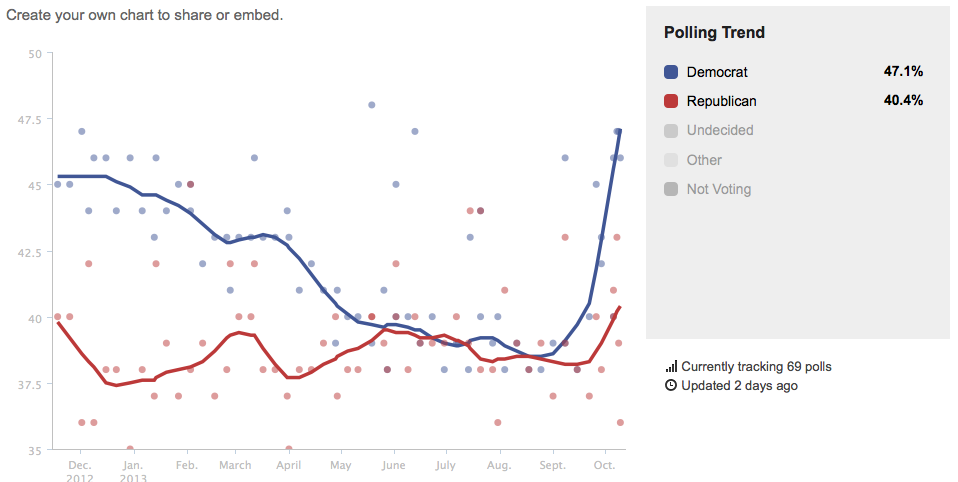
Here’s the poll of polls for the state of the 2014 national Congressional race (at the most sensitive level) from April of this year to today:

Screen Shot 2013-10-13 at 9.22.25 PM

None of this really tells us much about 2014, but it sure tells us something about broad public reaction to the self-induced crisis of the last two weeks. I just hope the Democrats don’t fall into the illusion that these kinds of numbers drive the Tea Party. They are driven by much deeper, less rational, more emotional forces than self-interest. Many of them want to destroy the GOP as well.

Is Palin Invoking Locke’s Right Of Rebellion?

Of course, she’s never heard of John Locke, but the person who made the flag above her sure did. A reader writes:

Note the white sign with the green arrow, pointing up with the text “Appeal to Heaven.” I would suspect that most casual observers, perhaps even most reporters, would assume that meant something like, “Let’s pray about all this” or “Let’s pray to God to change Obama’s mind” or something other prayer-centered interpretation of what that sign might mean.

However, that exact phrase appears, as I’m sure you will recall, in Ch. 14 of Locke’s Second Treatise, which describes the nature and extent of executive power, especially the executive’s “prerogative,” i.e. discretionary power. Here’s the relevant passage, in which “appeal to heaven” is used in the context of unjust or abusive uses of prerogative power:

The people have no other remedy in this, as in all other cases where they have no judge on earth, but to appeal to heaven: for the rulers, in such attempts, exercising a power the people never put into their hands, (who can never be supposed to consent that any body should rule over them for their harm) do that which they have not a right to do. And where the body of the people, or any single man, is deprived of their right, or is under the exercise of a power without right, and have no appeal on earth, then they have a liberty to appeal to heaven, whenever they judge the cause of sufficient moment.

It is clear that “appeal to heaven” in the text means revolution or rebellion. When the usual, political channels – i.e. earthly channels – are exhausted, then you can revolt in the name of the “laws of nature” or the “rights” we all possess and which no “government” can take away. I’ll spare you a lengthy exegesis of these sentences; my point is that “appeal to heaven” is not a random phrase, but one from the history of political thought that clearly means revolution or rebellion – and one the people take into their own hands, even.

I don’t think we can ignore the fact that many on the Republican right now believe themselves to be in open, non-violent rebellion against the government of the United States. Having the lost the appeal to the majority of Americans, they will soon be invoking an appeal to a higher power – against the president.

Update from a reader:

Your reader who identified Locke in the context of the “Appeal to Heaven” flag is correct in getting the reference, but wrong in thinking the flag is anything new. It’s the flag of Washington’s Cruisers, one of the flags of the American Revolution. That’s not a “green arrow”; it’s a pine tree. Alas, just like the Gadsden flag and it’s famous “Don’t Tread on Me” snake, it has now been appropriated by the Tea Party movement. I am a liberal Democrat who used to regularly fly those historic flags outside my home on the Fourth of July to commemorate the American Revolution – when there was a real, not imagined and hysterical, reason for revolt – but now I’m afraid I have to confine them to the closet. The idea that my neighbors might affiliate me with these crazies is too much to bear.

A Rolling Coup

How else do you explain this amendment to the following rule passed by the House just before it shut down the government:

Here’s the rule in question:

  • When the stage of disagreement has been reached on a bill or resolution with House or Senate amendments, a motion to dispose of any amendment shall be privileged.

In other words, if the House and Senate are gridlocked as they were on the eve of the shutdown, any motion from any member to end that gridlock should be allowed to proceed. Like, for example, a motion to vote on the Senate bill. That’s how House Democrats read it. But the House Rules Committee voted the night of Sept. 30 to change that rule for this specific bill. They added language dictating that any motion “may be offered only by the majority Leader or his designee.” So unless House Majority Leader Eric Cantor (R-VA) wanted the Senate spending bill to come to the floor, it wasn’t going to happen. And it didn’t.

So, in advance, the GOP changed parliamentary procedure to ensure that no clean resolution, based on a Senate budget agreement, could get on the floor of the House for a general vote. The hostage-takers made it impossible to defuse the bomb they have attached to our system of government without their consent – even against a majority of House members of both parties.

These people are deadly serious. Since they lost an election, they decided to start a cold civil war.