Inside The Room

Reviewing the new book Disaster Artist – a behind-the-scenes account of bizarre cult hit The Room and its auteur, Tommy Wisaeu – Adam Rosen asks whether the film should be considered “outsider art”:

For most viewers, little in The Room bears even remote resemblance to real life. One of the film’s most cherished lines, judging by YouTube views, is when Mark exhorts a nosy friend to “leave your stupid comments in your pocket!” For Wiseau, however, this expression made some kind of strange sense. So much so, in fact, he “wasn’t going to let any of us move on until he had this ridiculous line of dialogue in the can,” [co-star Greg] Sestero writes. What else made sense? A scene with four men, each in tuxedos, tossing a football around while standing only a few feet apart. And, the idea that a stockbroker with a randy stay-home woman is the apex of American achievement. The Room may be a non-native’s laughable, even grotesque caricature of modern American life, but it’s an incredibly sincere one.

Given this context, it might be useful to think of Wiseau as something of an outsider artist. Outsider art—also known as visionary art, or art brut— “describes the work of untrained, self-taught people who make art,” says Charles Russell, author of the book Groundwaters: A Century of Art by Self-Taught and Outsider Artists. Marginalized from society, or at least the art world, due to disability, isolation, or lack of artistic training, outsider artists “are basically following their own personal vision,” Russell says. The label has traditionally applied to painters and sculptors—Sarah Boxer gave an overview of the genre in a recent issue of The Atlantic—but it’s hard to see why it couldn’t also refer to Wiseau or any other thwarted, un-self-aware filmmaker.

The book reveals a lot about the chaotic film production but never cracks the enigma of Wiseau:

What we find out is that Tommy escaped a Soviet Bloc country, unnamed in the book, to Strasbourg, France, in the 1950s. He worked there for a while in a restaurant, eventually moved to Paris, and then on to the New Orleans area. He ended up in Chalmette, a town just east of New Orleans’ Lower Ninth Ward, where he worked at a grocery store for an undisclosed period of time. A Greyhound bus brought him to San Francisco, where he supposedly built a successful street vending business, Street Fashions, selling yo-yos and pleather jackets. There’s little information about how he funded this business, let alone a multimillion-dollar film. Sestero and Bissell insinuate that Wiseau may have been affiliated with local mobsters in San Francisco, but there’s little concrete information to support that.

Previous Dish on Wiseau and his bat-shit brilliance here and here.

“Twitterature”

In Alena Smith’s view, “a great Twitter writer is one who, like a parkourist in an urban space, plays with and quite possibly subverts the limits or expectations imposed by authorities.”  She highlights some writers worth following:

There is the tragicomic clowning of @RealCarrotFacts, by Late Night With Jimmy Fallon writer John Wyatt Haskell. There is the broken poetry of the “Weird Twitter” crew, notably including non-Internet-based poet Patricia Lockwood. There is the brilliant social satire of the hydra-headed Kaplan accounts, which mostly skewer [Jonathan] Franzen’s own New York publishing world, and their bitchy, hilarious Hollywood counterpart, Jarrad Paul (@JarradPaul). There is the visually fascinating, concrete-poetry-esque glitch art of accounts like @Glitchr_, @Newmoticons, and @l_i_i_l. There are established literary novelists who have effectively used Twitter for political provocations, such as in Teju Cole’s recent series of wryly incongruous tweets about bombing the U.K. And there are the peculiar pleasures to be found when the work of old-world writers is wittily transplanted to the 21st century Twitterscape, as in the case of Samuel Pepys (@samuelpepys: “Went to bed without prayers, my house being every where foul above stairs”) or Emily Dickinson, whose tight-knit, unnerving wordings are remarkably Twitter-ready and have spawned any number of homage accounts.

Meanwhile, An Xiao considers the revival of traditional Japanese poetry on Twitter:

[T]raditional Japanese poetic forms like haiku (17 syllables) and tanka (31 syllables) are ideally suited for Twitter’s brevity. Additionally, these poems were intended as creative dialogues, making the social aspect of Twitter relevant as well. In can be easy to read Twitter’s rapid fire nature as contra the meditative quality of poetry, but that feature couldn’t be more relevant.

The View From Your Window Contest

vfyw_10-12

You have until noon on Tuesday to guess it. City and/or state first, then country. Please put the location in the subject heading, along with any description within the email. If no one guesses the exact location, proximity counts.  Be sure to email entries to contest@andrewsullivan.com. Winner gets a free The View From Your Window book or two free gift subscriptions to the Dish. Have at it.

The Rape Double-Standard, Ctd

A reader writes:

Your post about the rape of Chris Brown brought to mind the recent Dr. Phil brouhaha. He tweeted the question of whether it was ok to have sex with an intoxicated girl. The outrage was predictably immediate. But in all the ado, I never heard anyone ask whether, if a man was guilty of rape for having sex with a drunk woman, a woman is guilty of rape if she has sex with a drunk man. My guess is the question was never raised because the answer of “no” was so unquestionable to most people. There can be no doubt that there is a ridiculously sexist double standard based not only on the perceived weakness of the male rape victim, but also the assumed sexual aggression of men.

A Poem For Saturday

daisy

“The Storm (Bear)” by Mary Oliver:

Now through the white orchard my little dog
romps, breaking the new snow
with wild feet.
Running here running there, excited,
hardly able to stop, he leaps, he spins

until the white snow is written upon
in large, exuberant letters,
a long sentence, expressing
the pleasures of the body in this world.

Oh, I could not have said it better
myself.

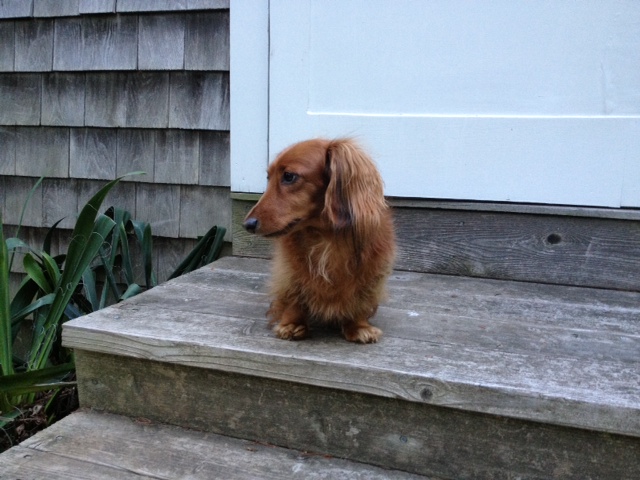
(From Dog Songs by Mary Oliver. Reprinted by arrangement of Penguin Press, a member of Penguin Random House LLC. © 2013 by Mary Oliver. Photo of Daisy, Alice Quinn’s pal and the Poetry Society of America‘s office mascot.)

Faces Of The Day

dish_double

Colossal captions:

Created by Berlin-based artist Sebastian BieniekDoublefaced is an ongoing series of experimental portraits where a second (or third), rudamentary face is painted with makeup products on the side of a subjects face. While the idea seems ridiculously simple, the actual result is a super bizarre, off-kilter series of photos.

More of Bieniek’s work can be seen on his Facebook page.

When Sexual Harassment Is Murky

Katie Roiphe digs into the saga of Colin McGinn, a philosophy professor (and multiple-time Poseur Alert nominee) who resigned this year from his tenured position at the University of Miami after a graduate student filed a report of sexual harassment against him:

One of the reasons I think people revel so much in the downfall of someone “like” Colin is that we like to hear news that the world is humming along just as we suspected, that all the prejudices and slights and wrongdoings we have always imagined are yet again proved to be real. Our fears that the “powerful” or “arrogant” are corrupt and abusive of the less powerful and less arrogant are confirmed. Our instinctive distrust of those who are stars, who have succeeded spectacularly, is vindicated by news of ugliness or corruption. We like, in other words, a good cliché.

What happened in the halls of the philosophy department at the University of Miami is much messier and more ambiguous and dingy and depressingly human than the glamorous black and white of the political language—sexual harassment. There is no arrogant, successful man sending dirty missives, no innocent, wronged victim to rally around; instead there is a whole complex swamp of motives and hopes and judgments and desires and ambitions, many conspicuously, spectacularly ill-advised, and there is a little bit of human warmth.

Scott Lemieux remains unsympathetic:

[S]ince McGinn resigned there was no “punishment” … If he was an adjunct that would be one thing; he had tenure and had due process rights. If the rules didn’t require him to resign he was free to make that argument within the university’s processes and in court if the university violated his contractual rights. He chose to resign rather than defend himself; this doesn’t entitle him to have his behavior interpreted with maximum charity.

Who Were Humanity’s First Artists?

Mostly women:

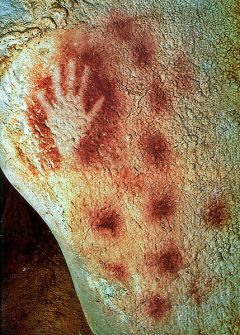
dish_pechmerle[Penn State archaeologist Dean Snow‘s new study] began more than a decade ago when he came across the work of JohnManning, a British biologist who had found that men and women differ in the relative lengths of their fingers: Women tend to have ring and index fingers of about the same length, whereas men’s ring fingers tend to be longer than their index fingers. …

[Snow] analyzed hand stencils found in eight cave sites in France and Spain. By comparing the relative lengths of certain fingers, Snow determined that three-quarters of the handprints were female. “There has been a male bias in the literature for a long time,” said Snow, whose research was supported by the National Geographic Society’s Committee for Research and Exploration. “People have made a lot of unwarranted assumptions about who made these things, and why.”

Archaeologists have found hundreds of hand stencils on cave walls across the world. Because many of these early paintings also showcase game animals—bison, reindeer, horses, woolly mammoths—many researchers have proposed that they were made by male hunters, perhaps to chronicle their kills or as some kind of “hunting magic” to improve success of an upcoming hunt. The new study suggests otherwise.

(Image of a handprint at Pech Merle via Wikimedia Commons)

Not Waiting For Teachable Moments

This embed is invalid


For Jenée Desmond-Harris, who contributes to The RootRace Manners column, the old-fashioned agony aunt can play an important role in the conversation on race:

I love [the advice-column format] because people write in with sincere questions and really want to understand something, help someone or do the right thing. And its so rare that we hear race and racism discussed in that context. Usually we dont address it until someone has been attacked or offended, and then the public conversation is adversarial, and no ones in the right state of mind to think critically or compassionately. I try to take the time to talk to experts, read up on history and write understanding responses that encourage empathy, so I hope Race Manners is refreshing in that way.

Recent columns have responded to “Annoyed Atheist” – a black woman tired of others assuming shes Christian – and “Ready to Get Rid of Racism” – a white man, much like Cartman, who irrationally fears black people but isnt sure how to stop.

Internet Connections

John McDermott ponders Jonathan Franzen’s anti-Internet leanings and the role of technology in modern life:

Life can indeed be sad and lonely, but technology can bridge that gap when used “correctly.” Now you can see photos of your niece who lives on the other side of the country; you can feel as if you’re not completely missing out on her infant years. You can Skype your boyfriend who’s studying abroad and feel relieved once you look into each other’s pixelated eyes. Your friend from college—the one with whom you immediately clicked because his music taste was miraculously similar to yours—sends you a song through Spotify and you listen to it and of course you love it and you appreciate that there’s someone, somewhere who not only shares your taste but appreciates it, and you, enough to try to turn you on to a new band. Or perhaps you hate the song and you laugh as you recall spending countless hours getting high as a fucking kite with that person and debating which bands did and did not suck at that point in time and for what reasons. You might have disagreed, but you were just happy to have someone with whom to sit around with, to get high and listen to music with for hours at a time. Your friend sends you a Snapchat, a 10-second long video performance—and you and you alone are the intended audience. …

Technology does not necessarily advance or diminish people’s lives. Technology is an extension of life itself: it can be as lonely or happy as you make it. You can use it to get lost in an echo chamber of self-importance, or you can use it to make genuine connections with people.