Ask Rick Doblin Anything

[Updated with many new questions from readers]

From his bio:

Rick Doblin, Ph.D., is the founder and executive director of the Multidisciplinary Association for shroomies Psychedelic Studies (MAPS). He received his doctorate in Public Policy from Harvard’s Kennedy School of Government, where he wrote his dissertation on the regulation of the medical uses of psychedelics and marijuana and his Master’s thesis on a survey of oncologists about smoked marijuana vs. the oral THC pill in nausea control for cancer patients. His undergraduate thesis at New College of Florida was a 25-year follow-up to the classic Good Friday Experiment, which evaluated the potential of psychedelic drugs to catalyze religious experiences.


His professional goal is to help develop legal contexts for the beneficial uses of psychedelics and marijuana, primarily as prescription medicines but also for personal growth for otherwise healthy people, and eventually to become a legally licensed psychedelic therapist. He founded MAPS in 1986, and currently resides in Boston with his wife and three children.

What should we ask Rick? Sound off in the survey below (if you are reading on a mobile device, click here):


This embed is invalid

Our extensive coverage of the spiritual and therapeutic benefits of psychedelics is here (or in chronological order here).

(Photo of Psilocybe Cubensis by Flickr user afgooey74)

Heckuva Job, Kathleen! Ctd

Screen Shot 2013-10-11 at 1.06.19 PM

A reader quotes me:

Why does Kathleen Sebelius still have her job? If this were a private company and she were responsible for rolling out a critical new product and came up with this nightmare, she wouldn’t last the week.

I have been an IT consultant for private companies that ranged in size from startups to Fortune-100 since 1998, and a smart private company would not fire someone within a week.  When there is a bad product launch (and the errors I’ve seen in the CA Obamacare site are just embarrassing), the company goes into crisis mode trying to deal with major issues.  When you’re in that mode, you don’t rock the boat unnecessarily. Why fire your leader and add one more complication to an already-complicated situation?  I guarantee you that behind the scenes everyone is scrambling to get the exchanges to an acceptable level of functionality, and once there is a chance to take a breath, people will be held accountable.  But unless Sebelius is somehow making things worse by being there, why would you fire her at this time and make a chaotic situation even worse?

Another adds:

Suppose she was let go, would her replacement not have to go through Congressional hearings before taking the position? How long is that going to take, and what would the effect be on HHS to be without leadership, especially NOW, for an extended time?

Another reader who takes issue with my quote:

Really? The exchanges were contracted out to private companies, CGI Group and Quality Software Services. As far as I know neither of their CEOs have resigned or been fired. Having worked in IT project management for a long time, the Obamacare glitches look pretty routine for such a complicated undertaking.

One of many more readers:

I would like to point out two parallel failures in private business that mirror the launch failure of healthcare.gov.

Last year’s Sim City 2013 and the Diablo 3 launches are great examples of digital products released to mass demand exposing deficient servers and buggy products. While these events are in the sphere of gaming culture and thus might not be “serious” enough for critical discussion both multi-million dollar products had awful launches which serve a good parallel. The individuals in charge of each of these products were not fired, in contrast to your view that private business would hold such incompetence immediately accountable. While both games ended up being disappointments, their directors were allowed to fix the problems before being shuttled off to the side.

If anything, the Obama administration is acting like a business by not removing someone who failed with a product launch, thus creating a larger PR problem, and allowing that person to remain until the problem is fixed.

The myths that surround “how business is done” and the empirical real-world examples are one of my pet peeves. Even the disastrous Apple Maps launch didn’t result in an immediate firing. It took two months and an internal power struggle to remove Scott Forstall and Richard Williamson.

Another example:

Fifteen years ago I was in management at the US headquarters of a Global 500 IT company. The president wanted to roll out an new (but internal) intergalactic system for managing distribution, networks, sales forecasts, revenues, and other operations. He believed his Accenture consulting cronies when they assured him that the turn-up would go smoothly. Seamlessly! (SAP was a co-conspirator.) Little testing was done, at load or otherwise. The integrity of data went unchecked.

The company was unable to take inventory, track sales, or recognize revenue, except by hand, for over a month. Dozens of worker bees had to be flown in from the home country to count the beans. Needless to say, no one was fired.

Another:

Um, I just want to point out that all new systems have their gliches and burps and crashes. Take the iPhone 5s; it’s crashing like crazy: “iOS apps are twice as likely to crash on the new iPhone 5s as they are when running on the iPhone 5 and 5c” – so would you put this in the category of massive failure? You say “And this while the roll-out has been about as disastrous as I could have imagined…” Really? The ACA is a brand new system that’s never been done before and it crashes and you say disaster? I realize this kind of talk is not just coming from you, but really, the drama, THE DRAMA! Nobody steps back and looks at the big picture.

Another steps back:

I’m all for accountability and no fan of Kathleen Sebelius. But you’re a bit harsh in criticizing what is perhaps the most ambitious online system roll-out in the history of the internet. As I understand it, this is an enormously complex system because of all the different agencies – with their own codes, protocols, and security measures – that need to “talk to one another” through the healthcare.gov portal. And isn’t the IRS partially shutdown – I would guess that affects the portal’s ability to verify all the data it needs to check people’s subsidization levels.

In any case, this is a site with high variables, high traffic, and very scary internet security possibilities. To top it off, it was never supposed to be run mostly by the federal government! The plan was that the states would run their own exchanges, right? But too many of them decided that they didn’t actually want “states’ rights” in this instance because rights entail responsibilities, and responsibilities are hard.

And I’ll repeat what many others have said: the comparison here should not be to other quotidian online transactions, but to the previously existing open market for individual health insurance plans. Even dealing with COBRA is a huge hassle – and that was the easiest way to have individual health insurance before the Affordable Care Act.

It was reported that more people tried to sign up for this in 24 hours than in Twitter’s first 24 months.  So, maybe, just maybe, take that Mental Health Break a bit early today and chill out?

Another steps back even more:

First, I want to say that I agree with you, Ezra Klein, and all the others who have been enormously critical of Healthcare.gov’s lack of functionality. I do information technology for a large healthcare nonprofit in Chicago and it has caused me and the people who actually need it nothing but problems. So I am not only disappointed but genuinely incensed at such an important program lacking such basic functionality.

I am also not surprised.

I fully believe that those in the Obama administration who were responsible for the rollout should actually live up to that responsibility. But I don’t think we should stop there. I think this speaks volumes about the process of awarding government contracts. The process to simply find a firm that is willing to do it is rough enough. Then you add in that the government usually chooses the lowest bidder, not the most qualified, which already won’t get the best results. But before you can choose the best of the lowest bids, you have to make sure that the engineers in the firm meet a myriad of federal requirements. I’m not a total anti-regulation nut (despite how it ties my hands, I still am mostly in favor of HIPAA and HITECH) but there are regulations that prohibit the best quality, especially in cases like this. And when it comes to something like a massive new healthcare initiative for the entire nation, how could you want anything but the best?

I’m sure you’ve received a bunch of emails like this one, so thanks for taking the time to read it! And keep up the good work on the blog; it’s still one of the best sites on the Internet – and it had a solid launch!

The GOP Hates Itself

Republican Dissaproval

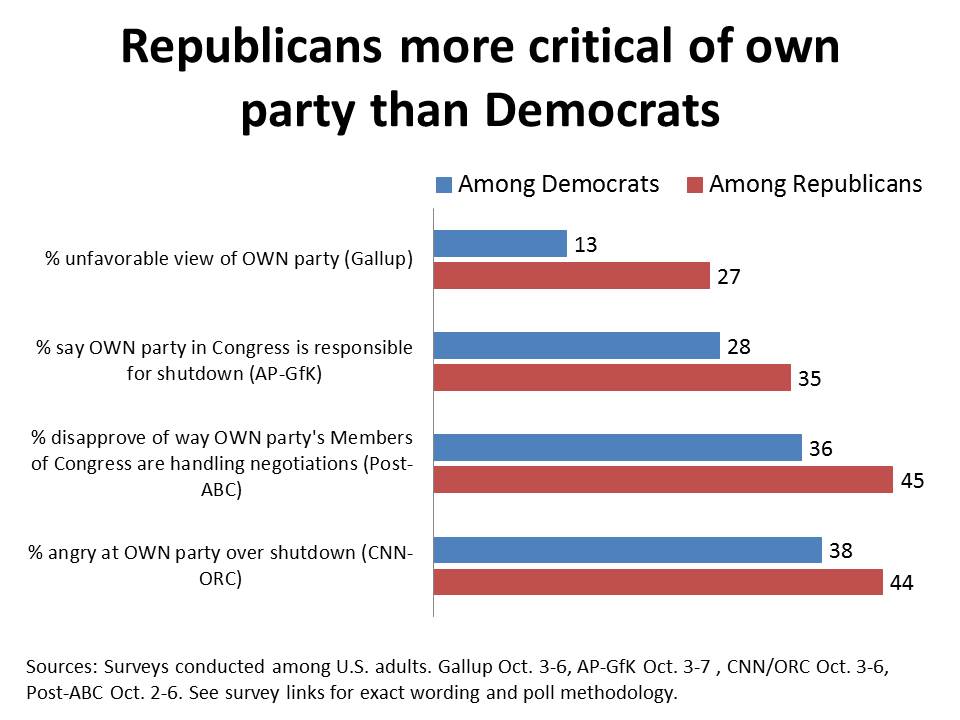
The Fix highlights the above chart:

The last thing the GOP needs as it seeks to unify, expand its reach and attract new voters is anger directed inward. But that’s the reality of what it’s dealing with.

The trouble is: I don’t think this is primarily moderate Republicans, if they actually exist, blaming Tea Party hostage-taking for their party’s fate. I think it’s base Republicans hating on their leadership’s alleged moderation! As someone who has read, edited or written countless “Republicans’ Coming Crackup” pieces, it might just be true this time that it’s happening. As so often, Obama is causing his enemies to self-destruct. How else to interpret a public statement like this one from the head of the National Federation of Independent Businesses:

There clearly are people in the Republican Party at the moment for whom the business community and the interests of the business community — the jobs and members they represent — don’t seem to be their top priority.

McCain (see below) and now Peter King have emerged from the shadows again. This is King on Cruz:

How did a guy eight months in the Senate be able to dominate the House Republicans, Senate Republicans, tie up the country, and bring the government to a halt with no end game, no strategy, and then now just sort of walk away, as if he’s done his job?

Meanwhile, a study finds that the government shut-down is hurting the red states most of all. Much of which prompts the usually sober John Judis to declare that the current GOP is pining for the fjords:

What is happening in the Republican Party today is reminiscent of what happened to the Democrats in the late 1960s and early 1970s.

At that time, the Democrats in Washington were faced by a grassroots revolt from the new left over the war in Vietnam and from the white South over the party’s support for civil rights. It took the Democrats over two decades to do undo the damage—to create a party coalition that united the leadership in Washington with the base and that was capable of winning national elections. The Republicans could be facing a similar split between their base and their Washington leadership, and it could cripple them not just in the 2014 and 2016 elections, but for decades to come.

Seth Masket doubts that we are in the middle of a realignment:

Obviously, it’s hard to know how the current rift will play out. There seems to be a consensus emerging that the current Tea Party-inspired crisis over health reform, the shutdown, and the debt ceiling has been an unmitigated disaster for the Republican Party, costing it in terms of policy and popularity. If that is the dominant interpretation a few weeks and months from now (especially among Republicans), Tea Party affiliates will get much of the blame, and this may represent an opportunity for the more traditional establishment types to reassert themselves and to ignore Tea Party demands in the future.

What more traditional establishment-types? Name one in the House with any clout or on Fox News with any regularity.

Heckuva Job, Kathleen, Ctd

Stay calm. Here’s what we paid for the Obamacare site:

[T]he fact that Healthcare.gov can’t do the one job it was built to do isn’t the most infuriating part of this debacle – it’s that we, the taxpayers, seem to have forked up more than $500 million of the federal purse to build the digital equivalent of a rock.

Update from a reader:

The Digital Trends piece on the cost of Healthcare.gov mis-read the government contract award documents and has walked back their “Healthcare.gov cost half a billion dollars” claim. Their post has been updated (rather mendaciously, I think). Here’s one blogger’s explanation of how they may have misread the contract costs.

Mike Masnick blames the way government hands out contracts:

[I]t appears that the federal government basically handed this project over to the same crew of giant government contractors, who have a long history of screwed up giant IT projects, and almost no sense of the “internet native” world.

The Sunlight Foundation (link above) figured out the list of contractors who worked on the site, and noted that the big ones not only are well-known DC power-player insiders, but they’re also big on the lobbying and political contributions side of things. You’ve got companies like… Booz Allen Hamilton, famous for promoting cyberwar hype and employing Ed Snowden. There’s defense contracting giant Northrup Grumman. Then there’s SAIC — which I can’t believe can still get government business. This is the same firm that famously was given a $380 million contract to revamp the FBI system, on which it went $220 million over budget, and then saw the entire system scrapped after it (literally) brought some users to tears, and the FBI realized it was useless in fighting terrorism. SAIC is also the company that NYC Mayor Bloomberg demanded return $600 million after a city computer project (budgeted at $68 million) actually cost $740 million. SAIC has a long list of similar spectacular failures on government IT projects.

Here’s what I don’t believe. I don’t believe the Obama campaign would have entrusted their polling and GOTV apparatus to these companies. So why do they take government less seriously than they do their own campaign? This is not the change we can believe in. And it better get fixed fast.

Should Obama Have Taken The Deal?

Noam Scheiber believes so:

Boehner’s idea was pure genius—at least if you’re rooting for the Democrats. It essentially solved the problem I just laid out. After all, polls show the GOP taking on massive amounts of water over the shutdown. There’s simply no way Republicans can hold out for over a month without reopening the government. Boehner wanted to use the shutdown to ensure that Obama negotiated a budget deal in good faith. But the enforcement mechanism he insisted on—government closure—is one that hurts Republicans far more than it hurts Obama politically. That means the GOP would have likely sued for a budget agreement* long before the debt ceiling had to be raised again in six weeks, very likely in the next week.

I sure hope Obama isn’t getting cocky. But we’ll soon see if the polls do all the work for him. Watching Cruz and Lee sink like stones in their home states is somewhat gratifying. But their margins are comfortable enough for Cruz to keep going, as his tub-thumping speech at a Christianist Summit this morning reveals.

Heckuva Job, Kathleen!

Ezra is admirably candid about Healthcare.gov’s failures:

The public is giving Obamacare’s roll-out low marks:

Just 7 percent of Americans believe that the rollout of President Obama’s health care law has gone very well, according to an Associated Press-GfK poll.

But, as the Dish noted last night, support for Obamacare has gone up since its launch. Ezra thanks the GOP for throwing Obamacare a lifeline:

Republicans have chosen such a wildly unpopular strategy to oppose it that they’ve helped both Obamacare and its author in the polls. This could’ve been a week when Republicans crystallized the case against Obamacare. Instead it’s been a week in which they’ve crystallized the case against themselves.

Yep, it was, in retrospect, an even worse gambit than it seemed at the time for the GOP not to wait and see how Obamacare was rolled out before their mass hostage-taking of America’s collective credit. But I’m still aghast at the rank incompetence at the White House as well as the lack of accountability.

Where, for example, is Valerie Jarrett, who purportedly had a key role in over-seeing this massive project? What does she have to say for herself? Why does Kathleen Sebelius still have her job? If this were a private company and she were responsible for rolling out a critical new product and came up with this nightmare, she wouldn’t last the week. If you want to persuade us that government can help people, then why give us a case-study in incompetence and then risible accountability? It is not good enough to say the GOP saved them. They should not have needed to be saved.

Meanwhile, Allahpundit asks if Ted Cruz will ever admit he was wrong:

I’m tempted to say that it’s just one poll, but on the ObamaCare question, it’s actually not.

John McCormack of the Standard pointed out to me this afternoon that Rasmussen also spotted a small rise in O-Care’s popularity from the beginning of September, when it was at 41/52, to October 4-5, when it blipped up to 45/49. …  The Cruz strategy for defunding (or delaying) ObamaCare was, as I understood it, to stand firm even if it meant a shutdown and then wait for public opposition to the law to build to the point where O would have no choice but to cave. The only two major polls about the health-care law that have been taken after the shutdown, though, show its unpopularity decreasing. Where’s the populist groundswell that’s supposedly going to make Obama blink? Would five polls prove that the strategy wasn’t working? Ten? We know how this theory of populist revolt could be confirmed, but how could it be falsified?

And this while the roll-out has been about as disastrous as I could have imagined. Call me crazy (and they do), but perhaps the simple idea of actually being able to get affordable health insurance is popular! Amazing idea, I know. Even if the initial roll-out should confirm every Tea Partier’s paranoid conviction that the federal government is a useless, unresponsive, money-sucking pile of mediocrity.

Well, in this case, under Obama, it has been.

Ideas That Kill

George Packer deconstructs September’s spate of Islamist violence:

American wars in Muslim countries created some extremists and inflamed many more, while producing a security vacuum that allowed them to wreak mayhem. But the origins of the slaughter are overwhelmingly internal—sectarian, tribal, political, economic. At its source, the violence flows from ideas, terrible ideas, about the meaning of Islam, the character of non-Muslims, and the duties of Muslims. These ideas are promulgated in mosques and coffee shops and schools, and on satellite TV and the Internet, with the aid of conspiracy theories, half-truths, deceptive editing, and lies. They are remarkably impervious to the ebb and flow of U.S. foreign policy.

He covers a new effort to combat these ideas:

At the end of September, the State Department announced the creation of a joint U.S.-Turkish fund to combat Islamist extremism, called the Global Fund for Community Engagement and Resilience. The goal is to raise two hundred million dollars over ten years, from governments and private donors, and to identify and finance grassroots groups around the Muslim world that will do the difficult work of opposing extremist ideas at home. These groups would take on the Islamists where they live, in mosques and community centers, in chat rooms and on social media. The American role would be very much in the background; citizens, organizations, and governments of key Islamic countries, such as Saudi Arabia and Pakistan, would take the lead.