What Afghans Are Watching

Documentarian Eva Orner’s latest film follows the first independent television network to launch in Afghanistan in 30 years, TOLO TV, which has “changed the country enormously”:

In addition to soap operas, police dramas, singing contests, and call-in advice shows, TOLO TV’s lineup includes a Parks And Rec homage The Ministry, an ensemble comedy that “centers on the day-to-day running of the illustrious Ministry of Garbage.” But the biggest draw is sports:

[I]t was like World Cup soccer fever in Afghanistan. They just won their first international soccer title in the South Asian Football Federation Championship, where they beat India. It was three days of partying in Afghanistan. I was talking to people who were there, and they said that you can’t even imagine the fervor in the country. It’s incredibly inspirational and aspirational, which is part of what TOLO’s always been about. Afghanistan needs heroes, people that kids can look up to.

Previous Dish on Afghan entertainment here.

A Two-Tiered Voting System? What Could Go Wrong?

Kansas and Arizona now require proof of citizenship to vote in state and local – as opposed to national – elections:

The dual methods are in response to a U.S. Supreme Court ruling in June that bars Arizona from rejecting federal voter-registration forms that don’t include proof of citizenship, which is required by both states. To comply, both plan to provide those voters with ballots listing just federal races. … State officials say they have little choice: the high court didn’t invalidate the statutes that require proof of citizenship to vote in state and local races. Critics say the mandates are designed to impede ballot access for minorities, the poor and older residents who may not have the needed documentation, such as a passport or a birth certificate.

One of those critics is Emily Badger:

This idea will have two obvious and unfortunate consequences:

It will create mass confusion (TPM writes that Kansas is envisioning four different registration scenarios involving two different registration forms, with some people left ineligible to vote in any election). And by creating greater barriers to registration specifically in non-federal elections, the idea threatens to particularly impact elections for offices like mayor, city council, and state representative. We already know that turnout in local elections tends to be dramatically lower than in national ones, with direct implications for who gets elected.

Benen warns, “The Republican war on voting didn’t end in 2012; it metastasized.”

If You See Something, Text Something

4312589663_fcf0181aea_o

Engrossed by their smartphones, passengers on a San Francisco Muni train didn’t notice a man on board brandishing a pistol until he had shot and killed a student. City authorities have expressed concern about the passengers’ “collective inattention to imminent danger.” Will Oremus elaborates:

San Francisco District Attorney George Gascon told the Chronicle he worries that technology is exacerbating the problem. “These weren’t concealed movements,” he said. “The gun is very clear. These people are in very close proximity with him, and nobody sees this. They’re just so engrossed, texting and reading and whatnot.” Authorities have been warning for years that people’s texting, browsing, and gaming habits make them more vulnerable to phone-snatchings, not to mention being beaned with a basketball by Baron Davis. But Gascon is among the first to suggest that smartphone users are putting their neighbors at risk as well when they block out the world and lose themselves in Candy Crush.

But Lex Berko charges that smartphones have become a scapegoat:

From personal experience, I know I’m just as unaware, perhaps even more so, when involved in an intricate fictional plot as I am when I’m trying to win a game of Dots. If each passenger had been reading instead of playing Candy Crush, answering text messages, or whatever else they were doing (quite frankly, they could’ve been reading an e-book), how would that change our perception of this crime or other similar situations? … We would never hear officially sanctioned statements about balancing our love affair with books in order to minimize crime. We love books, we read books in public, and sometimes reading books in public means not noticing other things going on. But replace books with phones and it’s a different tale entirely.

And Joe Eskenazi makes an uncomfortable point:

Authorities are preaching vigilance, which is probably a smarter thing to do than play Angry Birds. But left unsaid is just what the hell a train full of vigilant people were supposed to do if they noticed a man waving about a pistol – a man, specifically, in search of a random passenger to murder. What then?

(Photo of texting Muni passengers by Flickr user ejbSF)

The Age Of Internal Violence

Historian Joel F. Harrington, whose most recent book concerns the inner life of a prolific executioner in 16th-century Nuremberg, suggests that civilization hasn’t become less violent; the nature of violence has changed:

To argue our own (or any) society is more or less violent than in the past misses the point at an even more fundamental level: Violence is broader and deeper than just intentional killings or physical assaults. Perhaps because I commute on a near daily basis between the sixteenth and twenty-first centuries, I see in both eras an intuitive understanding that human violence is much more pervasive and malleable than mere homicide statistics suggest.

Consider self-harm:

Perhaps the most obvious indictment of modern internalized violence is the global spike in suicides during the past 40 years, particularly among the young. According to the World Health Organization, self-killing today accounts for four times as many intentional fatalities as war or other state violence, and 15 percent more than homicide — the inverse of [16th-century] Europe.

Previous Dish on the history of violence here.

Chart Of The Day

Most Americans have no idea that the deficit is falling:

Deficit Poll

Derek Thompson captions:

The point isn’t that Americans are stupid. They have busy lives and concerns that have nothing to do with the annual gap between taxes and outlays. Instead, the point is that public-opinion polls don’t belong on the same plane as facts and informed analysis, because they qualify as neither. … Public polls are a fine gauge of public opinion, but they’re not to be treated as a barometer of reality. Pretending otherwise mixes up the regurgitated misinformation of readers with the careful analysis of people who are in the business of busting misinformation.

Americans are also terrible at estimating the number of jobs added:

In the past twelve months, the U.S. has added 2.2 million jobs. And even though most respondents knew that unemployment has gone down, the average estimated number of jobs added was a mere 305,000.

Guess Ou’s Talking Now?

Christen McCurdy isn’t convinced that epicenes – gender-neutral singular pronouns such as ou or ze – will catch on among English-speakers:

Linguist Denis Baron argues that pronouns are the most conservative part of speech in English, and that speakers are incredibly slow to adopt new ones broadly. The most recent one he counts is “its,” which appears in some of Shakespeare’s work (though Shakespeare uses other words, including “is,” to mean precisely the same thing), but not in the King James Bible. … If the first attempts at creating an epicene pronoun came from nitpicky writers and grammarians, it’s only been fairly recently – say, the 1950s and ’60s – that writers started proposing epicene pronouns as an argument for greater inclusiveness. Feminists trying to shift away from the generic “he” were among the first; transgender and genderqueer writers came later. Baron finds broad use of the Spivak pronouns – “e,” “eim,” and “eir,” coined by mathematician Michael Spivak – in transgender forums online and in science fiction, but hasn’t found an instance of a new epicene pronoun gaining traction in English.

The CW network has more faith that the epicene will emerge; it recently announced that its new drama about a transgender teenager would be titled Ze.

The Farce Of Food Inspection

Amid fears that the shutdown will compromise food safety, Ritchie King and David Yanofsky look into the two major organizations that inspect food for the federal government:

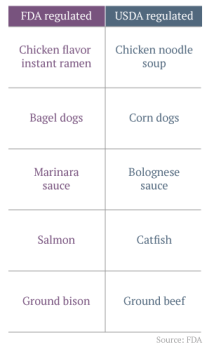
Screen Shot 2013-10-10 at 11.42.10 AMA disproportionate number of the furloughed inspectors work at the Food and Drug Administration—one of the two US government organizations that inspects farms and production facilities—rather than the US Department of Agriculture, where 87% of the food safety staff is still going to work.

So what’s getting inspected, and what isn’t? The answer is far from straightforward. Each agency is responsible for different foods: the USDA generally covers meat, poultry, and products made with egg, while the FDA covers everything else…kind of. As it turns out, their jurisdictions are divided in a way that seems totally arbitrary in some cases. In others, it’s downright farcical.

Take eggs:

The chickens that lay them are monitored by the USDA, as is the facility that they lay them in. The processing plant that washes, sorts, and packages the eggs is regulated by the FDA, and so is the carton that they’re sold in. Once that egg is cracked, the USDA is back in charge whether the contents are dried, frozen, or still in liquid form. That is, unless they are used in eggnog mix, french toast, or egg sandwiches; those items are in FDA territory.

The good news: the USDA, which conducts inspections more frequently than the FDA, hasn’t been hit as hard by the shutdown.

Stuck With The Status Quo?

Waldman bets on divided government for the foreseeable future:

[W]hat you could have is a party stubbornly alienated from the national electorate, but stubbornly able to keep control of the House of Representatives. Which would mean that we just go on in this current vein. The GOP’s descent into madness helps Hillary Clinton or Joe Biden or Martin O’Malley become president, and stalemate politics in Congress continues. The image of the Republican party doesn’t recover, convincing most Americans that they’re too irresponsible to be trusted with governing, making it all but impossible for them to win the presidency or take control of the Senate. Yet they keep holding the House indefinitely, or at a minimum until a post-2020 redistricting reduces their stranglehold on the House.

Barro sees Christie as the GOP’s only hope. He points out that, in New Jersey re-election polls, Christie is “drawing about a third of the black vote, an unheard of level for a Republican candidate”:

Republicans are worried about how to appeal to voters in a country that is decreasingly white. Christie has shown how much credibility Republicans can gain with black voters simply by showing respect to the president, even while disagreeing with him on a broad swath of policy issues. This shouldn’t be hard, but for most Republican politicians, it is. Much of the party’s energy today is based on animus toward the man who happens to be the first black president. Christie is one of the few Republican politicians who understands how damaging that has been to the party’s brand.

The Best Of The Dish Today

Government Shutdown Continues Without Resolution

Some semblance of sanity broke out among the Republicans on Capitol Hill. But it may not last long. And the president turned down the first offer because of a postponement of the debt ceiling raise for six weeks because the GOP insisted on keeping the entire federal government shut down. We got some more clarity on why Obamacare’s federal website is so inexcusably awful.  And we imposed some unaccustomed accountability from all those who confidently decried any notion that the Assad regime was serious about turning over its chemical weapon stockpiles.

A non-English speaker tried to figure out what a party-pooper is; readers pitched in to a suddenly popular thread on animal welfare; and we passed our 30,000th subscription (30,043 right now). Join the experiment [tinypass_offer text=”here”] – and help forge a new business model for online journalism from the ashes of the old.

The most popular post of the day was The Depravity Of The Pro-Torture Right, as leading neocons lined up to joke about waterboarding prisoners at a roast of the war criminal, Dick Cheney. In a strong third place came a YouTube that still cracks me up. Booo Wendy!

See you in the morning.

(Photo: Speaker of the House John Boehner (R-OH) leaves the U.S. Capitol for a meeting with House Republican leaders and U.S. President Barack Obama October 10, 2013 in Washington, DC. By Win McNamee/Getty Images.)

Email Of The Day

Screen Shot 2013-10-08 at 2.11.14 AM

A reader writes:

I realised recently that this month marks 12 years of my daily visits to The Dish. I recall that you received a flood of toasts and roasts on your 10th anniversary, but I thought you might appreciate receiving another such email out of the blue.

I live in Hong Kong and in 2001, my brother, who lived in Manhattan at the time, posted me a printed copy of “This Is a Religious War.” I enjoyed it and so I googled you and I howler beaglefound your blog. I had no idea what a blog was at the time. I simply knew you posted little articles everyday and I thoroughly enjoyed reading them. Now 12 years later, I am still a daily visitor to The Dish. I am a paid [tinypass_offer text=”subscriber”] and bought several copies of “The View From Your Window” book. I have emailed you a handful of times over the years and you have replied a few times. I remember very early days (maybe late 2001) you posted a survey designed to profile your readers. When the results came in, you were so amazed that you had any regular readers! You didn’t know if anyone was really out there.

We have certainly had our share of one-sided arguments with me yelling at my monitor – but hey, we got through it and I have always appreciated your intellectual honesty. I actually remember when you began posting your readers’ “Dissent of the Day.” I was so impressed with the transparency that those posts offered as well as the confidence it suggested you had in your own positions. (By the way, the “Dissent of the Day” posted without rebuttal from you remains my favourite Dish feature.) Congratulations on all your success and thanks to you and your team for the thousands of thoughtful posts – and for the daily grind of hard work that went into each one.

You’re extremely welcome. It’s a staggeringly rewarding – and utterly exhausting – thing to write for some readers for 13 years straight every day. But the experience has been the most fascinating in my life. And now, I’ve managed to find the best team of researchers, writers, techies and under-bloggers out there, the burden is nothing like as great for me personally. This has become a true team effort, and it remains true that I’m in awe of all of my colleagues, who are also, inescapably at this point, among my best friends.

Please help us make this work – a very high signal-to-noise, ad-free, reader-backed site. We’re out on a limb, trying this new business model out, and next February, when we face a huge wave of optional renewals – around 80 percent of our readership who signed up en masse last February – I’ll be shitting myself as usual. But you have always come through for us; and I hope we keep coming through for you. Thanks to every single subscriber – and if you’re still holding out, please take the plunge and [tinypass_offer text=”subscribe”]. It takes less than two minutes and costs as little as $2.