Laying down the marker—Obamacare implementation’s going to be great and people will love it: http://t.co/itm6J3BixD
— Matt Yglesias (@mattyglesias) July 17, 2013
Year: 2013
Face Of The Day

Vegetarian festival devotees get pierced early morning at the Bang Neow shrine in Phuket, Thailand on October 10, 2013. Ritual Vegetarianism in Phuket Island traces it roots back to the early 1800s. The festival begins on the first evening of the ninth lunar month and lasts for nine days. Participants in the festival perform acts of body piercing as a means of shifting evil spirits from individuals onto themselves and bring the community good luck. By Paula Bronstein/Getty Images.
Why The GOP Is Relenting
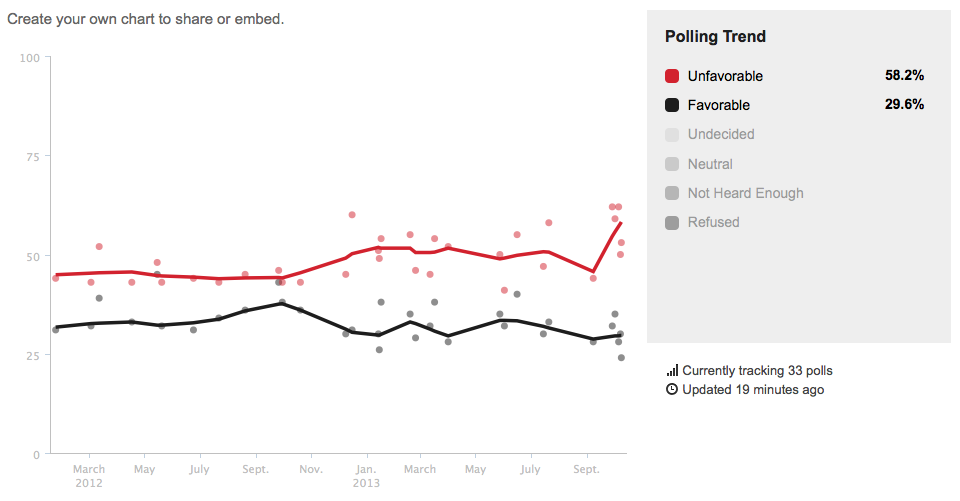
And why the president just turned their latest gambit down:
By a 22-point margin (53 percent to 31 percent), the public blames the Republican Party more for the shutdown than President Barack Obama – a wider margin of blame for the GOP than the party received during the poll during the last shutdown in 1995-96. Just 24 percent of respondents have a favorable opinion about the GOP, and only 21 percent have a favorable view of the Tea Party, which are both at all-time lows in the history of poll.
Obama’s ratings are pretty stable, in comparison. And this is the cherry on the top:
Thirty-eight percent see the Affordable Care Act (or “Obamacare”) as a good idea, versus 43 percent who see it as a bad idea – up from 31 percent good idea, 44 percent bad idea last month.
(Chart: poll of polls for Republican party favorability.)
Popcorn’s Appeal
Natasha Geiling details the history of the movie theater snack:
Before the Great Depression, most popcorn sold was a white corn variety–yellow corn wasn’t widely commercially grown, and cost twice as much as the white variety. Movie vendors, however, preferred yellow corn, which expanded more when it popped (creating more volume for less product) and had a yellowish tint that belied a coating of butter. People became accustomed to the yellow popcorn and would refuse to buy the white variety at markets, requesting the kind that looked like “the popcorn at the movies.” Today, white popcorn accounts for 10 percent of commercially grown popcorn; yellow popcorn takes up almost the rest of the commercial market (with some color varieties, like blue and black, grown in negligible amounts).
Some Calm Sanity From The Right
I’ve been looking for it – and Megan comes through.
The View From Your Window

Bend, Oregon, 11 am
Quote For The Day
“The biggest single problem since 1980 has been that the publishing industry has been led by the nose by the retail sector. The industry analyzes its strategies as though it were Procter and Gamble. It’s Hermès. It’s selling to a bunch of effete, educated snobs who read. Not very many people read. Most of them drag their knuckles around and quarrel and make money. We’re selling books. It’s a tiny little business. It doesn’t have to be Walmartized,” – Andrew Wylie, legendary literary agent (and my own).
But for the full flavor of the full metal Andrew, this captures him best of all:
Young writers, when they see me, it’s like meeting Ronald Reagan. Sometimes I go in to pay my respects. Everyone is perfectly polite, but you can tell they’d be a lot comfier if I’d just get the fuck out. So I do.
I can’t help but love the man.
Why Would You Put Your Balls To The Wall?
I guess I should ask Tina Brown, who was inordinately fond of the expression. Maybe it was my balls she was putting “to” the wall? Anyway, it probably doesn’t matter what she meant. From a short history of idioms:
Many figurative expressions have literal origins, but few people stop to think about what they are. For example, the saying “it’s raining cats and dogs” apparently comes from a time when cats and dogs liked to hide in thatched roofs for warmth; when heavy rains fell, the animals would either fall through the roof or jump down in masses, according to etymologist and author Michael Quinion. It’s doubtful that Marvin Gaye knew the roots of his own lyrics, “I heard it through the grapevine”—a term that caught on in the mid-19th century in reference to the twisted vine-like wires of the telegraph and the jumbled messages that would result.
To be fair, it’s hard to believe there was once literal meaning to most phrases. It all seems so violent:
we’d be shooting ourselves in the foot, cutting off our noses, breaking each other’s legs for good luck, shooting messengers, and stabbing friends in the back. We’d be too hurt to dig our own literal graves. We’d be killing birds with stones, breaking camels’ backs, and beating dead horses. Dogs would be eating other dogs, cats would be getting skinned, and Mr Biden would be strangling Republicans. Maybe people would somehow lose their shit, but not before it hits the fan.
Alas, sometimes we think we know the root of a term but we are wrong. “Balls to the wall”, for example, is a term that refers to military pilots accelerating rapidly, thrusting the ball-shaped grip of the throttle lever to the panel firewall, thus gaining full speed. (Naturally Mr Borg was perplexed over this expression as well. “[Putting my balls on the wall] does not help me to do anything, except smell the wall,” he observed.
Another observation from Borg above.
Is The Immediate Crisis Over?
Tim Alberta reported last night that the “particulars of this short-term [debt-ceiling] proposal are in flux, as there are ongoing discussions within the conference regarding which provisions — if any — should be attached.” Cohn is waiting to see the House’s bill:
[I]t’s hard to judge Boehner’s proposal without knowing more details. In particluar, will it actually stipulate that fiscal negotiations take place—and, if so, will it put restrictions on what the outcome of those talks can be? These are critical questions. While Obama and the Democrats have signaled that they would reluctantly accept a short-term increase in the debt ceiling—notwithstanding the political perils that my colleague Noam Scheiber recently identified—they have been adamant that legislation increasing the limit not come with strings attached. It’s not clear whether the bill Boehner described would satisfy those criteria.
Jonathan Bernstein’s perspective:
Democrats have no choice but to accept a clean debt-limit extension (or government funding bill, if that’s available) of any length at all … Where it gets fuzzier is if Republicans propose something that isn’t exactly “clean.”
If the add-ons are cosmetic, Democrats probably (again, depending on details) should accept it. If it includes Republican policy gains or Republican-favoring procedural gains, then Democrats should reject it. But if it’s just some meaningless mumbo-jumbo tossed in so that Republicans can claim a victory (or at least pretend there was no defeat), then Democrats should accept it.
Alex Altman is unsure how many Republicans will support the plan:
It is still uncertain whether the restive House Republican conference broadly supports the plan. While members described the meeting as positive and cordial, others said both more moderate and more conservative members expressed reservation. Some centrist Republicans are concerned about leaving the government shuttered. While several of the Tea Party Republicans who forced the shutdown in an effort to change elements of Obamacare said they would support the plan if Obama signed on, others withheld their support.
Chris Cillizza has similar questions:
Can a clean debt limit bill win a majority of the majority? This is perhaps the most basic question in all of this. Boehner, as we have noted previously in this space, has already passed three pieces of legislation — the fiscal cliff bill, Hurricane Sandy relief funding and the re-authorization of the Violence Against Women Act — with a minority of Republicans supporting them this year. Does he want to do it again on something as high profile as the debt ceiling?
My favorite quote of the day on all this is from a “senior Democratic aide“:
“Republicans may let one hostage go, but they are keeping a gun to the head of the other, while reserving the right to kidnap the first one again in a few weeks.”
And the beat goes on. Earlier Dish on Boehner’s latest, desperate gambit here.
Mental Health Break
A hyper-collaborative lip-dub that will leave you entranced:
 The Dish