Cohabitating With Cancer

George Johnson marvels at the power of words to convey “what it is like, just a little, to be sentenced to life with cancer”:

The writer Reynolds Price was moving smoothly through life, not a star like Roth or Updike but valued for his novels and poetry, when his body’s own story asserted itself. After stumbling unaccountably on a walk across campus, he went to a doctor and was diagnosed with a very rare cancer — one that took the form of an elongated tumor “pencil-thick and gray-colored, ten inches long from my neck-hair downward . . . intricately braided in the core of my spinal cord.” He named it “the eel” and wrote a poem about it. The verses are included in his memoir, A Whole New Life, along with his description of cancer as a being that seems to assert “its own rights.”

Now it sounds a little cracked to describe, but then I often felt that the tumor was as much a part of me as my liver or lungs and could call for its needs of space and food. I only hoped that it wouldn’t need all of me.

The Football Fan’s Dilemma

After watching a screener of the new documentary League of Denial: The NFL’s Concussion Crisis, Dan Amira winced his way through Monday Night Football:

Like many football fans, I’ve always cringed a little during those big, loud helmet-to-helmet hits, the ones you can almost feel in your own neck as you watch them. But now, even during the mundane plays, I couldn’t shake the thought that men were mortgaging their futures away, and perhaps shortening their lives significantly, for my entertainment.

Andrew Sharp applauds the film for making the facts of the matter – and thus the moral quandary – “as clear and undeniable as possible”:

Nothing in the documentary is breaking news, but if nothing else, it gives us a definitive document of all the NFL’s hypocrisy and ignorance that’s defined this battle from day one. … I love football, and I hate talking about concussions, but everything we know about football makes it impossible to choose between the two without being just as reprehensible as an NFL doctor.

Eric Levenson describes football fans one of the “losers” of the documentary:

After watching, it’s hard not to feel conflicted about the sport, particularly after hearing about Pittsburgh Steelers lineman “Iron Mike” Webster, whose football-caused head injuries led to an early death. The documentary showed parts of his autopsy and it wasn’t pretty for fans to see: cracked feet, disfigured legs, and a brain filled with tangled tau protein, the tell-tale signs of Chronic Traumatic Encephalopathy, the degenerative condition most associated with damaged football players. And as a fan, it’s hard not to feel a little responsible for that.

Fantasy football enthusiast Greg Pollock wonders what responsibility fans like him bear for transforming NFL players “from real people into collections of stats”:

To succeed in a game, the player must distinguish information that serves his goal from information that does not. Becoming a better player means doing more of that automatically, without thinking, before thinking. For serious fantasy players—and it is hard not to play fantasy without becoming serious about it – that means automating the process by which we ignore information that does not affect points earned. This warps the way we watch football – Frank Gore blocked so Vernon Davis could get the touchdown? What a useless idiot!—but also the way we think about the league as a broader institution.

Meanwhile, Evin Demirel asks if the film could mark a turning point for the NFL:

[A]fter you’re through with the film, you can’t help but feel that the league’s days of dominance are numbered, even if League isn’t what ultimately destroys it. It’s not that football is too violent; it’s that we now know too much about that violence’s effects. A tipping point of mothers who find the sport dangerous will inevitably be reached, and football will become yet another relic of America’s past, one of those things it’s embarrassing we used to love.

Previous Dish on League of Denial here. To read our extensive thread on head injuries in professional sports, go here.

Dick Morris Award Nominee

“Within three to five years, we can assume that Iran will become autonomous in its ability to develop and produce a nuclear bomb, without having to import either the technology or the material. [The nuclear threat] must be uprooted by an international front headed by the U.S.,” – Benjamin Netanyahu, January 1995, speaking at the Knesset. (Award glossary here.)

Ask Rick Doblin Anything

From his bio:

Rick Doblin, Ph.D., is the founder and executive director of the Multidisciplinary Association forshroomies Psychedelic Studies (MAPS). He received his doctorate in Public Policy from Harvard’s Kennedy School of Government, where he wrote his dissertation on the regulation of the medical uses of psychedelics and marijuana and his Master’s thesis on a survey of oncologists about smoked marijuana vs. the oral THC pill in nausea control for cancer patients. His undergraduate thesis at New College of Florida was a 25-year follow-up to the classic Good Friday Experiment, which evaluated the potential of psychedelic drugs to catalyze religious experiences.

His professional goal is to help develop legal contexts for the beneficial uses of psychedelics and marijuana, primarily as prescription medicines but also for personal growth for otherwise healthy people, and eventually to become a legally licensed psychedelic therapist. He founded MAPS in 1986, and currently resides in Boston with his wife and three children.

What should we ask Rick? Sound off in the survey below (if you are reading on a mobile device, click here):


This embed is invalid

(Photo of Psilocybe Cubensis by Flickr user afgooey74)

The Abatement Of Cruelty, Ctd

A reader writes:

Your acceptance of the “simply morally unacceptable” eating habits that you currently follow leads you to the “eat less meat, or eat better-raised meat” solution. That seems like an obvious, and perfectly reasonable, reaction when one views the evidence surrounding factory farming. But would that actually satisfy one’s moral compass? While eating less meat by definition reduces the number of animals killed, it implicitly gives sanction to eating some meat. I don’t think society generally accepts that sort of logic when approaching other acts that are morally frowned upon.  It would not be acceptable for the US to waterboard fewer prisoners, a rapist to target fewer victims, or an abusive father to beat his children less often, and claim to be acting in a morally upright manner.

And the option of only eating more humanely raised/killed meat is simply not a realistic option.  While specialty stores may stock meat that purports to be miraculously free of animal suffering, it is often little more than a marketing ploy.  The overwhelming majority of meat sold (in order to be economically competitive) comes from factory farms.  The same applies to the egg and dairy industries.

Eating less meat, or eating better-raised meat, as a morally-sound solution is simply a lie that many of us tell ourselves to feel better about our current habits.

I’m trying to be realistic here. Another vegan is less rigid and has some very helpful tips on cruelty-reduction:

You correctly state that people can still make big differences through their food choices in ways that suit their needs and desires. I would like to offer some guidance on that. No deep thoughts, just some practical advice. (Yes, some advice on eating animals from a vegan. Anything to reduce suffering!)

To begin with, if you want to reduce suffering as much as possible and still include animal products in your diet, reduce anything from pigs or birds.

These are by far the most abused animals in farming today because they can both be raised indoors in tight confinement. They have body parts hacked off to minimize the problems of living in such confinement, among other reasons. Pigs and birds are both very intelligent and social (crows are one of the five most intelligent non-human animals on earth). I believe you are totally wrong when you suggest that chickens have a low level of emotional experience – that describes clams, mussels, and oysters (but likely not most fish). Further, a single chicken yields far less meat than a single cow, so chickens are tortured in vast numbers.

First reduce or eliminate eggs, chicken, and turkey; and pork, ham, and bacon. Next on the reduce/eliminate priority list is dairy. Buy delicious nut milk cheeses and coconut milk/almond milk/soy milk/rice milk yogurt and ice cream.

Beef and lamb are much better choices, as they must live at least some of their lives out in pasture. “Grass fed” is good but deceptive, as they do end up in CAFOs eating grain. Grass-fed and grass-finished beef is better, as they don’t end up in feedlots – this is probably the closest to the “one bad day” school of agricultural animal welfare.

Be very suspicious of feel-good labeling, as most of it is highly deceptive. Terms like “cage free”; “free range”; “natural”; “humane” etc. are mostly used on products from atrocious factory farms. Do not believe them! Look for stores or products that use the labeling system from the Global Animal Partnership, as Whole Foods does, and try to stay in within the green labels. If you feel you must use eggs, make sure they are “pasture raised” or “pastured” – these still surely have their problems but are vastly better than anything without some form of the word “pasture” on them, when that word is used honestly.

Try ideas like Vegan Before Six, Meatless Mondays, meat as a small part of dishes, only on weekends or for special occasions, or any such approach that works for you. Buy vegetarian/vegan cookbooks. Read Jonathan Safran Foer’s book Eating Animals. Watch the documentary Earthlings (narrated by Joaquin Phoenix; music by Moby).

Of course if you add the environmental concerns to the cruelty concerns, then that may bring you closer to vegan … maybe, someday. Either way, everyone can help reduce suffering.

Cutting Egypt’s Allowance

EGYPT-POLITICS-UNREST-CLASHES

The US is finally trimming its aid to Egypt (NYT). Goldberg thinks it’s a bad idea, affecting regional stability, empowering Russia, and possibly making the peace process more difficult in Israel – also:

[T]he danger in suspending aid to Egypt, above all other dangers, is that Obama, by signaling that he will act aggressively against Arab autocrats, might provide Islamists with a glimmer of hope at a time when they’re generally back on their heels. Certainly, the opponents of such American friends as the king of Jordan would be pleased by this latest act of an administration that many already believe is naive about the nature of Islamic terrorism.

I think that the US, morally, has little choice. And I like the precedent. It means, for example, that if Israel continues to expand settlements on the West Bank, we have a precedent of cutting aid to one of the two biggest recipients of it, Egypt, and could possibly use that as leverage. But Eric Trager shares Goldberg’s worries:

If the past two-plus years have taught us anything about Egypt, it’s that newly emerging regimes quickly fall out of public favor as they become more autocratic. Much as Egyptians turned on the military leaders who assumed control of the country in February 2011, and much as they rebelled against the Muslim Brotherhood leader who won the presidential election in June 2012, they will likely bristle before long under the current regime, particularly as Egypt’s economy continues to tumble. If the U.S. desires a stable Egypt, it is at that moment that the U.S. will want to use its leverage to encourage the generals to lower their political sights, and permit a more inclusive and democratic politics.

But if the U.S. cuts aid now, it won’t be able to have that conversation then.

Yeah, yeah. And yet, as Michael Crowley notes, we never seem to get anything in return for the aid anyway:

Obama’s move is a clear punishment for Egypt’s military. It will be instructive now to see whether Sisi and company ease their crackdown against the Muslim Brotherhood—or whether they act as though they didn’t need us anyway. That will clarify the debate about whether military aid, with the right strings attached, can buy America real leverage—or whether we’re just being taken advantage of.

News flash: we’re being taken advantage of, and have been for decades. Keating expects the Saudis to be unhappy with us:

[W]hile this isn’t the full aid cut-off that some were hoping for, and it monetary terms it’s not going to make a huge impact, the White House does have the ability to inflict some discomfort on Egypt’s generals if it wants to. With the Saudi government already irked by the U.S. government’s reluctance to fund rebels in Syria, tentative steps toward rapprochement with Iran, and lack of support for the crackdown on the Muslim Brotherhood, it should also be interesting to watch the reaction to this latest development from Riyadh.

Fisher considers the possibility that cutting aid to Egypt might actually be effective:

Maybe, just maybe, it will work. The United States plans on restoring aid to Mali, which it cut after a coup in 2012. The troubled West African country has since taken some solid steps back to democracy. Maybe that would have happened without the United States holding out aid as an incentive, but it’s possible that the aid helped to encourage Malian leaders in the right direction. This seems a lot less likely in Egypt, which just does not need U.S. money in the same way that Mali does and where the military sees retaining power as much more important. But stranger things have happened.

Not a high bar, I’d say. My view is that we should slowly disengage from the region as best we can. It’s place where we cannot win, and that, with much higher imports of non-Middle East oil, we can begin to do without. Yes, we should retain a serious naval presence. But this maneuvering between Shia and Sunni is not something the government of the United States should be involved with. To the extent that we already have, it’s been a rolling disaster.

(Photo: Bloodstains are seen on the ground in Ramsis street, in downtown Cairo following clashes between Egyptian riot police and Muslim Brotherhood supporters of Egypt’s ousted Islamist president Mohamed Morsi on October 6, 2013. By Khaled Desouki/AFP/Getty Images)

Norm To The Rescue

An interesting proposal from Ornstein for a way forward:

What Obama needs to offer now is a proposal to make permanent 2011’s onetime “McConnell Rule.” Under that procedure, devised by the minority leader, the president could unilaterally raise the debt limit and Congress could have the option of blocking it by way of a resolution of disapproval. The president, in turn, could veto the resolution of disapproval; a vote of two-thirds of both houses would be required to override the veto.

In return for that action, if the president agreed to remove the tax on medical devices (and replace it with another source of revenue to help fund Obamacare), or agreed to some additional malpractice reform—neither action hitting at any essential core parts of the health care law—it would be a win-win. If, in addition, Boehner simply accepted yes for an answer on reopening the government, attaining the Ryan budget numbers, we could all move past this embarrassing crisis.

I can see Obama seeing that as an option – but not Boehner.

What Does The GOP Have To Show For Itself?

Douthat asks:

From RedState to Heritage to all the various pro-shutdown voices in the House, nobody-but-nobody has sketched out a remotely plausible scenario in which a continued government shutdown leads to any meaningful, worth-the-fighting-for concessions on Obamacare — or to anything, really, save gradually-building pain for the few House Republicans who actually have to fight to win re-election in 2014, and the ratification of the public’s pre-existing sense that the G.O.P. can’t really be trusted with the reins of government.

Sure, the polling could be worse. Sure, assuming cooler heads ultimately prevail, it’s not likely to be an irrecoverable disaster. But something can be less than a disaster and still not make a lick of sense. And that’s what we have here: A case study, for the right’s populists, in how all the good ideas and sound impulses in the world don’t matter if you decide to fight on ground where you simply cannot win.

Friedersdorf largely blames right-wing media for encouraging short-term thinking:

Watch Sean Hannity. Listen to Rush Limbaugh.

With few exceptions, the focus is winning whatever fight happens to be dominating the current news cycle. Each fight is treated as if it is as maximally significant as any other, and that is no coincidence. If you’re driven by partisan tribalism more than ideology, if getting in rhetorical digs at liberals thrills you more than persuading adversaries or achieving policy victories, it makes sense that you would fight substantively inconsequential battles with no more or less vigor than any other.

Galupo imagines what a functional GOP might have achieved:

There is a deal to be had now that Obamacare is again on the backburner and a short-term debt ceiling increase is apparently in play. The mismatch of demands and leverage points is coming back into balance. And so we’re left to wonder what House Republicans could have accomplished had they retained a sense of proportion and sought reasonable concessions without attempting to seize the highest-value hostage. A repeal of the medical device tax, plus sequester-level budget caps? The Keystone pipeline? More?

I have to say that after all this huffing and puffing and threatening to blow our house down, the idea of repealing a medical device tax as the final denouement has a certain element of bathos to it, don’t you think? You nearly destroyed the entire world economy for lower taxes on stethoscopes? Alrighty then …

Accountability Watch: Syria

Sen. McCain Speaks On Developments In Syria At The Council On Foreign Relations

You may recall, even though it feels like a couple of centuries ago now, that there was quite some debate about the decision to hand over responsibility for Syria’s chemical weapons program to the UN, headed up by the Russians. Here is Mike Doran, who was on AC360 Later with me on Sep. 10:

It wouldn’t surprise me if, weeks from now, President Obama were attending the United Nations General Assembly while still holding meetings about a U.N. resolution to compel Assad to give up his chemical weapons. I guarantee you that as we speak, Assad’s chemical weapons team is frantically pouring bottles of Chanel No. 5, which Hezbollah stole from Lebanon, into missile shells that it will deliver to the U.N. in an elaborate demonstration of compliance with the agreement. We will take one whiff, call it perfume, and cry foul.

Surprise!

Russian officials and Secretary of State John Kerry have lauded the Syrian government for its cooperation with the preliminary work of the experts, sent by the Organization for the Prohibition of Chemical Weapons, a group based in The Hague that ensures compliance with the treaty banning them. Syria’s government joined that treaty last month after having spent decades amassing an enormous stockpile of the munitions and refusing to acknowledge it possessed them.

Syrian state television released a brief video on Tuesday showing the organization’s experts at work. The experts oversaw the first destruction of components on Sunday, with the goal of rendering inoperable all of Syria’s production, mixing and filling equipment by Nov. 1.

Perhaps Doran still believes this is all a “Potemkin disarmament effort,” as he once tweeted. I’d like to see him defend that posture against the current facts on the ground. Speaking of people who know nothing and never get called on it, here’s a statement about the UN agreement from Senator John McCain and Butters from less than a month ago:

We cannot imagine a worse signal to send to Iran as it continues its push for a nuclear weapon. Without a U.N. Security Council Resolution under Chapter 7 authority, which threatens the use of force for non-compliance by the Assad regime, this framework agreement is meaningless. Assad will use the months and months afforded to him to delay and deceive the world using every trick in Saddam Hussein’s playbook. It requires a willful suspension of disbelief to see this agreement as anything other than the start of a diplomatic blind alley, and the Obama Administration is being led into it by Bashar Assad and Vladimir Putin.

And yet what we learn today is that by November 1, “all of Syria’s production, mixing and filling equipment” will be inoperable. Will this buffoon ever concede this? Of course not. The same statement accuses Assad of deceiving the world like Saddam. But Saddam’s ultimate deception was leaving the impression that he had WMDs, when he didn’t. It appears McCain has yet to absorb the most basic fact of the last war he successfully lobbied for (he’s unsuccessfully lobbied for a few dozen since, if memory serves).

Here’s Jeffrey Goldberg who knows so much about the complexities of the Middle East:

This plan probably won’t work. Assad is a lying, murdering terrorist, and lying, murdering terrorists aren’t, generally speaking, reliable partners, except for other lying, murdering terrorists.

Wrong again! More neocon wrongness from Jon Tobin at the magazine that roasts war criminals, Commentary:

[T]he Russian-sponsored process to get rid of Assad’s chemical weapons is an invitation for the Syrian tyrant to delay and obstruct any efforts to actually remove the toxic material and lock the U.S. into a partnership with a man that even United Nations Secretary-General Ban Ki-moon labeled as a criminal.

So why are the UN, the US, and Russia so happy with how things have worked out thus far? Now, of course, this is still an early stage, and we may have to wait a much longer time to see the real truth. But I seriously doubt any of these alleged hard-nosed foreign policy experts would have predicted the thoroughness of the Syrian cooperation so far, do you? I doubt it just as much as the idea that they will ever concede error, even when it is staring them, like newly-charred bodies in Baghdad, in the face.

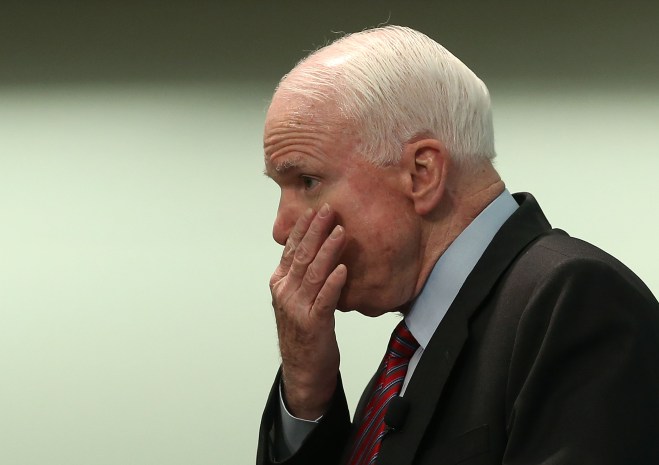
(Photo: U.S. Sen. John McCain (R-AZ) speaks about recent developments in Syria September 17, 2013 in Washington, DC. The senator was speaking during a forum at the Council on Foreign Relations. By Mark Wilson/Getty Images.)


Kicking Catastrophe Down The Road

Boehner wants to pass a six-week debt ceiling hike but keep the government shut down. Reihan analyzes:

My sense is that the reason for a short-term increase as opposed to a long-term increase is that while a short-term increase has at least some potential of garnering enough Republican votes to pass, a long-term increase does not. And one has to wonder why this is the case. Assume that we pass a short-term debt limit increase and that the Obama administration and Senate Democrats still refuse to offer Obamacare concessions to reopen the government. Do we have any reason to believe that the president and his allies will bear the brunt of the blame? If House Republicans remain united in resisting a clean CR for six weeks, will they be in a more favorable position the next time the federal government approaches the debt limit?

They’re in panic-mode right now, so trying to see any reason behind this is a bit of a mug’s game. My sensewile_e_coyote1 is that even the total loonies have begun to realize that if they blew up the entire US economy and the world’s, it wouldn’t be the first step toward achieving Mark Levin’s utopian new constitution. It might be their last act as a viable political party.

But the underlying issue is not resolved. Sustaining a government shutdown in order to defund Obamacare is not going to work, and must not be allowed to work. Repealing or reforming laws should be done through the regular process, not by shutting down the whole government as blackmail. More to the point, as Reihan also notes, it’s killing the GOP brand:

We’re in this situation in which no matter how unpopular Republicans get, some conservatives will claim that the reason Republicans are unpopular is that they haven’t been sufficiently audacious in making demands. We’re dealing with something akin to a death spiral. Recall that while GOP unfavorables are rising among self-identified Republicans, some number of Republicans will eventually become ex-Republicans — there is some point at which a threshold is crossed. So the 27 percent of Republicans who view their own party unfavorably don’t represent 27 percent of the larger universe of center-right voters. Rather, they represent 27 percent of the residual Republicans left after earlier moments during which other Republicans defected from the party.

My italics. But, leaving the GOP’s implosion to one side, the important thing right now for the country is for the hostage-takers to take the gun away from our collective head. That’s a positive first step. The next step is for them to put the gun down altogether. They haven’t. As for delaying the debt-ceiling Armageddon, Chait notes the remaining weirdness:

The putative reason for delaying the debt limit is to open fiscal negotiations with Democrats. But Republicans have been dodging fiscal negotiations with Democrats for most of the year. Why? Because they don’t want to compromise on the budget.

They want unilateral concessions. Obama won’t give Republicans unilateral concessions. Any deal Boehner strikes with Democrats will have to contain some concessions to Democrats, which will further enrage the tea party. So there’s no deal Boehner can cut on the budget that won’t anger the base, which brings us back to the same stalemate — waiting until the next debt-limit hike, when he needs to prevent catastrophe again.

Kilgore weighs in:

There are a thousand things that could go wrong with Boehner’s gambit, and it obviously doesn’t solve any of the underlying problems created by GOP hostage-taking. But it could at least avoid an immediate financial and economic crisis, with the “winners” including the craziest of conservative Republicans whose appropriations-centered strategy will again be the official GOP position, and the big losers being federal employees looking at at least six more weeks of furloughs.

In this self-induced emergency, lifting the threat of default -even for a few weeks – is something. But I fear that simple non-concession concession has only been granted because the GOP is sinking in the polls like a stone. How much further do they have to sink to start behaving like legitimate actors in government? Another ten point Gallup drop in another week? This is not over.