It’s going down! And Obama’s in the toilet!
Year: 2013
A Republican-Friendly Deal Republicans Won’t Accept
Yesterday, Paul Ryan suggested a smaller ransom for opening up the government and avoiding default. Cohn rejects the deal:
Ryan in the op-ed doesn’t simply call for negotiations over fiscal policy. He also sketches out what a deal should look like. And it would involve major concessions from Democrats—cuts to Social Security benefits and more means-testing of Medicare, plus tax reform that, presumably, would not raise revenue. In exchange, Republicans would offer some relief from the budget cuts taking place from budget sequestration. But this isn’t much of a concession. Just as Democrats are unhappy about sequestration’s cuts to domestic spending, Republicans are unhappy with sequestration’s cuts to defense spending. It’s hard to see how Republicans could get such a deal in a routine negotiation.
Pareene doubts other Republicans would support Ryan’s plan:
Ryan knows he has to demand concessions that border on unreasonable in order to get conservatives on board with any end to this crisis. The problem, as ever, is that any concessions Republicans can realistically extract from Democrats and the president run the risk of being seen as insufficient specifically because they are achievable, and trolls like Cruz and his enabling organizations will be happy to make that case. Republicans are a few steps away from using a government shutdown to get a Democratic president to cut Social Security and Medicare, and Republicans are the only people standing in their way.
Chait is on the same page:
The single most implausible element of the House leadership’s “let’s negotiate” gambit is the premise that a bipartisan budget deal would satisfy the Republican base. Any bipartisan deal, even one heavily slanted to the Republican side, would enrage conservatives. Even the tiniest concession — easing sequestration, closing a couple of token tax loopholes — would be received on the right as a betrayal. Loss aversion is a strong human emotion, and especially strong among movement conservatives. Concessions given away will dwarf any winnings in their mind. Boehner, Ryan, and Cantor have spent months regaling conservatives with promises of rich ransoms to come. Coming back with an actual negotiated settlement would enrage the right.
30,000 Dish Subscribers
We passed that milestone a couple of minutes ago. Just a small word now of thanks and amazement. An update on where we’re at in this new media experiment for all of you soon. And while I’m at it, if you haven’t already, [tinypass_offer text=”subscribe!”] It takes less than two minutes and can cost as little as $2.
What’s Ailing Healthcare.gov? Ctd

Timothy B. Lee passes along the above chart illustrating how complicated the Obamacare system is:
If the exchanges were just insurance marketplaces, getting them to work might have been a lot easier. Much of the complexity comes from the fact that the exchanges are used to administer the complex system of subsidies the Affordable Care Act provides to low-income consumers. Figuring out whether a customer is eligible for a subsidy, and if so how much, requires data from a lot of federal and state agencies.
A reader argues – persuasively to me – that the system could have been much simpler:
David Auerbach does a good job describing the poor execution of the federal exchange, and I’m sure there’s more of this kind of investigation to come. But the federal government also made an infinite number of policy decisions, and one of those is, perhaps, the original sin of the design. They decided, very intentionally, not to allow window-shopping.
The administration knew that letting consumers shop anonymously and look at what is available, including the general price ranges, was an important factor. However, they also knew that the federal subsidies reducing those ultimate prices would be a vital enticement. They decided that letting consumers know about the subsidies was the more important policy. But to make that happen, the site would have to require people to actually sign into a formal account, provide financial and other information, and only then proceed to the products available to them. That is a very intensive technological process, particularly in light of privacy concerns, and is a considerable part of the problem most consumers are having to suffer through. The benefit is that once through the application stage, they will know not only what products are available, and at what price, but also that they will get a subsidy if the information they’ve provided qualifies them for one.
Placing the subsidy as the primary policy goal came at the expense of allowing people to enter a few basic pieces of information anonymously (age, family structure, zip code, say) and simply explore the options and general prices. If they see something attractive, they can then either go into the application process at that point, or come back to it at a more convenient time (since no one needs to sign up immediately for coverage that won’t begin until January 1 at the earliest). That would have virtually eliminated the front-heavy technology that was enormously hard to manage, and was predictably glitch-prone. Anonymous shopping is far easier to design and implement, makes for a better consumer experience, and allows people more time to gather the necessary (and necessarily complicated) information they must have when they are finally ready to actually buy health insurance.
The problems in execution are blameworthy, but it is more than fair to hold the administration’s feet to the fire over their policy decision to prioritize subsidies over shopping. State-based exchanges had the same options available to them, and many chose shopping as the priority. Score one more for the wise decision in the ACA to let states take the lead in health care reform, and one more shake of the head at the states who chose to let the federal government do the job rather than doing it themselves.
When is Kathleen Sebelius going to be fired?
The Resurrection Of Crist
Is this a sign of major independent dissatisfaction with the loony right now running the GOP? Or a brief straw in the wind?
What’s The Endgame?

Ambers runs through various possibilities:
The most likely scenario is one where Boehner folds but pretends he didn’t, and Obama negotiates, but only in words. Privately, Boehner would prefer this solution because it would not actually concede any significant ground to the Tea Party, and if the optics are right, he could emerge from this fracas with roughly the same amount of power as before it started. What would this look like? A play, consisting of three acts. Act 1: Republicans promise to pass a clean CR and debt ceiling increase in exchange for specific words from Obama that he can be held to; Act 2: Obama proclaims publicly that he has said all along that he has been willing to negotiate with Republicans, and then says something like, “and I look forward to talking to them right after the the government opens on subjects ranging from tax reform to reducing the burden of entitlements.” Act 3: Boehner seizes on that sentence and tries to sell it to his conference. An unofficial whip count confirms this, but he says publicly that he will do the honorable thing and not allow the nation to go into default SO THAT Republicans can hold Obama accountable on his promise. Finale: the votes pass.
Waldman considers the situation from Boehner’s point of view:
[T]here is not a single factor that over time is making a GOP victory more likely. My guess is that Boehner knows this but is hoping that the fight itself will win him enough breathing space with the conservatives to keep his job when its over. He’ll lose, but he’ll show them that he was willing to inflict some harm on the country in the process, which will deplete their rage just enough.
Think about that for a moment. The only way the Speaker can keep his job is to inflict serious economic damage on the country. That’s the measure of his mettle. We can get lost in the tick-tock of this, and forget to step back and realize that this remains one of the most reckless, nihilist gambits by any political party in my adult lifetime – up there with impeaching Clinton, which, at least, wouldn’t have plunged the entire world into a second depression.
The more extremist they get, the more dangerous they become. If we can survive this self-induced fiasco, we have surely one overwhelming imperative – to get as much constructive things done in the next year and then launch a huge effort to rid the House of these fanatics in 2014. It won’t be easy, but it’s getting urgent.
(Photo: US Speaker of the House John Boehner leaves after speaking at the US Capitol in Washington, DC, October 8, 2013. By Saul Loeb/Getty.)
Will The GOP Take The Gun Away From Our Head?
Byron York passes along a new strategy the GOP is considering:
Many House Republicans, including some key leaders, have decided they can live with a government shutdown but not with the threat of default. In the hours ahead, look for the GOP to seek a deal with President Obama and Democrats on at least a short-term increase in the debt limit, while standing firm on their requirement that a continuing resolution to fund the government must contain some significant measure to limit Obamacare. The bottom line: Republicans have discovered the world did not end when shutdown became a reality — but they’re not willing to risk it with the debt ceiling.
Ponnuru tries to get inside Boehner’s head:
A “clean” CR — a budget bill that reopens the government without any anti-Obamacare conditions — could pass the House with mostly Democratic votes. I think he’s refusing to let it pass not because he’s afraid for his job, but because it would make it much harder for him to raise the debt limit — and he rightly thinks that’s more important.
Stay Classy, Erick
As the GOP begins to realize that destroying the American and the global economy to save millions of people from getting health insurance may not be quite the slam-dunk that Romney’s electoral triumph was going to be, the true believers keep digging in. Erickson wants secession – not from the union (that’s so last Friday), but from the confederacy:
I’m being told by several sources that Speaker Boehner and Majority Leader Eric Cantor are plotting to give up trying to either defund or delay Obamacare… John Boehner, Eric Cantor, Mitch McConnell, and John Cornyn will ensure that Obamacare is fully funded and give the American public no delay like businesses have.
In doing so, they will sow the seeds of a real third party movement that will fully divide the Republican Party.
Oh don’t tease us, Erick.
Print Is Dead, Long Live Books
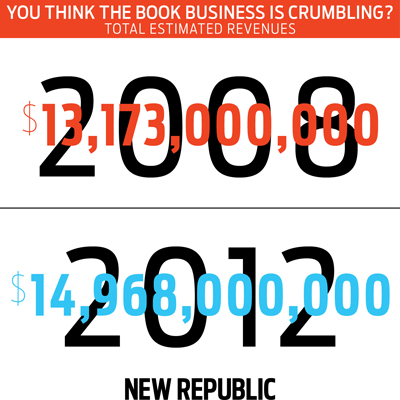
Evan Hughes presents evidence that the book business is relatively healthy:
Part of the problem for journalism, music, and television is that they are vulnerable to disaggregation. Their
products are made up of songs and articles and shows that have long been consumed in those individual units. Once the Internet made it possible to ignore the unwanted material, overall value slipped. Easy access to favorite singles opened those up to impulse buys—but also made purchasing the whole record feel almost indulgent, a splurge for audiophiles and diehard fans. Now the TV viewer wants “Breaking Bad” without bills from Comcast. The ability to score individual articles by the clicks and ad dollars they reap has exposed vital but embattled forms like international reporting and arts criticism to further pruning. ….
In publishing, meanwhile, the deal with the customer has always been dead simple, and the advent of digital has not changed it: You pay the asking price, and we give you the whole thing. It would make little sense to break novels or biographies into pieces, and they’re not dependent on the advertising that has kept journalism and television artificially inexpensive and that deceives the consumer into thinking the content is inexpensive to make.
Border Inequality
After more than 300 immigrants died less than a mile from the Italian coast, Max Fisher interviewed World Bank economist Branko Milanovic, author of The Haves and the Have-Nots:
[M]y book spends quite a lot of time discussing the income gaps between the countries. And of course these income gaps, historically, have risen tremendously, despite the fact that in the last 15 or 20 years, China and India have grown at very high rates. Still, the number of countries in Africa where income today is lower than in the 1960s [when they won independence] is large, I think about 15 countries.
So, clearly, the gap between Africa and Europe has increased. Even the gap between the United States and Mexico, for example in [gross domestic product at purchasing power parity], which is adjusted for price levels in each country, that gap has gone up. So the implication of that is that if the gap is significant, large, and in some cases rising, and the knowledge about the existence of such differences is more widespread, and the cost of transportation is less, then you will have huge pressure to migrate.
 The Dish