Where Digital Natives Come From

Screen Shot 2013-10-08 at 2.37.39 PM

China leads in absolute numbers, according to the International Telecommunications Union (pdf), but South Korea has the greatest percentage of wired young people – 99.6 have been online for at least five years. Still, two-thirds of the world’s youth didn’t grow up with the Internet:

As you might expect, impoverished and war-torn nations have the lowest proportion of digital natives, a fact that could make the global economic playing field even less even going forward. Digital natives make up less than 5 percent of the youth in Afghanistan, Nepal, Iraq, Ethiopia, Bangladesh, and many other countries across south Asia, central Africa, and parts of the Middle East. “This is fundamental to a country’s economic and social development and their participation in an information network society,” [researcher Michael] Best said. “In these conflict-stressed and developing countries, the report suggests that further attention to Internet infrastructure and capacity are critical to their economic development.”

The Inevitability Of Ignorance

Pivoting off Ilya Somin’s new book on political ignorance, Jack Shafer argues that the advent of mass media has done little to cure it:

Our political ignorance is as enduring as it is pervasive. When the Pew Research Center study compared the political knowledge of 1989 respondents with those from 2007 it found the advent of multiple 24-hour news channels, the C-SPAN channels, and hundreds of news sites on the Web had not moved the political ignorance dial in any appreciable way. Nor have massive rises in education over the past half-century put a dent in political ignorance, Somin finds. “On an education-adjusted basis, political knowledge may actually have declined, with 1990s college graduates having knowledge levels comparable to those of high school graduates in the 1940s,” he writes, even though IQ scores have been rising.

Somin responds:

None of this suggests that media coverage of politics is useless. It does provide helpful information to the minority of voters who do follow political issues closely. And sometimes the media uncover a major scandal that penetrates the consciousness even of those members of the public who are usually oblivious to political news. Without the media, politicians bureaucrats, and interest groups would cause more harm than at present. But the media is unlikely to solve the problem of widespread political ignorance.

Kafka The Creeper

Richard Marshall reviews a new biography, Kafka: The Years Of Insight:

KafkaHe was popular, smart, good looking enough to attract women, a joker and a writer with enough fame to feed the ego whilst not so much that would distract from the business. He was capable of acts of kindness but his erotic escapades were pretty dismal. Kafka was a creepy womanizer – at thirty he was stalking with the help of Max Brod some sixteen year old he saw one time at Goethe’s house and he built himself an impervious persona who was cruel, calculating and decisively self-serving when dealing with his never-ending erotic interests. …

Kafka writes letters and diaries that make clear that he has only one subject and that is himself as literature. ‘I have no literary interests; I am made of literature. I am nothing else and cannot be anything else.’ Decisive in this identity, Kafka frees himself from ties that bind those with merely an ‘artistic bent.’

John Banville considers another new volume, Franz Kafka: The Poet of Shame and Guilt, and how the man’s enigmatic sexuality probably informed his fiction:

[Author Saul] Friedländer follows the Kafka scholar Mark Anderson in thinking it “highly improbable that Kafka ever considered the possibility of homosexual relations.” Nor does he for a moment seek to suggest that the “imagined sexual possibilities” Kafka may have entertained are a key to unlock the enigmas at the heart of the Kafka canon. All the same, once this particular genie is out of the bottle there is no forcing it back inside. Repressed homosexual yearnings certainly would account for some of the more striking of Kafka’s darker preoccupations, including the disgust toward women that he so frequently displays, his fascination with torture and evisceration, and most of all, perhaps, his lifelong obsession with his father, or better say, with the Father—the eternal masculine.

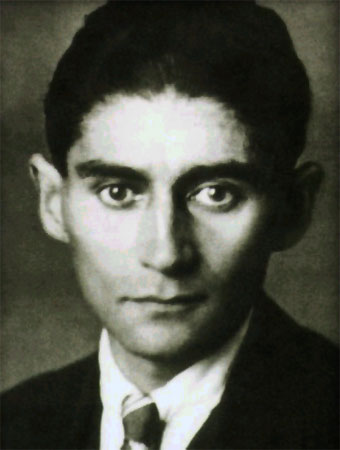
(Image via Wikimedia Commons)

Going Extinct On The Preserve

A 25-year study of “forest patches turned into islands by the filling of the Chiew Larn Reservoir in Thailand in 1986 and 1987” found that these islands, which were unpopulated by people, suffered major species extinction. What this tells us about conservation:

Small habitat patches may not be large enough to sustain a viable population. When ranges are compressed, populations face a number of hardships, from increased competition for resources to inbreeding and intrapopulation strife that can raise stress, increase conflict, and lower breeding rates.

This study isn’t just about isolated islands in a remote corner of Thailand. It’s also about the flecks of land we cordon off every time we fell a forest, plow a field, or plat a subdivision. We’re creating small islands of habitat surrounded by seas of human dominance. Certainly some animals and plants can move between those islands, but not all do and not all at rates needed to sustain remnant populations. … If we are to minimizing the impact we have on the environment—whether those be cities, farms, or even oil fields—we can’t just plan the land we’ll occupy, we have to plan the land we won’t.

Taming The Youth

Lissa Rivera considers the playground as a means for social control around the turn of the 20th century:

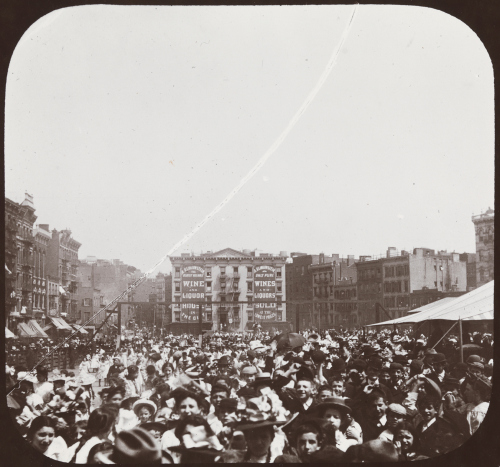
Due to the long working hours for all members of the family, youth who lived independent lives,Waiting to be let into playground. with no formal education, learned from the streets. Under harsh vocational conditions, they were no strangers to violent social interactions. They often recreated these interactions in rough play and developed their own social hierarchies in “mini gangs.” Nineteenth-century city streets teemed with “street urchins” out at all hours of the day. In New York City laws were established prohibiting playing outdoors in an attempt to tame the rampant street-culture.

Activist and photographer Jacob Riis championed the Child-Saving Movement to build supervised play spaces as safe-havens for children. … These spaces were influenced by the ‘sand gardens’ developed in Germany as part of the naturalist movement inspired by Darwin and Fröbel (who introduced kindergarten) to promote physical perfection in a system of strong moral values toward a more promising civic society. Although progressive, municipally ordained playgrounds were built to protect children from dangers within the urban environment, they can also be seen as deterrents from the imaginative culture that flourishes with less regulation.

(Photo: Waiting To Be Let Into Playground, ca. 1900. By Jacob Riis. Museum of the City of New York, 90.13.4.52.)

Profiting Off Prisoners, Ctd

Liliana Segura puts out the latest report on the businesses exploiting America’s penal system, including a phone company that charges $1.13 a minute for calls and a healthcare provider that “discourages treatment for hepatitis”:

Defenders of for-profit prison services pitch them as superior, efficient, money-saving options for cash-strapped states and localities that can ill-afford the costs of mass incarceration. (And indeed, historically, state-run services have often proven abysmal in themselves.) But not only do such privatized services often end up more expensive in reality, they can incur huge unseen costs to inmates and their families. Worse still are the implications on a larger scale: when corporations seek to profit from prisons, it creates a powerful financial incentive, not just to push for policies that fuel mass incarceration but to cut corners in the services they’ve been hired to provide. Society shows little concern for prisoners who might receive substandard food, phone service or healthcare behind bars, after all.

Cory Doctorow lists some disturbing facts from Segura’s piece:

These prisons are not subject to freedom of information requests, are not inspected in the same way as public prisons, and have profit-taking built into their billion-dollar business, meaning that every dollar they spend on care and rehabilitation for prisoners is a dollar they don’t return to their shareholders.

Previous Dish on for-profit prisons here.

The Best Of The Dish Today

Two big ones: on the torture jokes at a Cheney roast in Manhattan, organized by Commentary; and an essay on the horrifying treatment of farm animals by a Palin supporter. One priceless heckler MHB, which keeps cracking me up at random moments. And in the latest outbreak of Christianity in the Vatican, the Pope wrote a letter to a bunch of gay Catholics.

On the great Republican hold-up, there were some tentative signs that the tide may be turning against the extremists, as the GOP’s ratings went into free-fall. Dumbo got shot down by Syrian Jihadists. And submarine smugglers!

The most popular post of the day was this one. The close runner-up? This one.

As I write this, we have 29,986 subscribers. Get us to 30,000 by subscribing [tinypass_offer text=”here”].

And see you in the morning.

The Sequel To Citizens United

Supreme Court Hears Arguments On Case Involving Donor Limits To Political Campaigns

Ben Jacobs explains the basics of McCutcheon v. SEC:

Currently, federal law doesn’t just limit the amount of money that any individual can give to any federal candidate or campaign committee but the total amount that can be contributed. Individuals can give no more than $48,600 to all federal candidates and an additional $74,600 to all political party committees. The question is whether the aggregate limits unconstitutionally inhibit the free speech of donors or are a necessary check on corruption, like a restriction on giving “a Maserati to the secretary of defense,” to cite an example used by Solicitor General Donald Verrilli.

Garrett Epps expects campaign finance regulation to suffer another blow:

In the years since Citizens United, some wishful commentators—including myself—have suggested the Court might be daunted by the chaos that case has unleashed. On the evidence of yesterday’s argument, however, that seems unlikely. The five conservatives are moving confidently toward total deregulation of campaign finance. The only real question is whether they will take only one step—holding that aggregate limits are not allowed but individual-contribution limits are—or the entire leap, holding that contributions are speech and cannot be limited at all.

Scott Lemieux agrees “the Supreme Court is overwhelmingly likely to strike down aggregate campaign limits to candidates and may go further than that.” Why he’s unhappy about that result:

Prohibiting corruption is important, but for democracy to be meaningful the inequalities of the market cannot allow a select group of extremely wealthy individuals to dominate the political process. … Social scientists have shown that politicians pay far more attention to the interests of the wealthy. This has contributed to making the United States unusually inegalitarian for an advanced democracy. Preventing Congress from modestly addressing this unequal influence requires much more compelling arguments than have been advanced by the challengers here.

Adam Lioz makes related points:

What’s at stake in the case? New research from Demos and U.S. PIRG projects that striking aggregate limits would bring more than $1 billion in additional “McCutcheon Money” through the 2020 election cycle, from just slightly more than 1,500 elite donors. This is not a sea change in overall election spending, and much of this money may be shifted from Super PACs to candidates and parties. But, it will continue to shift the balance of power from average citizens to a tiny minority of wealthy donors. And, who are these wealthy donors? In a nutshell, they don’t look like the rest of the country, but rather are avatars of what Public Campaign calls “Country Club Politics.”

Jacob Sullum, on the other hand, wants the campaign restrictions struck down. His argument:

Under current law, a wealthy man can spend as much money as he wants on his own political campaign or on independent messages advocating a candidate’s election. But he can give that candidate’s campaign no more than $5,200.

This puzzling restriction violates the First Amendment rights of the candidate as well as the donor. It rules out insurgent campaigns by challengers (such as Eugene McCarthy in 1968) who have not managed to build wide networks of donors but have attracted support from a few rich patrons. It thereby makes elections less competitive, contributing to alarmingly high re-election rates for members of Congress.

Richard Hasen is unsure how SCOTUS will rule:

I am not certain that the five conservative justices who struck down the corporate spending limits in Citizens United will strike the aggregate limits in McCutcheon. The concerns that would raise about corruption are nicely illustrated in an amicus brief from the Campaign Legal Center, a public interest group supporting campaign finance regulation. A member of Congress, for example, would be able ask for a single $3.6 million contribution (through a “joint fundraising committee”—essentially an arrangement to take a check to be disbursed to more than one campaign) to distribute to all federal congressional candidates and to national and local political parties. He or she could keep from that check only $5,200 ($2,600 for the primary and another $2,600 for the general election), but the parties and PACs could then use the passed-on funds to run ads attacking his or her opponent. As a big bundler, this member of Congress would have great influence over other members. And, of course, the $3.6 million donor would have the most influence of all.

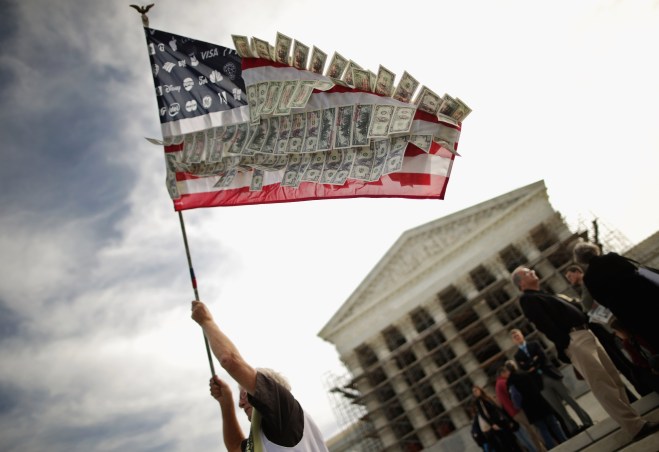
(Photo: David Barrows, of Washington, DC, waves a flag with corporate logos and fake money during a rally against money in politics outside the Supreme Court October 8, 2013 in Washington, DC. On Tuesday, the Supreme Court heard oral arguments in McCutcheon v. Federal Election Committee, a first amendment case that will determine how much money an individual can contribute directly to political campaigns. By Chip Somodevilla/Getty Images)

Where’s The Liberal Tea Party?

Waldman explains why the Tea Party has no left-wing equivalent. A key point:

Many Tea Partiers are people who hadn’t run for office before 2010, or maybe had served briefly in a state legislature where they were bomb-throwers, not legislators. They won their primaries by promising to be the most conservative, Obama-hating member of Congress the folks of their district had ever seen. In contrast, almost none of the safe Democratic members got elected just by saying that they were the most liberal candidate in their race. Most of them worked their way up through the lower political ranks, getting used to cutting deals, making compromises, and solving problems for constituents. They may be very liberal ideologically, but they’re also old-school pols in many ways.

That gives them a practicality that their conservative counterparts don’t have.

Scott Galupo wants the Republicans to purge itself of the Tea Party:

The very nature of Tea Party opposition, whether it issues from the likes of Bazooka Ted and His Gang in the Senate or the unappeasable Jacobins in the House, is to throw weight without consequence. They evince no interest in actually wielding power from the inside, which would require restraint, conciliation, and moderation. They are hysterics on the brink of utter demoralization. The danger they pose to democratic norms, institutional comity, and political functionality is precisely why they can’t be bargained with; they must be marginalized.

The Anti-Sitcom

Joseph Winkler praises It’s Always Sunny as the fun, nasty antidote to the bright sincerity of most other shows, such as “Parks and Recreation, Modern Family, Raising Hope, and even 30 Rock”:

[If] any sin can be said to exist in the amoral world of It’s Always Sunny in Philadelphia, it is the sin of boredom, which is perhaps its most scathing satire and commentary in the world of sitcoms. A sitcom essentially takes life situations and makes them less boring through unlikely, quirky, and slightly absurd twists. Something always happens in a sitcom — someone gets sick, or a miscommunication causes problems — but there is always a resolution, and in hindsight, the conflict was wholly innocuous. Sitcoms often try to depict TV life as a considerably less boring version of our lives, but that their reach is so limited often makes the shows boring in of themselves. (A county fair gone awry, Tracy Jordan is acting up again!). That our sitcoms, embroidered versions of our lives, start to feel boring is a testament to the prevalent sterility and innocuousness of our daily lives (Wake up, go to work, come home, family time, watch TV, et cetera). It’s Always Sunny in Philadelphia, if only for a mere twenty-two minutes a week, gives us a chance to enter a world without stakes; their idle schemes are the elixir for our idle generation.