Richard Marshall reviews a new biography, Kafka: The Years Of Insight:
He was popular, smart, good looking enough to attract women, a joker and a writer with enough fame to feed the ego whilst not so much that would distract from the business. He was capable of acts of kindness but his erotic escapades were pretty dismal. Kafka was a creepy womanizer – at thirty he was stalking with the help of Max Brod some sixteen year old he saw one time at Goethe’s house and he built himself an impervious persona who was cruel, calculating and decisively self-serving when dealing with his never-ending erotic interests. …
Kafka writes letters and diaries that make clear that he has only one subject and that is himself as literature. ‘I have no literary interests; I am made of literature. I am nothing else and cannot be anything else.’ Decisive in this identity, Kafka frees himself from ties that bind those with merely an ‘artistic bent.’
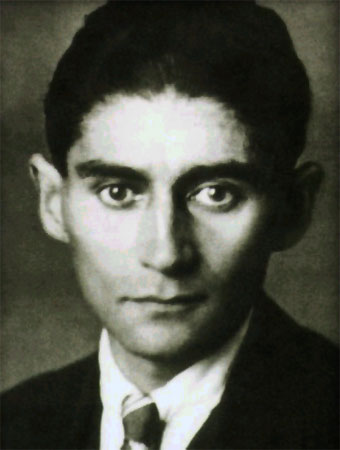
John Banville considers another new volume, Franz Kafka: The Poet of Shame and Guilt, and how the man’s enigmatic sexuality probably informed his fiction:
[Author Saul] Friedländer follows the Kafka scholar Mark Anderson in thinking it “highly improbable that Kafka ever considered the possibility of homosexual relations.” Nor does he for a moment seek to suggest that the “imagined sexual possibilities” Kafka may have entertained are a key to unlock the enigmas at the heart of the Kafka canon. All the same, once this particular genie is out of the bottle there is no forcing it back inside. Repressed homosexual yearnings certainly would account for some of the more striking of Kafka’s darker preoccupations, including the disgust toward women that he so frequently displays, his fascination with torture and evisceration, and most of all, perhaps, his lifelong obsession with his father, or better say, with the Father—the eternal masculine.
(Image via Wikimedia Commons)


