Lissa Rivera considers the playground as a means for social control around the turn of the 20th century:
Due to the long working hours for all members of the family, youth who lived independent lives,
with no formal education, learned from the streets. Under harsh vocational conditions, they were no strangers to violent social interactions. They often recreated these interactions in rough play and developed their own social hierarchies in “mini gangs.” Nineteenth-century city streets teemed with “street urchins” out at all hours of the day. In New York City laws were established prohibiting playing outdoors in an attempt to tame the rampant street-culture.
Activist and photographer Jacob Riis championed the Child-Saving Movement to build supervised play spaces as safe-havens for children. … These spaces were influenced by the ‘sand gardens’ developed in Germany as part of the naturalist movement inspired by Darwin and Fröbel (who introduced kindergarten) to promote physical perfection in a system of strong moral values toward a more promising civic society. Although progressive, municipally ordained playgrounds were built to protect children from dangers within the urban environment, they can also be seen as deterrents from the imaginative culture that flourishes with less regulation.
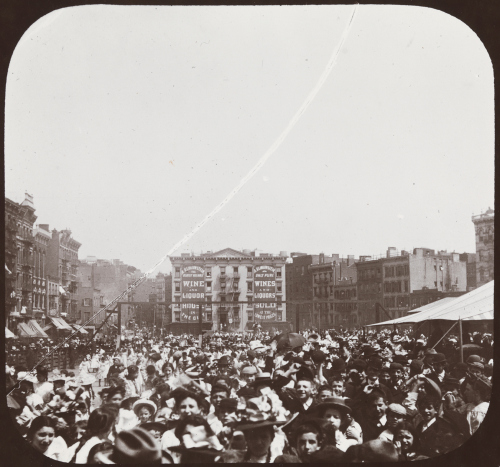
(Photo: Waiting To Be Let Into Playground, ca. 1900. By Jacob Riis. Museum of the City of New York, 90.13.4.52.)

