Who Is Janet Yellen?

Justin Wolfers introduces us to Obama’s Fed chair nominee:

Many will be keen to characterize Yellen’s appointment in the usual hawk-dove spectrum, with most analysts suggesting that she’s more concerned about reaching full employment than controlling inflation, making her a dove. This framing misses something important: While it’s true that Yellen has forcefully advocated for more monetary stimulus in recent years, what’s more notable is that she has gotten the big calls right. Those who argued for tighter monetary policy have been proven wrong. Inflation rates that have been persistently below target, and unemployment has been too high.

Dylan Matthews argues that Yellen is less dovish than she is made out to be:

As Evan Soltas and Matt O’Brien have noted, Yellen is plenty hawkish when the situation requires it. In the mid-1990s, when she served on the Fed Board of Governors, she made it clear that she thought unemployment was dangerously low, low enough that employers have to hike wages, which in turn leads to higher prices, i.e. inflation. “We have an economy operating at a level where we need to be nervous about rising inflation,” she said at one meeting. “We can’t dismiss the possibility that compensation growth will drift upward, raising core inflation and in turn inflationary expectations. This is a major risk. Obviously, we need to be vigilant in scrutinizing the data for signs of rising wages and salaries.”

So inflation hawks, take heart — if and when it’s actually worth worrying about inflation, Yellen will be ready to handle it.

Noam Scheiber hopes that Yellen will be tough on Wall Street:

Yellen’s social circle … consists mostly of tweedy professors and government officials. She strikes me as sufficiently devoid of attachments to bankers and money managers that she can imagine them having some truly terrible ideas—even the smart, witty, seemingly upstanding ones. This is in fact more true of her than the average senior Fed official in New York or Washington. Much of her tenure at the Fed was in San Francisco, thousands of miles away from Wall Street special pleaders.

Neil Irwin notes that “the Fed Yellen inherits is even more complicated than those led by Bernanke and Greenspan, so too will be her challenges”:

What unpredictable ripple effects is the multi-trillion Fed balance sheet having for the global economy, and how much should Fed leaders account for those in their policymaking? What is the interplay between the Fed’s low interest rate policies and excessive risk-taking in different corners of the financial world that could create new bubbles? How do you apply the lessons of the crisis to regulate banks and other institutions more effectively, implementing the immensely complicated Dodd-Frank Act? Does the very transparency that Bernanke has spent his chairmanship pushing create problems of its own, markets hear so much information about what the Fed is thinking and doing that there is unnecessary volatility?

Yellen has made her greatest mark as a thinker about employment and monetary. But as chairman, it will now be her problem to come up with answers to this full gamut of questions.

Yglesias sees Yellen’s nomination as a victory for women:

She’ll be the most important woman in economic policy in American history: It’s probably no coincidence that it took someone so super-duper-duper-qualified to break this particular glass ceiling. No woman has ever chaired the Federal Reserve. Nor has any woman ever chaired any of the other major central banks. We’ve never had a woman run the Treasury Department or the National Economic Council.

Hanna Rosin predicts that the focus on her gender will fade:

If all goes as planned, we will soon forget about the fact that she is a woman. Stories about the first female head of a major central bank will die down. Instead, much as happened with Madeleine Albright, Condoleezza Rice, and Hillary Clinton as Secretaries of State, we will start debating her policies, her interest rate decisions, her inflation targets, her easy money programs. We will move one step closer to not having to discuss or even think much about the fact that the person deciding our monetary policy wears lipstick sometimes.

Face Of The Day

Three Share Nobel Prize In Chemistry For Work On Complex Computing Modeling

Harvard University emeritus professor Martin Karplus speaks to the media after winning the Nobel Prize in chemistry at Harvard University on October 9, 2013. Karplus shared the prize with Michael Levitt of Stanford University and Arieh Warshel of the University of Southern California for developing research that laid the groundwork for computer programs that are used by pharmaceutical company trying to develop drugs. By Darren McCollester/Getty Images.

Yes, Francis Reached Out To Gay Catholics!

He responded to a letter from an Italian gay group, the first time they have ever received a response from anyone in the Catholic hierarchy. A Dish reader translated the story. Can you imagine Benedict doing such a thing? Money quote:

Pope Francis wrote that “he appreciated very much what we had written to him, calling it a gesture of ‘spontaneous confidence’, as well as ‘the way in which we had written it.’”

The full translated story is here. Know hope.

Shutting Down The Safety Net

Adam Serwer worries about the shutdown’s effects on food aid:

If the shutdown lasts into November, Americans reliant on SNAP could find themselves without aid, depending on the fiscal health of the state or the priorities of state leadership. A spokesperson for the Indiana Family and Social Services Administration told MSNBC that “If the shutdown continues beyond October, the State of Indiana will assess its resources and consider its options for continuing to provide SNAP benefits.” Similarly, a spokesperson for Mississippi’s Department of Human Services said they would look to the USDA for guidance.

Sasha Abramsky considers the mental toll this takes on the poor:

We don’t know how long the shutdown will last, and that uncertainty, too, is harder on the poor. The stress of not knowing what tomorrow will bring can be debilitating.

If you’re on food stamps, the fact that the Department of Agriculture believes that it can fund the program through the end of October is better than nothing—but the prospect of not being able to pay for food in November is anxiety-provoking in a way that puts even more pressure on families that already have their fair share of it.

When I was reporting my book “The American Way of Poverty,” several people talked to me about the impact that the stress associated with poverty had on them: on their ability to focus, on their mood, on their blood pressure, on their energy level. In late 2011, an ex-accountant who had lost her job at the start of the recession and spiraled downward spoke of losing weight due to her worries. A man who had lost the business he had owned talked of how his plight made him feel “worthless.” A hungry teen-ager in a suburb east of Los Angeles told me that he cried daily.

Taking Aim At Syria

Fisher analyzes the satirical Banksy video above:

If the video feels a bit awkward, it may be in part because the international leftist movement that Banksy so often speaks for has grappled with how to think about Syria. The idea of any Western intervention in the Middle East can carry, for them, echoes of imperialism – opposition to which is major tenet of the international left. Skepticism of religion also makes the Syrian rebels, a number of whom are Islamist, less than attractive. And the Bashar al-Assad regime has long claimed to represent a kind of anti-imperialist bulwark against the West and against Israel.

So there’s been a real hesitancy among leftists like Banksy to embrace the Syrian opposition, which is reflected a bit in his choice to skewer the rebels, portraying them as murdering beloved children’s cartoon characters. But no one – or virtually no one – can bring themselves to back the Assad regime, which has done and continues to do terrible things to its citizens. That’s led a lot of people in international leftist movements to talk around the conflict, to decry specific aspects of the West’s approach to the conflict without fully engaging in the conflict itself.

I have learned from my own crude generalizations in the past to avoid using terms like “leftists” the way Max does here. I don’t think you need to be a leftist to regard yelling “God is Great!” while trying to murder people as an obscene joke. It is an obscene joke. And the fact that the most potent opposition to the foul regime of Assad is a bunch of Jihadist fanatics says a lot about the Middle East, the whole ridiculous idea of a “nation”-state called Syria, and the total futility of getting engaged there. I can’t say I thought the video was even interesting. But as an expression of the absurdity of religious war, it wasn’t not cringe-inducing, which is what you usually get from artists making political statements.

The artist’s most recent NYC piece showed up in Greenpoint yesterday. Recent Dish on Banksy here.

Does Fact-Checking Deter Politicians?

New evidence points to yes:

During last year’s election, [Brendan] Nyhan and [Jason] Reifler picked nearly 1,200 state legislators in states with active affiliates of PolitiFact, the nonpartisan website based in Florida that seeks to evaluate politicians’ claims and rate their validity. To one-third of the lawmakers, chosen at random, Nyhan and Reifler sent a vaguely threatening letter. It alerted the lawmakers that PolitiFact was monitoring them and speculated about the potential consequences to their careers. … Another one-third of the legislators got a “placebo” letter: It told them they were part of a political-science experiment “studying the accuracy of the political statements made by legislators,” but no more. The final one-third got no letter.

At the end of the election, the researchers looked at the politicians’ record. How many had been called out for lying, either by their state’s PolitiFact affiliate or in a news story? The results were impressive: The politicians who didn’t get reminder letters were more than twice as likely to be criticized for inaccuracy than those who did. “Our results indicate that state legislators who were sent letters about the threat posed by fact-checkers were less likely to have their claims questioned as misleading or inaccurate during the fall campaign—a promising sign for journalistic monitoring in democratic societies,” the researchers concluded.

Is The Tide Turning?

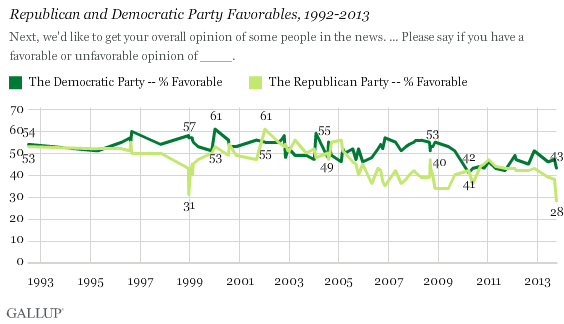
mmj6rr5b6kem323wnfrlvaThat last vertical line from a usually GOP-friendly polling outfit is one more factor in thinking that the GOP is isolating itself to a truly remarkable extent. No one is winning in this – Obama’s numbers are tanking too, though not as dramatically. The GOP is at their worst level in recorded polling. As Charlie Sheen would put it: “Winning!”

Then the Kochs are distancing themselves from the Cruz strategy that Boehner has adopted as his own, after welching on his deal on a sequester-level continuing resolution. And key business groups, suddenly aware that the GOP is no longer a pro-business party so much as a populist rage-machine, are lobbying hard to end the shutdown and lift the debt ceiling pronto:

The National Retail Federation joined other business groups like the U.S. Chamber of Commerce and the National Association of Manufacturers in asking House Republicans to relent.

“We strongly support passage of both a continuing resolution to provide for funding of the federal government into the next fiscal year and a measure to raise the nation’s debt ceiling,” the group’s president, Matthew Shay said in a letter to Congress that highlighted economic indicators showing that the shutdown has already hurt consumer spending and depressed consumer confidence.

Some are interpreting Paul Ryan’s op-ed today as some kind of olive branch. Sargent dispenses with that rather efficiently. The issue is not about how to balance the budget in the long term through a Grand Bargain. I’d love that, and would probably be more sympathetic to some GOP ideas on it than Obama’s. But the issue now is the economic terrorism that the GOP is using as an unprecedented lever to re-litigate the last election. Take the gun away from our heads, and lay it on the ground. Then we can negotiate – and if a bigger, better Grand Bargain comes from that negotiation, the Dish will cheer it on.

But first: put down your gun and leave it on the ground. And walk slowly away so we can see you have nothing left to harm the country or the world with.

Shutting Down Government Won’t Shrink It

Daniel McCarthy believes that the shutdown is doing serious damage to the cause of small government:

Reducing and restructuring government is going to take time and careful planning, but what we see from the Republicans—abetted by certain activist groups and entertainers who feed off over-emotional listeners, viewers, and donors—is a party whose leadership and record in power is big government and whose committed small-government faction is crippling rather than augmenting its appeal to the country as a whole. This is a recipe for defeat of the small-government faction in future presidential nominating contests—where the Republican Party has shown a longstanding preference for candidates who seem like they can win over centrist voters—and that means even if a Republican can win the White House again in the near future, he’s more likely to be a Republican in the Bush mold.

Larison nods:

Toying around with default threatens to impose greater costs on American taxpayers rather than reduce them. It is the perfect example of striking a symbolic blow against fiscal irresponsibility while adding to the country’s fiscal problems. If one seriously wants to control and reduce government debt, raising the debt ceiling ought to be the last thing that one worries about, since refusing to raise it simply makes paying off the debt that has already been incurred more expensive. Making useless “stands” of this kind not only make small-government conservative ideas unappealing to many other Americans and provoke backlashes against them, but they make even those that agree with many of those ideas conclude that their representatives are ill-suited to governing.

Would A Clean Bill Pass The House?

David Karol is unconvinced that moderate Republicans would deliver the votes required to pass a clean CR, even is Boehner allowed a vote:

In general, Congressional moderates are more closely aligned to their parties than is understood. Often their defections from party ranks occur when it is clear that their party does not need their votes to prevail on a given issue. Moderates frequently represent constituencies in which their parties are not very popular. This gives them a political incentive to create the impression of a certain distance between themselves and their party. Leadership understands this and does not punish legislators for such behavior.

John Dickerson agrees:

There’s a big difference between telling a reporter in your home district that you would vote for these measures and actually voting for them. To cast such a vote would expose these House Republicans to withering heat from their colleagues, the grass roots, conservative bloggers, and high-net-worth individuals willing to fund primary opponents. They would be responsible for a stunning defeat for Boehner and a victory for the president their constituents dislike.