Submarine Smugglers

Colombian soldiers guard a homemade subm

Jim Popkin marvels at the story of Mauner Mahecha, a high-school educated drug smuggler who recruited members of the Colombian navy to a build a fleet of subs:

Mahecha spared no expense. He had a fat R&D budget and spent millions of dollars building each submarine. These aren’t the crude semisubmersibles that drug runners have used for years to cruise just below the ocean’s surface. Those vessels can’t dive to avoid detection and are often just cigarette boats encased in wood and fiberglass. Mahecha’s Kevlar-coated submarines, by contrast, can submerge to 60 feet, go 10 days without refueling, and glide underwater for up to 18 hours at a clip. Unbelievably, they were made by hand in the mangrove swamps of Colombia and Ecuador, in desolate outposts with no access to electricity.

(Photo: Colombian soldiers guard one of the homemade submarines found in a rural southwestern Columbia. The submersible could transport up to 8 tons of cocaine at a time, the Colombian army said. By Luis Robayo/AFP/Getty Images)

Following In Romneycare’s Footsteps?

Stephanie Mencimer claims that “it doesn’t really matter whether many people enrolled in Obamacare last week”:

What happened in Massachusetts is pretty much exactly what’s happening right now with Obamacare. After the law went into effect in Massachusetts, state offices were totally overwhelmed by the number of people clamoring to sign up for insurance, or what the state’s Medicaid director dubbed the “stress of success.” Lost paperwork, computer glitches, confusion over who was eligible for what, and not enough staff to handle the workload meant that in those early days, consumers could wait several months after submitting an application to finally get coverage. So many people were trying to enroll in the expanded Medicaid program that the Medicaid agency ended up with a months-long backlog of applications. In the first two months, only 18,000 of more than 200,000 potentially eligible people had successfully signed up through the connector, according to Jonathan Gruber, an MIT professor who helped design the Massachusetts system and served on the Connector board. And all of that happened in a state with only 300,000 or so eligible applicants and without a well-funded opposition trying to derail the law at every turn.

But guess what? Eventually the kinks got worked out and people got covered. Enrollment opened in October 2006, and by the deadline for getting mandatory coverage, July 1, 2007, the Boston Globe reported, 20,000 more people had signed up for insurance on the exchange than the state had expected—12,000 of them in just the two weeks before the deadline.

What Kate Pickert is hearing:

They have one month. If the officials running the new Affordable Care Act insurance exchanges cannot fix crippling computer glitches by then, the health law’s future could be imperiled, according to a former high-ranking health care official.

The Abatement Of Cruelty

Matthew Scully has written a powerful, emotional and, to my mind, largely persuasive piece about the moral necessity of changing our collective treatment of farm animals. It is framed – somewhat relentlessly – as an argument designed to make pro-life conservatives look afresh pigs.jpgat the moral question of animal cruelty, which is, perhaps, a good thing if he wants to break through the noise. But it can alienate readers who may not share Matthew’s pro-life passion – which is a shame because the argument is worth a hearing in its own right – an urgent hearing about an urgent moral atrocity that many of us enable every day of our lives without even realizing it fully.

What I love about Matthew’s essay is that it refuses to let the reader off the hook. It made me deeply uncomfortable about my own eating habits, which I recognize are simply morally unacceptable. Some screeds are so screechy they make you more comfortable in your own position. This screed – though unnecessarily abrasive at times – doesn’t.

The great thing about the essay – apart from its splendid demolition of that preposterous bore, Anthony Bourdain – is its simplicity. What we do to pigs in factory farms is so morally wrong, so violating of even basic moral norms, that we have to stop it.

This week, we found new evidence that the brains of dogs, when examined under MRIs, react very similarly to human brains in terms of emotion, feeling, and suffering. Every dog owner knows this already, but the excuses that we cannot fully, scientifically, know that these animals are capable of feeling have now run completely dry:

Although we are just beginning to answer basic questions about the canine brain, we cannot ignore the striking similarity between dogs and humans in both the structure and function of a key brain region: the caudate nucleus. … In dogs, we found that activity in the caudate increased in response to hand signals indicating food. The caudate also activated to the smells of familiar humans. And in preliminary tests, it activated to the return of an owner who had momentarily stepped out of view. Do these findings prove that dogs love us? Not quite. But many of the same things that activate the human caudate, which are associated with positive emotions, also activate the dog caudate. Neuroscientists call this a functional homology, and it may be an indication of canine emotions.

The ability to experience positive emotions, like love and attachment, would mean that dogs have a level of sentience comparable to that of a human child.

Our deep familiarity with dogs makes this unsurprising. It is one reason we find dog-fighting or cruelty or mistreatment so abhorrent. But the brain structure of dogs is very similar to pigs, whose intelligence is close to identical. Which is why Matthew’s strongest paragraphs seem to me to be these:

Why is it right or fair to pamper dogs (the lucky ones) and torture pigs? In some corners of the world they torture and eat both, and by what coherent standard can we tell those savage people that they’ve got it wrong? In the underground meat markets of Thailand, Vietnam, and South Korea, as CNN reports, “a common belief is that stress and fear releases hormones that improve the taste of the meat, so the dogs are placed in stress cages that restrict their movement,” among many sufferings that end only when they “have their throats cut in front of other dogs who are awaiting the same fate.” If such practices are morally out of bounds, that’s news to American agribusiness.

It’s all just cultural preference, habit, and custom, as Asian connoisseurs of meat from dogs (or horses, monkeys, dolphins, whales, and on and on) will be quick to tell you. Morally, the differences between pigs and dogs, and between our treatment of them, are purely conventional, the technical term for meaningless. Appeals to convention may be well and good in matters of taste or social etiquette — there is no One True Way to greet guests or prepare party favors. But if we are being morally rigorous, then citing “custom” is just a tautology: We do it because we do it. In this case, you could switch the picture here in our own country all around — dogs to the abattoir, pigs on the couch — and convention and custom would be just as defensible. Or, more to the point, just as indefensible. We can be consistently kind or consistently cruel, but anything in between has the whiff of moral relativism, right and wrong decided by whim.

The main force against this, of course, is market capitalism. What Scully wants would mean much lower profits for Big Ag, a constituency well-tended to by the GOP, even as they slash food stamps for the poor (yeah, they really are compassionate, these conservatives, aren’t they?). And his argument is, at root, a moral and properly conservative critique of capitalism.

That’s why, by his account, Karl Rove simply gave him an arched eye-brow for bringing up the subject as something that might be included in a GOP platform some day. No party that would love Sarah Palin is ever going to sacrifice profits for animal welfare.

But I wish him well, even though I think he alienates liberals and pro-choice independents unnecessarily in his tone in parts. Perhaps given the raw partisanship that courses through what’s left of the right, it’s the most effective strategy for persuasion among Republicans. But what we are talking about here is an enlargement of human empathy – and slash and burn partisan rhetoric is not too helpful in that difficult endeavor.

He’s also rightly very, very defensive about working for a vice-presidential candidate, Sarah Palin, who has openly declaimed her utter contempt for animal welfare on multiple occasions and fought to kill wolves from helicopters leaving them to die excruciating, long deaths (Scully excuses her because of the pro-life testimony of the birth of Trig, the fantastic story of which he seems to take at face value). One obvious, glaring, unbelievable part of his essay is also his remaining inability to condemn the torture program of his former political masters – even to the point of citing torture advocate Andrew McCarthy in his defense. I’m sorry, Matthew. But no ringing condemnation of private sector cruelty against animals can stand without also acknowledging the horrifying treatment of humans that the Republican party still endorses, and even finds a subject worthy of foul, chuckling humor.

His recommendation – veganism – also seems to me a bit de trop. Yes, we can live without meat. But our species evolved as meat-eaters and we were once capable of husbanding animals humanely on traditional farms. It does not seem to me to be wrong to eat meat as such, but rather wrong to eat meat produced in the way almost all of it now is. Going vegan is an admirable choice in this context, but there are less drastic moves: to seek out meat from humane farmers as well as eating less of it. There are also types of meat. I think we can make distinctions of degree between, say, the emotional experience of a chicken and a pig. But the commodification of living beings is what troubles Scully, and it should trouble any Christian, and certainly any Catholic in a church headed by a man by the name of Francis.

In the larger sense, though, we are in Scully’s debt. His prose erupts at times with the righteous fury of the prophet. Because this is a great moral evil amidst us – and he is a true Prophet about that.

Update: This post prompted a reader thread.

What’s Ailing Healthcare.gov? Ctd

David Auerbach puts on his detective cap:

[T]he front-end static website and the back-end servers (and possibly some dynamic components of the Web pages) were developed by two different contractors. Coordination between them appears to have been nonexistent, or else front-end architect Development Seed never would have given this interview to theAtlantic a few months back, in which they embrace open-source and envision a new world of government agencies sharing code with one another. (It didn’t work out, apparently.) Development Seed now seems to be struggling to distance themselves from the site’s problems, having realized that however good their work was, the site will be judged in its totality, not piecemeal. Back-end developers CGI Federal, who were awarded a much larger contract in 2010 for federal health care tech, have made themselves rather scarce, providing no spokespeople at all to reporters. Their source code isn’t available anywhere, though I would dearly love to take a gander (and so would Reddit). I fear the worst, given that CGI is also being accused of screwing up Vermont’s health care website.

So we had (at least) two sets of contracted developers, apparently in isolation from each other, working on two pieces of a system that had to run together perfectly. Anyone in software engineering will tell you that cross-group coordination is one of the hardest things to get right, and also one of the most crucial, because while programmers are great at testing their own code, testing that their code works with everybody else’s code is much more difficult.

Earlier coverage of health exchanges’ glitches here.

This Isn’t 1996 All Over Again

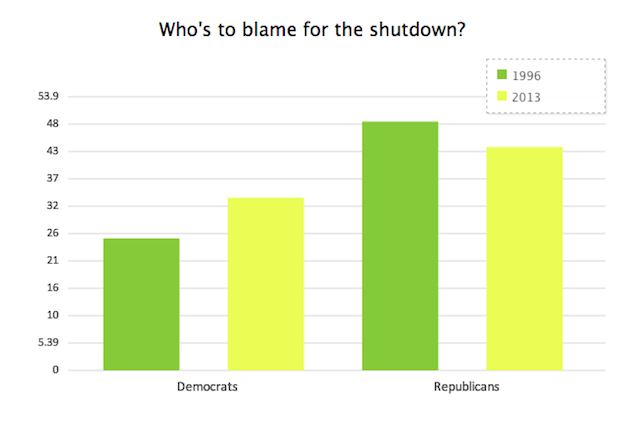
shutdown blame

Republicans are weathering this shutdown better than they did the last one:

At left, the proportion of people who blame Democrats for the shutdown: It’s bigger now than it was then. At right, the number who blame Republicans: It’s smaller! With all the talk about how John Boehner’s blunderous perpetuation of the crisis might jeopardize the GOP’s congressional majority, these numbers add a few additional grains to the mound of salt Nate has already thrown on the idea of a congressional upheaval.

Nevertheless, Gross expects the current shutdown to do more damage than the one in 1996:

When you look back over the past 18 years, one of the unavoidable conclusions is that, for a variety of reasons, the federal government is much more involved in the economy than it was. What’s more, the economy is now more dependent on certain sectors that can’t operate at their fullest capacity without the government being entirely open.

As this chart shows, the federal government has become a larger part of the economy over time. In 1995, federal spending accounted for about 19 percent of GDP. Now, it accounts for about 22 percent of GDP. Entitlements like Medicare and Social Security, which have yet to be affected, account for a big chunk of this rise. But the fact remains that federal government spending accounts for a significantly larger chunk of GDP than it did 18 years ago. So if you slam the brakes on that spending, it will have a bigger direct impact than it did 18 years ago, for example in the effect the furloughs of defense contractors is having on the private sector.

How The GOP Defines Surrender

Chait rips into Boehner’s recent debt-ceiling comments:

Boehner dismissed the notion of lifting the debt ceiling and then negotiating the budget as “unconditional surrender.” How it could be unconditional surrender when he publicly favors lifting the debt ceiling, Boehner did not say. Obama and Boehner disagree on a wide array of budget policies. They agree that the debt ceiling needs to be lifted. Doing the thing both parties agree upon is a bizarre definition of unconditional surrender. If Boehner was an actual debt-ceiling truther, who argued that lifting the debt ceiling somehow worsens the fiscal position of the U.S. government, then lifting the debt ceiling would be surrender. But he isn’t. He agrees with Obama on the merits of the debt ceiling. Unconditional surrender is when one party agrees to do something it opposes but the other party wants — say, delaying Obamacare, as Boehner is proposing.

Douthat partially blames Republican unreasonableness on sequester spin:

One of the underappreciated dynamics making the current mess worse is the fact that both left and right, for somewhat different reasons, have embraced the idea that the outcome of the last debt ceiling deal  — sequestration, with its butcher-knife cuts to domestic programs and defense — was a straightforward win for Republicans, and a huge concession by the Democrats.

For liberals, this idea has fed into the widespread “never again” attitude where debt ceiling negotiations are concerned. (“We can’t get blackmailed like that a second time!”) For conservatives, it’s encouraged deeply implausible ideas about what they can expect the White House to offer them this time. (“We basically won outright in 2011, so why not try to go for Obamacare repeal this time around?”)

The reality, though, is that sequestration really was a genuine, almost old-fashioned sort of compromise — one that bit deeply into a lot of Republican interests and constituencies, and left the liberal ringwall around entitlements unbreached.

At this point, Cassidy is hoping for a stock-market crash:

Once the markets started tanking, investors, the banks, and the media would besiege Congress for action. The political environment would change drastically. Refusing to acknowledge reality, including the reality that every country has to pay its creditors or face ruin, would no longer be an option. Within days, or even hours, the two sides would come up with some face-saving device to calm the markets. (Finding a more lasting solution would still be a big struggle.)

To sum up, Congress needs adult supervision. Since the President can’t provide it and the Republican leadership won’t, the market might well have to step in and do the job. Such a resolution wouldn’t be pretty, but history suggests it would be reasonably effective. And once the immediate crisis was resolved, the market would probably [recover] pretty sharply.

The Depravity Of The Pro-Torture Right

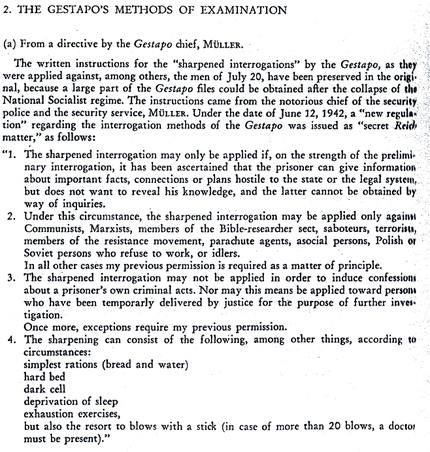
translationofmuellermemoSome small part of me still wants to believe that Don Rumsfeld is not a monster; that Dick Cheney is not a foul, unrepentant war criminal at large; that Joe Lieberman actually has some moral reservations about the torture his friends devised and perpetrated against thousands of victims, especially given the fact that the torture program – even its name – is indistinguishable in key respects from the “verschaerfte Vernehmung” techniques used by the Gestapo. Part of me wants still to believe that these decisions were anguished ones, made in terrible times, surrounded by profound ignorance and fear and imposed reluctantly for fear of the consequences of inaction, with moral trepidation.

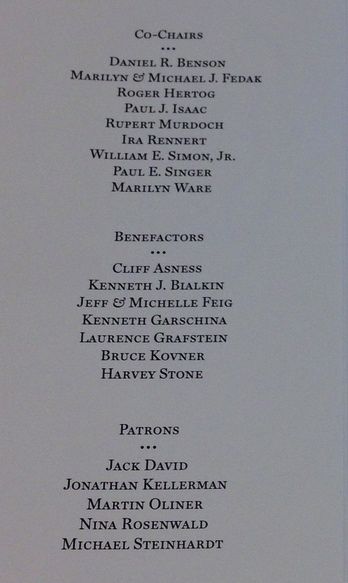
The first reason I cannot believe this is that none of the individuals involved in the torture program has shown the slightest remorse or even moral qualms about their decision to violate one of the most basic international moral norms against mistreatment of prisoners, in an international system called the Geneva Conventions that the US was integral to setting up. They have not even had the grace to remain silent. They appear in public, these braggers of their own barbarism. They get feted by a former attorney-general! They get bankrolled by men like Laurence Grafstein or Michael Hertog or Michael Steinhardt, men who I naively thought opposed this kind of thing that was authorized and enforced under Bush and Cheney:

using dogs to terrorize prisoners; stripping detainees naked and hooding them; isolating people in windowless cells for weeks and even months on end; freezing prisoners to near-death and reviving them and repeating the hypothermia; contorting prisoners into stress positions that create unbearable pain in the muscles and joints; cramming prisoners into upright coffins in painful positions with minimal air; near-drowning, on a waterboard, of human beings—in one case 183 times—even after they have cooperated with interrogators.

Here is Ben Smith’s invaluable account of the torture jokes:

“There were some waterboarding jokes that were really tasteless,” the guest said. “I can see the case for enhanced interrogation techniques after Sept. 11 but I can’t really endorse sitting there drinking wine and fancy dinner at the Plaza laughing uproariously about it.”

Cheney himself told one waterboarding joke, the attendees said, which he attributed to Jay Leno. It centered on a one-shot antelope hunting contest in Wyoming in which the loser had to dance with an Indian squaw. Cheney’s shot got caught in the barrel, producing a dispute over whether it counted as a hit or a miss — and Leno, according to Cheney, joked that Cheney wanted to go catch the animal with his bare hands and waterboard it.

Separately, Rumsfeld joked about Cheney waterboarding fish.

Waterboarding is a war crime, with no statute of limitations. It was, for Dick Cheney, a “no-brainer”. 183 separate incidents of near-suffocation on a single victim were, for Cheney, a “splash of water”. I wonder how many subscribers to Commentary – the magazine grotesquely sponsoring this event – endorsed those torture techniques when they were used against collaborators and Jews in Nazi-occupied Europe, or when they were used by Pol Pot in Cambodia’s genocide. For the record, here are the names of those who sponsored this event:

enhanced-buzz-wide-12974-1381258321-15Perhaps they will disown the event and publicly repudiate it. I’ll gladly publish any statement from any of them to that effect. Maybe they didn’t realize in advance that this would be a laugh-a-thon about war crimes. Maybe some left the room, as Yiddish songs were played to please a man who used Gestapo tactics. But this is so depraved, so morally bankrupt, so disgusting an event … there will be no consequences for any involved, will there?

I’m just glad to know their names. For the record. For history. Remember their names.

Why The President Can’t Save Us By Fiat

Sean Wilentz claimed yesterday that Obama has the power to unilaterally raise the debt ceiling and avoid default. Balkin pushes back:

Wilentz assumes that Obama could stabilize the crisis by acting on his own. But there is good reason to believe that the opposite would occur.  If Obama is impeached, then the issue will shift from the constitutionality of what the House has done (using the validity of the debt as hostage) to the legality of what Obama has done. He will lose the higher ground in the debate, and the country’s focus will be taken over by an impeachment trial for months, as the economy spirals ever downward.  In the meantime, the validity of debt issued by the President will be repeatedly attacked in the courts by allies of the Republicans–who could purchase the new bonds and then demand a refund in order to create standing for a lawsuit.

Obama made similar points in his presser yesterday. Balkin’s argument makes me queasier, even as default, which is the likeliest alternative, remains unthinkable. The key section from the transcript:

 I know there’s been some discussion, for example, about my powers under the 14th Amendment to go ahead and ignore the debt ceiling law. Setting aside the legal analysis, what matters is — is that if you start having a situation in which there — there’s legal controversy about the U.S. Treasury’s authority to issue debt, the damage will have been done even if that were constitutional, because people wouldn’t be sure. It’d be tied up in litigation for a long time. That’s going to make people nervous.

So — so a lot of the strategies that people have talked about — well, the president can roll out a big coin and — or, you know, he can — he can resort to some other constitutional measure — what people ignore is that ultimately what matters is, what do the people who are buying Treasury bills think? And again, I’ll — I’ll just boil it down in very personal terms.

If you’re buying a house, and you’re not sure whether the seller has title to the house, you’re going to be pretty nervous about buying it. And at minimum, you’d want a much cheaper price to buy that house because you wouldn’t be sure whether or not you’re going to own it at the end. Most of us would just walk away because no matter how much we like the house, we’d say to ourselves the last thing I want is to find out after I’ve bought it that I don’t actually own it.

Well, the same thing is true if I’m buying Treasury bills from the U.S. government, and here I am sitting here — you know, what if there’s a Supreme Court case deciding that these aren’t valid, that these aren’t, you know, valid legal instruments obligating the U.S. government to pay me? I’m going to be stressed, which means I may not purchase. And if I do purchase them, I’m going to ask for a big premium.

So there are no magic bullets here.

When Will The US Run Out Of Money?

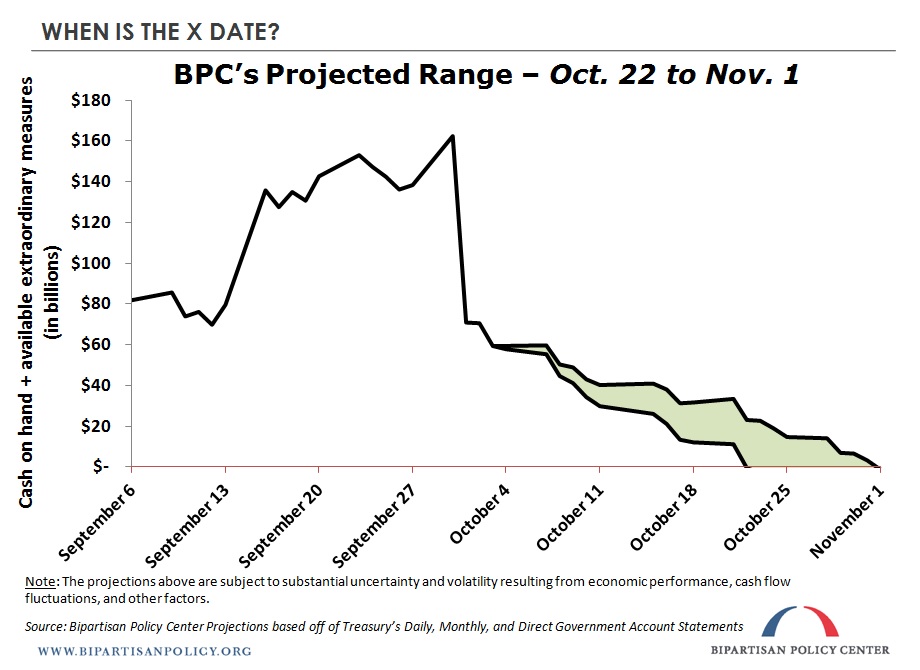
Debt Limit Estimate

Barro looks at the best estimates we have:

People have been talking a lot about Oct. 17. That’s the day the Treasury Department expects to exhaust ”extraordinary measures” that allow the government to finance itself without issuing Treasury bonds, such as borrowing from various government trust funds. But even when that happens, the federal government will have about $30 billion in cash left on hand, and every day it will collect more revenue. That means it will be able to go a few more days, or possibly as long as two weeks, without missing payments. The Bipartisan Policy Center has projected daily cash inflows and outflows and has narrowed the possible range for the “X date” — the first day the government can’t make all its payments due — as Oct. 22 to Nov. 1.

Matthew O’Brien also examines the government’s balance sheet and uses it to argue that debt prioritization won’t work:

[E]ven if the government is completely competent, the Treasury could still miss a debt payment. Why? Well, payments and revenues are lumpy. We owe more on some days, and we have more cash come in on some days. More importantly, we owe bondholders more on some days. So the question is whether there could ever be a particular day when we owe more in interest than we have in cash on hand. And there is.

Larison adds:

So the Republican members of Congress telling the public that they don’t need to worry about the danger of default if the debt ceiling isn’t raised are simply wrong. They are misinformed, and they are misinforming the public. They need to stop, but unfortunately many of the sources that they rely on for their news and analysis are recycling the same bad information.