Yglesias Award Nominee

“It is true that, according to Real Clear Politics, Americans disapprove of ObamaCare, 51 percent to 40 percent. It is unpopular. But it is not wildly, devastatingly unpopular — though given the fact that it is now rolling out and appears to be as incompetently executed as it was badly conceived, it may yet become so.

If ObamaCare had been as unpopular as conservatives believed, their plan for the shutdown — that there would be a public uprising to force Democratic senators in close races in 2014 to defund it — would’ve worked. It didn’t. Not a single senator budged. Their tactic failed, and now what they are left with is House Speaker John Boehner basically begging the president of the United States to negotiate with him,” – JPod.

It’s been interesting to me to see gung-ho New York Republican stalwarts like Pete King and John Podhoretz lead the charge against the Randian Cruzniks. These are not usually faint-hearted types. My sense is that they are motivated mostly by national security issues, crime, Islamism, and similar neoconnish hot-buttons. And they are getting a feeling that the libertarian surge that is now intertwined with the Tea Party and Christianist take-over of the GOP is not their natural ally. But there are precious few Republicans behind them.

When The Elephant Went Rogue

A Surabaya Zoo health worker checks the

Bernstein blames laziness for the current Republican madness:

The truth is that Republicans can pretty much say whatever they want, no matter what the bizarre logic and no matter what connection it has to what they were saying five minutes ago, and Fox News will totally accept it and blast it for hours or days. The result? Republicans have become incredibly lazy. After all, why bother constructing a coherent argument if you don’t need one.

So why is it a problem? Well, for one thing, it means that it’s easy for Republican politicians to fall deep within an information feedback loop, not even realizing that what everyone within that loop is excited about is unpopular, or perhaps just irrelevant, to the other 80 percent or so of the nation. Or to put it another way: Benghazi!

That’s potentially bad for Republicans if they lose a bit of popularity that way, but it’s worse for the system as a whole, because the system depends on parties and their politicians trying to do things that appeal to voters. The problem here is that Republican politicians deep enough in the loop might not even realize that they are espousing unpopular or irrelevant ideas.

Frum lists other factors that have crippled the party. Republicans’ rage at Obama is a big one of course:

Barack Obama was never likely to be popular with the Republican base. It’s not just that he’s black. He’s first president in 76 years with a foreign parent—and unlike Hulda Hoover, Barack Obama Sr. never even naturalized. While Obama is not the first president to hold two degrees from elite universities—Bill Clinton and George W. Bush did as well—his Ivy predecessors at least disguised their education with a down-home style of speech. Join this cultural inheritance to liberal politics, and of course you have a formula for conflict. But effective parties make conflict work for them. Hate leads to rage, and rage makes you stupid. Republicans have convinced themselves both that President Obama is a revolutionary radical hell-bent upon destroying America as we know it and that he’s so feckless and weak-willed that he’ll always yield to pressure. It’s that contradictory, angry assessment that has brought the GOP to a place where it must either abjectly surrender or force a national default. Calmer analysis would have achieved better results.

(Photo from Getty Images)

Francis Happy To Talk To Gay Catholics?

At least that’s what I think this report from the Italian media says. Could a reader translate and I’ll post the whole thing? Update:

Gay Catholics amazed at the Pope: “He answered our letter”

The Kairos group: “We wrote to him, and he blessed us.” Even Don Santoro will write to Bergoglio: “I want to ask him what he thinks of our condemnation”

by Maria Cristina Carratu

Pen and paper. Among the many revolutions of Pope Bergoglio – in addition to phone calls to the homes of everyday people (recently there was news of a family in Galluzzo telephoned by Francis, who, after inviting them to Assisi, asked if he could bless them and invited them to bring “the greetings and blessings of the Pope” to the parish) – there is also the “mail effect”. He receives a mountain of letters every day at his residence in Santa Marta, sent to him directly by those hoping to reach him by bypassing the “obstacles” of the Curia. And now there are those who think it may have been one of those “messages in a bottle” to inspire Bergoglio’s transformation on the subject of gays. A letter was sent last June to the Pope from several Italian Catholic homosexuals, many of whose signatures were collected by the Kairos group in Florence, which is very active in this area. In the letter, gays and lesbians asked Francis to be recognized as people and not as a “category”, asking for openness and dialogue from the Church, and reminding him that closure “always feeds homophobia”.

This was not the first of its kind to be sent to a pontiff, but one which “no one had ever given even a hint of an answer”, said one of the Kairos leaders, Innocenzo Pontillo. This time, instead, the answer arrived. Along with another letter from the Vatican Secretary of State (the contents of both letters are private, and it was only decided recently to make the exchange public), in which, Pontillo explained, Pope Francis wrote that “he appreciated very much what we had written to him, calling it a gesture of “spontaneous confidence”, as well as “the way in which we had written it.”

But not just that. “The Pope also assured us of his benedictory greeting.” “None of us could have imagined anything like this,” stated the Kairos representative, highlighting how, by contrast, the Archbishop of Florence, Giuseppe Betori, “always refused to even meet with us, claiming that if he did we would be legitimized as homosexuals.” Now Pope Francis actually sends us his benediction, and who knows whether his subsequent remarks about homosexuals (“Who am I to judge gays?” uttered on a plane coming back from Rio de Janeiro, and then the explosive words to Civiltà Cattolica [Catholic Civilization, a Roman Jesuit periodical]: “When God looks at a homosexual person, does he approve of his existence with affection, or does he reject him and condemn him? The person must always be considered”) might not actually be due to this exchange of letters.

In the meantime, the prisoners at Sollicciano [a Florentine prison] wrote a letter to Bergoglio (delivered directly to him in the final days of the prison chaplain don Vincenzo Russo), in which they described the ordeals of prison life and invited him to visit them, possibly on the occasion of the National Church Convention of the CEI [Italian Episcopal Conference], to be held in Florence in 2015 and where the pontiff’s presence is expected.

Now, even the Community of Piagge is addressing the Pope: “The climate has changed, and now those who want something different for the Church must stay with the Pope,” recognizes don Alessandro Santoro. “As a Community,” he explains, “we feel liberated from the many doctrinal snares of the past, and Pope Francis demonstrates how it is possible to go from mere doctrinal obedience to faith in the life of people.” Which “doesn’t mean that the Church can’t have its doctrine, provided that man with his suffering is at the center, as the Gospel says.” From this came the idea (on the occasion of the fourth anniversary, on October 27, of the celebration of the religious marriage of a man to a woman who had been born a man, which cost Santoro his job in Piagge), to write to the Pope “to talk to him about our Community, about what we are doing and why we are doing it, and to ask him what he thinks of the disapproval and blame we have suffered” (in addition to marriage, communion is also offered to gays and remarried divorcees).

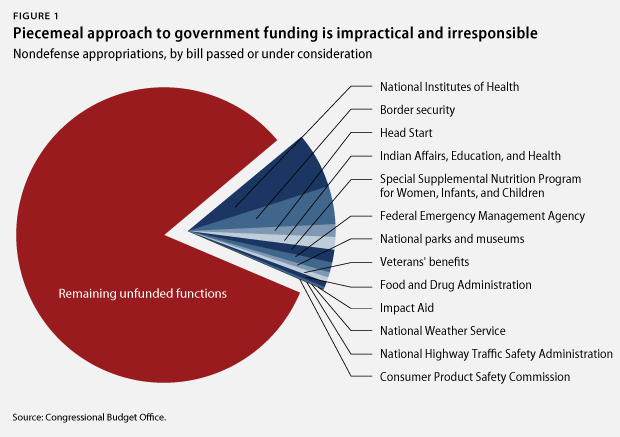
Chart Of The Day

Michael Linden visualized the parts of government that the GOP wants to fund:

Piecemeal

Derek Thompson captions:

Obama wants to fund the whole pie below. The GOP, which would like to pair government funding with Obamacare’s defunding or delay, is asking him to fund the blue slices only. The White House’s logic is that passing the blue stuff makes it more likely that we go even longer without the larger, redder part of the pie.

But doesn’t the GOP actually want the entire government shrunk to that blue size? And isn’t this massive over-reach part of that completely delusional strategy?

Losing Judaism, Staying Jewish, Ctd

As American Jews puzzle over the future of their faith and identity, a new community center in London is trying to attract the secular-minded:

The launch of JW3, as the center is called, comes at a time when many of London’s 200,000 Jews have become disengaged from Judaism. Increasing secularization, dispersal and inter-marriage have played a part, along with a sense that “‘if I don’t live my life this way then I’m not Jewish,’” explains Raymond Simonson, the center’s enthusiastic chief executive. As a cultural center – and not a place of worship – JW3 aims to create a sense of community by reflecting the diversity of Jewish life in the city. “I think we’re offering Jews a way back in who may have been moving away,” he says. “They’ll say ‘I don’t want to go to synagogue, I don’t believe in God, I don’t fast on Yom Kippur, but hang on, you’re doing a Woody Allen festival.’”

A reader comments on our previous post:

I think the Holocaust has a lot to do with this.

When I light the Menorah or sit down for Passover seder, I am celebrating my history and my family and my gratitude that we’re even here. My grandmother came to this country from Poland as a child and she lost basically her entire extended family in the Holocaust. Many of the stories told during Jewish holidays are ones of displacement, persecution and perseverance, and they ring all too true for the Holocaust generation. These traditions are how we remember and honor our ancestry and the extreme hardship our past generations endured simply to survive. Their sacrifice and courage is sacred to me and inspires in me more faith and grace than any God.

Cyborg Bugs And Bioethics

If you’ve ever yearned to control an insect with your iPhone, you’re in luck: The first create-your-own-cyborg kits will be on sale just in time for the holidays. At $99, they’ll include live cockroaches, “microelectronic hardware” and “surgical kits geared toward students as young as 10.” The product, naturally, has sparked debate:

Gage and Marzullo, both trained as neuroscientists and engineers, say that the purpose of the project is to spur a “neuro-revolution” by inspiring more kids to join the fields when they grow up, but some critics say the project is sending the wrong message. “They encourage amateurs to operate invasively on living organisms” and “encourage thinking of complex living organisms as mere machines or tools,” says Michael Allen Fox, a professor of philosophy at Queen’s University in Kingston, Canada. “It’s kind of weird to control via your smartphone a living organism,” says William Newman, a presenter at TEDx and managing principal at the Newport Consulting Group, who got to play with a RoboRoach at the conference. …

The roaches’ movements to the right or left are controlled by electrodes that feed into their antennae and receive signals by remote control—via the Bluetooth signals emitted by smartphones. To attach the device to the insect, students are instructed to douse the insect in ice water to “anesthetize” it, sand a patch of shell on its head so that the superglue and electrodes will stick, and then insert a groundwire into the insect’s thorax. Next, they must carefully trim the insect’s antennae, and insert silver electrodes into them. Ultimately, these wires receive electrical impulses from a circuit affixed to the insect’s back.

Gage says the roaches feel little pain from the stimulation, to which they quickly adapt. … “I try not to downplay the fact that in science we use animal models and a lot of times they are killed,” Gage says. “As scientists, we do this all the time, but it happens behind closed doors.” By following the surgical instructions, he says, all students learn that they have to care for the roaches—treating wounds by “putting a little Vaseline” on them, and minimizing suffering whenever possible. Still, Gage acknowledges, “we get a lot of e-mails telling us we’re teaching kids to be psychopaths.”

(Hat tip: Annalee Newitz)

Mugged For Your Mugshot

David Segal recently reported (NYT) on sleazy mugshot websites:

The ostensible point of these sites is to give the public a quick way to glean the unsavory history of a neighbor, a potential date or anyone else. That sounds civic-minded, until you consider one way most of these sites make money: by charging a fee to remove the image. That fee can be anywhere from $30 to $400, or even higher. Pay up, in other words, and the picture is deleted, at least from the site that was paid.

Mark Kleiman wants more protections for those being blackmailed by such websites:

The Fifth Amendment forbids the deprivation of life, liberty, or property without due process of law. That innocent people should sometimes be arrested is inevitable unless we can equip police with powers of omniscience. But the existence of an arrest record, even without a conviction, has many bad consequences. By maintaining arrest databases and making them available to others, the state in effect continues to punish someone for a crime of which that person was not convicted by due process of law. Why shouldn’t that be ruled unconstitutional?

Mike Riggs adds:

If the best argument for keeping mugshots in the “public information” category is that they’ve always been in that category, or that they help people instantaneously vet their dates and children’s baseball coaches, then open records advocates (of which I’m one 99 percent of the time) need to rethink this issue. Mugshots are a tool that allow police and crime victims to identify and track suspects through the criminal justice system. Making them publicly available turns an investigative tool into a lifelong punishment.

Google is already working to limit the harm these websites inflict:

Google has now found that these sites apparently do not comply with a certain guideline, and has taken action to demote them since Thursday, rolling out an amendment to its algorithms that has led to mugshots being pushed back and listed beyond the first page.

Credit card companies also took action:

“We looked at the activity and found it repugnant,” MasterCard General Counsel Noah Hanft told Times reporter David Segal of the websites offering to remove mug shots for fees. In the course of reporting the article, Segal brought the websites to the attention of MasterCard, American Express, Discover, and PayPal, all of which subsequently decided they would sever their relationships with the sites, effectively crippling their business model.

I Can Haz Heresy?

The Internet’s favorite pet has come a long way:

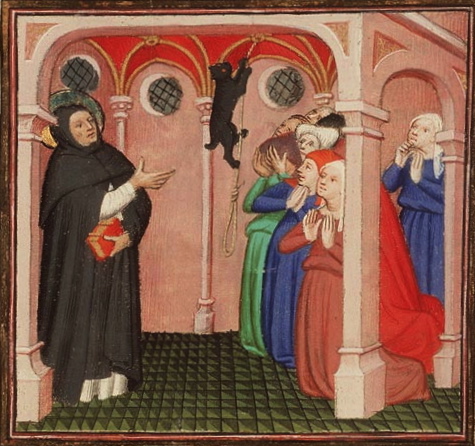
Cats in medieval Europe mostly had a bad reputation – they were associated with witches and MIMI_72A24_313V_MINheretics, and it was believed that the devil could transform himself into a black cat. … Heretical religious groups, such as the Cathars and Waldensians, were accused by Catholic churchmen of associating and even worshipping cats. When the Templars were put on trial in the early fourteenth-century, one of the accusations against them was allowing cats to be part of the services and even praying to the cats. Witches too, were said to be able to shape-shift into cats, which led to Pope Innocent VIII declaring in 1484 that “the cat was the devil’s favourite animal and idol of all witches.”

Medievalist Irina Metzler theorizes about the longstanding link between cats and heretics:

Medieval people may have wanted to restrict cats to the function of animated mousetraps, for the very reason that the cat “stands at the threshold between the familiar and the wild.”… This causes a kind of conceptual tension. While the cat possesses the characteristics of a good hunter it is useful, “but as long as it does, it remains incompletely domesticated.”

Heretics, too, in a transferred sense, are not completely domesticated, since by challenging orthodox thought and roaming freely hither and thither in their interpretation of religious beliefs they resemble the bestiary definition of wildness. As symbolic animals, then, cats may be the heretical animal par excellence.

(Image: The devil appears in the form of a cat to St. Dominic of Calerueja. From Le Miroir Historial, 1400-1410.)

How Obamacare Is Good For Business

Surowiecki claims that the ACA “may well be the best thing Washington has done for American small business in decades”:

[S]mall businesses often face so-called “experience rating”: a business with a lot of women or older workers faces high premiums, and even a single employee who runs up medical costs can be a disaster. A business that Arensmeyer represents recently saw premiums skyrocket because one employee has a child with diabetes. Insurance costs small companies as much as eighteen per cent more than it does large companies; worse, it’s also a crapshoot. [John] Arensmeyer [who heads the advocacy group Small Business Majority] said, “Companies live in fear that if one or two employees get sick their whole cost structure will radically change.” No wonder that fewer than half the companies with under fifty employees insure their employees, and that half of uninsured workers work for small businesses or are self-employed. In fact, a full quarter of small-business owners are uninsured, too.

Obamacare changes all this. It provides tax credits to smaller businesses that want to insure their employees. And it requires “community rating” for small businesses, just as it does for individuals, sharply restricting insurers’ ability to charge a company more because it has employees with higher health costs. And small-business exchanges will in effect allow companies to pool their risks to get better rates.