
Issues Latinos Don’t Vote On

Gabriel Arana uses a recent Hispanic voter survey to argue that Latinos are not “natural conservatives”:

[W]hether opposition to abortion and same-sex marriage translates into support for Republican candidates depends also on how important these issues are to voters. Here’s more bad news: Unlike a majority of Republican voters, Latinos place little importance on social issues. Only 22 percent and 32 percent respectively say gay marriage and abortion are critical issues facing the country today. Rather, they cited jobs and unemployment (72 percent), rising health-care costs (65 percent), and the quality of public schools (55 percent) as the most important issues facing the country. They also favor government intervention in the economy. Roughly 6 in 10 support higher taxes on businesses and the wealthy to support spending more on infrastructure and education. By similar margins, Hispanics say government should do more to address the gap between rich and poor and guarantee health care for all.

The Zombie Drug

That “Breaking Dead” mashup we linked to yesterday (and embedded above) is closer to reality than you think:

Krokodil, a highly addictive designer drug that aggressively eats through flesh, has reportedly arrived in the United States. A Phoenix CBS affiliate revealed [last] week that two cases involving krokodil had been phoned into a local poison control center and quoted one of the center’s medical directors, Dr. Frank LoVecchio, saying he and his colleagues were “extremely frightened.”

Details of what the drug does to you:

Krokodil, technically known as Desomorphine, has a similar effect to heroin, but is significantly cheaper and easier to make. In the last few years, it’s been wreaking severe havoc on the bodies and lives of Russian youth. The drug earned its nickname—the Russian word for crocodile—because of the ghastly side effects it has on the human body. Wherever the drug is injected, the skin turns green and scaly, showing symptoms of gangrene. In severe cases, the skin rots away completely revealing the bone beneath. Other permanent effects of the drug include speech impediments and erratic movement. Rotting flesh, jerky movements, and speech troubles have prompted media outlets to tag krokodil the “zombie drug.”

According to Time, the average user of krokodil only lives two or three years, and “the few who manage to quit usually come away disfigured.” Quitting is its own nasty business. Heroin withdrawal symptoms last about a week; symptoms for krokodil withdrawal can last over a month.

Take The Books Out Of Book Prizes?

Nigerian writer Kola Tubosun wonders how long it will take major literary awards to recognize works in new media:

For anyone interested in literature, and literary development, this is a good time to be alive, not just because of the quality of output and the zeal of the participants, but also because of the presence of new media and the dynamism it has allowed for the production of new forms, and new ways of expression. … I hope, of course, that new media eventually gets its pride of place in the mainstream of literary appraisal. It already does well in consumption and reach. Until the Booker, the NLNG, the Orange, or any other major prize rewards someone whose platform is mainly online, then we haven’t reached there yet.

I don’t advocate for the death of the book, just like inventors of the automobile didn’t go ahead and shoot all the horses. But judges of prizes need to start looking at the quality of production in the new media, and begin to pay attention to them. It is the future. We may as well get used to it.

On a related note, Bill Wyman believes Bob Dylan should be awarded the Nobel Prize in Literature:

[His] fierce and uncompromising poet whose writing, 50 years on, still crackles with relevance. Mr. Dylan’s work remains utterly lacking in conventionality, moral sleight of hand, pop pabulum or sops to his audience. His lyricism is exquisite; his concerns and subjects are demonstrably timeless; and few poets of any era have seen their work bear more influence.

But to Zach Schonfeld, Dylan is more performer than poet:

Dylan’s songs are far more than the content of the lyric booklets that accompany his releases; his artistry is rather seamlessly wedded to his (now almost incomprehensibly) gravelly voice and loooongstreetched-out delivery. Think of those iconic choruses – “Iiii-diot wiiind,” “Like a roooo-lling stone,” “Stuuuu-ck-in-siiide-of-Mooo-bile-with-the-Memphis-Bluuuues-again” – and now try to imagine them as standalone poetry, without the melodies and vocal inflections and musical color. Doesn’t work. Tarantula aside, Bob Dylan hasn’t followed Leonard Cohen’s path in supplementing his records with books of poetry, and to award him the Nobel would be to ignore the power of the medium he has made his life’s work.

The Best Of The Dish Today

Government Shutdown Forces Closures In Nation's  Capitol

I want to begin with a simple quote, a letter from Abraham Lincoln, facing a very similar constellation of forces as president Obama does with today’s nullification party, and sounding remarkably like his 2008 successor from Illinois:

What is our present condition? We have just carried an election on principles fairly stated to the people. Now we are told in advance, the government shall be broken up, unless we surrender to those we have beaten, before we take the offices. In this they are either attempting to play upon us, or they are in dead earnest. Either way, if we surrender, it is the end of us, and of the government. They will repeat the experiment upon us ad libitum.

This is the challenge today. Not to out-last these vandals, but to vanquish them. To vanquish them to end this preposterous excuse for a political party, to expose their lack of any constructive alternatives for the challenges we face, to indelibly mark them as vandals of the very constitution they dare to celebrate, and as saboteurs of this constitutional democracy. We have a chance now to show the kind of scorching sunlight on these creatures of ideological certainty and personal hubris that they scurry back to the dark holes from which they have recently emerged and be consigned to the moral margins their rancid racism finds most congenial.

To wit: their callousness; their transparent racism; their assault on reason; their contempt for democracy; and their inversion of conservative virtues.

Today was a traffic stunner with our top post being “The Nullification Party” and the second “What Kind Of World Do These People Live In?

Oh, and Tina Fey is a genius; and Aaron Paul makes me want to cry.

See you in the morning, if the Republicans allow it.

(Photograph: A U.S. Park Police officer stands guard at the Lincoln Memorial, October 1, 2013 in Washington, DC. The National Mall and all monuments and large sections of the government will close due to government shut down after Congress failed to agree on spending. By Mark Wilson/Getty Images.)

Facing Up To Cancer

In spite of increasing rates of survival, George Johnson argues for “learning to expect less from the war on cancer”:

Whether you look at the incidence, mortality, or survivability of cancer, most of the progress has come from simpler solutions: smoking prevention, pap smears, HPV vaccines. The high-tech approaches — the targeted drugs like Herceptin, Perjeta, Kadcyla, and the experimental immunotherapies so much in the news — have yet to prove themselves, particularly with metastatic cancer, which accounts for almost all cancer deaths. …

No matter how effective any of the new therapies or their successors might turn out to be, there is not going to be a complete victory in the war on cancer. We have to die of something. For every success in combatting other diseases, more people will be left to ultimately succumb to the breakdown of cellular functions that we call cancer. That is a number that can still be reduced but only somewhat.

My doc reminded me this week that as a long-term HIV survivor, my own likelihood of cancer is about 25 percent more than the average bear. I get my colonoscopy soon. For some reason, after surgery, after a battery of tests, fear returned today – fear of dying too soon, fear of having too much left to do, fear of leaving those I love. It hovers again at you around the edges after so many years of keeping it confidently and aggressively at bay,

And so it stays just on the edge of vision,
A small unfocused blur, a standing chill
That slows each impulse down to indecision.

And then decision.

Face of The Day

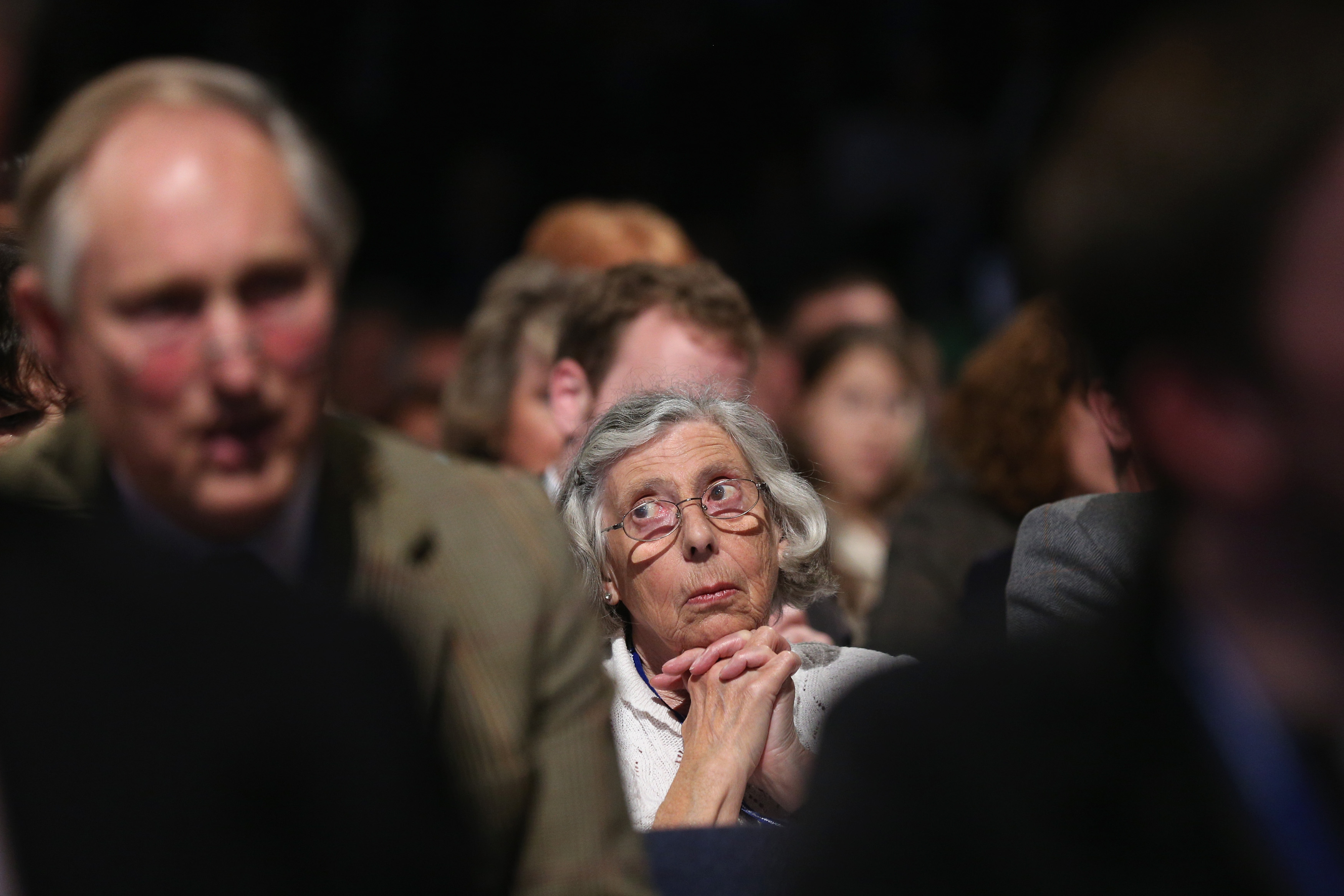
The Conservative Party Annual Conference

Delegates listen to speeches in the Main Hall of Manchester Central on the third day, and penultimate day, of the Conservative Party Conference on October 1, 2013 in Manchester, England. On the same day that America’s Republicans shut down the entire government to deny millions of uninsured people access to basic healthcare insurance, David Cameron unveiled a new Government pilot scheme for General Practitioner surgeries to open from 8am until 8pm seven days, backed by 50 million GBP of funding. By Oli Scarff/Getty Images. Update from a reader:

Why is Mitch McConnell in Manchester when he’s supposed to be solving our shutdown crisis?

Martially Modified Debates

According to linguistics professor Guy Cook, author of Genetically Modified Language, debates over genetically modified food “often use words commonly associated with war in which battles are fought with attacks and assaults”:

Interestingly, the two topics–GMs and war–might not be separate. Instead, they may be part of broader international debate involving recurring themes and ideological differences. This point is supported by a study examining the coverage of GMs by the British press and public reactions to it during the 2003 invasion of Iraq. At times, GM coverage was displaced in order to focus on Iraq. However, at other times, the two topics became interrelated through the use of parallels, emotive epithets, and metaphors. Using corpus linguistic analysis, expert and non-expert interviews and focus group discussions, the study found: “Both in the press and in public reaction, the issue of GM was found to be intimately associated with other political events of the time, notably the invasion of Iraq.”

Previous Dish on genetically modified food here, here, and here.

Obama Goes On The Offensive

Saletan registers the change in rhetoric:

This is a political fight, and it will end when the GOP decides to cut its losses. Speaking from the Rose Garden today, Obama signaled that he’s ready to bring the pain … [Obama repeatedly called] the standoff a “Republican shutdown.” That’s language he has never used before. His slam at “what the Republican Party stands for these days” was his broadest indictment of the GOP ever. He’s escalating the pressure on the entire party in a big way.

Waldman observes that the people gathered around Obama had pre-existing conditions and can now get insurance thanks to Obamacare:

Presidents (and other politicians) use the stories of ordinary people to illustrate political points all the time. What’s a little different here is that Obama is presenting these ordinary people as victims of his political opponents. He’s pointing to them and saying, Republicans are trying to hurt Jane here. They’re trying to stop her from getting insurance. It happens to be true. Is it going to be persuasive? It just might be.

The Dance Of The Man-Beetle

Laura Marsh lauds the Royal Ballet’s new adaptation of Kafka’s Metamorphosis, singling out lead Edward Watson’s performance as the gigantic insect:

Watson evokes the nightmarish experience Kafka describes—of a man who wakes up one morning to find himself transformed into a giant insect—through the vocabulary of ballet. Here you can see his leg turned out at the hip and his foot arched. But what he is doing with his toes makes the whole posture hideous. They wriggle like a millipede’s legs, as though beyond his control, and Watson looks at them in horror.

Watson has developed a wide range in this idiom. The role was choreographed on him: he makes his acutely articulated muscles look like arthropodic armor, and he has said that he has a tendency to “stretch things” so that they “don’t look right” in classical ballets. Yes, there is disgust and fear, but he also shows compassion toward his family, which is more than they show him. Despite his redeeming qualities, Gregor and his surroundings only get more squalid. Once he starts to get used to the idea of being an insect, the set, designed by Simon Daw, tilts up and backwards, so that he can scurry up the walls. Soon, brown gunge starts to spread over the white walls, the bedclothes, and the dancers.