Maps Of The Day

share_low_wage_growth_ share_high_wage_growth

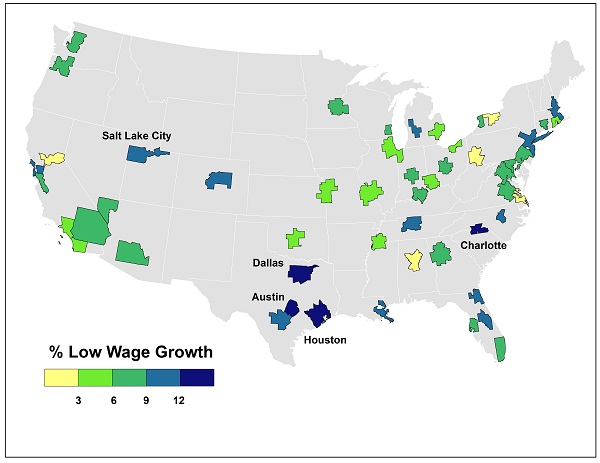
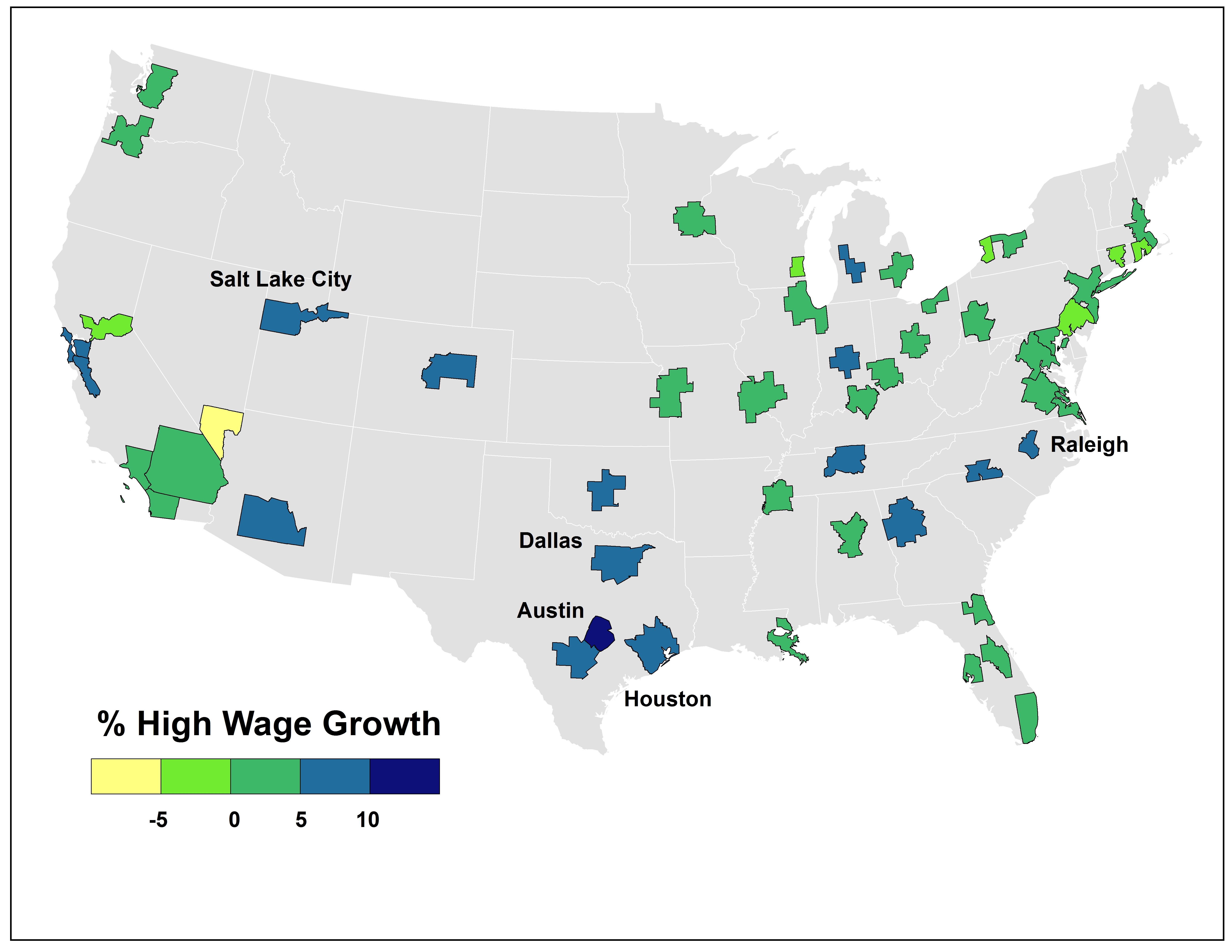
Richard Florida analyzes the growth of high- and low-wage jobs in metro areas across the country:

Taken together, these maps illustrate the underlying reality of America’s post-recession economy. The recovery — if we can call it that — has been driven largely by low-wage jobs. Nationwide, low-wage jobs have grown at a 6 percent clip, roughly double the rate for overall job growth (3.1 percent) and the growth rate in high-wage jobs (3 percent). 

What’s worse, the geography of job growth is uneven. In major knowledge-economy centers like San Jose, San Francisco, and Washington, D.C., high-wage jobs made up roughly half or more of all job growth. These places have also seen the creation of a large number of low-wage jobs as well. At the other end of the spectrum, there are many metros like St. Louis, New Orleans, Riverside and Rochester where low wage jobs have made up the bulk of new job creation. Even in Houston, the supposed center of America’s booming energy economy, growth in low-wage jobs has outpaced the metro’s overall employment gains.


Stamping Out Fraud

A reader quotes Yglesias:

“Why give poor people grocery vouchers when it would be simpler, easier, cheaper, and more helpful to give them money instead?” What a ridiculous question with an obvious answer: Cash is fungible. It can be used to buy anything, and not just the car repairs Yglesias suggests might be more helpful to some. Cash can be used to buy drugs, alcohol, tobacco, and a host of other things that government assistance should not be supporting the use of.

In fact, the major reason the USDA switched the program from paper scrip to the SNAP debit card system is to prevent the kind of fraud in which retailers were accepting food stamps for purchases of alcohol and tobacco. The modern grocery scanner automatically prevents non-SNAP eligible products from being charged to card, so it now requires a complicated work-around (ringing up a six-pack of beer as a six-pack of iced tea, for instance) to get a non-eligible product paid for with SNAP benefits.

If Yglesias wants the government to help with other typical household items (non-food groceries or repairs), he should be advocating for a return to a more generous welfare program, not making benefits intended for food capable of fraud and abuse.

Another reader:

I support SNAP as the best way to get food to kids. I stand behind the SNAP recipients in the grocery line so I know them in my rural area. I also stand behind some of them while they are buying lottery tickets. SNAP keeps our taxpayer dollars buying food for kids, and fewer cigarettes and lottery tickets for their parents. Is it perfect? No, of course not. But Yglesias is living in a dream world if he thinks SNAP is so generous that you could eat so cheaply that you could save enough money for anything substantial beyond, perhaps, a new microwave.

A Mini Military-Industrial-Complex, Ctd

800px-Navistar_MaxxPro

Why does Ohio State need a “Mine-Resistant Ambush Protected Vehicle”?

University police say the vehicle is meant to be used for “large-scale emergency situations,” but will primarily be used to carry university police around campus and to provide a police “presence” on football game days, the Ohio State University Lantern reports.

The gun turret will be disabled apparently. Well, that’s a relief – wouldn’t want to freak out students or anything.

Previous Dish on police militarization hereherehere, and here.

What Shutdown?

Ryan Kearney finds little mention of it in the right-wing press:

[T]he shutdown barely registers on the nation’s top conservative websites. The Weekly Standard is leading with a story about first lady Michelle Obama’s apparently insidious campaign to get Americans to drink more water, The National Review has a piece about how Obama’s agenda is “Transforming America,” and although The Daily Caller’s lead story, “Shutdown Party for Big Democrats,” claims to be on topic, it’s actually about a fundraiser Hillary Clinton hosted Monday night for Virginia gubernatorial candidate Terry McAuliffe. It seems the editors of these websites have read the polls, too, and would just as soon downplay, or outright ignore, that our government is grinding to a halt—lest the GOP be rightly blamed.

If It Happened There

Joshua Keating has begun “a regular feature in which American events are described using the tropes and tone normally employed by the American media to describe events in other countries.” The inaugural dispatch covers the lead-up to the shutdown:

The current rebellion has been led by Sen. Ted Cruz, a young fundamentalist lawmaker from the restive Texas region, known in the past as a hotbed of separatist activity. Activity in the legislature ground to a halt last week for a full day as Cruz insisted on performing a time-honored American demonstration of stamina and self-denial, which involved speaking for 21 hours, quoting liberally from science fiction films and children’s books. The gesture drew wide media attention, though its political purpose was unclear to outsiders.

Better still, in my view, is this classic piece by Henry Fairlie way back in 1980:

“Just as Americans in general do not have the habits of deference, so the conservative in America does not have them either. Ultimately he does not defer even to the country’s institutions. If one of these institutions, such as the Supreme Court, makes decisions he detests, he will defame that institution. He is as ready as is the common man to bypass the institutions he ought to defend.”

The American conservative is being revealed right now as the purest form of political vandalism known in the Western world. It is emphatically not conservative. Conservatives try to reserve constitutional order; today’s Republicans seek to destroy all such restraints and any form of moderation.

Getting Schooled On Sikhism

Most Americans know very little about the Sikh religion:

The study, titled “Turban Myths,” found that 70 percent of Americans misidentify turban-wearers, with 48 percent identifying men in turbans as Muslim despite the fact that most turbaned men in the U.S. are actually Sikh. More than one-third of Americans associate turban wearers with Osama bin Laden, more than with other named Muslim or Sikh alternatives and more than with no one in particular. And at least one in five people surveyed said that they would become angry or apprehensive if they encountered a stranger wearing a turban.

Although Sikhs have lived in the U.S. since the 19th century, the study also found that Americans still know relatively little about the community. According to the survey, 70 percent of Americans cannot identify a Sikh, and 79 percent cannot identify India as the religion’s country of origin. In fact, nearly half of Americans believe that Sikhism is actually a sect of Islam.

Fortunately, Captain America is here to help.

How Many Will Sign Up For Obamacare?

Kilgore looks at polling on the question:

Despite conservative efforts to discourage Americans (particularly young and health Americans) from buying health insurance under Obamacare, Gallup finds that about two-thirds of the uninsured say they will comply rather than doing without insurance and also risking fines. Just under half of the uninsured say they plan to use the exchanges. But an astonishing 51% of the uninsured are “not at all familiar” with the exchanges, and another 21% are “not too familiar.” Those numbers are going to change quickly, and so, too, will the numbers of those planning to use the exchanges (and take advantage of the tax subsidies available to those with incomes under 400% of the poverty line), and those understanding their lives just got better.

Kliff bets that few will buy insurance today:

If you’re an insurance shopper, buying coverage Tuesday doesn’t make a ton of sense. Your policy won’t start until January, but you will have to pay your first month’s premium right away. There’s no advantage to being first in line to sign up for health coverage.

The Congressional Budget Office expects 7 million people to enroll in the new marketplaces this year. There’s not going to be a lot more that we know Oct. 2 about whether the White House can hit than goal, beyond what we know this very moment.