The Nullification Party

1380633347-crop-promovar-mediumlarge

I’ve been trying to think of something original to say about the absurdity now transpiring in Washington, DC. I’ve said roughly what I think in short; and I defer to Fallows for an important dose of reality against the predictably moronic coverage of the Washington Post.

But there is something more here. How does one party that has lost two presidential elections and a Supreme Court case – as well as two Senate elections  –   think it has the right to shut down the entire government and destroy the full faith and credit of the United States Treasury to get its way on universal healthcare now? I see no quid pro quo even. Just pure blackmail, resting on understandable and predictable public concern whenever a major reform is enacted. But what has to be resisted is any idea that this is government or politics as usual. It is an attack on the governance and the constitutional order of the United States.

When ideologies become as calcified, as cocooned and as extremist as those galvanizing the GOP, the American system of government cannot work. But I fear this nullification of the last two elections is a deliberate attempt to ensure that the American system of government as we have known it cannot work. It cannot, must not work, in the mindset of these radicals, because they simply do not accept the legitimacy of a President and Congress of the opposing party. The GOP does not regard the president as merely wrong – but as illegitimate. Not misguided – illegitimate. This is not about ending Obamacare as such (although that is a preliminary scalp); it is about nullifying this presidency, the way the GOP attempted to nullify the last Democratic presidency by impeachment.

Except this time, of course, we cannot deny that race too is an added factor to the fathomless sense of entitlement felt among the GOP far right. You saw it in birtherism; in the Southern GOP’s constant outrageous claims of Obama’s alleged treason and alliance with Islamist enemies; in providing zero votes for a stimulus that was the only thing that prevented a global depression of far worse proportions; in the endless race-baiting from Fox News and the talk radio right. And in this racially-charged atmosphere, providing access to private healthcare insurance to the working poor is obviously the point of no return.

Even though the law is almost identical to that of their last presidential nominee’s in Massachusetts, the GOP is prepared to destroy both the American government and the global economy to stop it. They see it, it seems to me, as both some kind of profound attack on the Constitution (something even Supreme Court Chief Justice John Roberts viewed as a step too far) and, in some inchoate way, as a racial hand-out, however preposterous that is. And that is at the core of the recklessness behind this attack on the US – or at least my best attempt to understand something that has long since gone beyond reason. This is the point of no return – a black president doing something for black citizens (even though the vast majority of beneficiaries of Obamacare will be non-black).

I regard this development as one of the more insidious and anti-constitutional acts of racist vandalism against the American republic in my adult lifetime. Those who keep talking as if there are two sides to this, when there are not, are as much a part of the vandalism as Ted Cruz. Obama has played punctiliously by the constitutional rules – two elections, one court case – while the GOP has decided that the rules are for dummies and suckers, and throws over the board game as soon as it looks as if it is going to lose by the rules as they have always applied.

The president must therefore hold absolutely firm. This time, there can be no compromise because the GOP isn’t offering any. They’re offering the kind of constitutional surrender that would effectively end any routine operation of the American government. If we cave to their madness, we may unravel our system of government, something one might have thought conservatives would have opposed. Except these people are not conservatives. They’re vandals.

This time, the elephant must go down. And if possible, it must be so wounded it does not get up for a long time to come.

Shutdown For How Long?

Plumer passes along a chart on past government shutdowns:

Shutdowns

Collender compares the current shutdown to past ones:

1. Most of these lapses were short or happened over a weekend. They were barely noticed at the time and are not memorable now.

2. The lapses were not typically government-wide. Instead, they only happened to one or two agencies or departments.

3. In many ways most important, until Carter Attorney General Benjamin Civiletti issued memorandums in 1980 and 1981 that set up new rules and standards, agencies and departments that suffered an appropriations lapse were allowed to continue to operate as if there was no lapse at all.

In other words, using today’s terminology, there were shutdowns before 1980, but the agencies and departments didn’t actually shutdown.

Collender expects this shutdown to last at least a week “because it will take that long for the impact of the shutdown to start to be felt and, therefore, to make ending it more politically acceptable.” Beutler wonders whether the shutdown will outlast the debt-limit fight:

Now that furloughs have begun and services are interrupted, the cry from the public to end the shutdown should escalate quickly over the course of the next week or so. And if Republicans don’t yield to that pressure, they’ll soon find themselves staring into an abyss. The debt limit will need to be increased just days later. And though the shutdown will probably reduce the pace of government expenditures enough to buy Congress a very small amount of time, the Treasury will come calling sooner than later. It would constitute another act of bizarreness for Boehner to call Congress back to raise the debt limit and then return to the regularly scheduled shutdown, already in progress.

The FAA Bans Tech During Takeoff Because … Ctd

The agency looks likely to revise a policy prohibiting airline passengers from using e-readers and tablets. But aviation reporter William McGee begs the agency to reconsider:

Think what a partial lifting of this ban will mean: During takeoff and landing, statistically the most dangerous phases of your flight, some devices will be acceptable and others will not. Policing electronic toys will be one more task assigned to overworked and underpaid flight attendants, and if you think air rage is palpable now, wait until the guy in 24D is told to stop texting while the dudes in 24C and 24E watch videos and listen to podcasts.

Moreover, a partial lifting of the ban will encourage use of all electronics in airline cabins, from the moment boarding begins. And while some scientists may be O.K. with tablets and readers rather than phones because of how such transmissions may affect the cockpit, these battles shouldn’t be fought on the front lines — in airplane cabins where proven safety procedures can save lives. … Since departures and arrivals are so critical (most fatal accidents do not occur during the “cruise” portion), and since even the worst crashes have become increasingly survivable, the need for all passengers to stay alert and aware is critical. It’s not the time for one more Tweet.

Previous Dish on the topic here and here.

The Seeds Of Buzzfeed

Abby Rabinowitz traces “meme” from its coinage in Richard Dawkins’s 1976 book The Selfish Gene to its current incarnation:

Pinpointing when memes first made the leap to the Internet is tricky. Nowadays, we might think of the dancing baby, also known as Baby Cha-Cha, that grooved into our inboxes in the 1990s. It was a kind of proto-meme, but no one called it that at the time. The first reference I could find to an “Internet meme” appeared in a footnote in a 2003 academic article, describing an important event in the life of Jonah Peretti, co-founder of the hugely successful websites The Huffington Post and BuzzFeed.

In 2001, as a procrastinating graduate student at MIT, Peretti decided to order a pair of Nike sneakers customized to read “sweatshop.” Nike refused. Peretti forwarded the email exchange to friends, who sent it on and on, until the story leapt to the mainstream media, where Peretti debated a Nike representative on NBC’s Today Show. Peretti later wrote, “Without really trying, I had released what biologist Richard Dawkins calls a meme.” …

According to a recent profile in New York Magazine, the Nike experience was formative for Peretti, who created BuzzFeed with the explicit goal of creating viral Internet memes. The company uses a formula called “Big Seed Marketing,” that begins with an equation describing the growth of a virus, the spread of a disease.

Big Businesses That Benefit From Food Stamps

Yglesias poses a provocative question: “Why give poor people grocery vouchers when it would be simpler, easier, cheaper, and more helpful to give them money instead?”

[L]egally restricting SNAP benefits to apply only to grocery purchases is weirdly punitive to the thrifty. Want to dine on lentils and brown rice for six months to save up money for car repairs? Well, you’re out of luck. Unless, that is, you come up with some scam to trade your extra benefits for money. The poor can end up either condemned for irresponsibility or condemned for fraud.

The only real winners from focusing this keystone anti-poverty program on groceries are agribusiness interests. As long as those interests were delivering the goods – in the form of conservative votes for spending money on the poor – that was a reasonable enough compromise. But now that today’s more partisan Republicans aren’t interested in the deal, it’s time for liberals to scrap it, too.

Food industry groups are keeping quiet about the cuts:

Although all grocery stores and supermarkets that accept SNAP payments – there are more than 231,000 stores nationwide – stand to benefit extremely from continued SNAP funding, many of the same organizations are large Republican Party backers. …

[For example,] General Mills, the parent company of Betty Crocker, Yoplait and Pillsbury, among others, has spent more money on Republican candidates than Democratic candidates in every election cycle between 1990 and 2012. The National Grocers Association lobby spent $23,800 on Republican house members in 2012, and $4,000 on Democratic candidates.

The grocer associations and food companies face a political conundrum. They can advocate publicly for businesses benefitting from SNAP funding, and thus ally themselves with the White House and liberal advocacy groups against Washington Republicans. Or they can stay mum on the topic and continue to back Republicans who generally support their agenda on trade, labor, tax, and regulatory issues.

Carmel LoBello offers a theory for Big Grocery’s reticence:

Another reason may be that the bill isn’t expected to get very far in the Senate – and even if it somehow did, Obama would likely veto it – so businesses can keep their hands clean and appear politically consistent without any risk to their bottom lines.

Recent Dish on food stamp cuts here and here.

Chart Of The Day

Climate Opinion

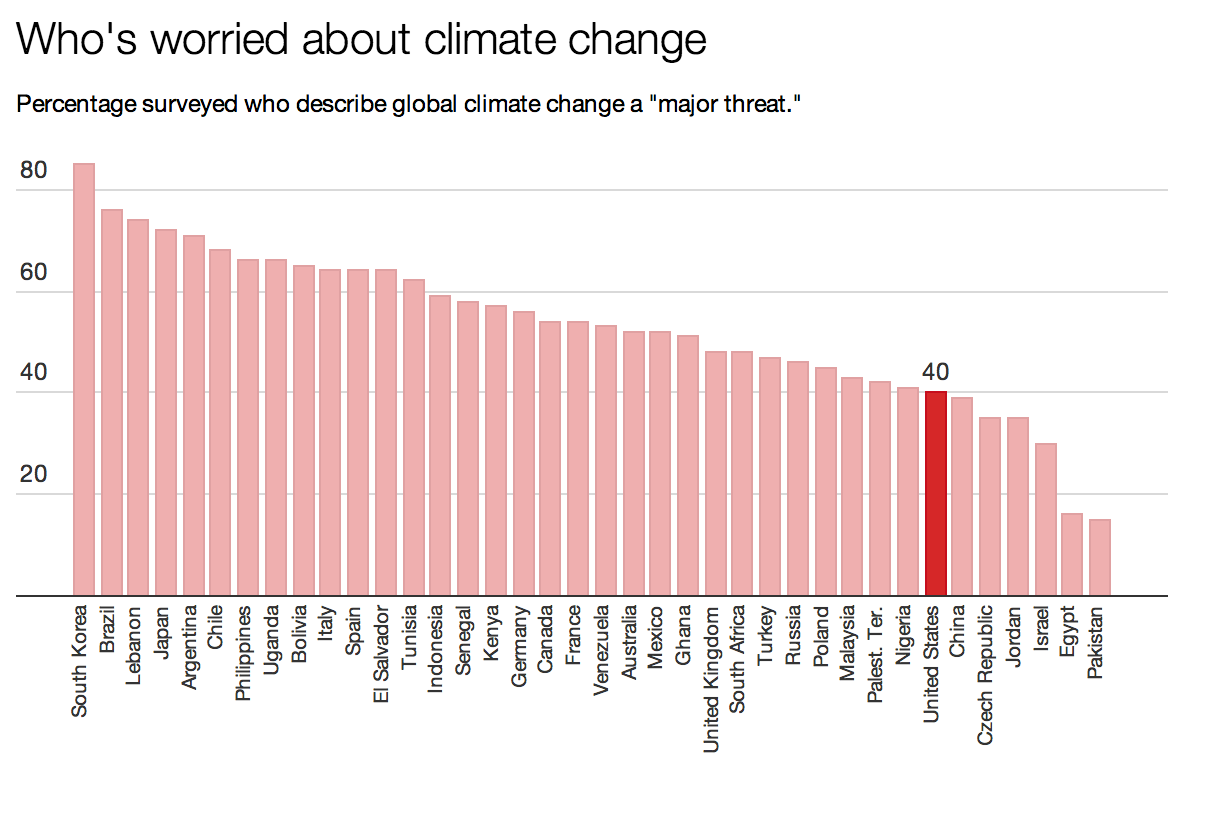
Sadly, America is home to far more climate skeptics than the global average:

According to Pew, 40 percent of Americans call climate change a “major threat.” The people most concerned about climate change are the Greeks, 87 percent of whom call it a major threat; so do 85 percent of South Koreans, 76 percent of Brazilians and 74 percent of Lebanese. The average, among the surveyed countries, is 54 percent.

Americans divide closely along partisan lines on the issue. According to Pew, only 22 percent of self-identified Republicans call climate change a major threat, but the number among self-identified Democrats is 55 percent, just above the survey’s global average. In comparative terms, Democrats are about as likely fear climate change as do Canadians and Germans; Republicans’ views are more akin to Egyptians or Israelis.

The End Of Esperanto?

The Economist spells doom for the would-be universal tongue, despite “some 87,000 users, far and away the most among invented languages”:

Esperanto will probably never become the world’s lingua franca. Why not? Well, one reason is simple: It hasn’t yet, in almost 130 years. Esperanto isn’t quite as old as The Economist, but it’s older than, say, Norway or Stanford University. Yet it remains thin on the ground. This is partly because language, more than any other tool, benefits from network effects. The more people who speak a language, the more desirable that language will be. This is of course why Esperanto speakers play up the biggest possible numbers for their community—the hopes that others will join, for the benefit of being able to use Esperanto with more people. …

People may learn English or German or Chinese to get a job. But they also learn languages to experience travel, food, film, music and literature. Look at the cover of a language textbook and you’ll find an attractive person strolling down a stereotypically picturesque street from the country in question, or maybe a famous landmark. “That,” thinks the learner, “is what I want.” What would that picture be for an Esperanto textbook?

Starving In The Spring

food-price-index

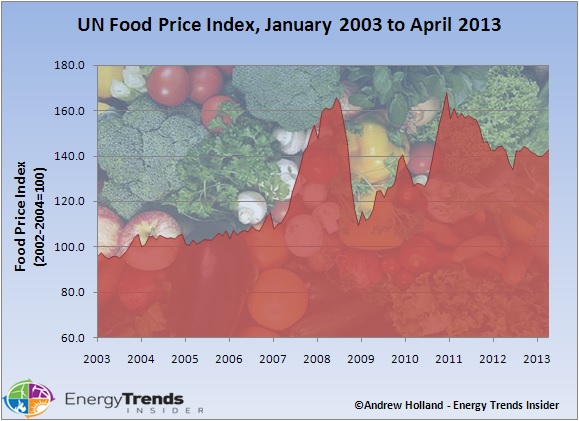
The Arab Spring nations, such as Egypt and Syria, have struggled with food security:

The food import dependence and lack of foreign exchange is all the more worrying as the global food crisis of 2008  [seen above] has shown a diminished reliability of global food markets. Not only did prices skyrocket, some agricultural exporters like Argentina, Russia, and Vietnam announced export restrictions out of concern for their own food security. Naturally this sent shock waves through the Middle East, which imports a third of globally traded cereals.

The oil rich Gulf countries reacted by announcing investments in farmland abroad to secure privileged bilateral access to food production. Only a fraction of these investments has gotten off the ground, yet they have been controversial as they have been mostly announced in developing countries like Sudan or Pakistan that have severe food security issues themselves.

Lily Kuo has more details on the buying of foreign farm land:

Saudi Arabia, South Korea, the United Arab Emirates, Britain, the US and other countries have been buying up foreign farmland, especially after the global food price spike of 2007 to 2008 that spurred global riots. According to a report last year by the nonprofit Grain, the main target of these purchases has been Africa but also Eastern Europe, Latin America and Asia. Between 0.7% and 1.75% of the world’s farmland is being transferred from locals to foreign investors, another study in January found.

(Chart via The American Security Project)

The Search For An Ironic Typeface

Popova surveys the many failed attempts:

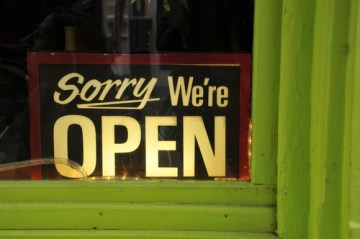
IronysorryThis raises the necessary question of what it is, exactly, that makes representing irony typographically so catastrophic. As someone who finds even the use of italics for emphasis, with very limited exceptions, a mark of weakness of style — if a writer can’t wield language in a way that produces organic emotional crescendos, how pitiful to try forcing those typographically — I see the answer as obvious: Irony thrives on an implicit juxtaposition of contextual intention and literal meaning, so as soon as we make it explicit, it stops being ironic.

Perhaps ironically, a separate crusade for a textual signifier of irony comes precisely in the form of a script — a reverse-italics typeface called Ironics, attributed to the iconoclastic journalist H. L. Mencken, who believed Americans were unable to recognize irony and thus needed a special typeface to indicate that the writer was being facetious.

Recent Dish on Shady Characters, the book that inspired Popova’s post, here.

(Image via The Narrative Breakdown)

Grieving Godlessly, Ctd

Many readers are responding to this quote from Tiffany White:

Expressing concern and condolence over death and illness has always been a confusing linguistic contortion for me, a life-long atheist living in the Deep South. I’ve since settled for variations on “You’re in my thoughts”. Though I myself am at-peace with the concept of the end of life being the end of existence, so many people believe otherwise. “They’re at peace now” works well for condolences; it lets me be comforting without having to be disingenuous.

Another reader:

I faced this recently when a friend of mind suddenly lost her husband.  Instead of “I’ll pray for you” there’s “I’m thinking of you” – logically they are the same thing and yet they feel different.  On the other hand I feel that the loss of “I’ll pray for you” is as a whole a positive thing.  Atheists know that prayer doesn’t help the recipient and yet makes the person praying feel like they’d done something to help the grieved.  The atheist is forced, if they do care for the person, to do something that actually does help the grieving person – bring them food, help them give stuff to Goodwill, some actual thing to help.  So in the end the loss of “I’ll pray for you” forces us to do more, and give more and be of personal help to the grieving person, and that is a good thing.

Another:

Oy vey. Tiffany White needs to get over herself. First, she’s not talking about grieving godlessly; she’s talking about being supportive of a friend (whose religious views she doesn’t disclose) who is grieving. Second, she’s assuming her lack of theism somehow limits her expression of consolation far more than it must.

I have been an agnostic for about 40 years, which – for the purposes she’s describing – is not that different from being an atheist. But more important, for about 20 years, I have been a Unitarian-Universalist – that is, I choose to belong to a religious community that works with its members to support them (and others) through life’s joys and sorrows, even though it eschews creedalism. A lot of UUs serve as chaplains. (Try listening to this podcast about Kate Baestrup, a UU chaplain with the Maine Warden service. )

When you are with someone who is grieving, it is your job to be present – physically, emotionally, and intellectually – and to focus on that person and her pain. It is not your job to worry about the finer points of your theology and what your theology says. Suppose you believed in the god of the Catholics. Could you say nothing comforting to a Baptist? To a Jew? To a Hindu? What happens to people when grief washes over them? Do they sit around like theology professors gauging the doctrinal nuances of what people say? C’mon.

Here’s what you can say: “I hear you.” “I brought you some supper.” “I’ll put it in the refrigerator.” “I’ll help you with the acknowledgement notes” “Yes.” “You’re right.” “Let me give you a hug.” “I know she loved you.” “I know she knew you loved her.” What the bereaved says and the bereaved needs determine what you say, not your religious beliefs.

Another:

Whenever I comfort anyone who’s lost a loved one, family member, or friend, I say the same thing, which I believe to be true for atheists like me or for believers: “I am so sorry.  I know, though, that the depths of your grief equal the heights of your love.”

Another:

When my first husband died, just about everything other than “I am sorry for your loss” – in its many forms – set my teeth on edge because no one could really understand just what I was feeling because to do that they needed to be me. People worry too much about this anyway. Just showing up or just acknowledging the loss, in even the smallest way, is better than a mass market sympathy card or straining your creative side trying to find a unique way to acknowledge a pain that never really goes away and is something that we will all know sooner or later and is a human reality that scares most of us witless.

Personally, I am waiting for the day when we can say, “Damn, this fucking sucks.” But that probably won’t happen.