Using Your Tongue To “See”

by Brendan James

When we really try, humans can perform echolocation à la bats and dolphins, like blind man Daniel Kish in the above video:

We can’t match the 200 or so clicks per second achieved by bats and dolphins, but it’s not really necessary. Kish, for one, simply makes a clicking noise every few seconds, with interludes of silence when he doesn’t need to get a new picture of his surroundings.

From there, the sound waves produced by the click are broadcast into our environment at a speed of roughly 1,100 feet per second. Shot out in all directions, these waves bounce off the objects, structures and people around the echolocator and arrive back in his or her ears. The volume of the returning click is much quieter than the original, but those with proper training readily identify the subtle sound. And although it might seem amazing to be able to analyze these sound waves to generate a picture of the environment, some of the basic principles in play are concepts you already rely on everyday.

Previous Dish on how the blind utilize other senses here.

The Open-Source Author, Ctd

by Jessie Roberts

“[T]he fact is … he was a godawful writer. He was so bad,” writes Peter Damien of H.P. Lovecraft:

A Lovecraft story isn’t delivered so much as thudded down on the table in front of you like a quivering glob of wet cement. So the writing isn’t great by any stretch of the imagination. And the man himself wasn’t that great either, a fairly unpleasant, incredibly racist guy who had a bit more sympathy for Adolf Hitler than you’d really hope for out of your 20th Century Icons of Writing list. He wrote a bunch. He wasn’t that successful. He died. The stories lingered. And why? Because the ideas beneath the ugly exterior were astonishing.

The notions of vast and ancient gods, hidden texts and cults, madness, and insanity in the realization that there was a world beyond ours and it was too horrifying to comprehend–all of his ideas were themselves amazing things. It’s just that Lovecraft lacked the capability to do anything useful with them himself. To use a perhaps wobbly metaphor, it’s as if Lovecraft wrote piles and piles of source code, but never thought to compile it into a beautiful and functional piece of software. So instead, the world was greeted with pages of source code, which, the world not being made up solely of programmers, did not read smoothly, did not look pretty, and was not interesting. The remarkable thing is all the people who have later come along and compiled that source code of ideas into amazing works of art.

Previous Dish on Lovecraft’s legacy here.

Households Shrink; Houses Don’t

by Tracy R. Walsh

Households by type

Emily Badger notes almost nine out of 10 U.S. dwellings are built for two or more people, even though more than 27 percent of Americans live alone:

Screen Shot 2013-08-27 at 3.01.16 PMAmerican households have been getting smaller as our houses, conversely, have actually been getting bigger. But the disconnect between those two trends may be felt the most strongly by people who live alone, whether they’re 22-year-old women who aren’t yet married, or 70-year-old retired widows. As more Americans are opting to live alone than ever before, that now seems like an entirely unremarkable choice. But for years we’ve been building houses for that big nuclear family that’s now less common. And housing data released earlier this summer by the Census Bureau, illustrated at right, suggests that the U.S. is now a country where many people live alone in a land of three-bedroom houses.

Flirting With Polarization

by Patrick Appel

Is online dating creating fewer politically-mixed couples?

People who use Internet dating sites are choosing who to date based on criteria that are highly correlated with political preferences, according to a study published in the most recent edition of the academic journal Political Behavior. As a result, the study suggests, there may be long-term consequences for political polarization: not only are such couples more likely to move to the ideological extremes because they lack access to contradictory opinions, they also are likely to produce children who hold ideologically extreme positions. The end result is a more polarized America where more and more people cannot understand how others could possibly think differently from themselves.

Rise Of The Anti-Bloomberg

by Chas Danner

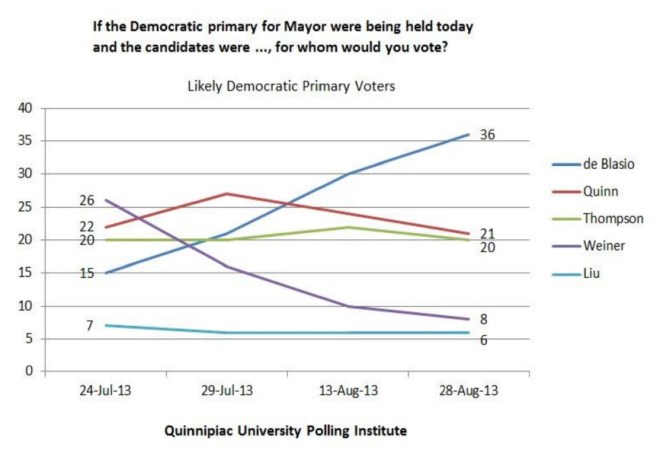
quinnpiac-university-polling-inst-828-mayoral-race

A new poll shows Bill De Blasio, a former underdog in the New York mayoral race, now leading by a comfortable margin. Marc Tracy notes how de Blasio’s focus on inequality and his rejection of the Bloomberg era has resonated with the same white liberals who once supported Bloomberg en masse:

The [old] Bloomberg pitch—laissez-faire stewardship of the money-making tax base, technocratic management, and liberal social programs—made sense for its era … [but d]uring the recovery from the 2008-9 recession, the benefits have overwhelmingly accrued to the wealthiest both nationwide and, especially, in the city that is the country’s financial center. …

“It was clear from our research,” said [Anna] Greenberg, de Blasio’s pollster, “that high income voters are as uncomfortable as low income voters about the stark inequality that has emerged in New York City in the Bloomberg years.” She told me: “Even New Yorkers who are doing quite well, and approve of the mayor’s agenda on things like bike lanes and sustainability, want to see a new direction centered around economic fairness and equality.” In 2013, the pocketbook is something that unites, instead of divides, the creative class and the working class.

Tracy suggests that NYC may prove a bellwether for the nation in this regard:

“New York, by its very nature, sets the tone for a class that exists nationwide,” [Chapman University Professor of Urban Development Joel] Kotkin explained. Its economics and politics, like its culture, are a potent distillation of trends present throughout the country. Across the land, this recovery has been unequal. Earlier this year, for instance, Pew Research examined U.S. Census data to 2011 and found that the top seven percent saw their net worth rise 28 percent since the recession while the bottom 93 percent (including households worth over $800,000) saw theirs decline. Not only in New York are the rich getting richer while everyone else goes in the other direction.

Relatedly, Rich Yeselson points out how the New York Times’ rejection of de Blasio may have backfired:

The long awaited endorsement by the Gray Lady, which some analysts thought would be decisive, went to [former frontrunner Christine] Quinn. The Times editorial page haughtily smacked down de Blasio’s scruffy campaign, labeling it dependent upon “legislative long shots” and attached its High Church liberalism to Quinn. Quinn was already seen as the favorite candidate of the increasingly unpopular Bloomberg, and the quintessential establishment imprimatur of the Times trapped her in the billionaire’s embrace. Indeed, the first poll post endorsement showed de Blasio expanding his lead. Because de Blasio has branded himself as the anti-Bloomberg, he likely gained more from the Times’ selection of Quinn than she did.

The Contradictions Of Military Justice

by Tracy R. Walsh

Nadal Hasan was sentenced to death for killing 13 soldiers in Texas just days after Robert Bales was sentenced to life for killing 16 civilians in Kandahar. Hendrik Hertzberg wonders how the Muslim world will respond:

Consider: One member of the U.S. Army is an apple-pie American (white, Catholic, high-school football captain, Ohio State student, married father of two) with a slightly shady past (he was implicated in a financial-fraud case when he worked as a broker, before joining the Army, in 2001). He kills 16 unarmed Afghan Muslim civilians, including four women and nine children. He gets life.

The other member of the U.S. Army is a Muslim, the eldest son of Palestinian immigrants, a medical doctor, an Army officer, unmarried. He kills 13 uniformed American soldiers, unarmed. He gets death.

A third case hovers in the background.

In 2003, in Kuwait, an Army sergeant used hand grenades and a rifle to kill two of his comrades and injure fourteen more. In 2005, a military court sentenced the sergeant to death. Last year – on July 13, 2012 – the Army’s court of appeals affirmed the sentence. While appeals continue, the sergeant remains on death row at Fort Leavenworth, Kansas. This third member of the U.S. Army, Sergeant Hasan Karim Akbar, né Mark Fidel Kools, is also Muslim. He is an African-American whose parents changed his name when they converted to Islam. He kills two American soldiers. He gets death.

Hertzberg hopes Obama will stop the executions:

If he declines to sign a death warrant in one of these cases, he will, of course, be subject to unrestrained demagogic attack from the Republican right. But if he does sign, and if the execution or executions are carried out, he will have essentially confirmed the suspicion that the United States places significantly less value on the lives of Muslims, regardless of nationality, than on the lives of Christians and other non-Muslims, also regardless of nationality. One can only hope that he will have the fortitude to reject that choice – a choice that, besides being morally abhorrent, would be grievously damaging to the national interest.

The Roots Of Random Rituals

by Jessie Roberts

Jim Davies describes how superstition arises from circumstance:

In 1948 the Polish born British anthropologist Bronislaw Malinowski published a book on a study he conducted of the fishermen of the Trobriand Islands. Sometimes they fished in an inner lagoon, where fishing was pretty predictable. Every time they fished there, they got pretty much the same kind of catch. But they also fished in the open ocean, where the fish were bigger and harder to catch. Sometimes people would get great catches, and other times, terrible ones. The lure of the very rare great catch proved too tempting for the Trobrianders, so they ventured into the open ocean despite the odds—and developed a set of superstitions. These included rituals performed during fishing and the casting of magic spells.

The circumstance dictated the explosion of rituals. We might think this is a completely human adaptation. But it turns out that the tendency to resort to ritual in an effort to manage a challenging situation isn’t exclusive to humans. In the same year that Malinowski published his experiment, American psychologist B. F. Skinner found that he could generate superstitious behavior in pigeons. He taught pigeons to press down on a bar in exchange for food. All animals can learn to do this, and this learning process is called reinforcement. But an interesting thing happens if the food is given at random intervals—that is, pressing the bar sometimes does, and sometimes does not, produce a treat, with no discernable pattern. Under these conditions, but not under reliable conditions, the pigeon will start repeating arbitrary, idiosyncratic behaviors before pressing the bar. It might bob its head, or turn around twice. The pigeon becomes superstitious.

When Childhood Classics Aren’t Innocent, Ctd

by Chris Bodenner

A new angle from readers:

I’m enjoying this thread immensely. Another great film marred by racism is Breakfast at Tiffany’s. Mickey Rooney’s portrayal of Japanese neighbor Mr. Yunioshi is so incredibly over the top that it becomes very difficult to watch. I couldn’t find a good clip from the film itself, but [above] is a scene from Dragon: The Bruce Lee Story, where Bruce Lee shows his discomfort at Rooney’s character.

Another reader:

Yes, Peter Pan is bad but, Disney has a lot of clunkers in its vault. I recently watched their 1966 Dean Jones/Suzanne Pleshette film The Ugly Dachshund, which is both incredibly sexist and racist. (Much comedy is attempted at the expense of a pair of father/son Japanese caterers.) Whoever let that film be re-released on DVD ought to be fired by Disney.

And another:

The great musical South Pacific should come with a warning label: not safe to watch with your Asian children. It’s been a long time since I watched it, but I recall a terrible scene where Shirley Jones meets the children of the man she thinks she loves, and they turn out to be the fruit of his previous union with … a native! They have dark hair and slanty eyes! As Shirley Jones recoiled in horror, my recently-adopted children (then about seven years old) turned to me in puzzlement: “Mama, why she no like those kids?” Oh gosh, was it hard to think of a quick lie about that; but my daughters were neither old enough, nor linguistically proficient enough, for me to explain the actual truth. Major ouch.

Update from a reader:

Shirley Jones isn’t in South Pacific; that was Mitzi Gaynor who played Nellie Furbush. Did this reader not understand the plot of the movie? The entire love story is jeopardized by Nellie’s racism. That’s the point. There’s even a song about it: “You’ve Got To Be Carefully Taught”. This is why the musical won the Pulitzer Prize for Drama. The reader had no business showing a 7-year-old that movie in the first place. Not all musicals are for children.

Assaulted On Social Media

by Brendan James

Ann Friedman studies the mixed effects of social media in the aftermath of of rape and sexual assaults:

For decades, the challenge facing anti-rape activists was to take what is often an intensely private crime—54 percent of sexual assaults are estimated to go unreported—and bring it to national attention as a pervasive crisis. Now that cases regularly crop up in which photos and videos of sexual assaults are circulated on social media, it’s becoming harder to argue that rape is anything but a public scourge. We are all bystanders. We all bear witness.

Yet the increased attention on social media often has tragic consequences for victims. They don’t just have to grapple with the physical and psychological ramifications of being sexually violated. They have to deal with the fact that everyone else knows what happened, too. …

For a victim, there’s no difference between people who share footage of the assault because they want to raise awareness about the problem and people who share footage to laugh at it or, worse, because it turns them on. “The horror of having the intimate violation of your body exposed, shared, transmitted, and existing in a way that you know can never be expunged is awful,” says Kaethe Morris Hoffer, legal director of the Chicago Alliance Against Sexual Exploitation. “Since the advent of the Internet, it has been a tremendous and devastating burden for survivors to live with the knowledge that they have no hope of ensuring that images of their sexual violation will ever be erased. What social media does is make the transmission of it a hundred times faster and more shareable.”