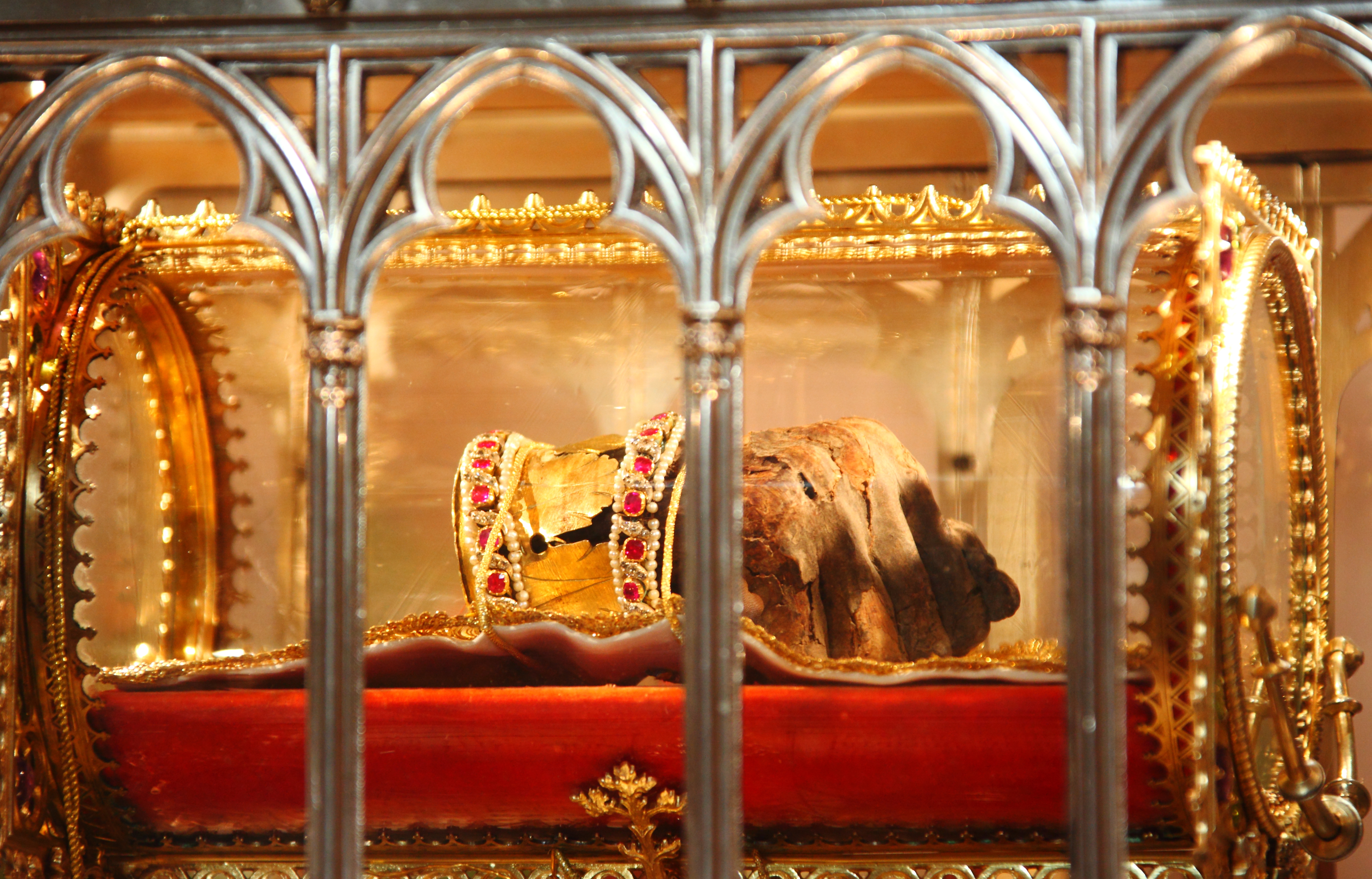
In the ’90s, I visited a church in Budapest where they displayed the 1000-year-old hand of St. Stephen. You have to put a coin in a box to make it light up. I couldn’t bear to look.
Another goes deep:
The problem with Christian opposition to idolatry is that the Doctrine of Incarnation postulates that God really became incarnate in matter. The Body of Christ is literally an idol (although a true idol per Orthodoxy). Furthermore, from the standpoint of Alexandrian theology, the whole point of the incarnation is so that we can become like God through the example of Christ, divinization, e.g. icons of Christ. Otherwise, the whole thing is pointless; you should just give up and study Aristotle or something.
Without saints, and icons and relics, you end up with a God that is just some occult metaphysical abstraction that saves us through some occult metaphysical process in some occult metaphysical by and by. Why not just worship God in an occult metaphysical way too? That is, why not just be nice and think positively? Why make a gesture of prayer or come together in a gesture of worship at all? Obviously, if we look up when we pray, then aren’t we suggesting that God is some kind of being up in the sky? If we speak, aren’t we suggesting that God has ears and can hear us? (And if he has ears, why can’t we draw them?) How is this any different from kissing an icon?
Or even better, isn’t the idea of a God that is not, in some sense, really physically present in matter a vacuous and meaningless idea? And isn’t that the central foundation of a vacuous and meaningless “contemporary” spirituality?
Back in May, Jonathan Mercer spelled out why national “credibility” is a terrible reason to go to war:
Do leaders assume that other leaders who have been irresolute in the past will be irresolute in the future and that, therefore, their threats are not credible? No; broad and deep evidence dispels that notion. In studies of the various political crises leading up to World War I and of those before and during the Korean War, I found that leaders did indeed worry about their reputations. But their worries were often mistaken.
For example, when North Korea attacked South Korea in 1950, U.S. Secretary of State Dean Acheson was certain that America’s credibility was on the line. He believed that the United States’ allies in the West were in a state of “near-panic, as they watched to see whether the United States would act.” He was wrong.
When one British cabinet secretary remarked to British Prime Minister Clement Attlee that Korea was “a rather distant obligation,” Attlee responded, “Distant — yes, but nonetheless an obligation.” For their part, the French were indeed worried, but not because they doubted U.S. credibility. Instead, they feared that American resolve would lead to a major war over a strategically inconsequential piece of territory. Later, once the war was underway, Acheson feared that Chinese leaders thought the United States was “too feeble or hesitant to make a genuine stand,” as the CIA put it, and could therefore “be bullied or bluffed into backing down before Communist might.” In fact, Mao thought no such thing. He believed that the Americans intended to destroy his revolution, perhaps with nuclear weapons.
Similarly, Ted Hopf, a professor of political science at the National University of Singapore, has found that the Soviet Union did not think the United States was irresolute for abandoning Vietnam; instead, Soviet officials were surprised that Americans would sacrifice so much for something the Soviets viewed as tangential to U.S. interests. And, in his study of Cold War showdowns, Dartmouth College professor Daryl Press found reputation to have been unimportant. During the Cuban Missile Crisis, the Soviets threatened to attack Berlin in response to any American use of force against Cuba; despite a long record of Soviet bluff and bluster over Berlin, policymakers in the United States took these threats seriously. As the record shows, reputations do not matter.
In a 2011 paper (pdf), David Luban made the case against punitive war:
War is a blunt instrument. Despite easy talk about “surgical” strikes and “precision” attacks, the fact is that warmaking wreaks damage across entire towns, cities, and territories. Wars are the equivalent of natural disasters like floods and hurricanes, and even the most discriminate war breaks whatever it touches. Thus, if war is retributive punishment, we must acknowledge that it is collective punishment, indeed collective corporal punishment.
Obama probably won’t use the word “punishment” when he presents the case for war to the American public, but given that no demands have been made of Assad—no one is suggesting that if he surrenders his chemical weapons or comes to the negotiating table in the next few days, the whole thing will be called off—this certainly does feel like punishment for a blatant human rights abuse and for crossing the “red line” Obama specified last year. Whether you agree with Luban’s take or not, that’s a more radical notion than I think people realize.
Unlike in our fine republic, the lower house of the British legislature is putting in the time to deliberate over intervention in Syria’s civil war – watch the live-stream below:
A reader senses that society is ready for the emergence of the first prominent gay rapper:
Maybe I missed it, but I haven’t seen a mention of the current #9 hit on the Top 40 chart – “Same Love” by rapper Macklemore. It was performed just this weekend on the MTV Video Music Awards. Macklemore addresses the issue in as direct a way as you could do it. Slate has a good post on it here.
Though many people on Twitter are assuming Macklemore is gay and bashing him for it. Another reader points to a fictional gay character:
The Wire‘s Omar Little isn’t a gay rapper, but many would consider him the type of street-smart Hood Robin Hood many rappers admire and purport to be in the musical fantasies they sell. I wonder if, and how far, Omar moved the needle.
One person who has definitely moved the needle is Frank Ocean, the black R&B artist who expressed same-sex love in latest album, covered by the Dish here.
Michael A. Fletcher bemoans the state of racial inequality 50 years after the March on Washington:
In 1963, blacks families earned 55 cents for every dollar earned by whites. In 2011, blacks earned 66 cents for every dollar earned by whites. The black unemployment rate averaged 11.6 percent between 1963 and 2012, more than double the white jobless rate over that time. The black poverty rate of 55.1 percent was just over three times the white rate in 1959. It dropped to 32.2 percent in 1972. But since then, progress has been slow. In 2011, 27.6 percent of black households were in poverty — nearly triple the 9.8 percent white rate, according to the Census Bureau.
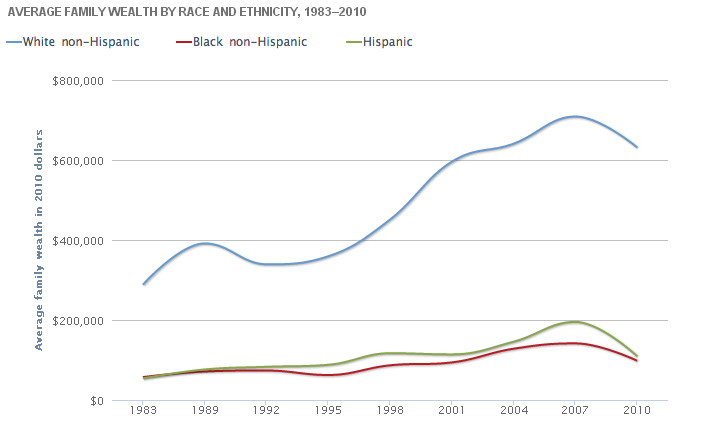
Plumer lays out an array of charts tracking the largely unchanged disparity across the board:
“The wealth gap between minorities and whites has not improved over the past three decades,” reports the Urban Institute. “From 1983 to 2010, average family wealth for whites has been about six times that of blacks and Hispanics — the gap in actual dollars growing as average wealth increased for both groups.” And the Great Recession exacerbated that gap, as blacks and Hispanics were hit especially hard.
Joseph Ritter examines the role of discrimination:
Black workers seem to earn less because of differences in education or upbringing, while black workers’ employment shortfall appears to be more a factor of employer discrimination. In other words, black workers that manage to get a job appear to earn at comparable rates, controlling for education levels—but regardless of education, they appear to have a harder time getting a job, due to their race.
Derek Thompson homes in on the point about education:
“Today, white adults 25 and older are significantly more likely than blacks to have completed at least a bachelor’s degree,” Pew tells us. On the one hand, the black completion rate as a percentage of the white completion rate has increased from 42% then to 62% now. On the other hand, whites are still far more likely to graduate from a bachelor’s program by 25. This college advantage — reinforced through dual-earner households — translates into higher family incomes, higher home-ownership, and (as a result) higher wealth for whites. There is a reason why so many discussions of social mobility begin and conclude with education.
Watch the whole thing here or read the transcript here. Waldman thinks the speech was directed to future generations, not the present:
This seemed to me to be a speech written in the hope it would be read 50 years hence. He’ll get some criticism for not talking about any specific policy issues, but that’s what happens when you swing for the rhetorical fences; you can’t get too bogged down in the mundane arguments of the moment. And what struck me most about it was how little he talked about Martin Luther King. He mentioned him only a few times, but spent much more time talking about ordinary people. This was the running theme of the speech and perhaps what was most important about it.
Brentin Mock agrees that history will be the judge:
Obama’s speech wasn’t, as rapper Keith Murray would say, the most beautifulest thing in the world, but it accomplished what Obama has been setting out to accomplish from the beginning: staying the middle-road course in effort to appeal to the liberals and conservatives among all races in the spirit of perfecting the union. Whether his legacy will reflect a victory on this as an honorable effort or flat failure won’t be determined for decades.
But Jamelle Bouie argues that now is no time for bromides:
What Obama didn’t say, but what the civil rights movement recognized, is that the specific experience of African-Americans requires – and required – a specific response. It’s what motivated the Freedman’s Bureau of Reconstruction, and Martin Luther King Jr.’s call for an inner city “Marshall Plan” during the Second Reconstruction of the 1960s. … [T]he economic legacy of white supremacy is still with us, and—outside of half-measures and rhetoric—we’ve shown little appetite for dealing with it. Simply put, 350 years of bondage and oppression can’t be ameliorated with 50 years of citizenship rights, tepid liberal programs, and “colorblindness.” That includes the president, who works hard to avoid race and its role in shaping our problems.
That Obama could not – or would not – elucidate his plans to address the intractable realities of race and the economic consequences of those realities, even as he acknowledged that “black unemployment has remained almost twice as high as white unemployment, Latino unemployment close behind,” calls into question the logic of a black Presidency in itself. There was something despair-inducing about the way he said “change doesn’t come from Washington, it comes to Washington,” an oratorical turn that cloaked the fact that something vital was being reneged upon. …
Obama’s tic for rhetorical evenhandedness meant that even in his discussion of racial inequality, he had to nod to black failings by pointing to “self-defeating riots” and “criminal excuse-making.” And his tendency to chide black America in public appears all the more cynical when compared with his refusal to point to his own responsibilities to that community as Commander-in-Chief.
Peniel E. Joseph is similarly disappointed by Obama’s vagueness:
[W]here were the specifics that would have truly honored the March on Washington? The 250,000 people who gathered 50 years ago were looking for specific solutions, not just soaring rhetoric. Where was the president’s promise to sign a series of executive orders that would focus on anti-poverty efforts or increase access to higher education? Or governmental action that perhaps could ease the transition of ex-offenders back into communities or promote jobs programs, especially in economically devastated urban and rural communities?
Meanwhile, Ed Kilgore detects a hint of despair from the commander-in-chief:
What struck me most about it was that it seemed a wistful tribute by a politician hemmed in by politics to a social movement that alone has the power to overcome the resistance to change. “Change does not come from Washington but to Washington,” Obama said, and while some may view that as an abdication of responsibility, it’s more a plain fact of the long struggle for justice and equality. This passage in particular seemed a recognition that Obama – once thought to be the Joshua who would bring the civil rights movement into the promised land its “Moses generation” could not reach—was passing the torch to the next generation: There’s a reason why so many who marched that day and in the days to come were young, for the young are unconstrained by habits of fear, unconstrained by the conventions of what is. They dared to dream different and to imagine something better. And I am convinced that same imagination, the same hunger of purpose serves in this generation.
And Jeff Shesol believes Obama was holding himself back:
When Obama permits himself to speak about [race and equality] — as he did in his 2004 debut at the Democratic National Convention, in his “race speech” of 2008, in his unscripted remarks about the Trayvon Martin shooting — he conveys an understanding that enriches our own. On each of those occasions it was said, rightly, that only Obama could have given that speech. But one of the disappointments of yesterday’s speech was that it could have been given — credibly, if less movingly — by any one of a number of Democrats. It was largely devoid not only of first-person pronouns, but first-person perspective.
Like du Bois, Barack Obama has taken the stage at a moment when it is popular to assert that black people are the agents of their own doom. There has never been any other such moment in American history. The response to Trayvon Martin, indeed the response to Barack Obama himself, has been to attack black morality, to highlight black criminality and thus change the conversation from what the American state has done to black people, to what black people have done to themselves. Like Du Bois, Barack Obama believes that this these people have a point. His biographer, David Levering Lewis, says that Du Bois came to look back back on that speech with some embarrassment. I don’t know that Barack Obama will ever reach such a conclusion.
Indeed, if we are – as the president asks us to be – honest with ourselves, we will see that we have elected a president who claims to oppose racial profiling one minute, and then flirts with inaugurating the country’s greatest racial profiler the next. If we are honest with ourselves we will see that we have a president who can condemn the riots as “self-defeating,” but can’t see his way clear to enforce the fair housing law that came out of them. If we are honest with ourselves we will see a president who believes in particular black morality, but eschews particular black policy. It is heart-breaking to see this. But it is also clarifying.
Obama claims that he hasn’t made a decision regarding Syria, but he emphasizes that “the international norm against the use of chemical weapons needs to be kept in place”:
Fisher thinks that this is the primary rationale for using force:
The U.S. decision to move toward possible strikes appears, rightly or wrongly, wisely or unwisely, to be all about reinforcing international norms. It’s not about us; it’s not about “because Obama said so.” It’s about “because international norms say so.”
Alex Massie wants to know exactly what we are trying to achieve:
We are clear that we do not wish to remove Bashar al-Assad from power. So we do not think his use of chemical weapons is that big a deal. Certainly not a big enough deal to make the case for regime change.
The plan, in as much as there is one, seems to be to put him in detention rather than expel him. But to what end? Will bombing Syria persuade Assad to modify his behaviour? Is our objective to make him offer the rebels a “fairer fight”?
… How, having intervened once, can the United States and its allies walk away? Shoving Assad onto the naughty step seems an insufficient response to his misdeeds. If the aim is simply to persuade Assad that any further use of chemical weapons will bring additional consequences it might be wise to consider what those consequences might be.
Marc Lynch likewise worries that intervention will lead to more intervention:
[T]he administration’s loud protestations of limited aims and actions are only partially reassuring. Much the same language was used at the outset of the Libya campaign. Everybody knows that it will be excruciatingly difficult for Obama to hold the line at punitive bombing after those strikes inevitably fail to end the war, Assad remains publicly defiant, the Geneva 2 diplomatic process officially dies, and U.S. allies and Syrian insurgents grumble loudly about the strike’s inadequacy. Once the psychological and political barrier to intervention has been shattered, the demands for escalation and victory will become that much harder to resist. And what happens when Assad launches his next deadly sarin attack — or just massacres a lot of Syrians by non-chemical means? This too Obama clearly knows. But that knowledge may still not be enough to save him.
Eli Lake reports on Iran’s response to America attacking Syria:
Recent U.S. intelligence assessments are not entirely comforting, but one silver lining is that for now the government’s analysts do not expect Iran to attempt terrorist attacks outside the Middle East or Afghanistan in the event of limited U.S. air strikes on Syria, according to U.S. officials who spoke with The Daily Beast on the condition of anonymity. Although Iran as recently as 2011 plotted a terrorist attack in Washington, D.C., a statement Wednesday from the country’s supreme leader, Ayatollah Ali Khamenei, hinted that Iran would focus retaliation inside the Middle East.
Larison thinks bombing Syria will make war with Iran more likely:
A direct attack on Syria would make it virtually impossible for Rouhani to pursue a more conciliatory course, which in turn makes conflict with Iran more likely in the coming years. Iran might not respond militarily to an attack on its ally, but if hard-liners in Tehran are as blinkered as our own “credibility”-obsessed politicians they very well might feel that they have to respond or risk being perceived as weak. Whether Iran retaliates or not, Rouhani will be in no position to offer concessions, and Iran hawks here will use this to justify their own demands for even more sanctions and more aggressive measures against Iran’s nuclear program.
Karim Sadjadpour has a useful primer on Iran’s alliance with Syria. A section on Iran’s strategic interests:
Syria has been Tehran’s only consistent ally since the 1979 Islamic revolution. Whereas the rest of the Arab world supported, and in some cases bankrolled, Saddam Hussein during the Iran-Iraq war, Hafiz al-Assad’s Syria sided with Tehran. While Iranian and Syrian tactical interests have occasionally diverged during the last three decades, on macro-strategic issues the two regimes have more often worked in unison.
Beyond its political support, Syria is also critical to Iran in that it provides it a geographic thoroughfare to Lebanese Shi`a militia Hizb Allah, which is one of the crown jewels of the Iranian revolution. Both Syria and Hizb Allah are crucial elements of Iran’s resistance alliance, and much of Hizb Allah’s armaments are thought to emanate from Iran via the Damascus airport.
Iranian motivations in keeping the al-Assad regime in power are also driven by deep concerns about the composition of a post-Assad government. Given Syria’s overwhelming Sunni Arab demographic majority, Iran fears the prospect of Syria being rendered a Sunni sectarian regime aligned with Saudi Arabia or the United States and hostile to Shi`a Iran. While visiting Damascus in August 2012, former Iranian Supreme National Security Adviser Saeed Jalili stated that “Iran will absolutely not allow the axis of resistance, of which it considers Syria to be a main pillar, to be broken in any way.” In other words, if the ends are opposing the United States and Israel, almost any means are justified.

 The Dish