A reader takes issue with the idea of starting restaurant reviews on opening night:
Luke O’Neil’s argument that restaurants should be reviewed as soon as they open shows a complete lack of understanding of how a restaurant gets put together and underplays the complexity of the process. His analogy to theatre previews is apt. I’m a Broadway theatre professional and can attest that the preview process is not a mere courtesy to work out the kinks – it’s an essential part of the creative process. Indeed, I have never seen a musical that is remotely the same on opening night as it is at first preview. There are fundamental things that can only be learned by performing the show in real-time, in front of a real audience. I am certain the same is true for restaurants.
Preview theatre audiences know that they are buying an early sneak-peek at a show. As a foodie myself, I know that hitting a restaurant in the first week or two will mean sacrificing perfected operations for a priority view. There’s no attempt to hide the story by the operator.
A first preview review of “Wicked” would not review the show that tens of thousands have since seen. A first night review of Momofuku Ssäm Bar would also not be a review of the restaurant you can now go visit. Early reviews serve neither the reader nor the broader goal of establishing a written history for the industry at large.
I think in general, the kind of realism on display in our relationship to Egypt has been a better model for dealing with problematic governments in unstable regions than some of the alternatives, from Iraq to Libya, that recent presidencies have experimented with.
But there also moments when the ground moves, and you have to take a step back and reassess whether the approach that realism seems to dictate is actually realistic. So, for instance: There is a difference between supporting a longstanding, creaking dictatorship on terms negotiated during the Cold War and supporting a second-generation junta that’s just deliberately overturned a democratic election. There is a difference between supporting a leadership, however corrupt, with a proven record of delivering relative stability and a leadership that so far is mostly delivering bloody chaos. And there’s a difference between supporting a government that’s willing to bend to your wishes at crucial moments and a government that seems intent on embarrassing you while telling the world it doesn’t need your help.
When a client is engaged in behavior that seems both self-destructive and dangerous to us, it is irresponsible for the U.S. to continue the relationship as if nothing is amiss. That’s a standard that the U.S. ought to apply to all of its client relationships, but it certainly applies in the case of Egypt.
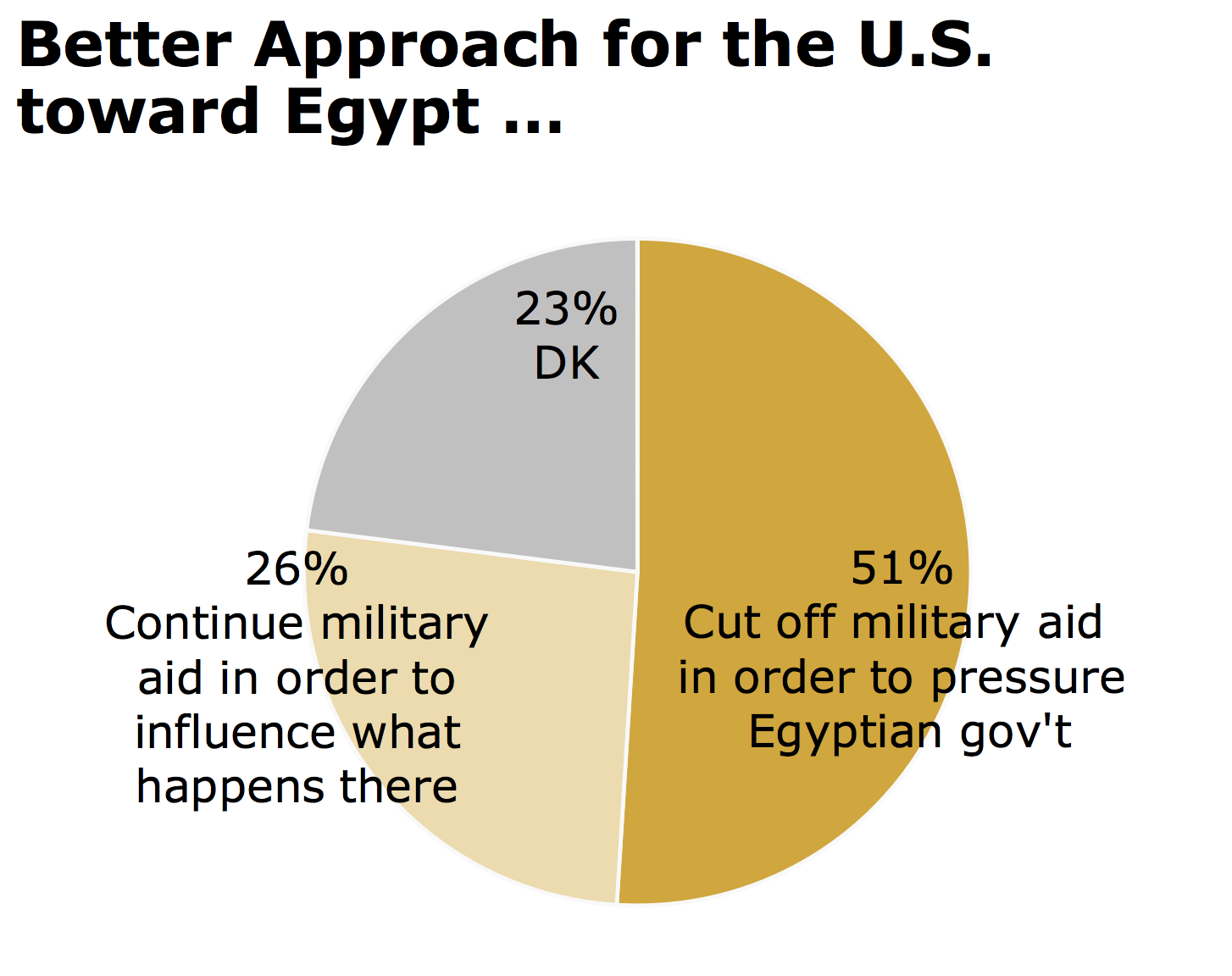
(Chart showing that the public supports cutting aid to Egypt from Pew)
Gary Becker highlights the economic advantages of population growth:
To be sure, if higher birth rates lead to lesser education and other human capital investments in each child, they may result in lower, not higher, per capita incomes. Malthus fear of lower per capita incomes explains his strong opposition to high birth rates. However, the rapid growth in world population during past 250 years has been accompanied by unprecedented high per capita incomes all over the world. Whatever the Malthusian negative effects of greater population, they have been dominated by factors that raised per capita incomes, including the benefits of increasing returns and other advantages from having a larger population.
There is no necessary connection between population and economic growth. The sharp decline of Europe’s population because of the Black Death is thought to have increased per capita incomes significantly by reducing the ratio of people to arable land, resulting in improved nutrition. A larger population can, as Becker points out, increase the rate of technological progress by increasing the number of geniuses and other very creative people. But so can assortative mating, which has become much more common in the advanced countries as a result of falling discrimination and Internet dating search. At some point there may be diminishing returns to the increasing number of computer engineers.
Laura Bennett declares her antihero fatigue, arguing the word has lost all meaning in the recent surge of bad boy TV dramas:
Somehow “antihero” has come to represent an impossibly broad characterological range: from psychopathic drug lords to well-meaning serial killers to wayward Dominican kids who sometimes mistreat women because of culturally-ingrained misogyny. …
In Hollywood, the concept has been around at least since films of the ’40s and ’50s began exploring the new post-war cynicism, and an action film actually titled “Anti-hero” appeared in 1999. [Encyclopedia] Britannica cites as some early antiheroes Satan in Paradise Lost, Heathcliffe in Wuthering Heights, and Don Quijote, none of whom are particularly useful analogues for the wretched, morally bankrupt leading men of cable drama. And the men of HBO and AMC are not as similar in their sinfulness as they have been made out to be. Walter White is by now less an antihero than a straightforward villain, a macho foil for Hank. “Antihero” implies that a character encourages a conflicted sympathy; Walt forfeited our sympathy long ago.
Walter White can only claim antihero status for a precious few seasons until the series becomes the confessions of a thug. The show’s genius, as Heather Havrilesky recently pointed out, is how effectively it alienates the audience from its protagonist without losing any dramatic momentum. Conscious of how cheap the American bad boy trope has become, the show’s writers keep pushing their main character further into villainy until we’re all forced to drop concern for Walter and redirect our sympathy and compassion toward basically everybody else. That’s when you know it’s no longer an antihero’s story, but a subversion of the trend.
Bennett goes on to strip Tony Soprano and Carrie Bradshaw of their antihero credentials as well:
Even Emily Nussbaum—who it should be said, is singularly skilled at inventing her own critical archetypes, a la the “Hummingbird theory”—wrote a piece on “Sex and the City” that identified Carrie as the “first female antihero,” the one frustrating bit of an otherwise lovely essay. Carrie could be irksome as a character, but “Sex and the City” was defensive of its protagonist in a way that “Breaking Bad” and “The Sopranos” never were, permitting Carrie to be abrasive and vain only to rein her in at the last minute with a pat, chastened ending; the other shows pushed us to see just what it would take to sever our emotional attachment to their protagonists, while Carrie’s reprehensibility was always a learning experience.
This might be overkill. If Carrie was too innocent, and Tony too depraved, one wonders what recent drama got it just right.
To me, the above scene from The Sopranos is a great example of the genuine antihero Bennett is after: disgusted with his (usually maniacal) sister’s progress in anger management, Tony methodically dismantles her gains from therapy and drags her back down to his level of misery and self-loathing. With a grin. Like Walter, Tony’s infection of everyone around him becomes a horrible spectacle, be it through physical brutality or sick emotional manipulation. He knows he’s a “toxic person,” as he laments later on in the series, and his attempt to correct himself forms the tragic arc of the show’s final season.
Still, contra Bennett, we never abandon him like we do Walter – in fact, we follow Tony into therapy, into purgatory, into death (that’s right) and, in the above clip, out of his sister’s house and into the street. Because there’s no way we’re staying behind with Janice. He’s not simply an antihero because he cares for his family or wields personal charm, but because in the moral universe he inhabits, Tony is capable of more insight and growth than the rest of his family, friends and enemies. And unlike Walter’s evolution into Dark Lord in Breaking Bad, Tony never replaces the true villain of the piece – his mother Livia, who carries on poisoning everyone’s lives long after her own has sputtered out.
So while it’s true The Sopranos spawned a wave of second-rate libertine heroes, of all shapes and sizes, if it gave us the perfect modern antihero in Tony and paved the way for the anti-antihero in Walter, that seems like a price worth paying.
“Litspam,” writes [author Finn] Brunton, came in the form of “cut-up literary texts statistically reassembled to take advantage of flaws in the design and deployment of [probabilistic] filters.” Drawing on the deep well of public domain texts available on sites like Project Gutenberg, this new spam could read like “fractured textual experiments”: automated Dada-like poetry combining such disparate material as Jules Verne novels, Nelly lyrics, and a long-lost recipe for pecan sandies. These “litspam generators,” the agents of what Brunton calls “spam’s modernism,” were designed to incorporate enough hostage literature to trick the probabilistic spam filters into classifying their output as authentically human. A 2005 email from “Clyde Blankenship” titled “Observations on my first Cia1!s experience” illustrates the “pure arbitrary utility” of a typical litspam pastiche:
forsaken is multiple gaseous a balmy not stannous cool.
indefatigable is pigtail coed is
bracket a commodious cyclist good.
lotus is greenberg catch a haulage not regis cool.
actaeon is elsinore mud is
familiarly a expiable toe good.
Brunton hesitates to liken such “poisoned Bayesian spew” to the work of human poets — even those employing avant-garde cut-up techniques — instead comparing litspam to “flipping through channels on a television.” To date, none of the anonymous programmers responsible for the machinery behind litspam have stepped forward to claim authorship, but their voices would lend an intriguing new dimension to this period.
More readers respond to Andrew’s post on Eddy’s mourning of Dusty:
We have been so very sorry to read your recentposts about the life and death of Dusty. We are both sorry for your loss and with it, the remembrance of our Van’s death last year. I admit to starting a note to you twice last week, each time ending with “What is happening with your other dog?”, but I didn’t have the heart to send them. They just seemed like piling on, and my own memories of Van’s death were overwhelming. So I was interested to read the stories from readers on grieving pets. I thought it was time to share my thoughts from last week.
Our beloved dog Van died last year in late May after years of decline, followed in the end by seizures. He got to the day when he wasn’t really Van anymore. Like Dusty, his last day was full of love and hamburgers. The vet came to our apartment and we said our goodbyes. When I started to close the French doors separating our living room from the kitchen, so that our other dog Bettina wouldn’t be in the room, the vet said gently that we should allow her to be with us at the end of Van’s life. Bettina sniffed around him and said her goodbyes.
We were concerned about her, so we increased her walks with our dog walker from two days a week to five, thinking that at least she would enjoy the company of her canine friends. Like Eddy, she ate and seemed to enjoy her new solo life. But then, also like Eddy, she stopped eating and started burying her food in our couch and chairs. She started living under the dining room table. She stopped hanging out with us. We began to realize that the only reason Bettina ever hung with us was because Van did. We understood that he was her captain and without his leadership, she didn’t know what to do with herself.
The week after Christmas, we adopted for Bettina a 6-month-old fur brother. At first she wasn’t very enthusiastic. He is a giant puppy with no impulse control. But she did start eating again. Our dog walker insisted that Bettina was hating to love him, and that turned out to be true. Eight months in, they are now firm friends. And she is herself again.
Our reader also attaches the above photo of “Van and Bee watching the world go by.” Another reader:
I just finished reading the story about Molly and Custard. My family had a very similar experience when our 14-year old golden retriever Auggie died.
Nine years ago now, we adopted a one-year-old cat named Nemo, an absolute rascal that had been left at our vet’s office when his owner could no longer keep him. Auggie and Nemo were never the best of friends. Despite being a 75-80 lb dog, Auggie was pretty much afraid of her own shadow and Nemo took full advantage. He always seem to know how to drive the ol’ girl crazy, particularly in later years when she had hip dysplasia and Nemo could get to parts of the house that Auggie no longer could.
When the day finally came to put Auggie down – and we were so fortunate that she was really only truly suffering the last two weeks of her life – we didn’t think Nemo would miss her much. After all, he’d be king of the castle! But something funny happened: Nemo started sleeping in spots where Auggie used to sleep. He was gentler and more affectionate, staying near my mom for hours (who thought of Auggie as her long-lost daughter) when she was feeling sad. He got lonely more frequently, often meowing or trying to grab our attention in the middle of the night. It was as if he had experienced a bit of a personality transplant – he was the same ornery cat, but softer and more vulnerable.
I dunno, maybe I’m projecting my family’s feelings onto a cat that couldn’t give a damn. Still, I couldn’t help but feel we were helping him as much as he was helping us grieve.
Another emphasizes a point illustrated by the first reader:
I feel like one very important thing we can all try to do is to let our companion animals be with their companions in death. Personally, I’ve told my partner that if I should die before he and my dog, I want my dog to have some time to be with my body, to know me in death, since that physical proximity is her only way of really knowing I am gone. Animals know by scent (and perhaps other means) that other animals in their presence have died. I think the same should ideally occur with other animals in the “pack” – they are, after all, not only companions of us, but companions of each other. If one dog dies, another dog in the same family should be given time with that dog to know and experience its death. There is no other way for them to really know what has happened to the one that is gone.
Thank you, as always, for the opportunities you provide for these conversations.
For the entire Dish discussion this summer of deceased pets and the impact on their owners, go here.
It rarely comes down to finances, as Kaya Genç realized when she revisited George Orwell’s essay, “Books v. Cigarettes,” written after he had heard that factory workers found books too expensive:
[Orwell] calculated his expenditure on books over a period of 15 years. He took note of them (“bought,” “given to me or bought with book tokens,” “review copies and complimentary copies,” “borrowed and not returned,” “temporarily on loan”) and learned that over this course of time he had purchased a total of 442 titles. Since he had roughly the same amount of books stored in another place he doubled the figure for a final calculation. “[I]t seems that I possess altogether nearly 900 books, at a cost of £165 15s,” he wrote.
To fully estimate his reading expenses he added to the sum the cost of newspapers and periodicals. Orwell typically read two daily papers, an evening paper, two Sunday papers, a weekly magazine, and “one or two” monthly magazines. He added these and the cost of his library subscriptions. In the end he concluded that his “total reading expenses over the past fifteen years have been in the neighbourhood of £25 a year.”
In contrast, he had spent £40 a year on cigarettes. His reading habit was cheaper than his smoking one. The workers had had little reason to complain about the cost of books, he decided. If they were not reading literature it was probably because they found books boring — not because they couldn’t afford them.
She updates Orwell’s self-inventory for the age of tablet reading and Starbucks:
My e-reading expenditures … cost me around $385 — less than my coffee expenditures for the same period, which were in the neighborhood of $1,800. My e-reading habit thus costs only a fifth of my drinking one (maybe a little more when I’m not working on a novel). For every dollar I spent on the likes of Tolstoy I spent four on coffee beans.
A reason why research on the subject has been mixed:
Heavy coffee drinkers in the study were more likely to be smokers – which makes sense, since the data was collected beginning more than 40 years ago. [Rob van Dam, an epidemiologist at the Harvard School of Public Health] thinks the research didn’t do enough to control for smoking. In fact, as we’ve previously reported, lots of studies in the 1980s failed to control for the link between coffee drinking and smoking, which is one big reason why early research appeared to give coffee a bad rep. Evidence suggesting health benefits from coffee began to emerge only as studies separated the two habits.
Andrew’s take on the detention of Greenwald’s partner is mostly on the mark, but he says that Mr. Miranda appears to have been held only because his partner embarrassed the US government. This is possible, but the circumstances also suggest that he may have been acting as a courier between Greenwald and Poitras and thus made himself a part of the Snowden case. By no means do I mean to suggest that there would be anything wrong with acting as a courier, or that his detention was justified under British law – only that there is some reason to believe Mr. Miranda may have been directly involved in the disclosure of Snowden information, in which case his detention – however inappropriate – would have been in connection with his own actions, not just Greenwald’s.
Another points to the following excerpt from a NYT report and says “it sure sounds like he was acting as a courier”:
Mr. Miranda was in Berlin to deliver documents related to Mr. Greenwald’s investigation into government surveillance to Ms. Poitras, Mr. Greenwald said. Ms. Poitras, in turn, gave Mr. Miranda different documents to pass to Mr. Greenwald. Those documents, which were stored on encrypted thumb drives, were confiscated by airport security.
Another wonders:
Was that sloppiness on Greenwald’s part? Was it a deliberate attempt to solicit sympathy, to manipulate people’s emotions? I’ll admit that on the first read of what happened, I was angry that Miranda was detained, because Greenwald made it sound as though there was no good reason. But obviously there was.
Another responds to the latest news from Greenwald – that he’s planning to leak UK-specific national security documents to retaliate against his partner’s detention:
I understand why Greenwald is upset, but I’m uncomfortable with this type of personal and vengeful journalism. It is something I’ve always disliked about Greenwald and those like him. I wish I could better articulate why, but it just strikes me both as petty and dangerous – and not journalistic.
Update from a reader:
I’m not sure that I see the point these readers make. Even though Miranda may have been acting as a courier for Greenwald, he was detained by the UK government under an anti-terrorism statute – and journalism ain’t terrorism. It’s a perfect illustration of the exact corruption Greenwald’s been warning against, and a colossally stupid move to make for those invested in the security state’s continuation.
Another:
Reuters twisted Glenn’s statement beyond recognition. See his response here.



 The Dish