“To Be Or Not To Be?” Isn’t The Only Question

Joshua Rothman reviews Simon Critchley and Jamieson Webster’s Stay, Illusion!, a new book about Hamlet that considers the play through the lens of “love and its internal contradictions”:

All humans need too much. That might not be such a bad thing: at least it is a flaw that we share. But Hamlet, according to Critchley and Jamieson, is too ashamed to share. He rejects not just love—and Ophelia—but all of the passions. That’s a mistake. “To be or not to be—is that the question?” the authors ask. “Perhaps not… . Love is an admission of the power of powerlessness that cuts through the binary opposition of being and not being.” The stability and solidity of love might be a kind of illusion, but it’s a mutual one. Its mutuality makes it sustaining.

Is this what “Hamlet” is really about?

Maybe, maybe not. This way of reading the play has one huge advantage: it makes sense of Hamlet’s enraged breakup with Ophelia. Inevitably, it leaves other themes— including the meaning of vengeance, the need for law, the nature of inheritance, the inexorability of death—to the side. One of the difficulties in literary criticism is rhetorical: in order to fully lay out your ideas, you often have to claim that they are satisfying explanations in themselves, when you know that they represent just one of many equal, and perhaps simultaneously true, alternatives.

The ideas in “Stay, Illusion!” can’t explain the whole play, but what ideas can? Jamieson and Critchley illuminate “Hamlet.” They highlight its ghostliness and expand our sense of its eroticism. They suggest that the play has a lot to tell us about the value of illusion in our own lives, and they justify our sense that the tragedy in “Hamlet” isn’t really about the pile of bodies left on stage. Instead, it inheres in Hamlet’s disillusion. Even as we reject it, it’s a feeling we can understand.

Faces Of The Day

dish_monroe

For his series “City of Dreams”, photographer Nguan captured portraits of Hollywood hopefuls:

“The only strategy I had was to walk in the city with my camera and keep walking, in a state of heightened attentiveness,” he said. “It’s hard to say how I ‘cast’ the people in my photographs, as it’s more of an instinct than a skill. In general, I look for faces that can bear the weight of the hopes, anxieties, and narratives that I wish to project on their owners.”

(Photo by Nguan)

The Real Orwell

A new volume of George Orwell’s letters brings the legendary writer down to Earth:

If Peter Davison’s refulgent new volume, George Orwell: A Life in Letters, isn’t dish_orwell altogether de-sanctifying, it is certainly humanizing, a reminder that Orwell the Saint and Seer was also a lowly man named Eric Blair, a man whose fingernails were dirt-crammed from gardening, whose bank account was perennially bereft, and whose health was forever threatened by the tuberculosis that would eventually claim him. It’s always necessary to remember that our heroes are human—Orwell, above all others, would have insisted on that. He witnessed and reported on what blood-wet havoc stems from our maniacal making of heroes, from our masochistic need to be herded and lead. This is the real warning of Nineteen Eighty-Four: the danger comes not from our suppressors but from our ovine willingness to be suppressed.

Jason Diamond agrees that the letters have a humanizing effect, praising Orwell’s often dark sense of humor:

For all the worrying Orwell did about the future, he still had a sense of humor about what might come: “It is just as well to get all this cleared up, what with the atomic bombs etc.” he writes in a letter dated November 2, 1945 — a little over three months after the United States dropped bombs on Hiroshima and Nagasaki. He also had some humorous things to say about literature; in one of his letters to Henry Miller, he explains what he liked about Miller’s controversial book, Tropic of Cancer: “the fact that you dealt with facts well known to everybody but never mentioned it in print ( eg. when the chap is supposed to be making love to the woman but is dying for a piss all the while[.]“

Below is an excerpt from a 1944 letter in which Orwell speaks of his hopes and fears for the British people in the face of totalitarianism:

Whatever the pacifists etc. may say, we have not gone totalitarian yet and this is a very hopeful symptom. I believe very deeply, as I explained in my book The Lion and the Unicorn, in the English people and in their capacity to centralise their economy without destroying freedom in doing so. But one must remember that Britain and the USA haven’t been really tried, they haven’t known defeat or severe suffering, and there are some bad symptoms to balance the good ones. To begin with there is the general indifference to the decay of democracy. Do you realise, for instance, that no one in England under 26 now has a vote and that so far as one can see the great mass of people of that age don’t give a damn for this? Secondly there is the fact that the intellectuals are more totalitarian in outlook than the common people. On the whole the English intelligentsia have opposed Hitler, but only at the price of accepting Stalin. Most of them are perfectly ready for dictatorial methods, secret police, systematic falsification of history etc. so long as they feel that it is on ‘our’ side. Indeed the statement that we haven’t a Fascist movement in England largely means that the young, at this moment, look for their fuhrer elsewhere. One can’t be sure that that won’t change, nor can one be sure that the common people won’t think ten years hence as the intellectuals do now. I hope they won’t, I even trust they won’t, but if so it will be at the cost of a struggle. If one simply proclaims that all is for the best and doesn’t point to the sinister symptoms, one is merely helping to bring totalitarianism nearer.

Previous Dish on Orwell here, here, and here.

Joking About Suicide

Comedian Amy Schumer says that Comedy Central steered her away from making a suicide joke on her TV show:

“I wanted to write a sketch where a guy tried to kill himself and had a failed suicide attempt, but then still had to come to work on Monday,” 32-year-old Schumer revealed in a recent radio interview. “And everyone knew, but he didn’t get his work done and he is like, ‘Well, I didn’t think I was going to be here.’ And we wanted it to be like he was a hipster — like, what would a failed suicide be as a hipster? And I think they were like, ‘that’s too sensitive’ or ‘too personal.’”

This prompts Emma Garman to wonder whether suicide is the last taboo in comedy. But Michelle Dean suspects Schumer’s set-up just wasn’t funny enough:

[I]t’s not that suicide is viewed as beyond comedy. It’s that a comedian who legitimately thinks the best joke about returning to work after a suicide is of the “hehe, I didn’t do my work” variety is probably not really zeroing in on what’s funny about the situation. I’m no comedian, of course, and can’t tell you what a better joke would be. I can only say, in this context, well: try something else. If you’re going to make suicide funny, well: make it funny. It shouldn’t take a genius to see that’s the only real rule of the game.

Garman cites Heathers as an example of a comedy that successfully worked the topic for laughs:

The low-budget movie, a box office flop that became hugely popular on cable, VHS and DVD, is widely considered one of the best high school comedies ever made. Yet the sophistication of the “Heathers” script, and the unremitting blackness of the humor, places it in a category of its own. High school’s toxic cauldron of peer pressure, mindless conformity and amoral superficiality — embodied in the ruling triad of popular girls all named Heather — is scriptwriter Daniel Waters’ primary target.

But he’s also savage on the self-glorifying earnestness brought forth by public tragedy. “Whether or not a teenager decides to kill themselves is the biggest decision of their life,” declares the hippie-ish guidance counselor in a TV broadcast. “With supervision from people like myself, we can help young people make the right decision.” It’s a rare film whose caustic sensibility packs as hard a punch twenty-five years on, but “Heathers” makes today’s teen comedies, even the more daring ones, seem anodyne. That suicide remains a verboten subject — at least in homegrown comedy — only underscores the audacity of Waters and the director, Michael Lehmann.

How Does An Artist Remain Pure?

The New Yorker just published, for the first time in English, Albert Camus’s The Life of the Artist: A Mimodrama in Two Parts. Ryan Bloom, the translator, describes the short play this way:

Unlike his other plays, “La Vie d’Artiste” contains no dialogue; the text of the mime, or “mimodrame,” as Camus called it, is made up entirely of actions and directions. Composed in a clipped, elliptical style, and alternating between humor and horror, the play, appearing in English here for the first time, poses the question: How is one to be a pure, authentic artist and live in a world that corrupts and destroys purity?

Tracing the evolution of a painter’s fortunes, the entire work can be read in just a few minutes. The opening scene:

A small painter’s studio. Three walls, one of which is, perhaps, made of glass. These panels must be mobile. The studio is shabby but contains some attractive objects: an antique, a beautiful pitcher, some drawings, an old copper vase, two or three pieces of old furniture with dirty, but handsomely made, wood. Above all, the light.

As the curtain rises, the painter and his wife. He paints, she poses. They are shabbily, but tastefully, dressed. She shivers. He looks at her. He stops painting, goes to load up the stove. While he’s doing this, she gets up and goes over to hug him. He keeps her against him a moment, then takes her back to the pedestal on which she poses. She makes angry faces. They laugh. She returns to posing. He works.

Continued here.

The View From Your Window Contest

vfyw_8-17

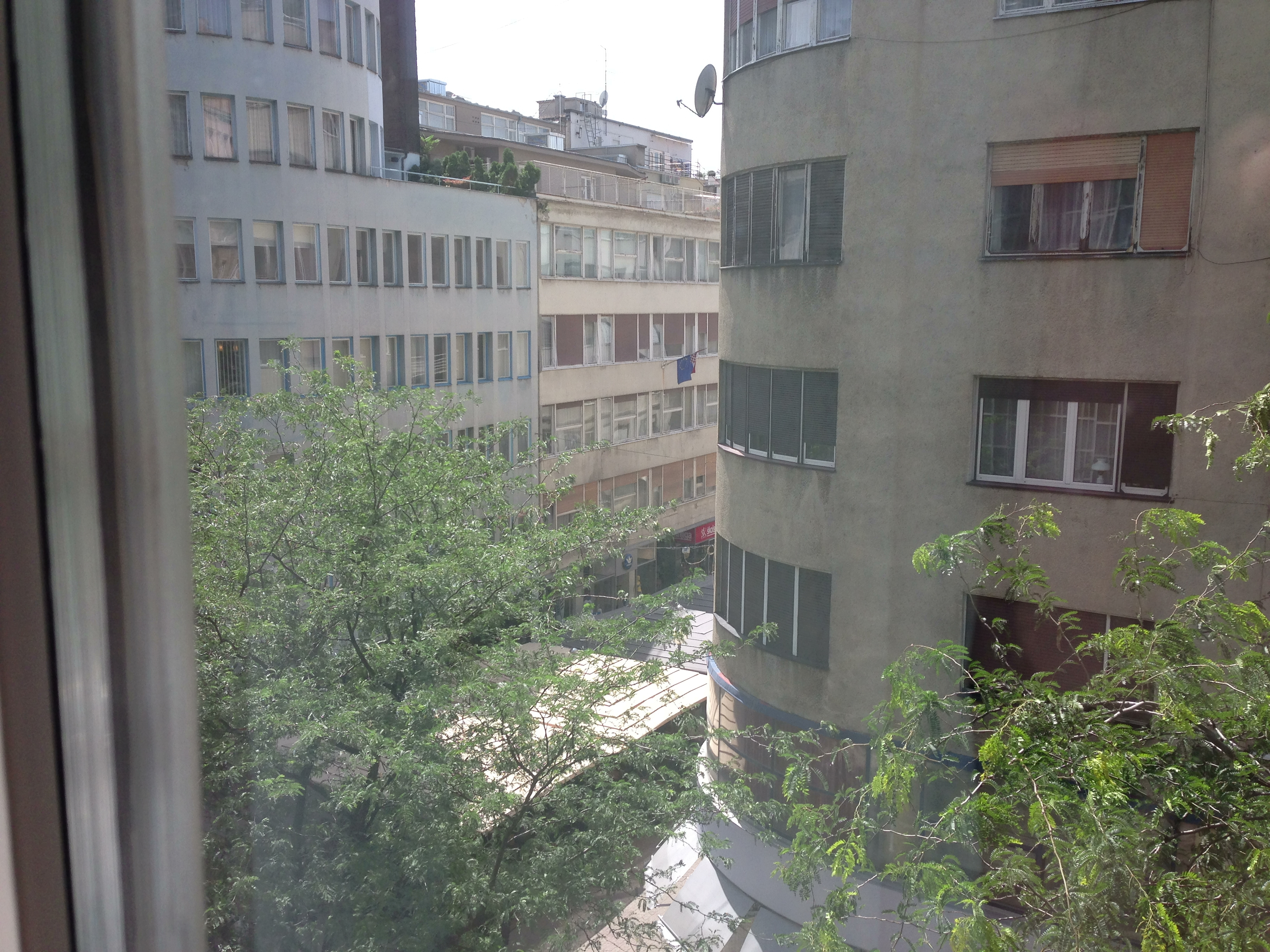
You have until noon on Tuesday to guess it. City and/or state first, then country. Please put the location in the subject heading, along with any description within the email. If no one guesses the exact location, proximity counts.  Be sure to email entries to contest@andrewsullivan.com. Winner gets a free The View From Your Window book or two free gift subscriptions to the Dish. Have at it.

More Friends With Free Will?

Jonathan Schooler surveys research suggesting that belief in free will correlates with desirable personal traits:

Recently we found that a belief in free will is positively correlated with a host of positive attributes (including: self-control, life satisfaction, subjective happiness, mindfulness, and ambition) and negatively correlated with several less desirable traits (such as neuroticism and mind-wandering). Of course, we must be cautious in drawing causal inferences from correlational studies. Nevertheless, these findings are consistent with the view … that a belief in free will affords some positive benefits.

Given these various lines of research, it might be tempting to conclude that a belief in free will makes us better people. However, I think such a blanket conclusion is misguided for a number of reasons.

First, the strengths of the relationships between belief in free will and the assorted positive traits and behaviors reviewed above, though observed in various labs and typically statistically significant, are generally relatively modest. Indeed, some studies have failed to find these relationships at all.

Second, although the bulk of studies investigating the issue have found positive benefits of a belief in free will, there is also evidence that a disbelief in free will has its advantages. For example, a recent set of studies by Sharif and colleagues found that discouraging a belief in free will reduced people’s tendency to punish purely for the sake of vengeance.

Finally, and perhaps most importantly, those who have concluded that a belief in free will is misguided would reasonably cringe at the notion that people who believe in a convenient fiction are “better” than those who have faced up to the reality of the situation.

Chart Of The Day

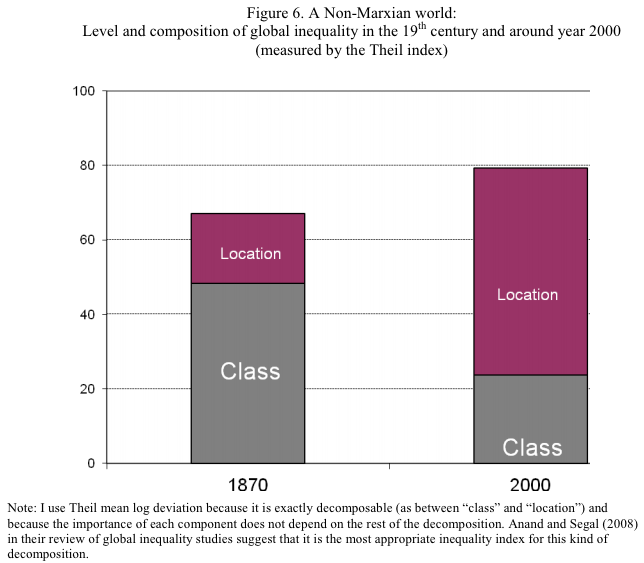
location vs class

Dylan Matthews explains the above chart on global inequality:

[C]lass rank matters far less than location in determining where someone falls in the global income distribution. That’s a big change from the 19th century, where class rank predominated. [Branko Milanovic, the lead economist at the World Bank’s research group] argues this means we live in a “non-Marxian world,” where the relevant cleavage is not between the proletariat and the owners of capital but between those with the misfortune to be born in poor countries and those with the great fortune not to be. “A proper analysis of global inequality today requires an empirical and mental shift from concerns with class to concerns with location,” he writes. “In other words, a movement ‘from proletarians to migrants.’”

An American Family

Sabrina Rubin Erdeley profiles twin siblings Patterson and Georgia Inman, heirs to the Duke tobacco fortune who will inherit a $1 billion trust fund when they turn 21. A riveting excerpt:

Raised by two drug addicts with virtually unlimited wealth, Georgia and Patterson survived a gilded childhood that was also a horror story of Dickensian neglect and abuse. They were globe-trotting trust-fund babies who snorkeled in Fiji, owned a pet lion cub and considered it normal to bring loose diamonds to elementary school for show and tell.

And yet they also spent their childhoods inhaling freebase fumes, locked in cellars and deadbolted into their bedrooms at night in the secluded Wyoming mountains and on their ancestral South Carolina plantation. While their father spent millions on drug binges and extravagances, the children lived like terrified prisoners, kept at bay by a revolving door of some four dozen nannies and caregivers, underfed, undereducated, scarcely noticed except as objects of wrath.

“We were so fearful. I would hide in cupboards smaller than that,” says Georgia in her Southern-tinged lilt, pointing to a two-foot-tall cabinet in the kitchen of their spacious Park City, Utah, home where the twins, now 15, are reassembling their lives and residing with their mother, a woman who has seen her own share of trouble and who has only recently become a presence in her children’s lives. Patterson anxiously paces across the house’s open floor plan with its panoramic view of snowcapped mountains while he and his sister take turns narrating their harrowing history. Unfailingly polite, earnest and occasionally skittish, the twins radiate a sheltered naiveté that can make them seem far younger, or like visitors from another culture. For instance, Georgia confesses she’s never heard of the children’s party game musical chairs.

“What is it?” she asks, her eyes wide and curious. “No, really, tell me!”

Such frank sweetness, delivered in their mushy drawl, tends to take the edge off some of the harsh and surprising things they will say in the coming days, as when Georgia wistfully recalls her toddler years: “I remember walking to my dad’s room and holding a gun to his head. I don’t know what stopped me,” she says before bursting into giggles. “I’m sorry, that’s terrible, I laugh when I’m nervous or upset.”