Not Just For Valley Girls Anymore

Paula Marantz Cohen defends the use of “like”:

“Like” is a comfort word in some respects. It gives those who are tentative or unsure a chance to sidle into a point. It is a marker for uncertainty: “I, like, think I’m going to, like, go to medical school, only, like, I’m not really sure.” That’s qualification with a vengeance, but, then, the subject—whether to spend years in medical school followed by a career ministering to the sick—warrants such uncertainty.

“Like” is also a way to diminish or cushion the force of an idea or to acknowledge an approximation of meaning. One’s first inclination is to be annoyed that the speaker has not found a more precise word. But the right word may not exist, and the approximate word, softened or qualified by “like,” may be more precise. I used the word a while back in my course on Paradise Lost: “The thing you have to realize with Milton is that even if you don’t, like, ‘believe,’ there is a wealth of profound observation about human relationships in the poem.” Here, “like” gives the listener a bit of latitude in how to understand “believe.” It also opens up the idea of belief in a way I felt was helpful. For some, it might seem I was being sarcastic, for others that I was simply acknowledging their probable uncertainty about their own belief or the difficulty of pinning down what belief actually consists of.

The Burka Avenger

A Pakistani cartoon features a burka-clad heroine:

Burka Avenger stars a girls’ school teacher who dons a burka to combat a cast of Taliban-esque villains with a decidedly conservative view of the appropriate role of women in society (the show contains clear parallels to Malala Yousafzai, the young campaigner for girls’ education in Pakistan who was shot in the head by the Taliban). To fight these nemeses, Jiya, the star of the show, employs a novel form of marshal arts that utilizes only books and pens. The message is clear: The pen is mightier than the sword.

Faiza S. Khan defends the show’s use of a burka:

It goes without saying that forcing women to wear anything is entirely unacceptable. The woman in question, however, is adopting the veil of her own free will, for the express purpose of obscuring her identity. When we ignore the character’s intentions behind willingly adopting a burka (as a disguise), it brings us back to good old-fashioned patriarchy, whereby a woman’s decisions are dwarfed by whatever message her clothing is putting out.

Elias Groll agrees that Jiya’s burka is not a simple symbol of oppression:

Ultimately, the show — in emphasizing the right of girls to an education — is doing something far more subversive with the burka than its critics contend. It’s also important to note that Jiya is not covered by day, and only puts on the burka when she assumes her crime-fighting alter ego. That she does so in a burka while running atop power lines to a sweet theme song seems all the better. Suddenly the woman in the burka has been turned into something altogether different — a pretty great superhero.

M. Sophia Newman suggests that the educational benefits of the show may extend beyond wealthier Pakistanis more likely to own a TV:

[A] 2007 economics study (PDF) documented an upswing in gender equality and education in India after the arrival of cable television. “Introducing cable increases the likelihood of current enrollment for girls by 3.5 percentage points,” the authors wrote, describing a shift over four times larger than the 0.83% increase created by the Pakistani government between 2005 and 2011. … By promoting middle-class values to the Pakistanis who do see the show, “Burka Avenger” might make the show’s tagline a real promise to Pakistan’s Islamist minority: “Don’t mess with the lady in black.”

Second Tongue, Second Life

For writers, learning a new language can be profoundly transformative:

Towards the end of Ray Bradbury’s novel “Fahrenheit 451” the reader comes across something whose significance exceeds the confines of the story. It is the scene where Montague meets the “book people.” In a world where printed texts are banned, they have dedicated their lives to preserving the “great books” of the humankind; each commits a book to memory and spends the whole life reciting it. They are living texts, these people, language incarnated. Apart from the masterpieces that inhabit them, they don’t mean much. Their bodies matter as little as the paper on which a book is printed. In a way, a writer who has changed languages is not very different from these people. In the long run, because of their compulsive preoccupation with linguistic precision and stylistic perfection, a colonization of sorts takes place: language penetrates all the details of that writer’s life, it informs and re-shapes it, it proclaims its dominion over her – it takes over. The writer’s self is now under the occupation of an invading power: her own writing in the new language.

In a certain sense, then, it could be said that in the end you don’t really change languages; the language changes you.

At a deeper, more personal level, writing literature in another language has a distinctly performative dimension: as you do it something happens to you, the language acts upon you. The book you are writing ends up writing you in turn. The result is a “ghostification” of sorts. For to change languages as a writer is to undergo a process of dematerialization: before you know it, you are language more than anything else. One day, suddenly, a certain intuition starts visiting you, namely that you are not made primarily out of flesh anymore, but out of lines and rhymes, of rhetorical strategies and narrative patterns. Just like the “book people,” you don’t mean much apart the texts that inhabit you. More than a man or a woman of flesh and blood, you are now rather a fleshing out of the language itself, a literary project, very much like the books you write. The writer who has changed languages is truly a ghost writer – the only one worthy of the name.

A Poem For Friday

Harlem Holds Vigil For Trayvon Martin

Matthew Kelty is a playwright living in Hawaii whose plays, including “Flood,” “The Clay Pot Bloom,” and “When a Storm Comes” have been performed in New York and regionally. He is currently updating one called “Black and Blue.” Kelty hasn’t published poetry since his college days, but he took pen to paper on the night that the Zimmerman verdict was announced. “The poem was my attempt to translate what I think the country should be feeling–rage and regret at the loss of so many young lives like Trayvon’s–into the words of one sorrowful and vengeful father who’s lost his son.” Here’s “Father”:

Flame. Bring me.
Bring me torches, matches, candles, lanterns:
I can’t see.
Bring me kindling: branches, twigs.
Bring switches like my father used to tan my hide when I’d done wrong.
I want switches to tan hides.

Bring me spruce, pine, dogwood.
Bring me slow-burning oak: I want this fire to last.
Bring me conifers; bring me cones. Bring me rods and cones, eyes,
I want eyes, I can’t see, bring me eyes I can’t see.
Bring me limbs, trunks and limbs, torsos and limbs,
bring me bodies bring me my son’s body, my son my son where is
my son bring me bodies ‘til they bring me my son.
Bring me wood and bark, the bark, the harsh cough of command to
bring me forests, bring me jungles, bring me nations to burn as a
funeral pyre. Burn forests to the ground burn this city to the ground
smoke is everywhere I can’t see
no fire so strong as my son no fire so bright as his face
bring me the past to burn bring me my son for his funeral pyre
my son my son where is my son all I taste is ashes I want ashes I want
my son bring me my son.

Bring me.

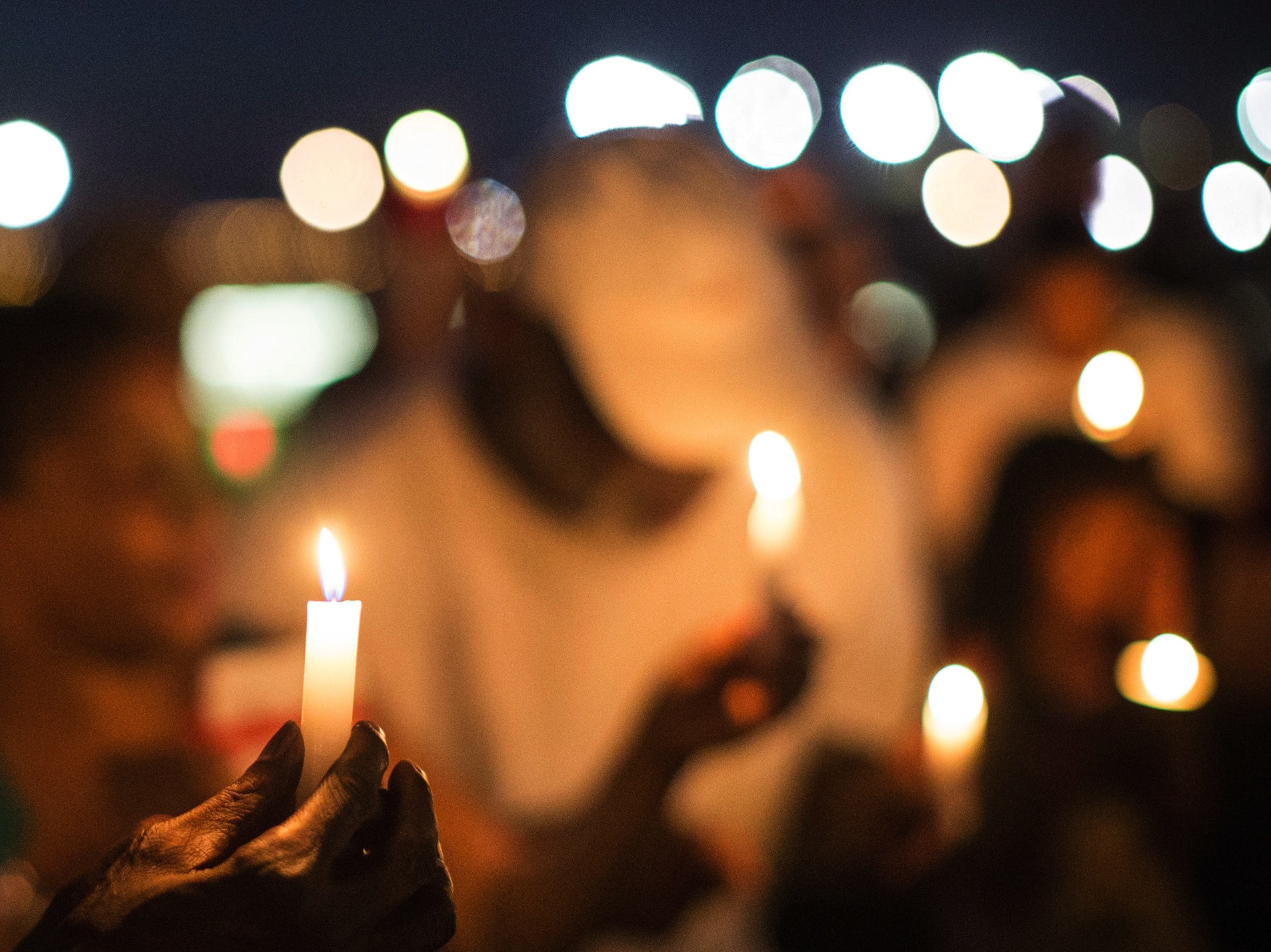
(Photo: Mourners participate in a candlelight vigil for Trayvon Martin on July 15, 2013 in New York City. By Andrew Burton/Getty Images)

Hollywood’s Blacksmith

James McLauchlin profiles California blacksmith Tony Swatton, who keeps Hollywood decked out in arms and armor:

His business, The Sword and the Stone, has been going strong for 25 years, and his services range from knife sharpening, which costs four bucks, to massive armor projects that top $100,000. He’s got no end of work to do, and some years he’ll create more than 1,200 swords alone. … The hook from Hook, the blade from Blade, creepy weapons from the Hellboy movies, Batarangs from Batman Returns and even custom crucifixes from Sons of Anarchy all came from the forge at The Sword and the Stone. All the vikings in Capital One’s “What’s in your wallet?” commercials carried Swatton’s gear, and Rihanna, Katy Perry and Britney Spears have worn his armor in videos. It’s an odd occasion when Swatton’s fingerprints aren’t on something seen in a big-budget flick.

How Best To Challenge Putin? Ctd

A reader writes:

Allow me to think aloud a bit about the question of boycotting the Sochi Olympics or of asking foreign athletes to perform some act of civil disobedience. You wrote in your response to the Dissent of the Day:

The reason this may be the best form of civil disobedience is that it would have the maximum television exposure and therefore the maximum visibility…. It would also be against Olympic rules. But if the issue became one of athletes versus the IOC as much as athletes versus Putin, so much the better. The IOC needs a kick in the ass for its blithe acquiescence to authoritarianism.

This statement raises some interesting questions – about the target of the action and about the goal of the action, and I’m not so sure that they can be collapsed in the way you do above.

If the purpose of any protest, whether boycott or civil disobedience, is to affect Russian society and Russian law, then I’m not sure that the type of civil disobedience by foreign athletes that you and Frank Bruni are advocating would have much effect. The Putin regime is more than prepared to withstand a little global embarrassment. In that sense, a boycott, which has real (if limited) economic effects, might be more effective.

I also think it highly unlikely that Putin would risk a global incident by arresting lots of foreign athletes who perform such acts of civil disobedience, especially when the harm to Russia is so minimal, little more than a public shaming (this is different from the Snowden issue in the sense that it would likely not merely target the U.S.).

On the other hand, Putin might be prepared to retaliate against Russian LGBTQ people and activists in the aftermath of such protests. And Russian nationalists, their national pride harmed, might be likely to act out with even greater violence against Russian LGBTQ. In advocating such acts of civil disobedience (or, for that matter, a boycott), especially from the comfort of afar, one must consider not just the potential risk that the foreign athletes are taking, but also the potential backlash against Russian activists and the degree to which civil disobedience might be counterproductive for the Russian LGBTQ rights movement.

If the purpose of the protest is to expose the hypocrisy of the IOC and the Olympic movement, then it might have more effect. The Olympic movement, as you note, prohibits political expression, but it also takes as one of its core values a commitment to human rights. Waving a rainbow flag during the opening ceremony is thus an act of civil disobedience against the IOC, one that exposes the tension between the stated commitment to human rights and the prohibition on political expression when that political expression is itself a show of commitment to human rights and a protest against the systematic violation of human rights. Such public shaming is likely to have a far greater influence on the IOC than it is on Russia. It could also be a powerful challenge to the IOC, to have it live up to its stated ideals. But, again, is that protest against the IOC worth the potential backlash against the Russian LGBTQ movement that it might trigger?

In making such calls for civil disobedience, I think that we also need to make it clear to the athletes themselves that in doing so they are assuming the risk of punishment – and, according to theories of civil disobedience, must be prepared to accept that punishment. That punishment might come in the form of arrest by Russian authorities. But it might also come in the form of expulsion from the Games or being stripped of their medals.

Finally, I would be interested to hear more Russian voices in this debate. I’m hearing a lot from American, British, German, French LGBTQ rights and human rights activists, but Russian voices seem few and far between. Before we start to advocate protests that are in large part designed to make us feel good, I would hope that we would try to find out what Russian activists want – that is, to truly be their allies.

Thanks for letting me think aloud a bit.
Where E-Books Reign

A study indicates that 70% of Russians now read electronically. But these aren’t Amazon downloads:

According to representatives of Eksmo, Russia’s largest publishing house, up to 95%% of all downloads of ebooks are pirate copies, something at results in the annual losses to the industry of 4 billion rubles (USD $120 million). … According to Andrei Yurchenko, a senior analyst at Pro-books magazine, one of Russia’s leading publishing trade magazines, pirated sites remains popular in Russia resulting from the lack of any real competition from companies that distribute legal content: it is estimated that between 100,000-110,000 titles are available in pirated editions, compared to just 60,000 available legally.

Piotr Kowalczyk notes:

[M]ost Russians read ebooks on a computer or notebook. Tablets occupy the last place on a list (21%), after dedicated e-readers (38%), and smartphones (28%). Tablets taking over e-readers is clearly not a worldwide trend.

Where You Can’t Name Your Kids

A Tennessee judge recently ordered an infant’s name changed from “Messiah” to “Martin.” Eugene Volokh expects the case to be reversed on appeal. Dahlia Lithwick reads the “baby Messiah” case as “a reminder of how much freedom Americans truly enjoy when it comes to naming their children”:

In many Western democracies, it’s not at all unusual for a judge to weigh in on a baby’s name, if there is reason to believe the child is at risk of bullying or abuse. For starters, in New Zealand you can’t give your child a moniker that might cause offense to a “reasonable” person. “Talula Does The Hula From Hawaii” is perhaps the most famous name that’s been judicially blocked in New Zealand, but so were the rather charming “Fish” and “Chips” (for twins). (“Messiah” was also blocked in New Zealand, for whatever that’s worth.)

Sweden is also notorious for its strict baby naming laws, famously blocking the names “Metallica,” “IKEA,” and “Veranda,” as well as “Brfxxccxxmnpcccclllmmnprxvclmnckssqlbb11116” (pronounced “Albin”).

In Norway they tossed a woman in jail for two days for naming her son “Gesher” (which means “Bridge” in Hebrew) after it appeared to her in a dream. In Denmark, parents must select from one of 7,000 or so names pre-approved by the government, with room to appeal for special circumstances. Ditto for Iceland, where a teen is suing the government to reinstate her name, which means, benignly, “Light Breeze.” …

In short, the notion that judges can intercede to change a baby’s name in order to protect her from bad consequences later in life may shock the heck out of Americans but it is remarkably common worldwide.

Keli Goff notes that – contra Louis C.K. – America actually has several laws regulating baby names:

But such laws (pdf) are regulated by the state, not at the federal level, and there is absolutely no continuity regarding what is and is not allowed. “Some states restrict things like obscenities, numerals, pictograms and/or diacritical marks. Other states impose no prohibitions at all,” [attorney Lawrence Walters] said. Louisiana and Tennessee require that the father’s last name be listed as the surname of the child if a couple is married. Iowa and Massachusetts limit how long names can be. Connecticut and Kentucky have no restrictions, while New Jersey prohibits numerals. It is worth noting that no states restrict names on the basis of meaning. So in New Jersey, where little Hitler lives, his parents would have been restricted from naming him “8,” but “Hitler” is OK.

Should A Computer Grade Essays?

The advent of essay-grading software has some educators upset, but Anya Kamenetz thinks its weaknesses can be turned into strengths:

One great assignment would be for students to follow the work of Les Perelman, a retired writing professor and longtime critic of automated grading, who excels in producing nonsensical essays that fool the algorithms. “In today’s society, college is ambiguous. We need it to live, but we also need it to love. Moreover, without college most of the world’s learning would be egregious,” read one of his essays in part that earned a perfect score from the computer. Spotting the logical holes in writing that only appears to be erudite, not to mention the “compositions” of spambots, is a key task of the modern world.

Read Perelman’s full essay here.