Introducing The Snowden Prize! Ctd

A reader writes:

Rewards to whistleblowers who report fraud against the government?  That’s what I do; I’m an attorney specializing in representing whistleblowers under the federal False Claims Act.  The FCA allows private citizens to bring a lawsuit on behalf of the federal government against those who commit fraud against government programs – Medicare fraud, defense program fraud, and many more.  The Act makes defendants liable for triple the actual damages and – critically – provides that the whistleblowers who bring successful cases can be awarded 15-30% of the amount recovered.

According to the organization Taxpayers Against Fraud, since 1987, False Claims Act lawsuits have resulted in recovery of over $40 billion from fraudfeasors.  The False Claims Act is a critical piece of combating waste, fraud and abuse in government contracting and grants, and has generally enjoyed bipartisan support in Congress.  Many states have their own false claims acts, modeled after the federal act.

The federal government has more recently enacted other whistleblower reward programs (tax fraud and securities law, for example).

Unfortunately, the procedures for these programs, including provisions for the protection, involvement, and payment of whistleblowers, are not as strong, and they have not (yet) been as effective as the FCA.  There are many reasons these newer laws depart from the proven model of the FCA, but much of it has to do with successful lobbying by large corporate defendants, who work to demonize whistleblowers they label as “opportunistic,” and the lawyers who represent them. Never mind that the FCA has strong provisions to bar claims brought by me-too whistleblowers who don’t bring anything new to the table, once the boogeyman of “Plaintiffs’ Lawyers” has been identified, some lawmakers are scared off.

I should add, government employees are generally barred from acting as whistleblowers and receiving rewards under the FCA with respect to fraud they discover in the course of performing their official duties.  Why?  Because we’re already paying them to discover and stop fraud.

The FCA does not, however, help the Snowdens of the world, because he is not reporting monetary losses.  However, the FCA clearly teaches that financial incentives matter.  As Taxpayers Against Fraud puts it:

Incentivized whistleblower laws work because whistleblowers bring hidden information to the government’s attention and their lawyers act as ‘force multipliers’ when cases are investigated and prosecuted.  Because successful whistleblowers [under the FCA] are awarded 10 to 30 percent of the sum recovered, whistleblowers and their lawyers are incentivized to investigate frauds in a timely manner, to find as much fraud as possible, and to present evidence of fraud to the government in way in which it can be easily understood and prosecuted.
Egypt Is Erupting Again

The Best Of The Dish Today

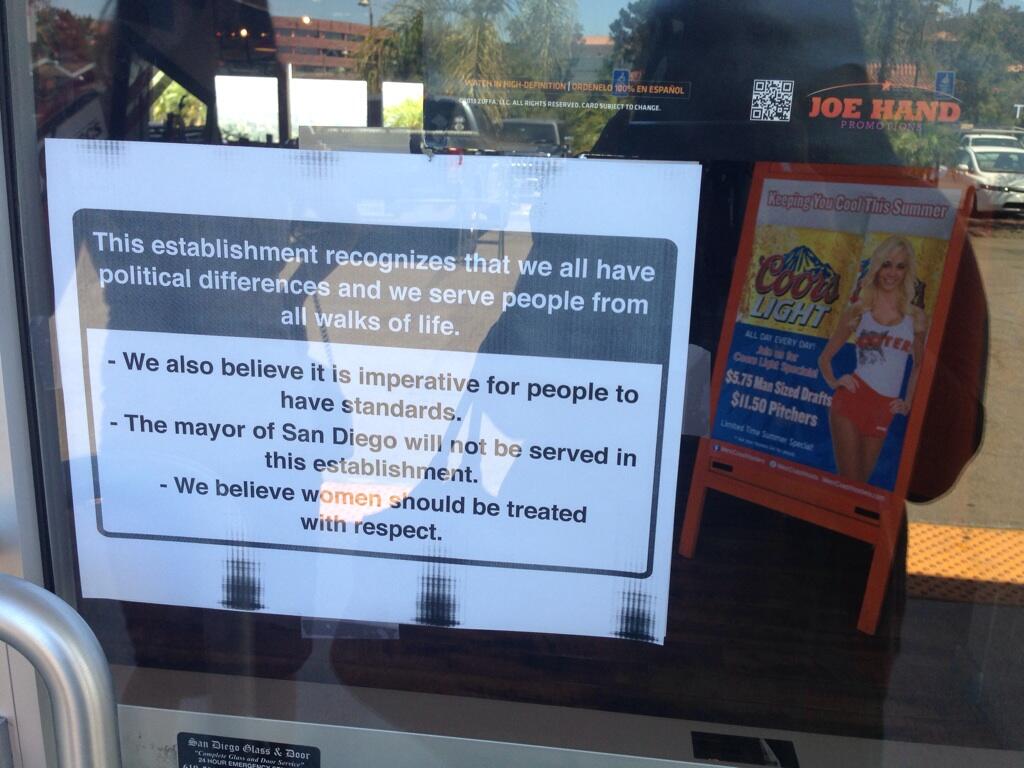
BRkl0I9CAAEtCFS.jpg_large

Good for Hooters!

And good for Glenn Greenwald and good for Elon Musk and his Hyperloop.

Here’s my take on the latest paranoid fantasy concocted by the modern Republican right – that FDR was Stalin’s handmaiden as Obama is the Muslim Brotherhood’s. And here’s my criticism of some feminists’ view of the roots of rape, and my small common ground with Richard Dawkins on Islam.

The plight of rhinos here; and old horses here. Reflections on the West’s treatment of animals here.

The most popular post of the day remained my critique of Maureen Dowd’s critique of Obama; the second most popular was my celebration of the blogger amidst the monkeys.

I hear Anthony Weiner kicked ass in the mayoral debate tonight … but I will see you in the morning.

No Sacred Cows

In a long essay on the ethics of eating animals, Namit Arora explains the intellectual and cultural backdrop to the West’s comparative indifference and even cruelty to the creatures we raise for food:

What might have arrested this decline in the fortunes of farm animals are big cultural ideas, both religious and secular, that for whatever reasons opposed killing animals. But those did not arise in the West as they did, for example, in India. Depending on whom you ask, Western monotheistic religions, while seeing humankind as God’s special creation, ranged in attitude from passive disaffection to active malice towards animals. Christian doctrine has practically no injunctions against treating animals as a means to human ends, so no sin is committed when mistreating or killing animals. Rather, animals were declared vastly inferior, incapable of possessing souls, and created for the use of humans, who stood right below the angels. And so Western monotheisms have long seen animals as dispensable for human interests, desires, and whims. (This is also true for the “Confucian zone” of East Asia.)

In the modern age, even secular humanism, with its nearly exclusive focus on humans, has shown little regard for the treatment of animals.

“In the West,” writes Mary Midgley in Animals and Why They Matter (1998), “both the religious and the secular moral traditions have, till lately, scarcely attended to any non-human species.” With notable exceptions like Jacques Rousseau, Jeremy Bentham, Arthur Schopenhauer, and contemporary animal welfare organizations like the Society for the Prevention of Cruelty to Animals (SPCA), the dominant strands of Western culture have remained heavily invested in denying moral consideration to animals. Rather conveniently, animals are presumed to lack feelings, thoughts, emotions, memory, reason, intelligence, sense of time, language, consciousness, or autonomy. Until the 1980s scientists entertained the idea that animals do not feel pain. Such self-serving presumptions, enabled by our estrangement from farm animals, certainly made our consciences rest easier. This helps explain why the animal rights movement focuses so hard on demonstrating many of these capacities in animals (sometimes overstating their case). So tenacious can our habits of life and mind be that even today, despite everything we know and the genuine alternatives we have for a nutritious diet, less than 1 percent of U.S. adults have turned away from factory-farmed meat for ethical reasons.

Face Of The Day

Ultra-Orthodox Jews Protest Against The Construction Of New Housing

An Ultra-Orthodox Jewish man argues with a security man during a demonstration on August 13, 2013 in Beit Shemesh, Israel. Around a hundred Jews protested against the construction of a new housing unit on the site they believe will be located on ancient Jewish graves. By Lior Mizrahi/Getty Images. Update from a reader:

Any chance you would post something like this: Abbas celebrates with murders? Didn’t think so.

Don’t Lose Sleep Over Sleepovers

Henry Alford recently pondered (NYT) whether parents should allow their teenagers to have sleepovers with significant others:

Susan Merrill, a painter in Stockbridge, Mass., who has three children now 18 or older, said of herself and her husband: “We want to meet the boy or girlfriend. We would love to take them out to dinner with our child. We tell our child: ‘Here are the rules. This is our house, and while you are welcome to have a friend stay the night, we expect you to consider sex to be a private, two-person activity. That means you go to bed when we do, you get up when we do, and if you are really well behaved, we’ll make you pancakes for breakfast. We do not want to be involved in any way in your sex life. We don’t want to hear it. We don’t want to see it. We expect you to wash your sheets and towels. In other words, we expect you to behave like good guests.’ ”

This setup strikes me as fairly ideal: a well-mixed cocktail of caution and tolerance with a possible pancake chaser.

Amanda Marcotte advises we look to the Dutch:

Sleepovers have been normalized in the Netherlands for decades now, and as social scientist Amy Schalet’s research suggests, the results have been generally positive. By demonstrating acceptance and respect for their kids’ relationships, Dutch parents, on average, enjoy more communication with their kids about sex and relationships than American parents do, which in turn means the kids are more likely to get the health care and education they need to prevent STIs and unwanted pregnancy. Oh, and the teenage pregnancy rate in the Netherlands is nearly four times lower than ours.

The women at The Cut debate the issue further.

Art Imitating Lifeforms

Artist Theo Jansen creates creatures out of plastic yellow tubes, as the above video illustrates:

I make skeletons that are able to walk on the wind, so they don’t have to eat. Over time, these skeletons have become increasingly better at surviving the elements such as storm and water and eventually I want to put these animals out in herds on the beaches, so they will live their own lives.

Alva Noë considers a question raised by these “strandbeests”: What is life?

Jansen’s intuition is that life is tied to problem-solving, to coping with basic tasks necessary for living. In the case of the beach beasts, this means letting the winds carry you along without being destroyed by their forces, navigating the shore without getting sucked into the water. Every change Jansen introduces to their design and function is a direct response to these real survival challenges. The result of this evolutionary process is, or would finally be, autonomy. …

Is it right that life is tied in this way to autonomy and problem-solving, to self-sustaining activity? Are living beings just machines that, within limits, can keep themselves up and running? Is the difference between Jansen’s strandbeests as they exist today and their descendants that might someday patrol the coasts of Holland just a matter of degree? Or is life qualitatively different?

The Original Kids Menu

It wasn’t very appetizing:

The earliest children’s menus didn’t look so different from the playful ones we know today. The Waldorf-Astoria put Little Jack Horner on the cover of their pink-and-cream booklet; as he brandishes his plummy thumb, a dish runs away with a spoon. But then there was the food—the bland, practically monastic food, appearing all the more austere for the teddy bear picnic taking place overleaf. Here was flaked chicken over boiled rice; here were mixed green vegetables in butter; here was a splat of prune whip. And the one dish that appeared without exception—the chicken nugget of the Jazz Age—was a plain broiled lamb chop.

Kottke sighs:

I hate kid’s menus. Our kids would happily order off the main menu but as soon as the promise of hot dogs and chicken fingers arrives with crayons, it’s difficult to steer them away.

The Anti-Hero’s Other Half

William Brennan asserts that Skyler White “is the best character on Breaking Bad“:

Yes, Jesse’s as smart and loveable as a newborn baby dolphin, and Mike seemed at times a vision of what an older, more sympathetic Walt might have been had things gone differently—we sensed his sense of rules and limitations, however deformed it was. But Skyler is the best character on the show because she’s the one who reminds us that it’s necessary to loathe Walt. She is our moral grounding. “People are griping about Skyler White being too much of a killjoy to her meth-cooking, murdering husband?” Vince Gilligan, the show’s creator, said in an interview this March with Vulture. “She’s telling him not to be a murderer and a guy who cooks drugs for kids. How could you have a problem with that?”

Laura Bennett also focuses on Skyler:

The question of likeability for fictional protagonists has always seemed beside the point. The issue, when it comes to assessing fiction, is not whether we like this person but whether we can identify some psychic strain of ourselves refracted through them, however ugly and small.

That’s what makes Tony [Soprano] and Don [Draper], even in their awful selfishness, even as show creators dared viewers to empathize with them, such good protagonists. Walt no longer offers us such complex psychological grist. He is less tortured evildoer than mythic bad guy, his ambition amplified and motives blurred beyond recognition. Instead of a jumble of lethal insecurities and urges he is all monstrous, abstract greed. Hank is a straightforward hero, easy to root for. Jesse is the adorable underdog, running frantically on the hamster wheel of his conscience. But Skyler—brash, self-righteous, unsure of what it means to do the right thing—is a messier case. And even at her least likeable, she is key to what makes this show overall so compelling: its moral prickliness, the way its view of good and evil can seem at once so twisted and so stark.

The Democrats’ Slipping White Support

Enten argues that Obama’s falling polling numbers can’t be blamed on racism:

The greatest fall for Obama isn’t among whites in the south; it’s in the northeast – you know that region that was on the correct side of the Civil War. Obama went from winning northern whites by 10pt in the election to a -12 net approval now. The next greatest drop is in the west where Obama fought to a near-tie in the election, but now has a net approval of nearly -20 among white voters. Close is his 14pt drop in the midwest where Obama’s net approval is now a measly -23pt.

The one place where Obama’s support among whites hasn’t fallen sharply is in the south. Obama’s net approval there is only a statistically insignificant 3pt lower than it was before the election. In other words, it’s likely he completely bottomed out in that region. Lack of white support for Obama hasn’t bottomed out in other regions.

Nate Cohn believes that, unless Democrats win more white Texans, the Lone Star State won’t be turning blue any time soon:

[I]n a state where half of whites are evangelicals, there’s only so much room for Democrats to improve—at least if they keep nominating progressives.

The point isn’t that Democrats can’t do better among Texas whites. Maybe the next wave of young Texans will get more Democratic. Maybe the next wave of migrants will be more Democratic. Maybe Democrats will nominate a relatively conservative southerner. It’s all possible. The point is that they must if they intend to win any time soon. The growing Hispanic share of the population won’t be enough. And so far, there aren’t any signs of Democrats making big inroads among Texas whites. It might come some day, but it hasn’t; and there are plenty of reasons to question whether it will.