Peas In An Ever-Faster Pod? Ctd

Joel Johnson thinks that if anybody can pull off the Hyperloop, visionary Elon Musk can:

SpaceX has shown that commercial spaceflight can improve on launch costs over what NASA can provide through other contractors. Tesla has the first top-rate electric car and has a shot of bringing the technology mainstream. Even PayPal, as annoying as it may be from time to time, is something I use at least once a month without complaint. Musk has proven that he’s not just some more-clever-than-thou daydreamer, but a man who’s willing to bet real money on real projects, to get his hands dirty proving these entrenched systems can be changed. …

We should be cheering [him] on. We need innovation in this country that goes beyond squeezing a few more profits out of the status quo by ignoring the looming energy and environmental crises. American engineering was never just about refinement of others’ ideas: It was about proving that the old world could be left behind, that audacious marvels could become everyday conveniences by only embracing them and their inventors.

Where Are Egypt’s Liberals?

Steven A. Cook calls for the country’s liberal camp to “wake up,” since they don’t appear to be organizing in the post-Morsi power vacuum:

The Muslim Brotherhood’s egregious mistake and the military’s intervention have for better or worse given the groups that did not do well during the 2011-12 parliamentary elections a new opportunity at the ballot box.  There is no evidence that they are doing anything about this new lease on life provided courtesy of the Egyptian armed forces.  It’s entirely unclear if anyone on the non-religious end of the political spectrum is doing any political work or merely relying on the fact that the Brothers so botched their time in office that they will be a non-factor in politics for some time.  Maybe. Their supporters seem highly motivated.  Even if the Brotherhood says now that it will not legitimate the political process resulting from a coup, or the military makes good on its promise to clear the area around the Rabaa al Adawiya mosque, who knows what will happen in six or nine months.

The fact that some revolutionary groups and democracy activists, who claim to be liberal, have made common cause with remnants of the old regime and the military undermines their claims to be democratic.  It also makes them—if they are not careful—potential pawns in a game that anti-revolutionary forces are playing aimed at restoring some semblance of the old order.

Max Fisher is disturbed by the support liberals are lending to the brutal military crackdowns on pro-Brotherhood protests:

To me, the movement is starting to look less driven by liberalism than by secular nationalism, hardly a force unique to Egypt but one that has a deep history here, including under Mubarak’s reign. Many have pointed to parallels with the rise of Egypt’s first nationalist military leader, Gamal Abdel Nasser, in the 1950s. Vendors in liberal-dominated protest areas of Cairo have been selling posters of the new military ruler, General Abdel Fata el-Sissi, alongside posters of Nasser and his successor Anwar Sadat (but not of Sadat’s successor, Mubarak; maybe it’s still too soon). The world has something of an ugly history with nationalist movements that celebrate autocratic military rulers and back state violence against fellow citizens, so people are naturally worried.

Is Driving With A Cell Phone Really That Dangerous? Ctd

A reader writes:

One study from one guy done during one off-peak driving time of the day and you have a reader that responds “At last!”?  My guess is this is somebody who uses their phone while in the car on a regular basis, feels more than a bit defensive about it, and is grasping onto this one straw to justify their behavior. There have been plenty of studies showing an decrease in attentiveness and driving ability from cell phone usage. Regular handset usage is worse than driving over the legal alcohol limit of 0.08% and texting is much worse.

Here are a handful of articles in the CS Monitor about some of the problems. Before reading too much into a single study, it’s best to review all of the other studies out there.

Another piles on:

Here’s an article on a study done back in 2003 that showed that drivers on a cellphone were more distracted than those who were legally drunk.  And this was done even before the advent of widespread texting. Money quote:

Drivers talking on cell phones were 18 percent slower to react to brake lights, the new study found. In a minor bright note, they also kept a 12 percent greater following distance. But they also took 17 percent longer to regain the speed they lost when they braked. That frustrates everyone.

Another chips in:

I know this study doesn’t include drivers specifically, but the awareness level of pedestrians who were just walking and talking on a cell phone was startling low.  Even if cell phone distractions aren’t causing wrecks specifically, I don’t believe that a driver using a cell phone in any fashion isn’t distracted.

One more:

Your reader suggests that cell phone distraction is offset by the attentiveness increase in performing an activity.  Here’s a perfect solution: Drive Stick.  It certainly keeps me more attentive when I drive, and I challenge anyone to text while driving stick in traffic.

Driving is a skill, and it should be honed daily.  You wouldn’t talk on the phone while you’re practicing the piano, would you?

So It Goes

vonn

Last week, Amazon announced plans to publish Vonnegut-inspired fan fiction. Matthew Kahn parses the ironies of the enterprise:

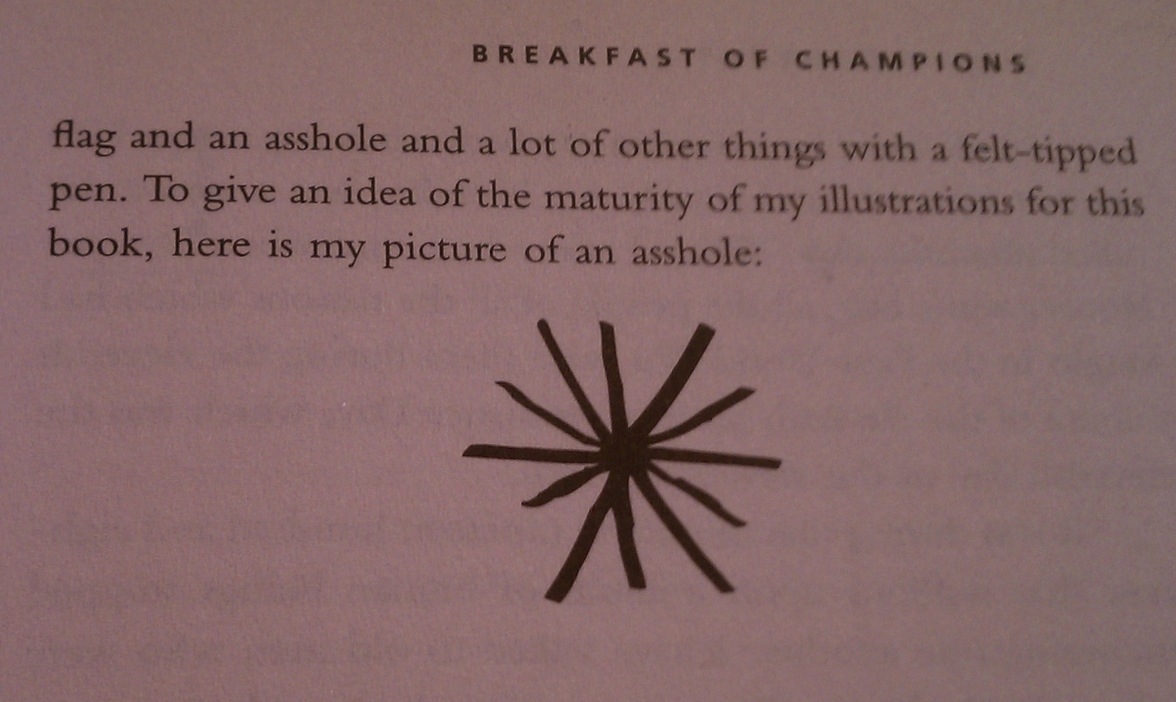
In case you were wondering, here are the rules for the Vonnegut fan fiction project. Pretty much anything the man ever wrote would be prohibited under these rules. One rule is: “We don’t accept offensive content, including but not limited to racial slurs, excessively graphic or violent material, or excessive use of foul language.” This is a man who has a story called “The Big Space Fuck.” … Vonnegut’s books have been burned because people have found the content offensive! His novels frequently end with the protagonist committing suicide! He routinely draws assholes in his books! And what counts as offensive content? He writes about World War 2. One of his novel’s main characters is a Nazi propagandist. Try that without risking offending anybody.

Rob Bricken adds:

In theory, the idea is solid, and as I mentioned when Amazon first announced the service, it’s a great way to bring fans and a franchise together and make everybody a bit of money at the same time. But Kurt Vonnegut? FUCK AND NO. The man is one of America’s literary icons. To allow fan fiction based on his work is a disgrace to it, because while someone might write a Vampire Diaries story as good as the original Vampire Diaries author, there is no goddamned way anyone is going to write a story starring Kurt Vonnegut’s characters as well as Vonnegut did.

(Photo from Breakfast of Champions by David Press)

Must We Kill Healthy Horses?

James McWilliams claims, contra the GAO, that the horse slaughter ban hasn’t increased horse abuse. From his conclusion:

Despite the report’s suggestion that the need for local slaughterhouses is an urgent matter, the GAO fails to note something quite extraordinary about the situation: Only about one percent of existing domestic horses are slaughtered every year. Ninety-two percent of that one percent, according to Temple Grandin, are healthy and devoid of behavioral problems. They’re bucking horses that won’t buck and racehorses that won’t win and quarter horses that nobody is buying from breeders because hay prices are too high. The only thing that’s urgent in this entire scenario is the desire to profit from sending these healthy horses to slaughter.

Horse abuse and neglect is a small problem that got smaller with the closure of slaughterhouses. The GAO—and the slaughter lobby it seems to represent—falsely presents it as a large problem getting larger.

Previous Dish on horse slaughter herehere, and here.

Memes 101

dish_whohath

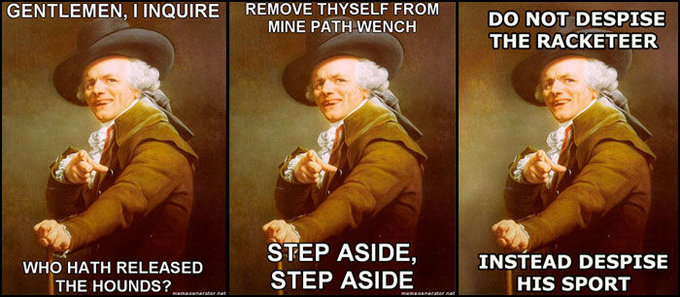
Jessica Love deconstructs the image macro, or the captioned images that pervade the Internet:

As with most games, there are rules. Some image macros—those built around the sarcastic catchphrase Cool Story, Bro come immediately to mind—should only be posted in specific contexts, such as in response to a previous contribution that was overly long and personal.

Captions, on the other hand, tend to be generated according to templates that dictate how words are spelled (the vs. teh vs. th), how they are pronounced (Oh my God vs. O.M.G. vs. ermahgerd), and how they are strung together. Consider, for instance, one image macro series built around the self-portrait of 18th-century painter Joseph Ducreux. Here, captions are composed of modern-day rap lyrics translated into faux-formal, old-timey English (Gentlemen, I inquire: Who hath released the hounds?).

She notes that memes are “creeping offline”:

The Internet slang phrase “nom nom nom” can now be heard around the technophobe’s dinner table; what will be next to make the jump? Perhaps the use of –fag as a suffix? Brennan explains that the suffix was coined on the image-posting board 4chan in 2007 as an equal-opportunity descriptor: there were newfags who were new to the forum (and thus looked down upon), but also oldfags and musicfags and artfags. “Despite the homophobia and hate associated with the suffix, it’s been adopted and used as an identifier within some communities,” she tells me.

(Image from Know Your Meme)

The NSA Warns Of Big Data

Shane Harris has details:

The doomsday thinkers over at DARPA [Defense Advanced Research Projects Agency] are looking for researchers to “investigate the national security threat posed by public data available either for purchase or through open sources.” The question is, could a determined data miner use only publicly available information — culled from Web pages and social media or from a consumer data broker — to cause “nation-state type effects.” Forget identify theft. DARPA appears to be talking about outing undercover intelligence officers; revealing military war plans; giving hackers a playbook for taking down a bank; or creating maps of sensitive government facilities.

The irony is delicious. At the time government officials are assuring Americans they have nothing to fear from the National Security Agency poring through their personal records, the military is worried that Russia or al Qaeda is going to wreak nationwide havoc after combing through people’s personal records.

Update from a reader:

A few points of information/correction:

– DARPA is not the NSA.

– Open-source and commercially-available data are not the same as (ostensibly) private “personal records” such as phone call metadata, emails, and chat contents.

– Government officials aren’t “assuring Americans they have nothing to fear from the NSA poring through their personal records”; they are trying to assure Americans that they don’t pore through their personal records, but instead that they (merely) collect lots of personal records to make it easier to identify which (supposedly tiny) fraction of records to pore over, and to make it feasible to do so quickly. Perhaps a distinction without a difference, but that’s precisely the crux of the controversy, IMHO.

In addition, the structure of the story here (such as it is) is parallel to the government saying “we need military weapons systems to protect you, but military weapons systems may be dangerous in the wrong hands.” You may disagree with their logic or the content of their assertions, but I don’t see any irony there.

The Rise Of Tornado Chasing

Sam Anderson looks into it:

The tradition goes back at least to Benjamin Franklin, who chased twisters on horseback, watching them chew paths through virgin Colonial forest. In the 20th century, aided by cars and cameras, the pastime exploded in popularity and eventually – with the invention of portable video cameras and satellite links – became a full-time profession. In the old days, [Oklahoma City meteorologist Gary] England had to bribe reporters with beer to get decent storm footage. (England himself, having grown up surrounded by storms, prefers to stay in the studio.)

Now the footage is everywhere, all the time, on the networks and cable and YouTube. When serious weather starts bubbling up over the Great Plains, the roads become clogged with hundreds of cars – students, journalists, mercenaries, even tour groups, all competing for the most incredible footage. Greg Carbin, a meteorologist at the National Weather Service, told me, half seriously, that he would like to see the largely unpopulated area of western Kansas set aside as Storm Chaser National Park, where all the adrenaline junkies could drive around freely, at their own risk, without getting in the way of residents or emergency vehicles.

Why Haven’t More Muslims Won The Nobel Prize? Ctd

Sharia Law in Pakistan's Swat Valley and North-West Frontier Province

Last week, as the Dish noted, Dawkins caused an uproar by tweeting: “All the world’s Muslims have fewer Nobel Prizes than Trinity College, Cambridge. They did great things in the Middle Ages, though.” Isaac Chotiner mounts a defense of Dawkins:

[T]here is something not quite right with many of the responses to Dawkins. The point he was trying to make, I would assume, is that Islam is a religion which holds back intellectual development, and thus the Nobel Prize count is skewed towards non-Muslim countries. This might be a silly argument in point of fact, but it is perfectly acceptable to make these types of claims. Religions are man-made things. People choose to follow a particular faith. It would be one thing to say that the color of one’s skin sets back one’s intellectual development; Dawkins was (I think) trying to say that a belief system human beings choose to follow has impaired their development. Arguments like this should be not only within the bounds of reasonable debate, but are completely necessary.

I couldn’t agree more. Isaac is rightly tough on Dawkins for tweeting such a grand and foolish generalization. But it would be strange not to consider culture when analyzing any part of the world which is quite clearly lagging in economic, intellectual and social development. Just take a read of the UN reports on the Muslim Arab world and absorb their devastating conclusions about the region. Think of what the Israelis have managed to achieve in a few decades and then look at Egypt’s pathetic record. Of course, this cannot be reduced simply to Islam, which, as Dawkins noted, played a huge role in advancing human civilization a few centuries ago. But to ignore it seems perverse.

Take the simple issue of women’s equality.

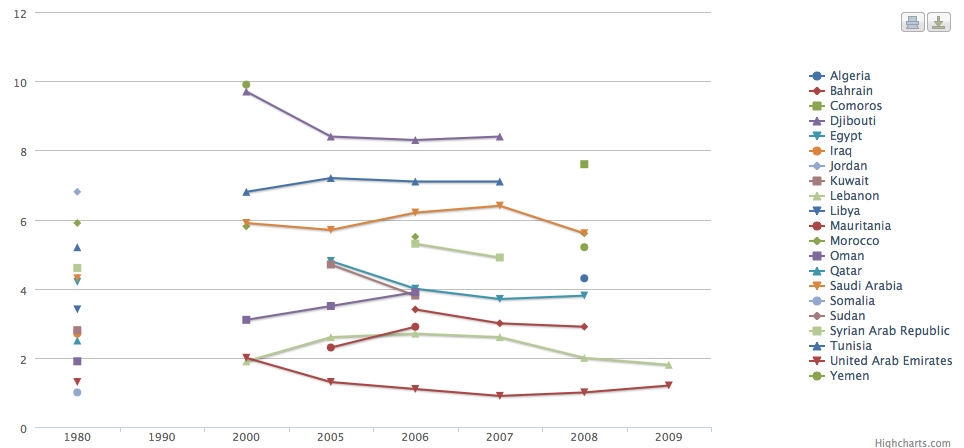
Is there any doubt that a huge amount of the West’s success in past decades has been the final unraveling of female subjugation, unleashing half of humanity’s potential in the process? The places sealed off from that shift are going to be more backward than those who pioneered it. And since Islam in Arabia is critical to sustaining this subordinate role for women, it must be seen, for that reason alone, less intellectually vibrant and economically powerful than the West. Here’s the data on education spending as a proportion of GDP:
Screen Shot 2013-08-13 at 1.53.37 PM

It’s at a low level of low GDP and not going anywhere. And the most important correlation with it is the presence of mothers in the workplace.  And is there any doubt that Islam’s often-rigid subjugation of women is connected to this?

I believe that the West is superior to the Arab Muslim world for this reason alone – as well as many others. And I believe religion has a big role to play in this. I suspect that’s what Dawkins was driving at, in his own glib, bigoted, off-hand way. I cannot stand his approach to these subjects – but I sure find more honesty in what he is saying than in the self-righteous chorus of anti-anti-Islamophobes.

(Photo: Girl students look through the window at the damage in their classroom at Hathier High School, which was bombed on March 22, 2009 by Taliban militants opposed to female education, pictured on March 31, 2009 in Mardan, North-West Frontier Province, Pakistan. By Veronique de Viguerie/Getty Images.)