The Roots Of Rape?

There’s plenty to agree with in Frank Bruni’s column today on ameliorating the culture that leads to disparagement of and aggression toward women. In fact, I’d probably endorse most of the proposals he makes. But, unlike Frank, I don’t believe that masculinity is entirely a cultural construct. Here’s how he puts it:

There are times when I find myself darkly wondering if there’s some ineradicable predatory streak in the male subset of our species. Wrong, Chris Kilmartin told me. It’s not DNA we’re up against; it’s movies, manners and a set of mores, magnified in the worlds of the military and sports, that assign different roles and different worth to men and women. Fix that culture and we can keep women a whole lot safer.

But there is a third option between DNA and culture. It’s called testosterone. It’s a very powerful hormone that makes men men (we are all originally default female embryos) and is the sole real difference between the sexes. And it correlates very strongly with aggression, confidence, pride, and physical strength. There is nothing inherently “dark” about this. Testosterone has fueled a huge amount of human achievement and success as well as over-reach and disaster. And it makes men and women inherently different – something so obvious no one really doubted it until very recently, when the blank-slate left emerged, merging self-righteousness with empirical delusion.

This absolutely doesn’t mean acquiescence to rape or the culture that leads to rape.

That is an extreme and heinously immoral act of violence. Indeed, there’s a great deal of work to be done in creating a dialogue and culture in which the logic of testosterone is challenged constantly. But this used to be done by appealing to male pride, not by suspecting generalized male infamy. The concept of “gentle”-men or “gentlemen” was honed in the last few centuries specifically to encourage such a civilizing cultural climate. And I’d argue that approach will pay far more dividends than the well-intentioned attempts to remake human nature by cultural coercion – because it deploys one the most powerful forces in men, testosterone, against itself. It works with the grain of human nature, rather than assuming that such nature doesn’t really exist and culture is all we need to change.

A man’s self-esteem can be, in some hideous fashion, fed by acts of violence. But it can also be sustained through more open and public recognition of such virtues as courage, confidence and prudent risk-taking and through the critical institution of the family. A spouse channels testosterone to calmer waters; off-spring can bring with them a new sense of manhood if fatherhood is a truly appreciated moral activity. Virtuous institutions – such as you see in the Boy Scouts or at West Point or in the ethos instilled in the US military from George Washington on – are also vital to this. But none of this is possible if we insist on denying reality. Men are not women – and never will be.

A celebration of virtuous masculinity is impossible unless you accept the deep hormonal reality of masculinity itself. And even find much in it to admire.

Peas In An Ever-Faster Pod?

Hyperloop

Yesterday, Elon Musk, founder of SpaceX and co-founder of Tesla, unveiled plans (pdf) for the “Hyperloop,” which could theoretically transport passengers from San Francisco to Los Angeles in 30 minutes. You know: like the opening credits of Futurama. Seriously. Merchant provides the basics:

The Hyperloop is essentially a giant elevated system that hurls aerodynamic rail-riding capsules through an enclosed steel tube at subsonic speeds.

Musk suggests building the system along Interstate 5, and his finalized schematics say that it could move 840 people per hour—that means 30 pods taking 30 trips per hour, one way. The system would be powered by solar arrays that line the top of the tube. According to the plan, the passenger pods will hold 28 people each. They’ll be fired off at a distance so there’s always 23 miles between the last. Propulsion will be provided by linear accelerators that are placed at various points through the tube—the “rail gun” part of Musk’s famous comment that the Hyperloop was part Concorde jet, part rail gun, and part air hockey table.

Karl Smith explains the physics:

The core design problem that all high speed travel faces is what to do about the air the vehicle runs into. Airplanes deal with this by flying at high altitudes where the air is naturally thinner. This is the basic advantage that planes have going for them, as otherwise there is really no reason to speed a lot of energy and effort leaving the ground, only to come back to the ground later. Here on the ground you can try to get ever more aerodynamic designs as the Shanghi bullet trains do, but there is a limit to how effective this can be.

If you want to go faster and faster eventually you are going to have get a tube in which you can actively play with the air pressure. Most designs, including Musk’s Hyperloop, call for lowering the air pressure inside the tube.

Where’s the toilet? Because I’d be shitting myself cruising at sub-sonic speed in a pod. Plumer questions whether Musk’s proposed costs are really plausible:

Consider some of the major factors for why California’s $68 billion high-speed rail system has gone over budget. In many cases, local communities have demanded extra viaducts and tunnels added to the project that weren’t strictly necessary. Other towns, meanwhile, have insisted they not be bypassed even in cases where it would be cheaper to do so. Would the Hyperloop be immune from these sorts of political pressures and tweaks?

What’s more, California’s high-speed rail project has had to grapple with the high costs of acquiring more than 1,100 parcels of land, often from farmers resistant to sell. The Hyperloop would try to minimize this problem by propping the whole system up on pylons, shrinking its footprint, but it can’t escape the land problem entirely. As Alexis Madrigal points out, Musk’s proposal seems to assume it’s possible to buy up tens of thousands of acres in California for a mere $1 billion. That’s awfully optimistic.

Casey Johnston worries about malfunctions:

The proposal states that it would be hard for a capsule to become stranded within the tube, given that it spends most of its time coasting at a high speed (“no propulsion required for more than 90 percent of the journey). If a capsule was truly rendered immobile by its normal means of travel, however, it would use “small onboard electric motors” to power “deployed wheels” so the cabin could roll itself to safety.

It’s difficult not to imagine a partial loss of sanity among passengers who, thinking they’re in for a half-hour journey, suddenly find themselves taking 10 times as long to get there. Hopefully it wouldn’t be a frequent occurrence. The document makes special note that all capsules would be supplied with enough air to support the passengers even for this failure scenario of a suddenly-normal-length trip.

And Hannah Elliott provides highlights from a conference call with Musk.

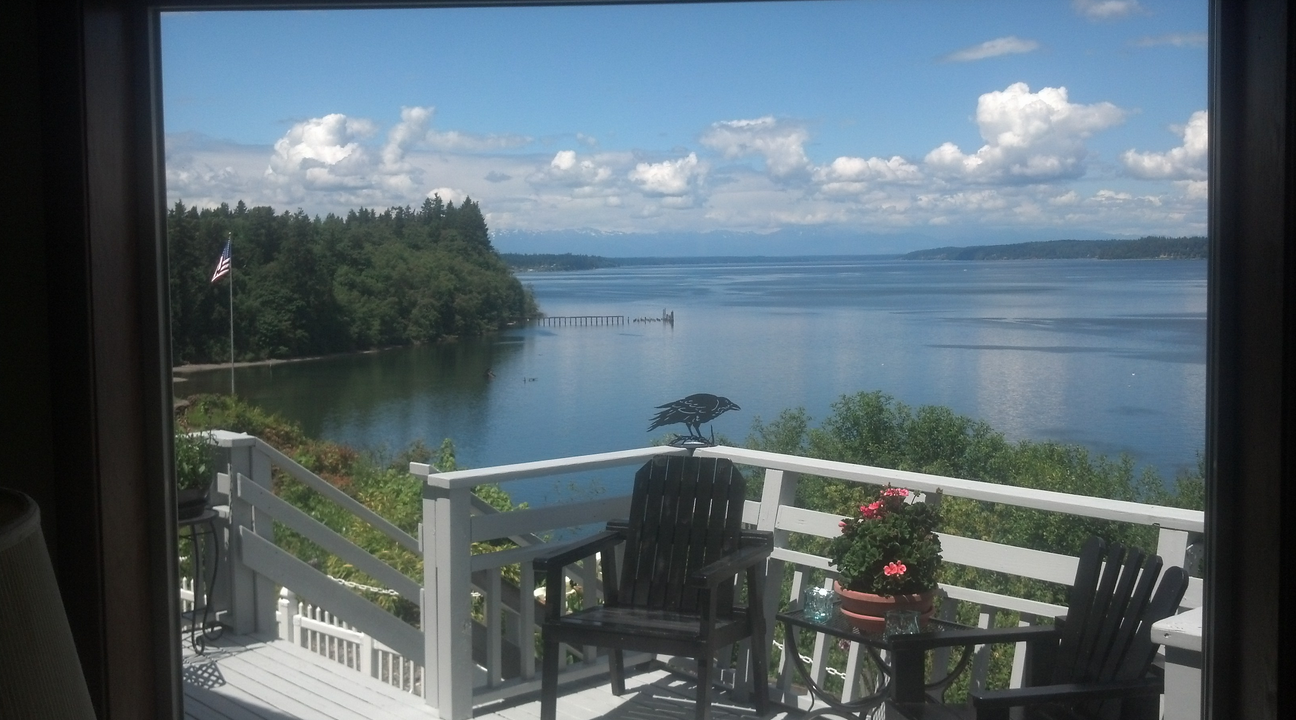
The View From Your Window Contest: Winner #166

vfyw_8-10

A reader writes:

Such a classic-looking American lake photo, especially that flag.  At first was thinking Lake George in the Adirondacks, but the mountains are too big, so I shifted to the Rockies. There is very little development on the lake and peculiarly no boats anywhere, despite being a beautiful day and seemingly temperate time of the year (else there’d be more snow visible).  So I thought of Lake Yellowstone in Wyoming, which may be “protected” to some degree from boat usage, and images of the lake (e.g. this, this) suggest that may well be the case, as they feature the same combination of low altitude forests with high altitude mountains nearby.  There are at least some hotels and restaurants allowed on the lake, and so this photo may have been taken from one of those.

Another’s guess:

Table Rock Lake in Branson, Missouri? My Great Uncle Robert would take us out on the lake when I was a kid. He had a grill on his pontoon boat. The burgers tasted like lighter fluid. Good times.

Another:

This guess honors my brother, who loved boating on Lake Strom Thurmond, Georgia during his posting at nearby Fort Gordon. I’ll guess the military marina.  The area is littered with sites named to honor racists – including Richard Russell State Park and Calhoun Falls Recreation Area – and Lake Strom Thurmond is itself the subject of a naming controversy, as Georgia still refers to the lake as Clarkes Hill Lake.

Another provides a bit of trivia:

Could be anywhere, so this is a wild guess, but it appears to be Lake Mille Lacs in Minnesota.  Ah, but which town? Ummmm, Garrison? Sure. Oh, that’s right, amazing facts must be included: Garrison is the smallest town to have a McDonalds.

Another:

It looks like the Chesapeake Bay to me. It’s too rural to be Baltimore, but the raven statue would seem to mean a Baltimore Ravens fan lives there, so not far from Baltimore. The water seems to be narrowing, so I’ll go with northeast of Baltimore. Looking at the map of the west coast of the bay north of Baltimore, I happen to see … Romney Creek, just north of Bush River. But that is Aberdeen Proving Ground, so the flowers and raven statue are a little too personal. I’ll go with Carroll Island, Middle River, Maryland.

Another:

That looks like Lake Charlevoix, where I spend my summers and the place I’m currently missing desperately as I’m taking a SuperShuttle van from BWI into DC. I’d guess it was taken from a cottage on the north arm of the lake, looking west towards Charlevoix and the channel to Lake Michigan. It could be any number of lakes in Northern Michigan, but the clouds, trees, and shores look just like Charlevoix.

Another:

In the Thousand Islands on the St. Lawrence river, possibly taken from the Canadian side. I’m taking a guess based on two summer vacations there.  The picture makes me want to go again; it’s a beautiful place.

Another:

This could be any of 50,000 places in Minnesota. The lack of development around the shore would suggest it is a place with lots of shoreline available and/or far from the Twin Cities. Swan Lake, halfway between Grand Rapids and Hibbing is as good a place to guess as any.

Another assumes too much:

Mitt Romney’s deck on Lake Winnipesaukee, New Hampshire!

Another gets on the right track:

Well, you threw us a bone with the American flag (unless you’re really sadistic and this is some ex-pat flying a flag in Canada or Norway or Japan or Patagonia). As such, it focuses really quickly on the San Juan islands north of Seattle. Snowy mountains? Check. Ocean-y-looking water? Check. Easily identifiable features? Uh …

It appears to be a view to the west, based on the length and direction of the shadows. Beyond that? Who knows. If you need a tie-breaking decision on the exact location (although I’m sure I’m way off) here’s a link to my approximate guess. I’m sure I’m off by a lot, though.

Another:

I’ve seen an iron raven like that before – unfortunately, it’s on a stick in my wife’s back yard garden.  That might make me think this is an Alaskan scene, but the view seems more Puget Sound or the San Juan Islands than Alaska.  The mountains in the back are almost certainly the Olympics, and the lack of sodden wood in this deck makes me think we are in its rain shadow, so let’s go with Orcas Island (second choice would be somewhere around Port Townsend).  No time to look today … summer is running out.

Another:

It sure looks like my neck of the woods: the San Juan Islands in Washington state. Which island? Not sure. Which inn or window? Again, not sure. I know, I’m kind of worthless. I have a bet with my daughter that before I die, one of my bad answers will appear at the top of the list of wrong guesses. I’ll let you know when I’m on my deathbed, so you can grant me this bucket-list wish.

Too long to wait. Another reader:

I’ve never entered A VFYW contest, because I really, really suck at it. I friggin’ LIVED in Ulaanbaatar, when you had the photo from there. I saw it, thought “hey, that’s UB,” the noticed the trees (of which I think there are two in the whole town) and decided, “nah.”

But here again, I looked at this picture and just KNOW it’s somewhere on the Puget Sound. I grew up in Tacoma, and my father is a scuba instructor, so I have been in every nook and cranny of that place with any kind of claim to a beach. But honestly, I don’t have a clue as to where on the Puget Sound. It does look to be somewhere around the Tacoma area, so I’ll say Gig Harbor, though it could be Poulsbo, Bremerton – who knows? I’m just thrilled to death I recognized the Sound.

Another:

My instant reaction was Puget Sound/Olympic Peninsula/San Juan Islands. We were fortunate to live in the Seattle area for a bit in the early ’80s and there is nothing like seeing the Olympic mountains, or the Cascades, on a clear day.

It took a bit of digging through Google Earth to discover that the mountains in the background were not the Olympics, but the Cascade range, beyond Seattle. The view is from Sinclair Island in the San Juans, looking more or less SSE, with Cypress Island on the right and Guemes Island on the left and center. My best guess, based on lining up the end of the dock, is the house circled below:
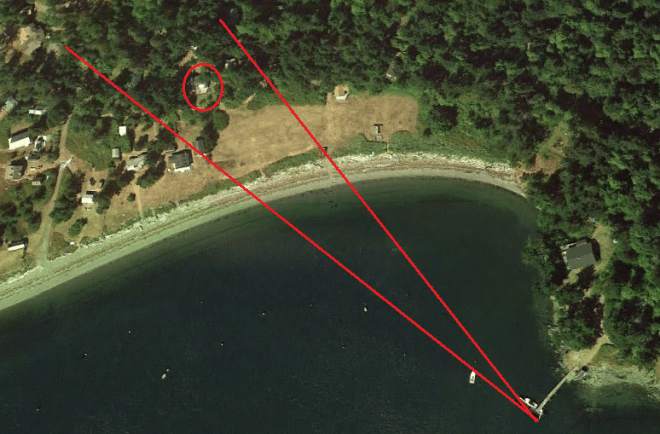
sinclair1

Another:

The proximity to land, decrepit dock and snow on the mountain peaks (the Olympic Mountains) – it is Vashon, Washington. Vashon lies in Puget Sound between Seattle to the north and Tacoma to the south. With access to the mainland only by ferry, Vashon has a remote, country feel while being a 15 minute (or so) ferry ride into the big city. Lots of small farms, artsy types and cars you might see in Havana (meaning old). Here is a NY Times travel piece from last year that captures the place very well. Come visit! Coffee on me at the Burton Coffee Stand at the south end of the island.

Another:

I’d guess looking West up Nisqually Reach towards the Olympic Mountains, maybe from Steilacoom. A view from a free and tolerant state that recently legalized both pot and gay marriage.

Another gets the right city:

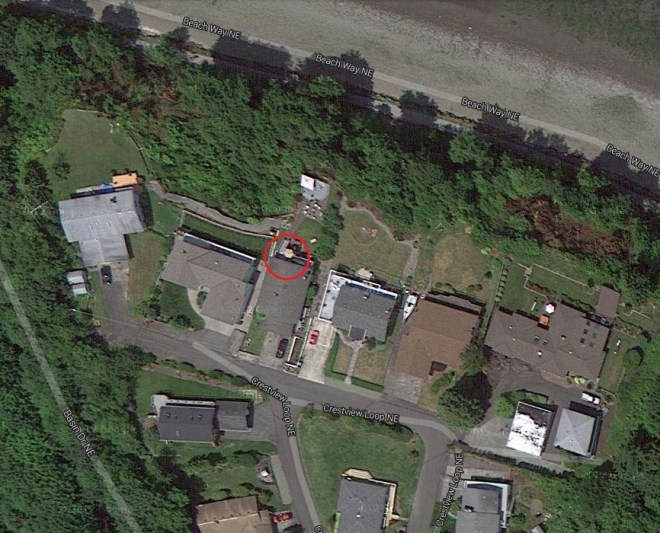
I am hopeful that this is 5538 Marian Drive NE in Olympia, and I’m certain this view is from a home in that neighborhood – just around the corner from the Nisqually Delta in the South Sound. What a nice view. My partner and I moved four months ago from Seattle to a dried out, dusty little farm town in the Oregon Wine Country and we have been really missing the water lately.

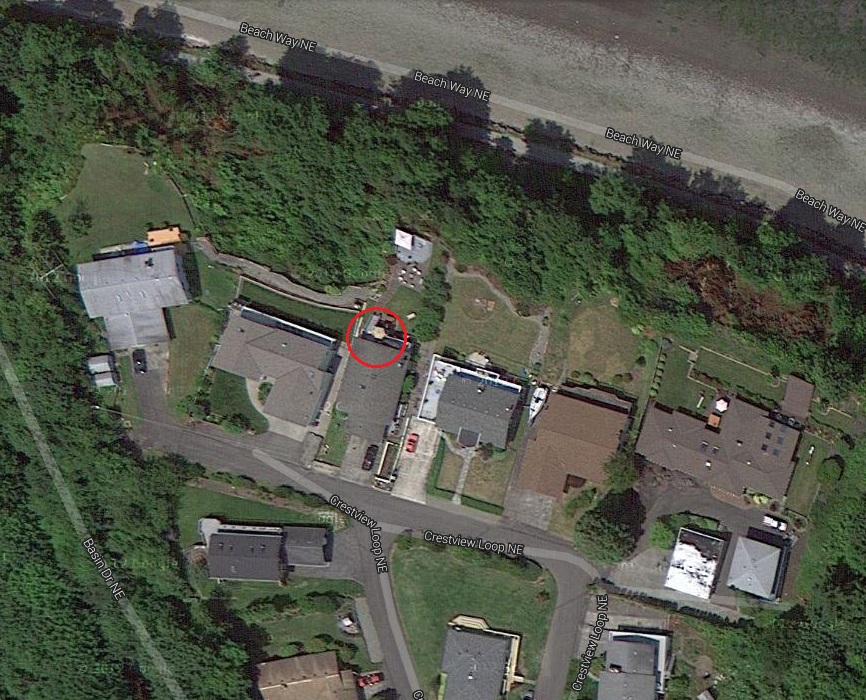
An accurate aerial view from a reader:

VFYW Olympia Aerial Marked - Copy

Another nails the right address in Olympia:

Longtime lurker, first time entrant in the VFYW contest. Whenever a photo is posted on your blog, I hope to see a place I know well or a place I’ve been to. Today’s photo is both for me. In fact, I was just on a ferry today, sailing across the Puget Sound from my home in Seattle to Bremerton to pick up half of a pastured hog. Needless to say, I instantly recognized the locale of today’s photo.

I believe this photo was taken from the living room window of a house located at 5534 Crestview Loop NE in Olympia, WA. The dots in the water that resemble geese are actually the remnants of an old shipwreck. The majestic Olympic mountains are in the background.

BTW, you posted one of my photos in the Weirder Windows category a month or so ago, taken from under a beach umbrella at Priest Lake, Idaho. We’ve just returned from our annual visit. I’m an atheist, but that place is holy.

A correct guesser of a previous difficult view provides a precise visual:
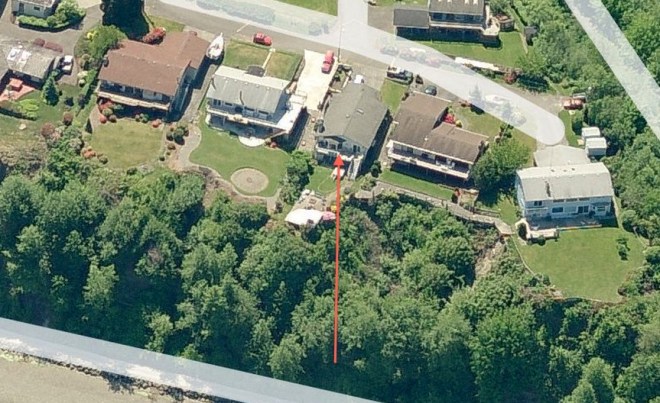
view of 5534 Crestview Loop NE

Answer: The picture was taken from the rear of 5534 Crestview Loop NE, Olympia, WA 98516 looking northwest towards the Olympic Mountains.  The rear of the house seems to have a set of glass doors and a bay with three windows.  I think the contest window is the west most window in the bay (left most when looking out from the house).  Attached are two pictures identifying the window.

The only other “correct guesser” gets more detailed:

One look at this week’s VFYW and I knew it was the USA’s Pacific Northwest.  I’ve never lived there, but I travel there occasionally for work and I love the place.  I so wanted the picture to be in one of my all-time favorite places, the San Juan Islands, but I couldn’t find that dilapidated pier anywhere on Google Maps, so I decided to put a little more thought into my search.

First, the shadows cast by the porch furniture are short, indicating midday.  Since midday shadows point north here, the photo looks northwest.  At the far end of the reach are snow-capped mountains, which looked to me like the Olympic Mountains of Washington.  The area between Olympia and Tacoma has two or three broad saltwater reaches aiming northwest toward the Olympic Mountains, so that’s where I resumed my search for the broken-down pier.  And there it was, on the southern shore of Nisqually Reach, between Butterball Cove and De Wolf Bight, near Lacey, Thurston County, Washington, USA.

The next challenge was determining the location of the window, and I struggled for a while because I focused on the wrong cluster of nearby houses.  A seemingly unimportant item in Google’s satellite image came to my rescue.  Google’s satellite photo shows the skeleton of a sunken boat about 400 meters southeast of the pier.  Sure enough, a few pieces of the wreck are sticking out of the water in the VFYW photo, directly in line with the landward end of the pier.  Drawing a line on the satellite image from the landward end of the pier through the wreck brought me to the correct cluster of houses.

Then, noting the staircase, the neighbor’s white fence, and the hint of a gray gravel path bordered by shrubbery on the other side of that fence, I concluded that the photo was taken from the northern end of the house at 5534 Crestview Loop NE, Olympia/Lacey, Washington, USA 98516.  In case the house number is incorrect (although both Google Maps and MapQuest agree on it), in the lineup of six waterfront homes along Crestview Loop, the VFYW home is the third from the left (West) end.  Furthermore, both Olympia and Lacey seem to be valid city addresses for the location.  I lack the skills to capture a picture with an arrow pointing to the house, so my description will have to suffice.

So far I’ve had a few correct VFYW Contest submissions, but no tie-breaker yet.  As much as I would love to win the book, with this VFYW I don’t care.  I enjoyed being transported back to a place I love.  Even if I lose, I will have been rewarded.

The tie-breaker this week is one of the closest ones ever, between the last two readers cited above. Since they more or less provided equally accurate answers, and since they have both gotten a difficult view in the past without winning, the determining factor has to come down to the total number of contests entered. The last cited reader has entered 9 total contests, but the reader with the visual has entered 14 contests, so he wins the prize this week. Thanks to everyone else for the wonderful entries. See you again on Saturday for the next contest.

But here’s one more impressive entry, from a first-time contestant:
WindowClose

A friend of mine said I should follow up with some details of how I narrowed down the location of this week’s photo. In all the excitement, at first I focused solely on the foreground.  The flag was a give-away for the country, and the chairs and water made me think this was on the east-coast somewhere.  After a little while I noticed that there were large mountains in the background, which immediately made me switch my focus to the Seattle area (I’m from Vancouver so the combination of water, mountains, and evergreen forest suddenly looked very familiar).

I next focused on the direction that the photographer was facing.  Short shadows from the furniture suggested that it was around noon.  The shadows also suggested that the porch faces roughly north, and the photographer was looking north-west.  This reinforced my hunch that it was near Seattle as this is the only place that I could think of in the US where you can face north-west and see large mountains across a large expanse of salt-water surrounded with evergreen forests.  It had to be in Puget Sound looking at the Olympic mountains.

Next I looked at other photos that showed the Olympic mountains from different areas around Seattle to get an idea of how large or small the mountains would appear depending on how far away the photographer was.  This let me know that the photographer could have been as far away as Tacoma.  I next focused on channels in Puget Sound, searching Google Maps along the north-facing shores for a combination of an old broken-down dock and adjacent houses with north facing porches.  After an hour or so of searching, I found a likely dock and house combination.

What really sealed it for me was the fact that there was a shipwreck on a tidal flat directly between the houses and dock – a feature which can be seen in the photo.  Running a ruler from the near end of the dock, over the shipwreck to the houses let me pinpoint a house, which had a back porch with stairs in the same configuration as the photo.  Further confirmation was obtained by comparing the treetops on the shore directly above the dock with street-view images taken from up the road behind the house.  In street-view I could also see that the neighbour house has a white fence with the same fence-post style as the photo, and that the house I pinpointed had a back porch with the same style of railing as the photo.

I hope that’s not too much information!

(Archive)

Obama Begins To Undo The Drug War? Ctd

Holder announced yesterday that the administration will scale back mandatory minimum sentences for non-violent drug offenders:

Kleiman supports the change:

It’s hard to tell from the bare-bones official statement just how much of a difference today’s announcement will make. It doesn’t go as far as I might have gone, by requiring that a prosecutor who wants to ask for more than five years in a case not involving violence specifically justify that decision and have it approved in Washington. But in principle it’s the right thing to do, and the fact that Holder now thinks he can do it safely (unlike the situation with five-year crack mandatory, a problem that also could have been fixed administratively without waiting for legislation) suggests that some aspects of drug policy, and criminal-justice policy more generally, are – slowly and belatedly – recovering from their forty years of agitated delirium.

Waldman adds:

The most important change in the last 20 years is that crime has fallen so dramatically (see here for instance), and in response we’ve seen a real cultural shift. I’m sure there are still politicians who’d love to tar their opponents as soft on crime. But they know it probably wouldn’t work. And that means there’s at least a chance we can make real policy change.

Ilya Somin wants more details on Holder’s new policy:

The key question, it seems to me, is whether the exceptions for defendants who have “significant ties to large-scale gangs or cartels” and those who have a “significant criminal history” are likely to swallow the new rule. How close do ties to a gang or cartel have to be before they qualify as “significant”? Do previous convictions for drug trafficking count as a “significant” criminal history?

How much evidence is enough to conclude that the defendant really does have ties to a gang; is a preponderance of evidence or proof beyond a reasonable doubt required, or is circumstantial evidence going to be enough? In many inner city neighborhoods, a high proportion of all drug offenders probably have at least some ties to gangs or cartels. The nature of illegal markets makes it dangerous and difficult to function within them without such connections.

Jacob Sullum also focuses the new policy’s loopholes:

The practical impact of this change will depend on details such as what Holder means by “no ties to large-scale organizations, gangs, or cartels.” Many marijuana dealers and pretty much all cocaine and heroin dealers arguably would fail that test. According to a memo that Holder sent to U.S. attorneys today, another requirement is “no significant criminal history.” The memo adds that “a significant criminal history will normally be evidenced by three or more criminal history points but may involve fewer or greater depending on the nature of any prior convictions.” In practice, a “significant” criminal history can be quite minor: An offense for which a defendant received a 60-day sentence, for instance, counts as two points, so a New Yorker who is caught with more than seven rounds in his gun after getting busted for “public display” of marijuana may be ineligible for Holder’s mercy.

Plumer breaks down the economic reasons why the DOJ would start liberalizing drug policy:

justice-department-budgetThe rapid growth in federal prisons was putting a serious strain on the Justice Department’s budget. The number of federal inmates has quadrupled since 1980 and now surpasses 218,000. Housing all those prisoners isn’t cheap: The average minimum-security inmate now costs $21,000 a year, while the average high-security inmate costs $33,000 a year.

Add it all up, and the Obama administration had to request $6.9 billion for the Bureau of Prisons in fiscal 2013. That may not sound like much in the context of trillion-dollar deficits. But a recent report (pdf) from the Urban Institute pointed out that if the current rate of incarceration continues, federal prisons will keep taking up a bigger and bigger chunk of the Department of Justice’s budget — rising to 30 percent by 2020 …

Dylan Matthews points out that the new policy will only make a small dent in the prison population:

[T]he federal system isn’t really where the action is. The most recent Bureau of Justice Statistics (BJS) estimates find that there are 1,353,198 people incarcerated at the state level and 217,815 incarcerated federally. So about 13.9 percent of U.S. prisoners are in federal institutions; the other 86.1 percent are in state facilities. And most prisoners at the state level are not there for drug crimes.

And Keith Humphreys suggests another policy change that would further reduce the prison population:

I would rather have sentences determined by people with personal knowledge of individual criminal cases than by elected officials in a faraway city. For that reason I would like to see the Congress endorse even more governmental discretion by restoring parole within the federal prison system, which it abolished in 1984. If we are willing to have correctional officials make judgments about who deserves compassionate early release because of illnesses and family tragedies, then we should be equally willing to let the same officials make judgements about who might be released because they are rehabilitated and unlikely to re-offend.

Dissent Of The Day

BRITAIN-RUSSIA-GAY-PROTEST

A reader writes:

I’m growing quite tired of the calls for gay athletes to lead some sort of civil disobedience in Russia during the Sochi Olympics. Most of these are coming out of members of the press with stars in their eyes, I get that. But I am surprised that you are not more circumspect.

Vladimir Putin is not Bull Connor. The worst gay rights activists in Russia would face is not being sprayed with firehoses and thrown in the county jail for a few days. The Russian prison system has scarcely changed since the days of the old Soviet Gulag. Having spent time in Lithuania, I had the opportunity to talk with people whose relatives were shipped off to Siberia and never heard from again. Asking other people to go over and risk a similar fate while enjoying complete freedom of speech – and a vastly better climate towards gay rights – here in our cushy Western democracy is the very height of irresponsibility. Unless you yourself are willing to board a plane wearing a rainbow t-shirt and face the possibility of arrest and detention without trial in a country where the concept of habeas corpus is a dicey proposition at best, I would respectfully request that you back off.

For that matter, Putin’s deal right now is pretty transparent. He’s trying to win favor at home by flipping the bird to the rest of the world, particularly the US and Western Europe. Can’t you see how sending gay protesters there and daring him to arrest them would play right into his hands? He could go to his citizens and the rabidly conservative Orthodox Church and say, “See! The decadent West has sent these gays to destabilize our country!” Why give him more ammunition?

Finally, internal civil disobedience is one thing; I fully support those Russian activists who are risking arrest even now. But disobedience from outside is phenomenally dangerous. How would the US have reacted if the civil rights leaders of the sixties had enlisted help from the Soviet Union? I’m going to go out on a limb and say probably not well. Would it have been a good idea for the world to have protested the Nuremburg Laws by telling Jews to travel to Germany in 1938 and give Hitler all the bad press he could stomach? Come on.

My reader makes some sharp points, especially about the glibness of that post. I regret that tone in retrospect. I didn’t mean to urge others to go to Siberia while I sit in comfort in the West. But, equally, I cannot imagine the Russian authorities rounding up foreign Olympic athletes if they find a way to express opposition to the demonization of gay people now enshrined in Russian law. Frank Bruni’s suggestion is perhaps the best way to do this – have athletes from countries that respect human rights for gay people wear some small tokens or signs of solidarity:

As the television cameras zoom in on Team U.S.A., one of its members quietly pulls out a rainbow flag, no bigger than a handkerchief, and holds it up. Not ostentatiously high, but just high enough that it can’t be mistaken.

The reason this may be the best form of civil disobedience is that it would have the maximum television exposure and therefore the maximum visibility. Chuck Schumer endorsed it today. It would also be against Olympic rules. But if the issue became one of athletes versus the IOC as much as athletes versus Putin, so much the better. The IOC needs a kick in the ass for its blithe acquiescence to authoritarianism.

As for non-athletes exercizing civil disobedience, I should not have urged others to do something I’m not doing myself. But I can admire, celebrate and cover such civil disobedience – and the prospect of having to jail many foreigners under the anti-gay law in a moment of huge visibility might well even cause Putin to think twice before cracking down. It’s not as if this is the first time this happened. The courageous Peter Tatchell has faced down Putin before and lived to tell the tale. And I doubt Peter is going to stay away from Sochi when the moment comes.

(Photo: a dummy from an August 10 London protest against Putin. By Andrew Cowie/Getty.)

Yes, Of Course It Was Jihad, Ctd

The Fort Hood gunman’s testimony to a panel of military mental health experts is a rare glimpse into the motives of a Jihadist mass murderer. He says he wished he had been killed in the rampage because that would have made him a martyr. Then this:

In the documents, he described in blunt and unapologetic terms how he killed soldiers as he stepped into a medical processing building on Nov. 5, 2009. He said he wore earplugs to muffle the sound of his semiautomatic weapon, and shot into areas that had the “greatest density of soldiers.” In the end, 13 people were dead. “I don’t think what I did was wrong because it was for the greater cause of helping my Muslim brothers,” he told the military panel.

The three pages of documents were from a 49-page report of a military panel known as a sanity board, which concluded that Major Hasan was fit to stand trial.

Right-vs-wrong is a less potent concept in his sane mind than Muslim-vs-infidel. In fact, Muslim-vs-infidel is his version of right-vs-wrong. This is the appeal of fundamentalism – giving one group inherently more moral value than another. It is a strong current Islam, but obviously common to all groups, and made much more dangerous by religion. But that it is a function of fundamentalist religion is indisputable.

Celebrating The Blogger

Am I wrong to be entranced by this scene from the cutting edge of future journalism?

Greenwald lives and works in a house surrounded by tropical foliage in a remote area of Rio de Janeiro. He shares the home with his Brazilian partner and their 10 dogs and one cat, and the place has the feel of a low-key fraternity that has been dropped down in the jungle. The kitchen clock is off by hours, but no one notices; dishes tend to pile up in the sink; the living room contains a table and a couch and a large TV, an Xbox console and a box of poker chips and not much else. The refrigerator is not always filled with fresh vegetables. A family of monkeys occasionally raids the banana trees in the backyard and engages in shrieking battles with the dogs. Greenwald does most of his work on a shaded porch, usually dressed in a T-shirt, surfer shorts and flip-flops.

Whatever your view of the merits of Edward Snowden, the fact that this description is now printed in the New York Times is a BFD. The whole concept of journalism is shifting with technology, the old newsrooms and “boys on the bus” ceding to a dude in surfer shorts, surrounded by monkeys, yelling “Shut up, everyone!”

By the way, the driness of the sentence – “The refrigerator is not always filled with fresh vegetables” – made me guffaw. The life of the blogger is not kind to the fridge.

Peering Into The Rotting Entrails Of The Intellectual Right

Is there a point at which a “movement” actually hits bottom? You know: like an addict? My only true experience with this was observing the British left in the 1970s and 1980s, reacting to the tectonic shift toward less state control in Britain and America. Instead of examining their own biases, challenging their own assumptions and thinking constructively about policy, they simply began talking to each other, 51yHDd+p4NL._SY346_PJlook-inside-v2,TopRight,1,0_SH20_split into factions, and, with each passing day, they got loopier and loopier. American liberalism had a less surreal intellectual collapse as well – degenerating into interest group leftism, as Reagan re-made the polity.

Reading the current conservative press (with the obvious exception of The American Conservative), it’s hard not to see the parallels. What was once Joe-Farah-style looniness is now mainstreamed; Newsmax is all over NRO; David Brooks’ idea of a revived version of early neo-conservatism is almost poignant in its level of denial. There appears to be nothing ever too far to the right, and the fervor of the true believers increasingly eclipses the worries of the doubters. Reading conservatives like Pete Wehner or David Brooks feels worthy but irrelevant. Watching conservatives like George Will and Charles Krauthammer effectively go over the cliff with the party is just dismaying. Seeing Peggy Noonan morph into Michelle Malkin may be entertaining in its incoherence, but it’s still not good for the republic.

And then you get to what one might call a “whole new level”. Take a new book by Diana West about how the Soviet Union “occupied” America under FDR and dictated foreign policy to serve communist interests. Here’s how the book advertizes itself:

If the Soviet penetration of Washington, D.C., was so wide and so deep that it functioned like an occupation …

If, as a result of that occupation, American statecraft became an extension of Soviet strategy …

If the people who caught on – investigators, politicians, defectors – and tried to warn the American public were demonized, ridiculed and destroyed for the good of that occupation and to further that strategy …

And if the truth was suppressed by an increasingly complicit Uncle Sam …

Would you feel betrayed?

Probably. But why all the question marks? And then you begin to inquire further and your eyes widen a little.  A few paragraphs into reading the debate, you realize that all of this is connected with the claim of a current huge conspiracy lying in plain sight – the Muslim Brotherhood’s grip on the White House. Obama is a closet Islamist, just as FDR was a closet Stalinist. It all makes sense now!

If you’re like me and steeped in this kind of ideological stew for a few decades, you immediately check on the slightly calmer voices in the anti-Communist historical universe. The result is both a relief – not everyone has gone bonkers – which is followed by more dismay, as you realize that even the people who lived their intellectual lives as passionate, revisionist anti-Communists and anti-anti-anti-Communists are now outliers in the conservative ranks.

So do yourself a favor and get a glimpse of the insanity now dominating what was once a vibrant intellectual culture by reading Ron Radosh’s devastating review of the book. (David Horowitz gives his side of the kerfuffle here.) Front Page offered West equal space to respond but she wisely refused (see her position here). After reading Radosh, you realize why. She’s got nothing. But she still has much of the movement right on her side. Radosh:

As a historian I normally would not have agreed to review a book such as this one.  But I changed my mind after seeing the reckless endorsements of its unhinged theories by a number of conservative individuals and organizations.

These included the Heritage Foundation which has hosted her for book promotions at a lunchtime speech and a dinner; Breitbart.com which is serializing America Betrayed; PJ Media which has already run three favorable features on West; Amity Shlaes, who writes unnervingly that West’s book, “masterfully reminds us what history is for: to suggest action for the present”; and by conservative political scientist and media commentator Monica Crowley, who called West’s book “A monumental achievement.”

Shlaes, whom I recall as previously sane, even calls West (presumably without irony) the “Michelangelo of denial.” Then you think this has to be the rock-bottom of the loony right, but stupidly read the comments under Radosh’s painstakingly thorough demolition. The “best” and first comment has this throw-away line:

Incidentally, Joe McCarthy was right.

Within a few more comments, we have a Birther; then we have this, claiming that these past affairs are not worth reading into because they pale in comparison with the treason in Washington today:

How about the fact that a number of mid East advisers working in the sate department [sic] are connected with CAIR or the Moslem Brotherhood?

Mercifully, there is some sanity among some Front Page readers and it elbows its way to the front at times. But check out the Amazon reviews. Anyone with any serious understanding of history gives it one star at most. The rest? Five stars! Seriously. There is no middle ground. My favorite review:

Where West’s contribution differs from anything else, thus far available, is that in addition to assimilating all of the most important aspects of the Soviet infestation she illustrates a parallel action on the part of the Islamists today. An understanding of the current Islamic penetration into our society, government and culture alike, is vitally important, and should be readily apparent.

My second favorite:

History that I never got in school.

You can say that again.

Yglesias Award Nominee

“I understand that congressmen say stupid things from time to time. And I understand that Mr. Farenthold is an obscure back-bencher who doesn’t speak for most of his colleagues. Still, the fact that a member of the House of Representatives would treat lunatic theories as serious is a problem. It does reflect poorly not only on Farenthold but the party he represents. And what he said is damaging, since it will confirm in the minds of rational people that at least among some of its elected representatives, the Republican Party is comprised of conspiratorial nuts,” – Pete Wehner, Commentary.